


























Views
Downloads



Calculate Percentage Value | Essential Grade 7 Math
Paste this activity's link or code into your existing LMS (Google Classroom, Canvas, Teams, Schoology, Moodle, etc.).
Students can open and work on the activity right away, with no student login required.
You'll still be able to track student progress and results from your teacher account.
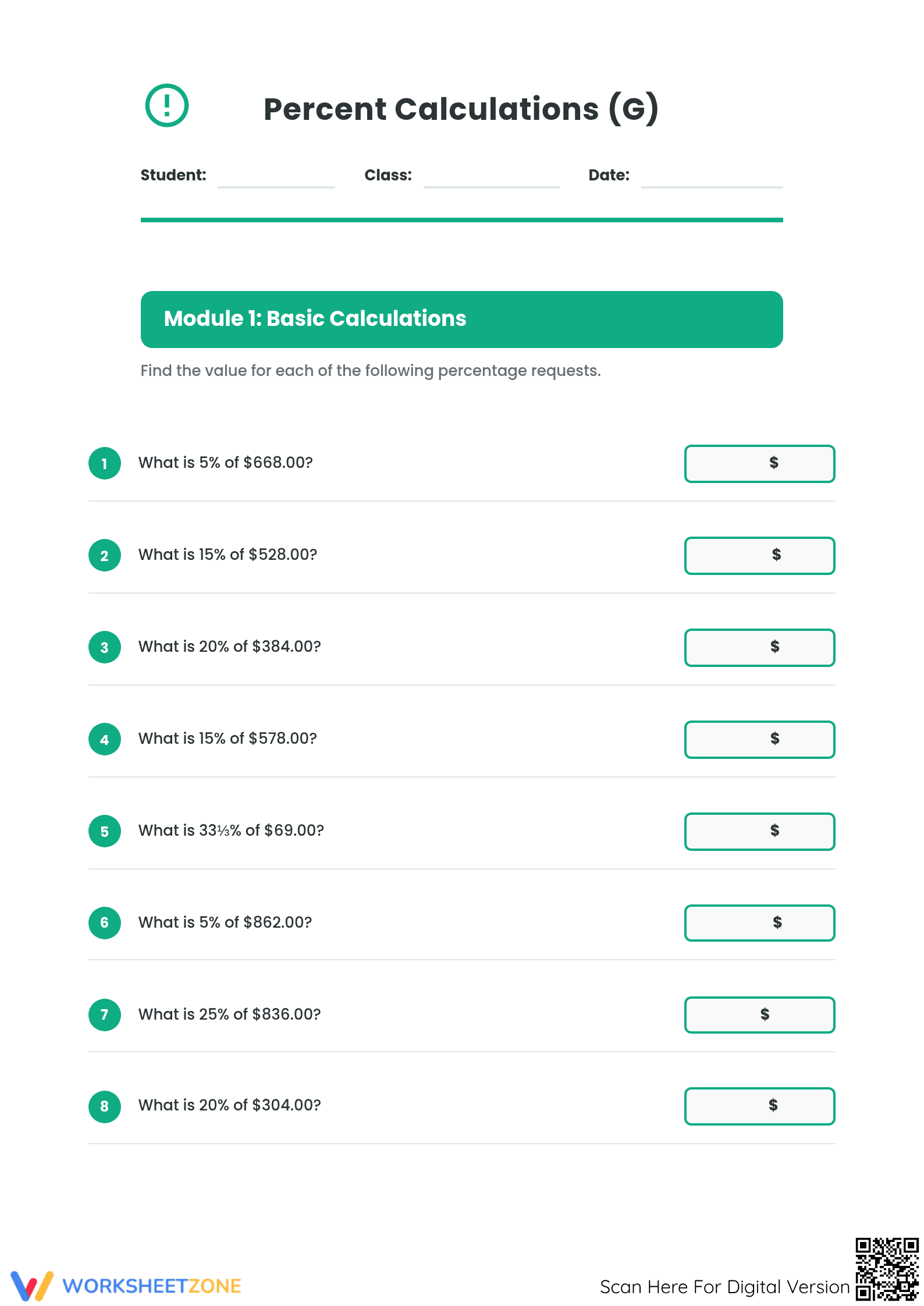
This 30-problem worksheet empowers students to master percent calculations within real-world financial contexts. By focusing on currency and decimal values, learners bridge the gap between abstract ratios and practical applications like shopping discounts, sales tax, and interest. Students develop the fluency needed for financial literacy and middle school mathematics through these structured exercises.
At a Glance
- Grade: 7 · Subject: Math
- Standard:
CCSS.MATH.CONTENT.7.RP.A.3— Use proportional relationships to solve multistep ratio and percent problems in financial contexts- Skill Focus: Financial Percent Calculations
- Format: 4 pages · 30 problems · Answer key included · PDF
- Best For: Middle school financial literacy and mastery
- Time: 45–60 minutes
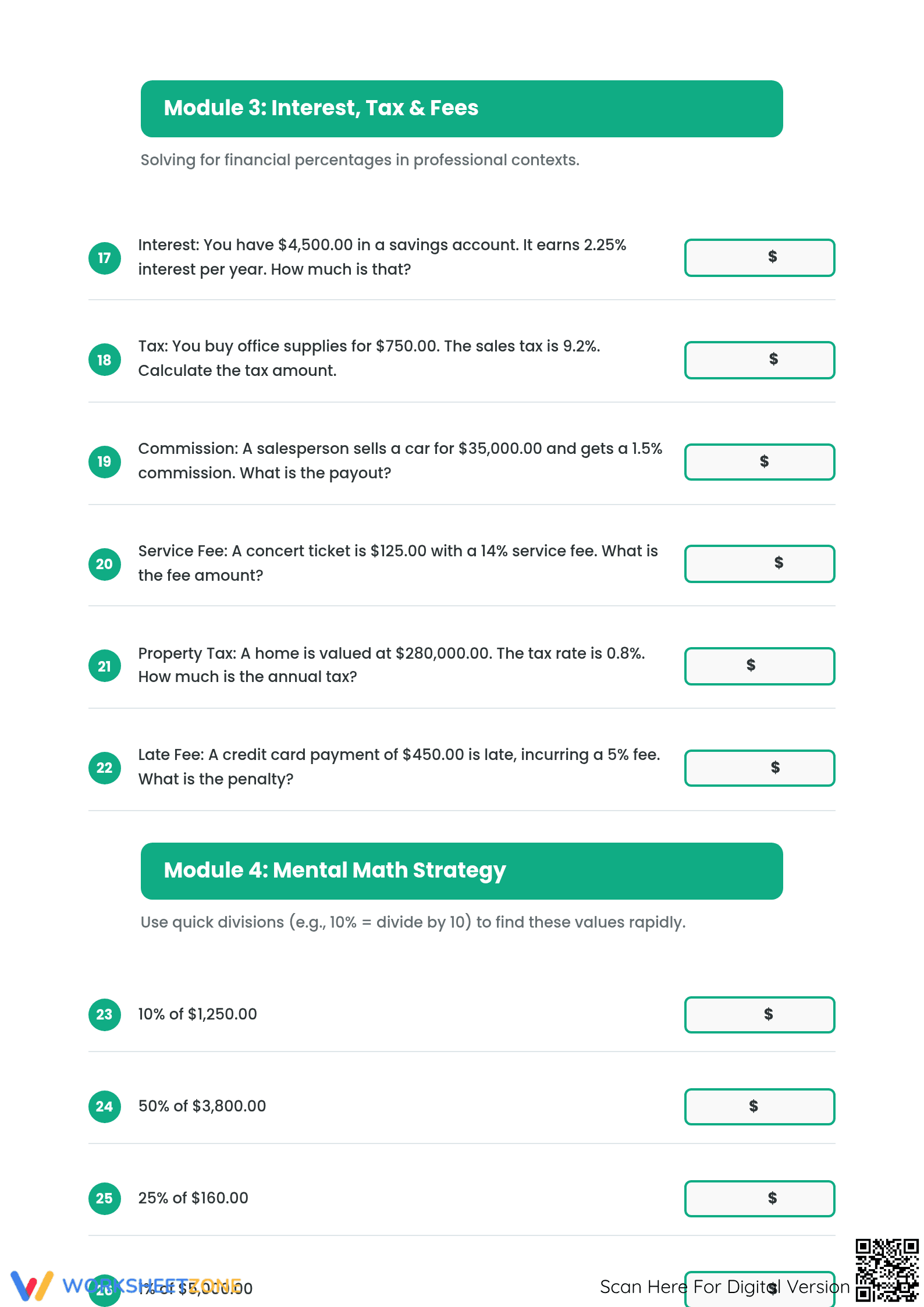
This four-page collection is organized into four modules for a structured learning path. Module 1 focuses on basic percent-of-number calculations. Module 2 moves into shopping scenarios, calculating savings and discounts. Module 3 introduces professional contexts like interest and commission. Finally, Module 4 provides mental math strategies to improve calculation speed and accuracy across 30 tasks total.
Skill Progression
- Guided Practice: The first ten problems use a direct "What is X% of $Y?" format, providing 10 consistent trials to stabilize calculation methods and decimal placement.
- Supported Practice: Modules 2 and 3 transition to word problems, requiring students to extract the base amount and rate from real-world financial scenarios.
- Independent Practice: Module 4 challenges students to apply mental math strategies, finding common values like 10% and 50% without heavy calculation reliance.
Following a gradual-release model, this instructional sequence ensures students build confidence before tackling complex financial demands.
Standards Alignment
The primary alignment is to CCSS.MATH.CONTENT.7.RP.A.3: "Use proportional relationships to solve multistep ratio and percent problems." This targets financial applications like simple interest, tax, and markups. The standard code can be copied directly into lesson plans or district curriculum mapping tools, ensuring every problem helps students meet essential Grade 7 numeracy benchmarks for success in higher mathematics.
How to Use It
Use this during the independent practice phase of a ratio unit. It serves as an excellent formative assessment tool; teachers should observe if students correctly place decimals when converting percentages. Expect completion in 45 to 60 minutes, or assign specific modules as targeted homework. The modular design allows for flexible instructional use in any classroom setting.
Who It's For
This resource is designed for Grade 7 and 8 students, though it provides excellent remediation for high schoolers needing financial literacy support. It pairs naturally with a lesson on decimal multiplication or a classroom activity involving sales flyers and simulated shopping. The clear module breaks allow for easy differentiation by task volume.
ScienceDirect TpT Analysis (2024) highlights that math resources integrating real-world financial scenarios improve student engagement and retention of proportional reasoning. This worksheet aligns with CCSS.MATH.CONTENT.7.RP.A.3 by requiring students to calculate percentage values involving currency and decimals across 30 problems. By presenting tasks within "Shopping & Sales" and "Interest, Tax & Fees," the material ensures the plain-English skill of finding a percent of a quantity is grounded in practical utility. Structured practice is essential for moving students beyond rote memorization toward a conceptual understanding of percentages as rates. Research suggests the cumulative effect of these focused modules helps reduce mathematical anxiety by providing clear, achievable milestones. This resource is a vital tool for achieving numeracy goals in middle school mathematics, ensuring students can accurately apply percentage logic to everyday financial transactions while meeting rigorous state and national standards.


