


























Views
Downloads
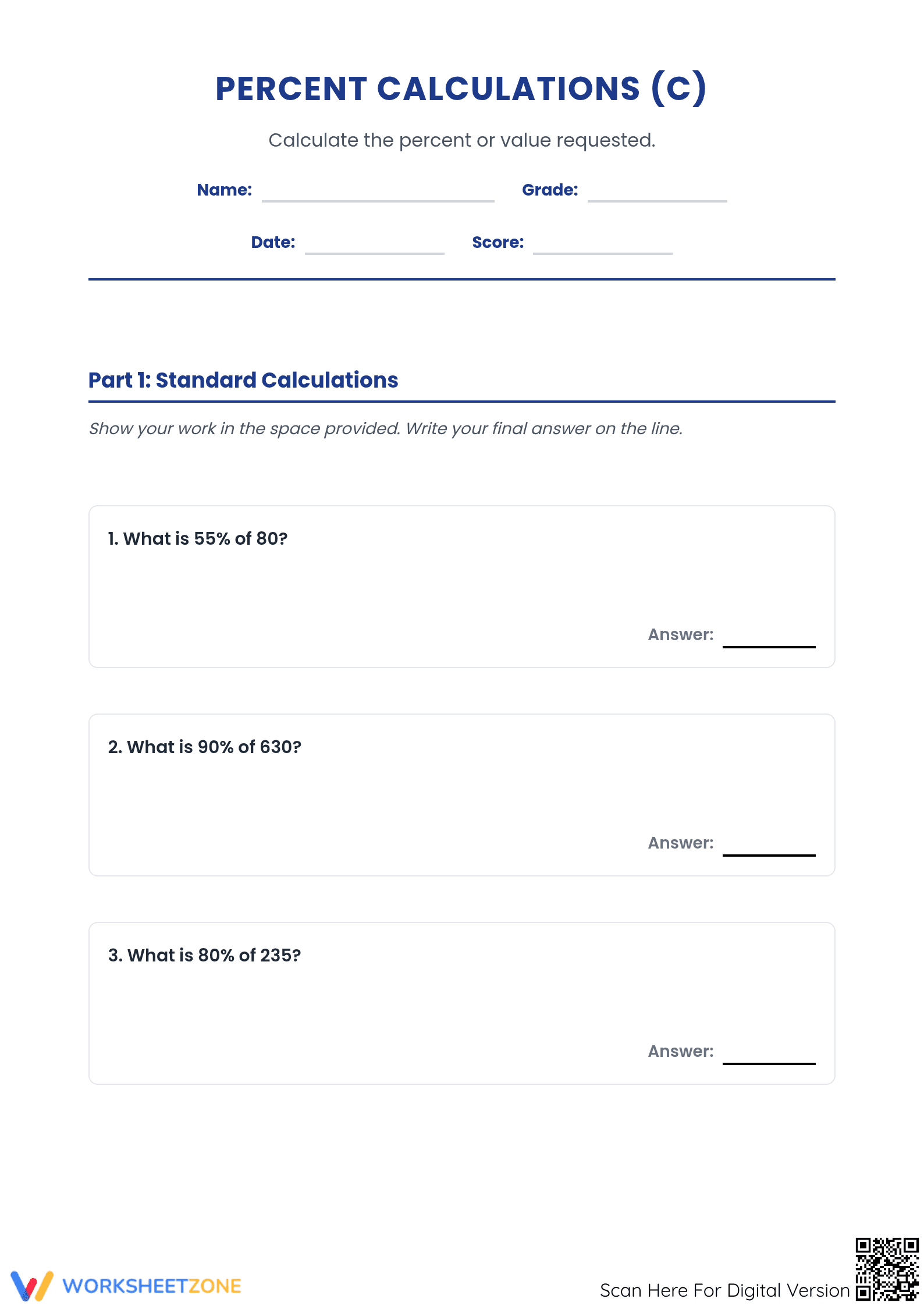


Essential Percent Calculations Worksheet | Grade 6 Math
Paste this activity's link or code into your existing LMS (Google Classroom, Canvas, Teams, Schoology, Moodle, etc.).
Students can open and work on the activity right away, with no student login required.
You'll still be able to track student progress and results from your teacher account.
This focused Grade 6 math worksheet empowers students to master the essential skill of calculating percentage values of whole numbers. By working through structured problems, learners develop the procedural fluency needed to find a percent of a quantity, ensuring a strong foundation for real-world mathematical applications.
At a Glance
- Grade: 6 · Subject: Mathematics and Pre-Algebra
- Standard:
CCSS.MATH.CONTENT.6.RP.A.3.C— Calculate a percent of a quantity as a rate per 100 for any given whole number- Skill Focus: Calculating percentage values of regular whole numbers including challenge decimals
- Format: 4-page printable PDF · 13 structured calculation problems · Full answer key included
- Best For: In-class practice, homework assignments, or a quick formative assessment
- Time: 20–30 minutes
The resource contains four clean pages designed to build student confidence through a logical progression. It includes 10 standard calculation tasks focusing on whole number percentages and 3 challenge tasks introducing decimal percentages and values over 100%. A comprehensive answer key is provided for immediate grading or student self-correction.
Skill Progression
- Guided practice: Students begin with 5 problems calculating common percentages of large whole numbers to establish a baseline.
- Supported practice: Learners tackle 5 tasks requiring calculations of complex percentages to sharpen precision and arithmetic accuracy.
- Independent practice: The set concludes with 3 challenge bonus problems testing mastery with decimal percentages and values exceeding the whole.
This sequence effectively utilizes the gradual-release model to move students from basic recognition to higher-order application.
Standards Alignment
This resource is directly aligned with `CCSS.MATH.CONTENT.6.RP.A.3.C`, which requires students to "find a percent of a quantity as a rate per 100 (e.g., 30% of a quantity means 30/100 times the quantity)." The problems reinforce the relationship between ratios, fractions, and percentages. This standard code can be copied directly into lesson plans, IEP goals, or district curriculum mapping tools.
How to Use It
Teachers can implement this worksheet following direct instruction on percentage conversions. Use it as a mid-unit check-in by observing students as they tackle the first five problems. If they struggle with decimal placement, provide immediate intervention. Students typically complete the standard section in 15 minutes, with extra time for the challenge portion.
Who It's For
This practice set is primarily for Grade 6 students developing ratio and proportional reasoning skills. It is also an excellent remediation resource for Grade 7 or 8 learners needing foundational fluency. The worksheet pairs naturally with an anchor chart showing the "part = percent × whole" formula to support diverse learners.
The mastery of percentage calculations is a pivotal milestone in middle school mathematics, serving as a gateway to financial literacy and advanced statistical reasoning. Research from the RAND AIRS 2024 report emphasizes that structured, repetitive practice with calculating percents of quantities is essential for building the procedural fluency required for complex problem-solving in later grades. By providing students with 13 diverse tasks that move from simple whole numbers to challenging decimals, this worksheet aligns with best practices in mathematics instruction that prioritize the gradual release of responsibility. Specifically, finding a percent of a quantity as a rate per 100 allows students to internalize the multiplicative relationship between parts and wholes. This instructional approach ensures that learners are prepared for the rigorous demands of algebra and beyond, where percentage-based change and growth models are prevalent. This resource provides the necessary repetition to move these concepts from short-term memory to long-term mathematical mastery.


