


























Views
Downloads
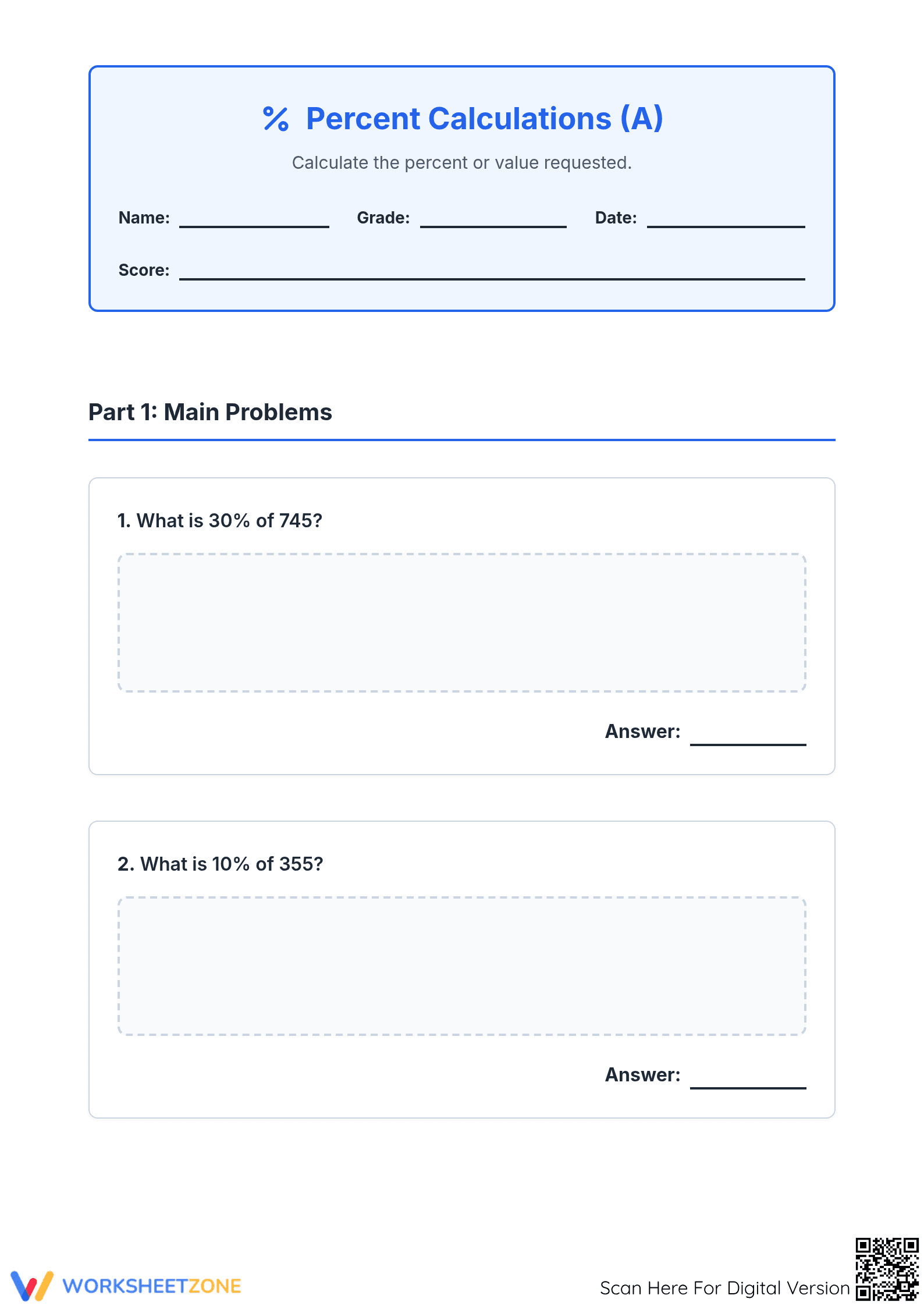


Grade 6 Percent Calculations — Printable No-Prep Worksheet
Paste this activity's link or code into your existing LMS (Google Classroom, Canvas, Teams, Schoology, Moodle, etc.).
Students can open and work on the activity right away, with no student login required.
You'll still be able to track student progress and results from your teacher account.
This Grade 6 math worksheet provides students with targeted practice in calculating the percentage of a specific value. By working through numeric problems, learners strengthen their understanding of proportional relationships. Students will master the transition from percentages to decimals to solve mathematical quantities with high precision and confidence.
At a Glance
- Grade: 6 · Subject: Math
- Standard:
6.RP.A.3.c— Find a percent of a quantity as a rate per 100- Skill Focus: Calculating Percent of a Value
- Format: 5 pages · 14 problems · Answer key included · PDF
- Best For: Homework, math centers, or sub plans
- Time: 20–35 minutes
What's Inside
The packet contains 14 mathematical problems divided into two sections. Part 1 features 10 foundational problems focusing on standard percent-of-number calculations using two- and three-digit numbers. Part 2 introduces 4 "Bonus Challenges" with larger values. Each problem provides a dedicated workspace for calculations and a clear answer line for student results.
Zero-Prep Workflow
The zero-prep design allows teachers to implement this resource in under 2 minutes. Step 1: Print the 5-page PDF packet and the answer key. Step 2: Distribute to students for immediate independent practice or small group work. Step 3: Use the key for rapid grading. The layout and large font size make it an ideal emergency sub plan.
Standards Alignment
The primary standard addressed is `6.RP.A.3.c`, which requires students to find a percent of a quantity as a rate per 100. This resource focuses on the "percent of a quantity" aspect, bridging the gap between basic ratios and advanced percentage applications. This standard code can be copied directly into lesson plans or curriculum mapping tools.
How to Use It
This worksheet is best utilized as an independent practice set after a lesson on converting percentages to decimals. For a formative assessment, teachers can observe students during problems 1 through 5 to identify errors in decimal placement. Expect students to complete the set in 20 minutes, with 10 minutes for the bonus section.
Who It's For
Designed for Grade 6 students, this resource also serves as a remediation tool for Grade 7 students who require fluency practice with percentages. It pairs naturally with an anchor chart demonstrating the percentage formula or a short passage explaining the word "percent" to provide context to the mathematics.
According to the NAEP 2024 framework, fluency in proportional reasoning and percentage calculation is a critical predictor of success in middle school algebra and beyond. This resource aligns with evidence-based practices for mathematical fluency by providing spaced repetition of numeric tasks within a structured format. The inclusion of bonus challenges supports the "productive struggle" identified by Fisher & Frey (2014) as essential for moving students from surface-level procedural knowledge to deep conceptual mastery of rates and ratios. By focusing on the 6.RP.A.3.c standard, this worksheet ensures that students are not merely performing a rote operation but are building the mental models necessary for calculating rates per hundred in more complex, multi-step scenarios. The clearly defined workspaces encourage students to show their thinking, which is a key component of effective formative assessment in the modern math classroom.


