


























Views
Downloads

Essential Percent of Currency Worksheet | Grade 6-7 Math
Paste this activity's link or code into your existing LMS (Google Classroom, Canvas, Teams, Schoology, Moodle, etc.).
Students can open and work on the activity right away, with no student login required.
You'll still be able to track student progress and results from your teacher account.
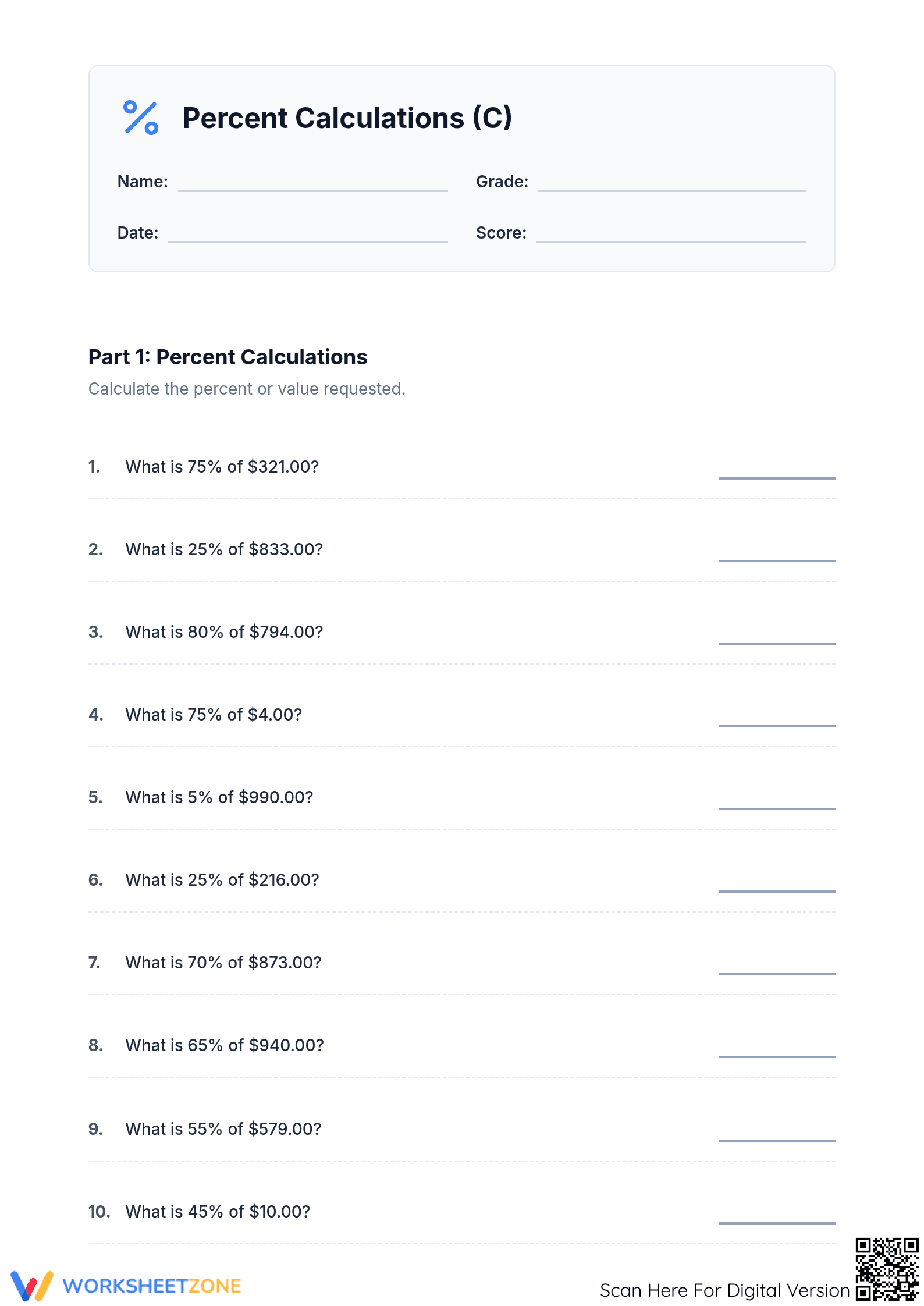
This comprehensive math worksheet empowers students to master percent calculations using real-world currency and decimal values. By solving 25 structured problems, learners bridge the gap between abstract percentage concepts and practical financial applications. Students will gain the confidence needed to calculate tax, discounts, and fees accurately in both direct equations and complex word problem scenarios.
At a Glance
- Grade: 7 · Subject: Math
- Standard:
7.RP.A.3— Use proportional relationships to solve multistep percent problems like tax and discounts- Skill Focus: Percent of currency and decimal values
- Format: 3 pages · 25 problems · Answer key included · PDF
- Best For: Financial literacy units and percentage mastery
- Time: 30–45 minutes
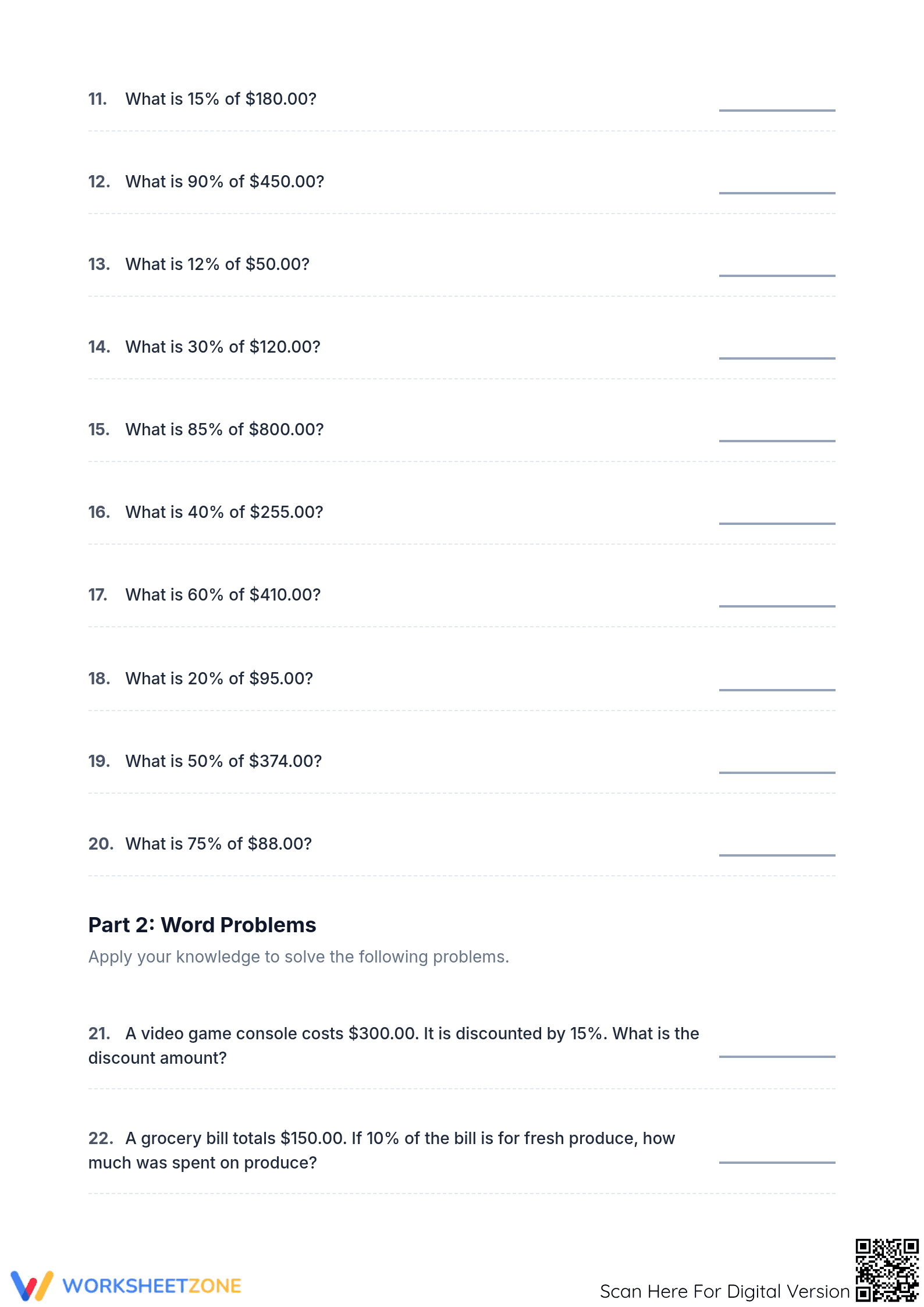
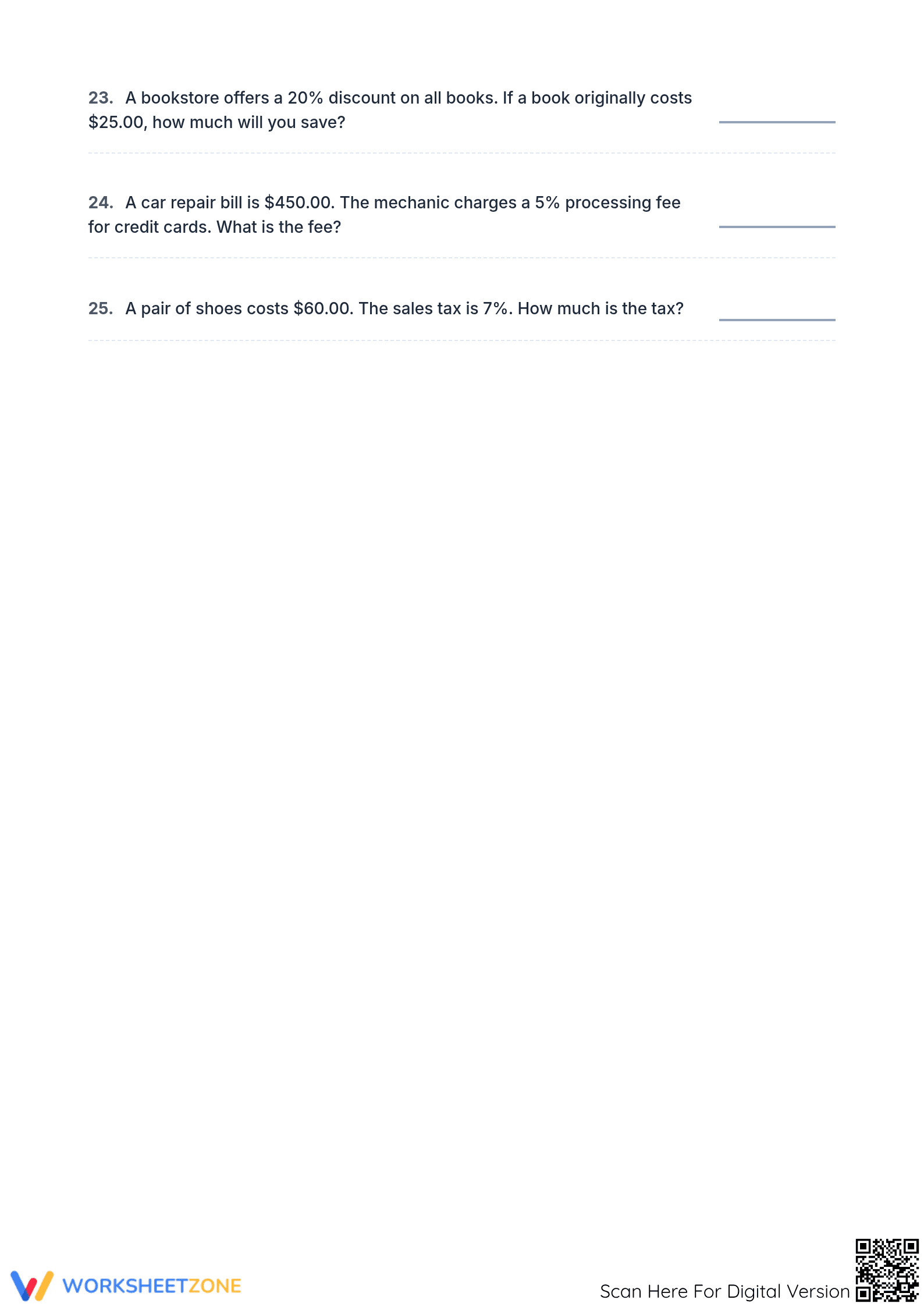
The resource consists of three clearly organized pages. Part one provides 20 direct calculation tasks (e.g., "What is 75% of $321.00?") that isolate the core algorithm using varied decimal values. Part two transitions into five realistic word problems involving video game discounts, grocery totals, bookstore savings, processing fees, and sales tax. A full answer key ensures efficient grading or student self-correction.
Skill Progression
- Guided Practice: Problems 1–10 use familiar percentages and larger whole-dollar amounts to establish the base calculation method without overwhelming cognitive load.
- Supported Practice: Problems 11–20 introduce more complex percentages (e.g., 12%, 55%) and smaller currency values, requiring students to maintain precision when placing decimal points.
- Independent Practice: The final five word problems require students to extract relevant data from text-based scenarios and apply their percentage skills to solve for taxes and fees independently.
This gradual-release approach follows the standard mathematical instructional model to ensure every student reaches mastery before tackling complex real-world applications.
Standards Alignment
The worksheet is strictly aligned to 7.RP.A.3: "Use proportional relationships to solve multistep ratio and percent problems." It also supports 6.RP.A.3.c for students needing foundational practice with finding a percent of a quantity. These codes can be copied directly into lesson plans, IEP goals, or district curriculum mapping tools.
How to Use It
Deploy this as a formative assessment during the "You Do" phase of instruction. Observe if students correctly convert percentages to decimals before multiplying. It serves as an excellent check for understanding before moving to interest-based calculations. Allow a 40-minute completion window for a standard classroom setting.
Who It's For
This resource is designed for Grade 7 math students but is highly effective for Grade 6 acceleration or Grades 8-10 remediation. It is particularly valuable for students working on financial literacy goals or IEP objectives involving functional math. Pair this with a decimal-shift anchor chart for maximum instructional impact.
Calculational fluency in percentages is a critical prerequisite for adult financial literacy and secondary mathematics. This worksheet addresses 7.RP.A.3 by requiring students to calculate the value of a percentage in the context of currency and decimals, a task that demands both procedural accuracy and conceptual understanding. Research from Fisher & Frey (2014) emphasizes that the gradual release of responsibility—moving from isolated drills to contextualized word problems—is essential for long-term retention of mathematical procedures. By forcing students to navigate the intersection of percentages and decimal place value within currency systems, this resource reinforces the "Rate per 100" concept emphasized in the EdReports 2024 curriculum guidelines. Consistent practice with these 25 problems ensures students can reliably calculate real-world values such as sales tax and discounts, satisfying the rigorous demands of state and national standards for proportional reasoning.


