


























Views
Downloads



Essential 25% Percentage Worksheet | Grade 6 Math
Paste this activity's link or code into your existing LMS (Google Classroom, Canvas, Teams, Schoology, Moodle, etc.).
Students can open and work on the activity right away, with no student login required.
You'll still be able to track student progress and results from your teacher account.
This essential 25% percentage calculation worksheet is designed to help Grade 6 students bridge the gap between simple fractions and percentage mastery. By focusing exclusively on finding one-quarter of whole numbers, students build the computational fluency required for more complex financial literacy and data analysis tasks later in their mathematical journey.
At a Glance
- Grade: 6 · Subject: Math
- Standard:
CCSS.MATH.6.RP.3.c— Find a percent of a quantity as a rate per 100- Skill Focus: Finding 25% of whole numbers
- Format: 4 pages · 44 problems · Answer key included · PDF
- Best For: Intro to percentages and mental math
- Time: 25–35 minutes
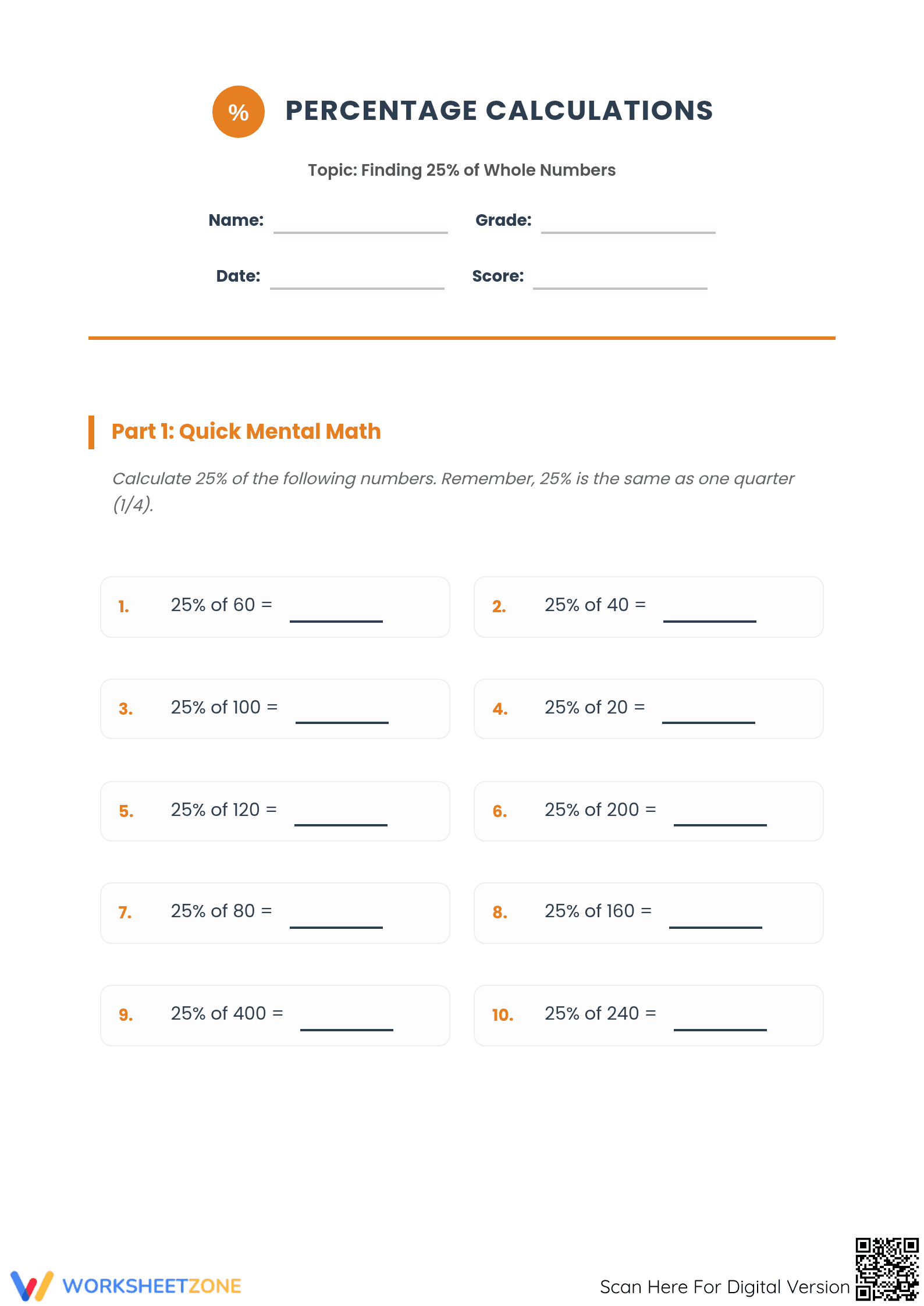
This comprehensive four-page resource provides a thorough exploration of 25% calculations. It begins with basic mental math problems supported by visual bar models to reinforce the concept that 25% is equivalent to one-fourth. As students progress, they encounter larger whole numbers and eventually transition to mastery-level challenges. The final section features four real-world word problems that apply these skills to scenarios involving discounts, forestry, and stadium seating.
Skill Progression
- Guided Practice: The first 10 problems focus on quick mental math using numbers like 40, 80, and 100, paired with a visual fraction model that clearly illustrates the 25% to 1/4 relationship.
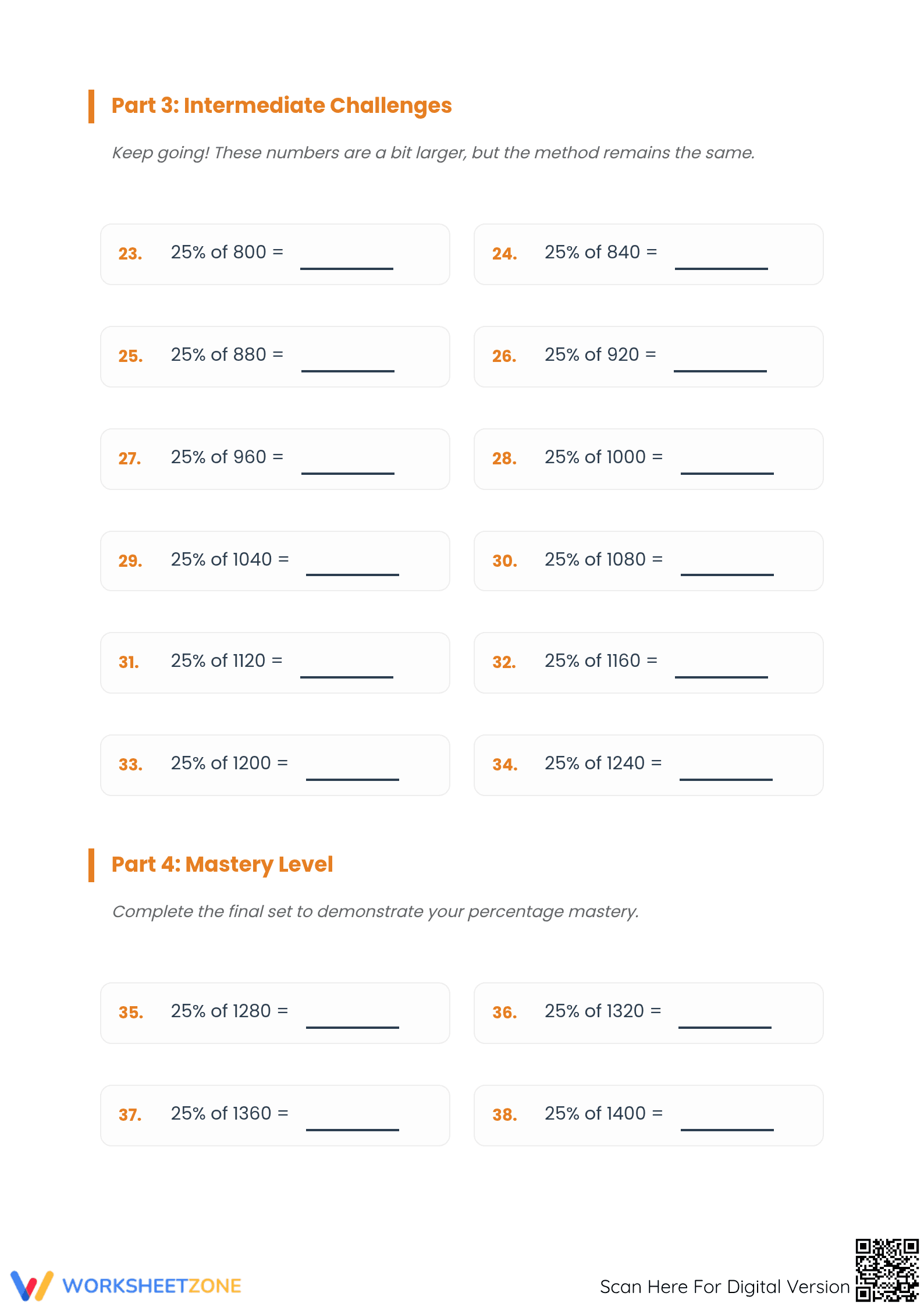
- Supported Practice: Parts 2 and 3 gradually increase numerical complexity, moving from double-digit values to intermediate four-digit challenges while maintaining a consistent calculation method.
- Independent Practice: The final mastery problems and real-world applications (problems 35-44) require students to interpret word problems and perform calculations without scaffolding.
This structured sequence follows a gradual-release model, ensuring students move confidently from "I Do" to "You Do" phases of learning.
Standards Alignment
This worksheet is strictly aligned to `CCSS.MATH.CONTENT.6.RP.A.3.C`, which requires students to find a percent of a quantity as a rate per 100. It also supports mathematical practice standards as students model real-world situations with mathematics. Both standard codes (CCSS.MATH.6.RP.3.c and MP4) can be copied directly into lesson plans, IEP goals, or district curriculum mapping tools for administrative compliance.
How to Use It
Use this worksheet as a primary instructional tool during the introduction of percentages or as a high-impact homework assignment. For a formative assessment observation, watch how students handle the transition from mental math to larger four-digit numbers; if they struggle, refer them back to the 1/4 visual model on page two. Students typically complete the entire 44-problem set in approximately 30 minutes.
Who It's For
This resource is ideal for Grade 6 math students first encountering percentages. It also serves as an excellent remediation tool for Grade 7 and 8 students who need to strengthen their mental math skills. Naturally pair this worksheet with a percentage anchor chart or a short lesson on fraction-to-percent conversions to provide a complete learning experience.
According to research by Fisher & Frey (2014) on the gradual release of responsibility, structured scaffolding is critical when introducing abstract mathematical concepts like percentages. This worksheet implements those findings by starting with high-frequency "mental math" numbers before challenging students with larger quantities and complex applications. By explicitly linking the 25% value to the more familiar concept of one-quarter through visual bar models, the resource reduces cognitive load and allows learners to focus on the underlying logic of the operation. This alignment with evidence-based instructional design ensures that students don't just memorize a procedure but develop a deep conceptual understanding of proportional relationships. The inclusion of real-world contexts further reinforces the utility of the skill, matching the rigor expected in modern CCSS-aligned classrooms. This comprehensive approach to skill acquisition supports long-term retention and prepares students for more advanced algebraic thinking.


