


























Views
Downloads
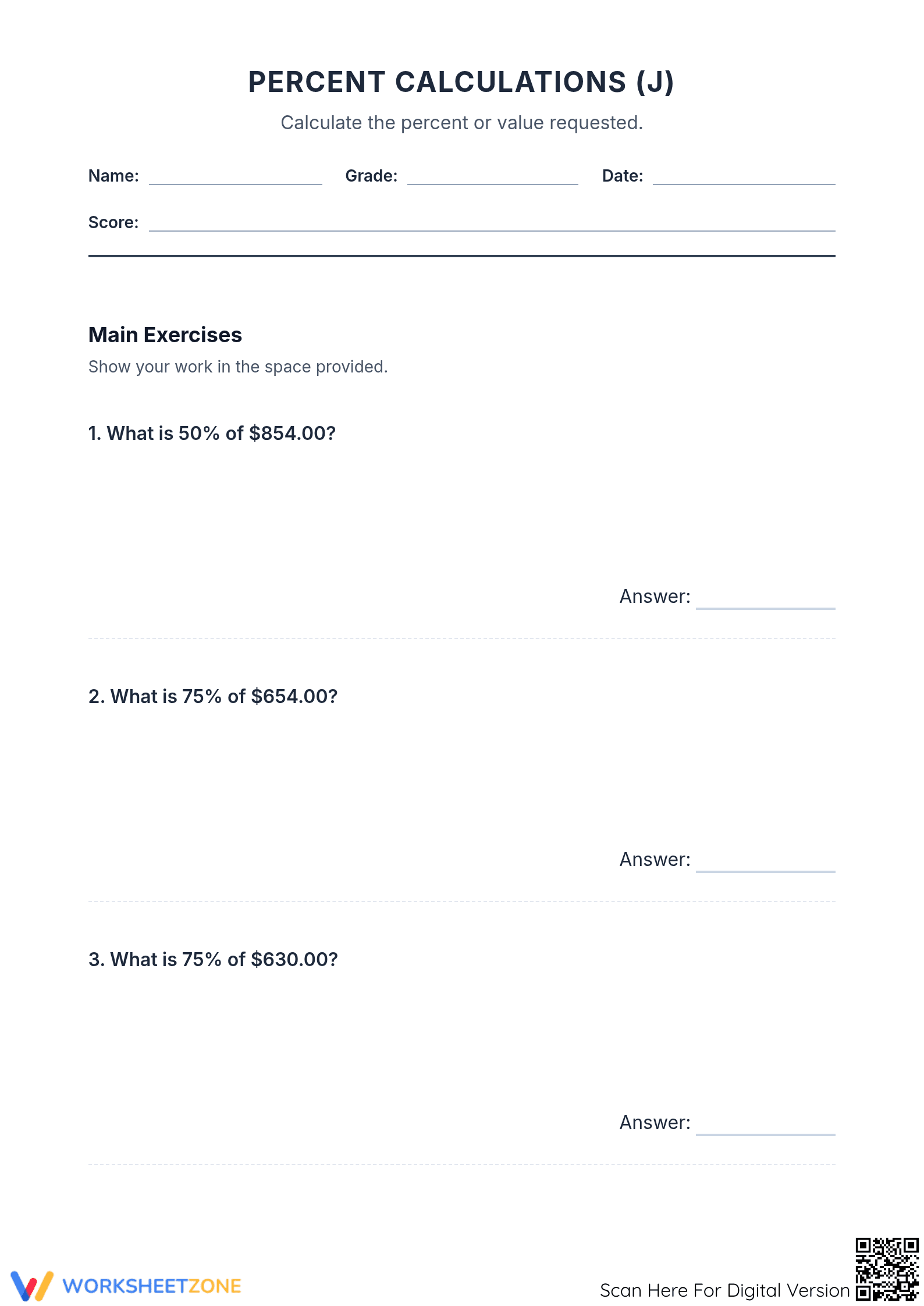
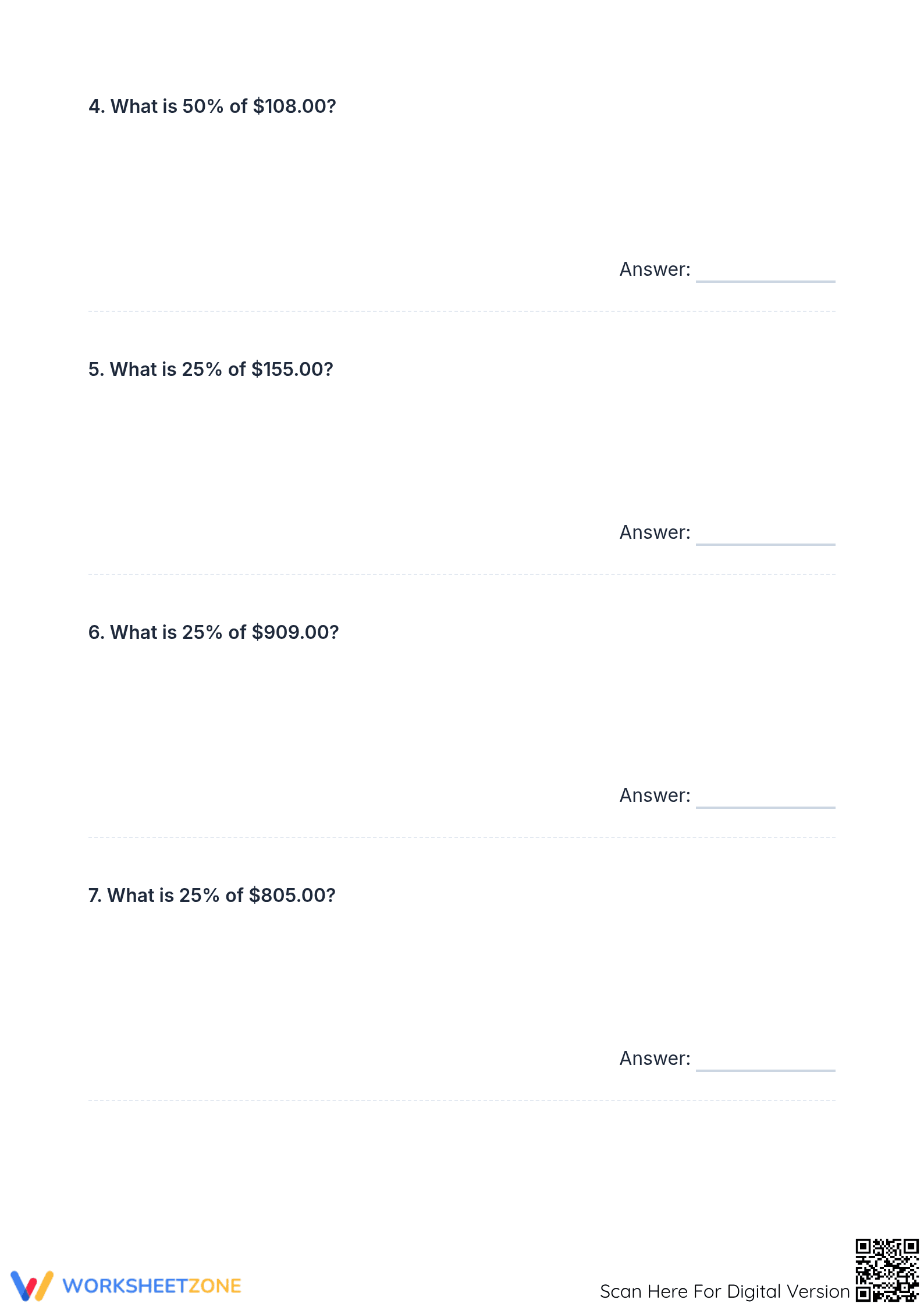
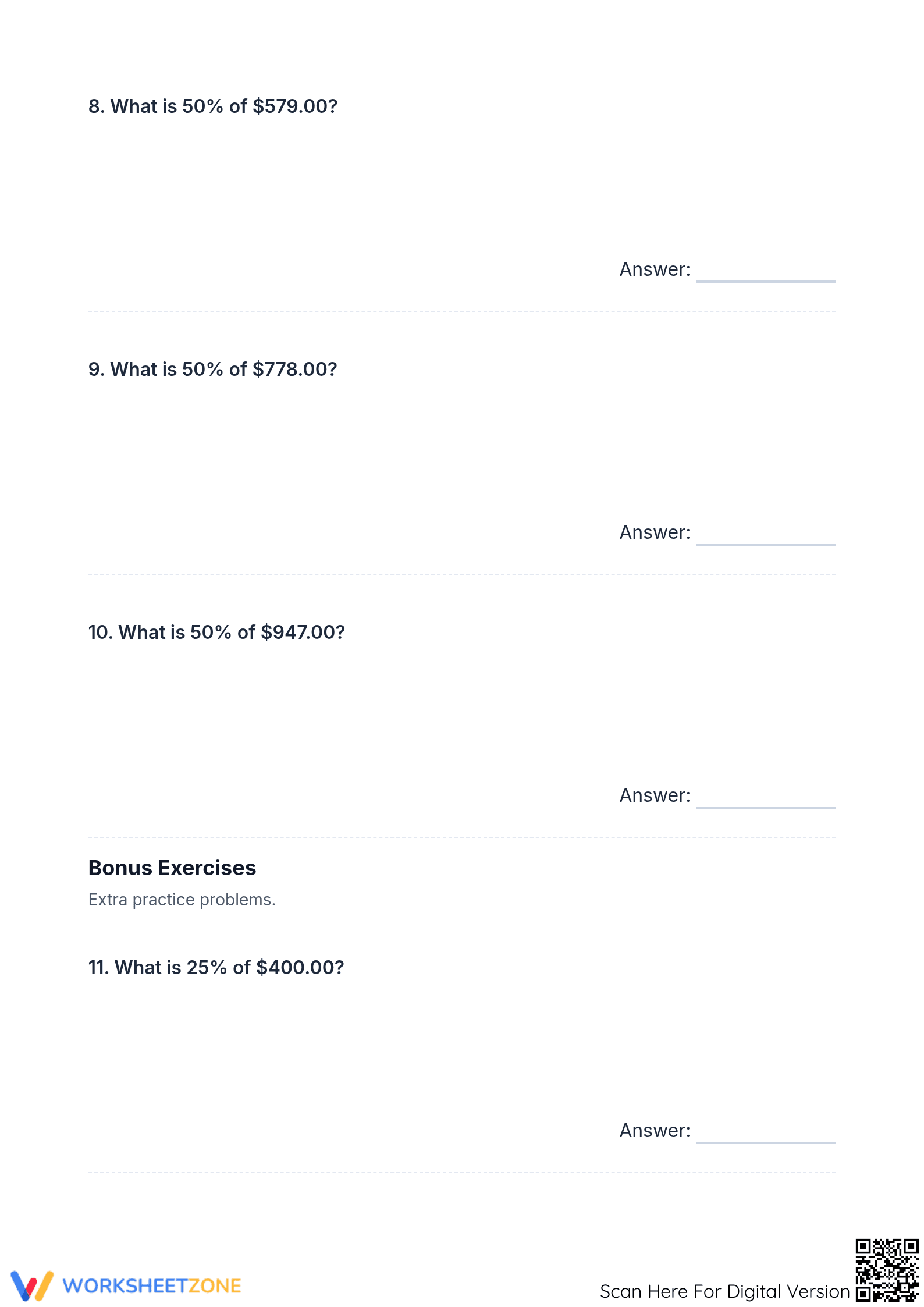
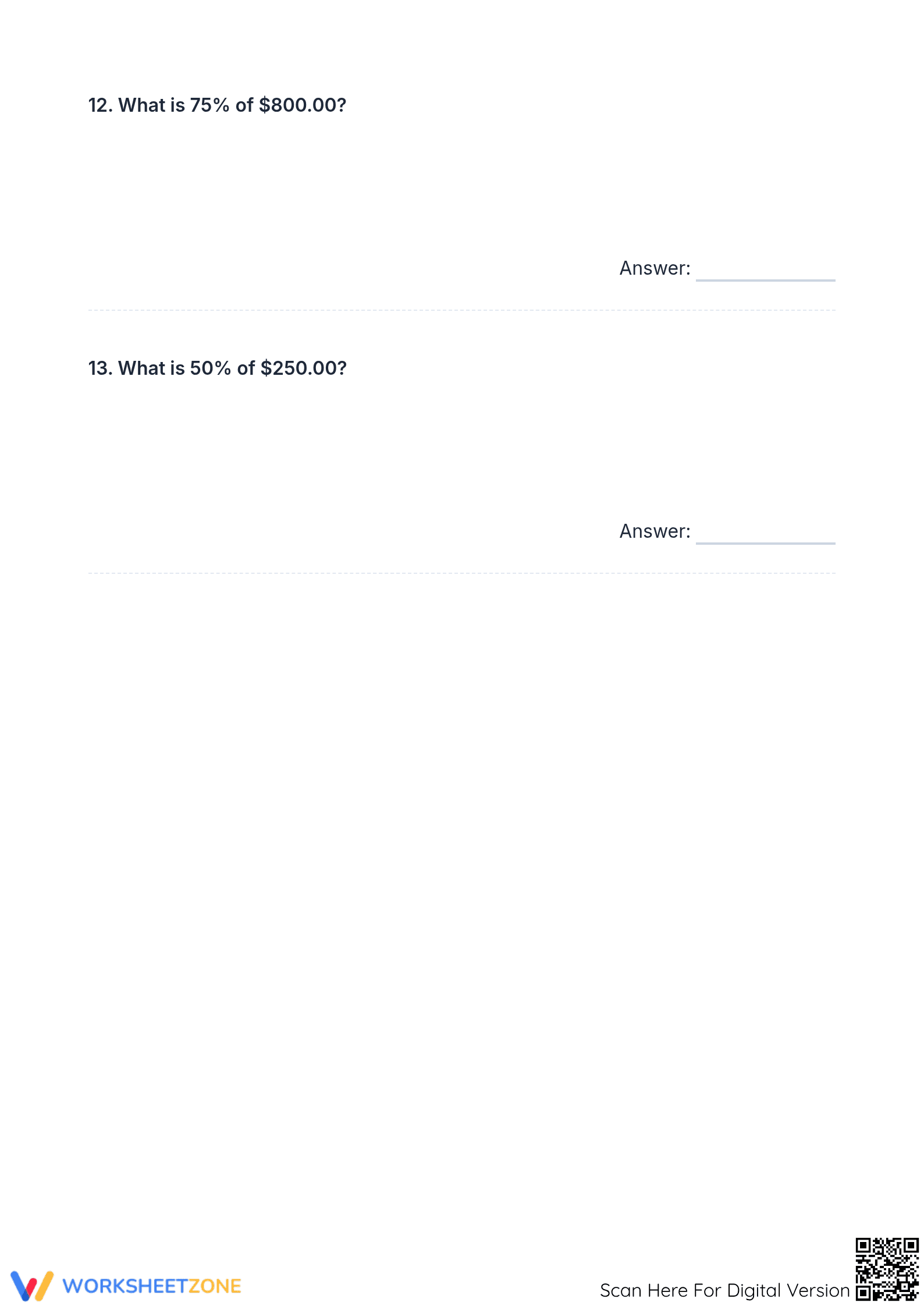

Printable Money Percentages Worksheet | Grades 4-10 Math
Paste this activity's link or code into your existing LMS (Google Classroom, Canvas, Teams, Schoology, Moodle, etc.).
Students can open and work on the activity right away, with no student login required.
You'll still be able to track student progress and results from your teacher account.
Mastering percentages is essential for financial literacy. This Grades 4-10 math worksheet provides targeted practice for calculating the value of a part using common percentages like 25%, 50%, and 75% applied to currency. Students build procedural fluency working with decimals and dollar signs, ensuring they are ready for real-world consumer math challenges.
At a Glance
- Grade: 4–10 · Subject: Math
- Standard:
CCSS.MATH.CONTENT.6.RP.A.3.C— Find a percent of a quantity as a rate per 100- Skill Focus: Calculating 25%, 50%, and 75% of currency values
- Format: 4 pages · 13 problems · Answer key included · PDF
- Best For: Middle school financial math skill reinforcement
- Time: 20–30 minutes
This four-page resource contains thirteen structured problems. Ten "Main Exercises" focus on finding half, three-quarters, and one-quarter of monetary sums, ranging from whole numbers to complex decimals. A "Bonus Exercises" section provides three additional challenges. Every problem includes a designated workspace and answer line for clarity. A comprehensive answer key is included for immediate feedback.
- Guided Practice: Initial exercises use 50% benchmarks, allowing students to apply division-by-two strategies to monetary contexts while managing decimal placement.
- Supported Practice: Mid-range tasks introduce 75% calculations, requiring learners to combine their understanding of 50% and 25% to reinforce fractional connections.
- Independent Practice: Final problems present less intuitive values, requiring full independent application of the percent-of-a-quantity formula without scaffolding.
This follows a gradual-release model from benchmarks to independent financial calculations.
The worksheet is aligned with CCSS.MATH.CONTENT.6.RP.A.3.C: "Find a percent of a quantity as a rate per 100." By focusing on currency, it also supports CCSS.MATH.CONTENT.7.RP.A.3 for multi-step percent problems. Both standard codes can be copied directly into lesson plans, IEP goals, or district curriculum mapping tools.
Use this worksheet during the independent practice phase or as a math workshop station. For formative assessment, observe students who struggle with decimal placement when calculating 25% of odd dollar amounts. This typically identifies gaps in decimal division. Expect students to complete the thirteen problems in 20 to 30 minutes.
This resource serves upper elementary and middle school students transitioning to decimal-based percentages. It is effective for students needing financial literacy practice or those with money-management IEP goals. Pair this with a sales tax anchor chart or a consumer math lesson to provide practical context for these calculations.
Calculating percentages within real-world contexts, such as currency, is a critical milestone for middle school mathematics. According to the RAND AIRS 2024 report on mathematical literacy, students who master percentage-based proportions in financial scenarios demonstrate higher proficiency in later algebraic reasoning and consumer math applications. This worksheet directly supports CCSS.6.RP.A.3.C by requiring students to find a percent of a quantity as a rate per 100. By using decimals and currency symbols, the task bridges abstract arithmetic with tangible financial skills. The inclusion of decimals increases cognitive load, ensuring learners apply procedural fluency to complex numbers. This resource provides the repetition needed to internalize relationships between parts and wholes in monetary systems. Educators can use these thirteen problems to identify misconceptions regarding place value during multi-step percentage calculations.


