


























Views
Downloads

Grade 6-8 Percent Rate — Printable Essential Worksheet
Paste this activity's link or code into your existing LMS (Google Classroom, Canvas, Teams, Schoology, Moodle, etc.).
Students can open and work on the activity right away, with no student login required.
You'll still be able to track student progress and results from your teacher account.
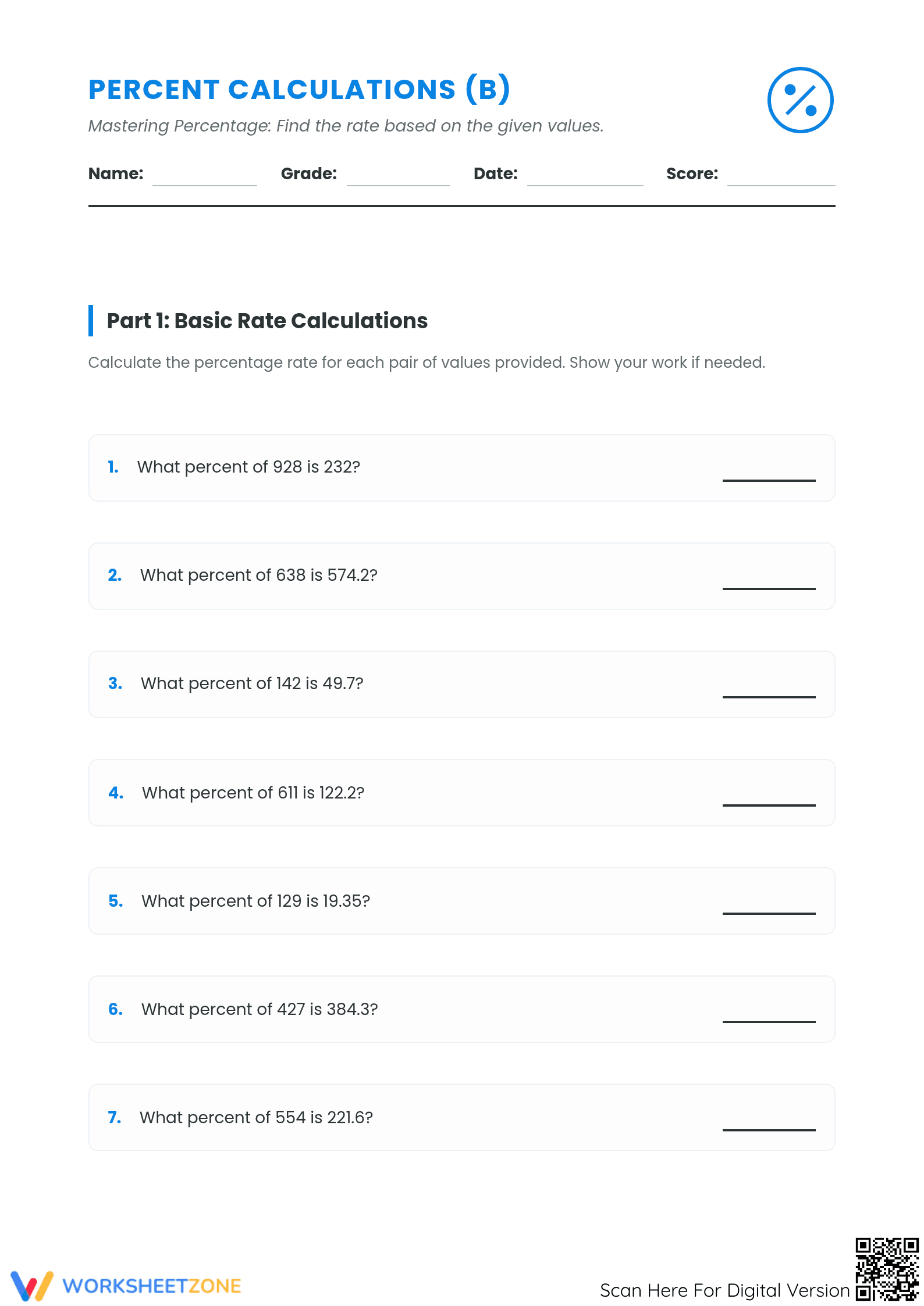
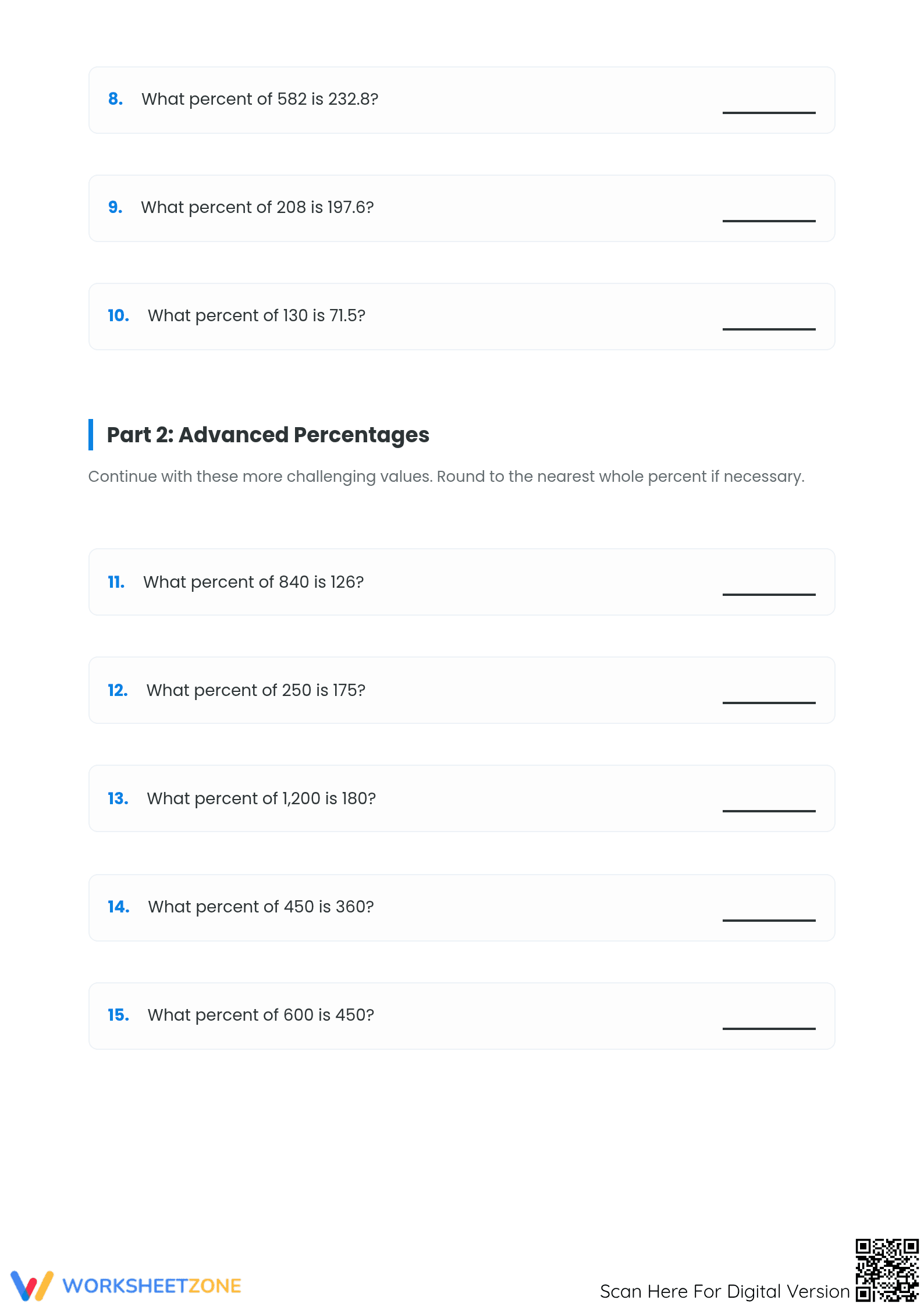
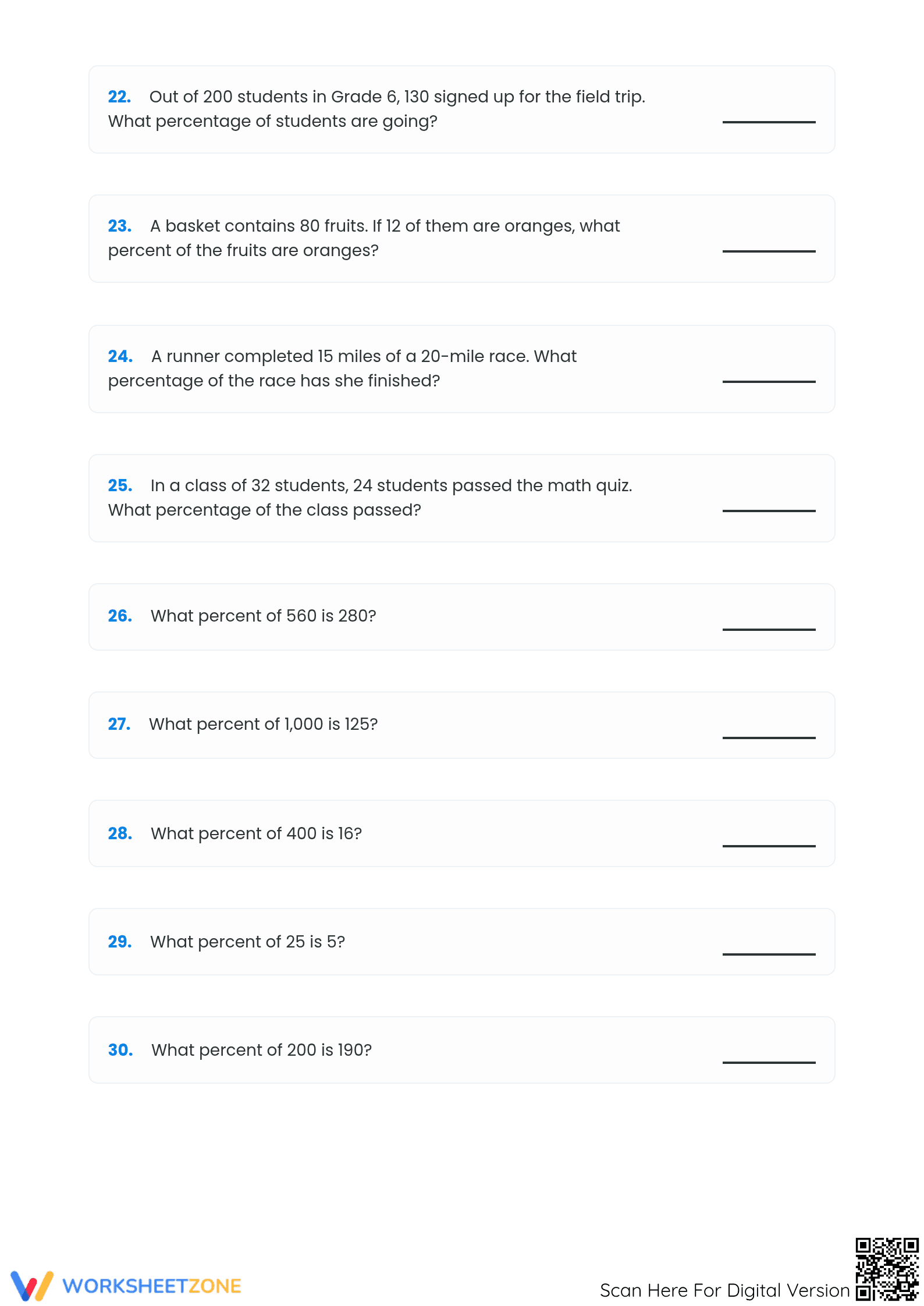
This comprehensive 5-page math worksheet focuses on calculating the percentage rate, enabling students to determine what percent one number is of another. By providing 39 structured problems, it helps learners bridge the gap between basic decimal operations and real-world proportional reasoning. Students will achieve mastery in rate identification through diverse numerical pairs and application-based scenarios.
At a Glance
- Grade: 6–8 · Subject: Math (Ratios & Proportions)
- Standard:
6.RP.A.3.C— Find a percent of a quantity as a rate per 100- Skill Focus: Calculating percentage rates from part-whole relationships
- Format: 5 pages · 39 problems · Answer key included · PDF
- Best For: Classroom practice or homework reinforcement
- Time: 45–60 minutes
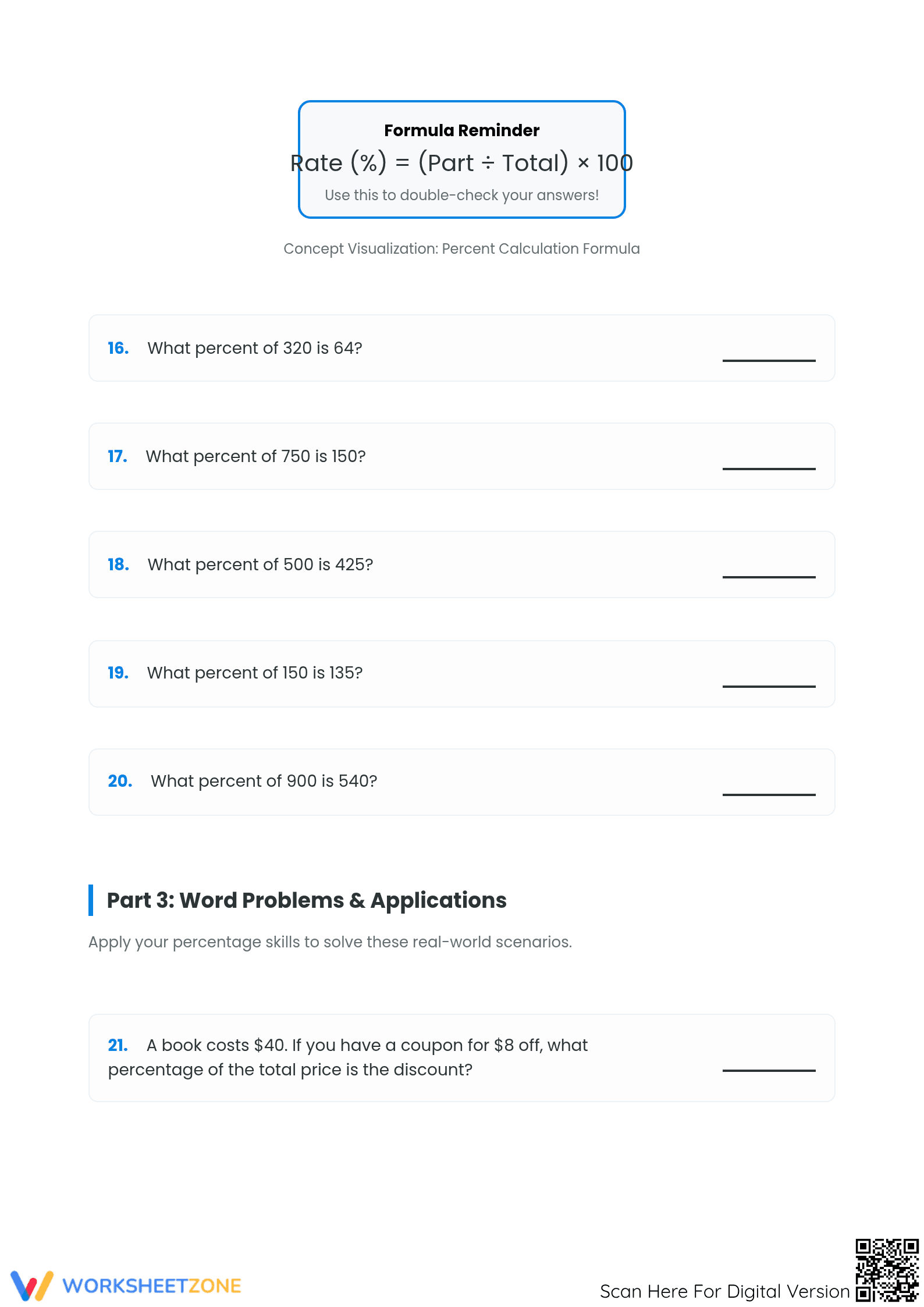
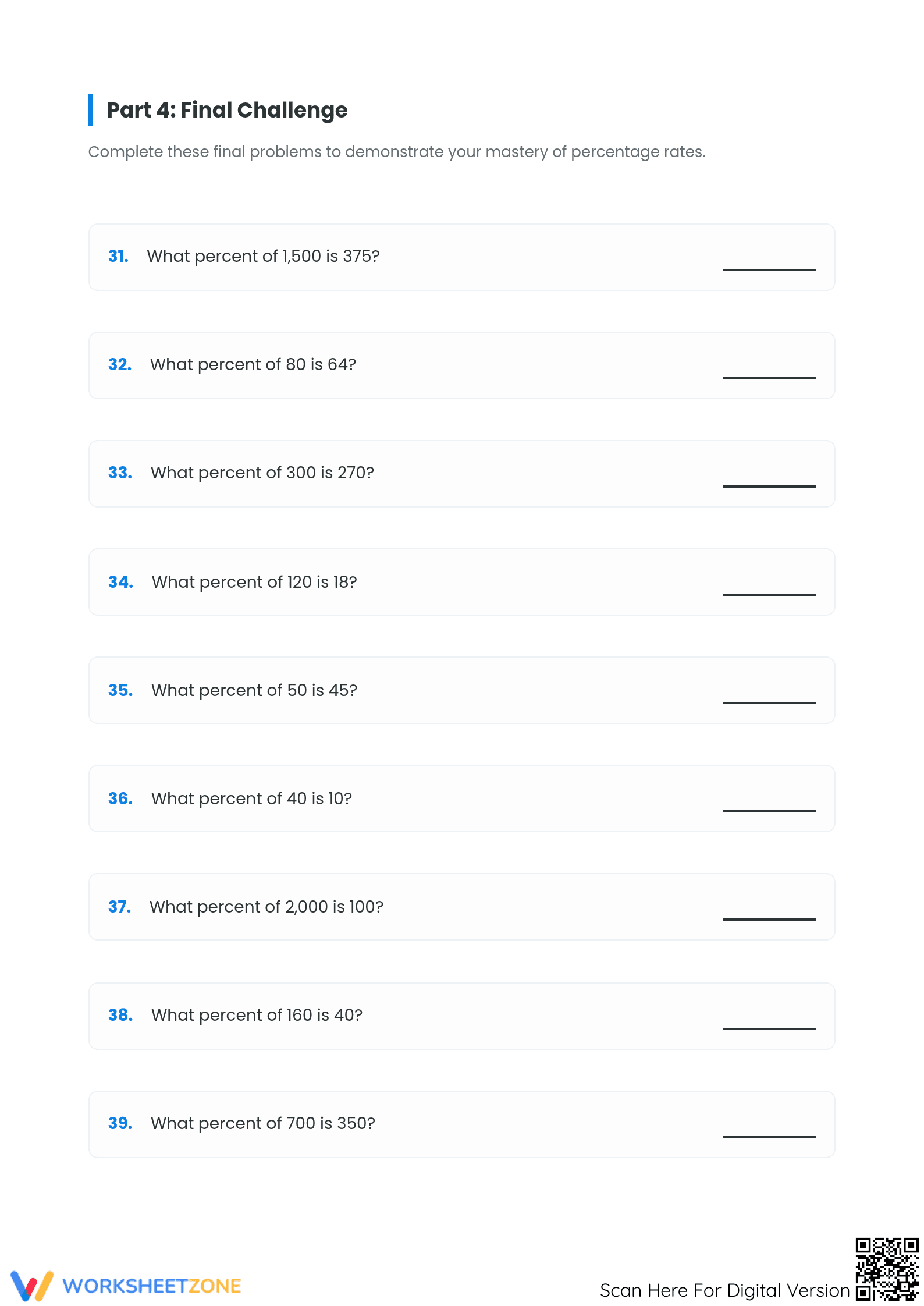
The resource contains four distinct sections across five printable pages. Part 1 covers basic rate calculations with integers and decimals, while Part 2 introduces more advanced numerical values. Part 3 integrates word problems to provide real-world context, and Part 4 offers a "Final Challenge" to test retention. A visual formula reminder is included on the third page to support independent student work, alongside a full answer key for grading.
This worksheet is designed for immediate classroom deployment with a zero-prep workflow. Teachers can print the 5-page packet in under 30 seconds and distribute it directly to students. The self-explanatory layout and built-in formula reminder mean students can begin working with minimal verbal instruction. Grading is streamlined using the provided answer key, requiring less than two minutes per student for a full review of all 39 tasks.
This resource is directly aligned with CCSS.MATH.CONTENT.6.RP.A.3.C, which requires students to "Find a percent of a quantity as a rate per 100; solve problems involving finding the whole, given a part and the percent." It specifically targets the inverse operation of finding the rate when the part and whole are known. Both standard codes can be copied directly into lesson plans, IEP goals, or district curriculum mapping tools.
Deploy this worksheet during the independent practice phase of a lesson on percentages or as a summative assessment after direct instruction. For formative assessment, observe students as they complete the "Formula Reminder" section to ensure they are correctly setting up the division of part over total. The estimated completion time of 45-60 minutes makes it an ideal fit for a single standard class period or a multi-day homework assignment.
The material is tailored for 6th, 7th, and 8th-grade students mastery of proportional relationships. It is particularly effective for learners who struggle with abstract percentage concepts and benefit from the concrete repetition found in the 39 tasks. This worksheet pairs naturally with a visual anchor chart displaying decimal-to-percent conversions or a focused lesson on ratios and unit rates.
Aligned with CCSS.MATH.CONTENT.6.RP.A.3.C, this 5-page resource provides rigorous practice in calculating percentage rates, a fundamental skill in middle-school proportional reasoning. By isolating the rate calculation across 39 distinct problems, the worksheet supports the cognitive shift from additive to multiplicative thinking. The inclusion of word problems reflects the RAND AIRS 2024 findings that situating abstract math in real-world contexts significantly improves student retention and conceptual transfer. Specifically, the "Part over Total" scaffolding aligns with research-based strategies for developing fluency in rational numbers. Educators can rely on this structured approach to ensure students meet state-mandated benchmarks for ratio and proportion mastery. This document serves as a durable instructional asset that can be integrated into broader curriculum maps or utilized for targeted intervention sessions within the Multi-Tiered System of Supports (MTSS) framework.


