


























Views
Downloads

Essential 5% Percentage Rate Worksheet | Grades 4-8 Math
Paste this activity's link or code into your existing LMS (Google Classroom, Canvas, Teams, Schoology, Moodle, etc.).
Students can open and work on the activity right away, with no student login required.
You'll still be able to track student progress and results from your teacher account.
Build student confidence in financial literacy and foundational arithmetic with this comprehensive percentage mastery set. This resource bridges the gap between abstract calculation and concrete real-world application, ensuring students understand how to find five percent of any value. By moving from simple whole numbers to currency and complex word problems, students develop a fluid understanding of proportional reasoning and rate-based mathematics.
At a Glance
- Grade: 6 · Subject: Math
- Standard:
CCSS.MATH.CONTENT.6.RP.A.3.C— Find a percent of a quantity as a rate per 100- Skill Focus: 5% Rate Calculation
- Format: 3 pages · 28 problems · Answer key included · PDF
- Best For: Independent practice or financial math introduction
- Time: 35–45 minutes
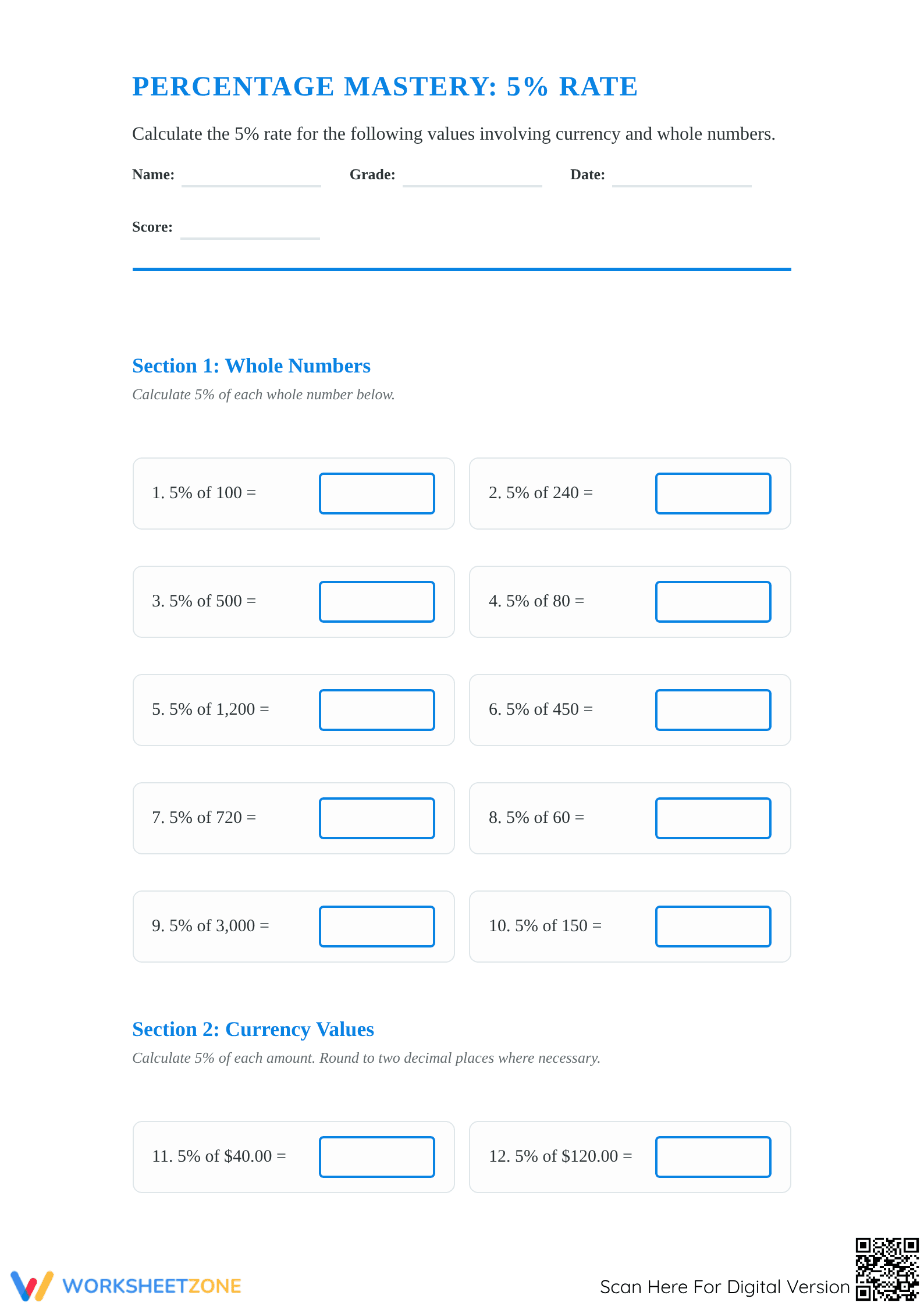
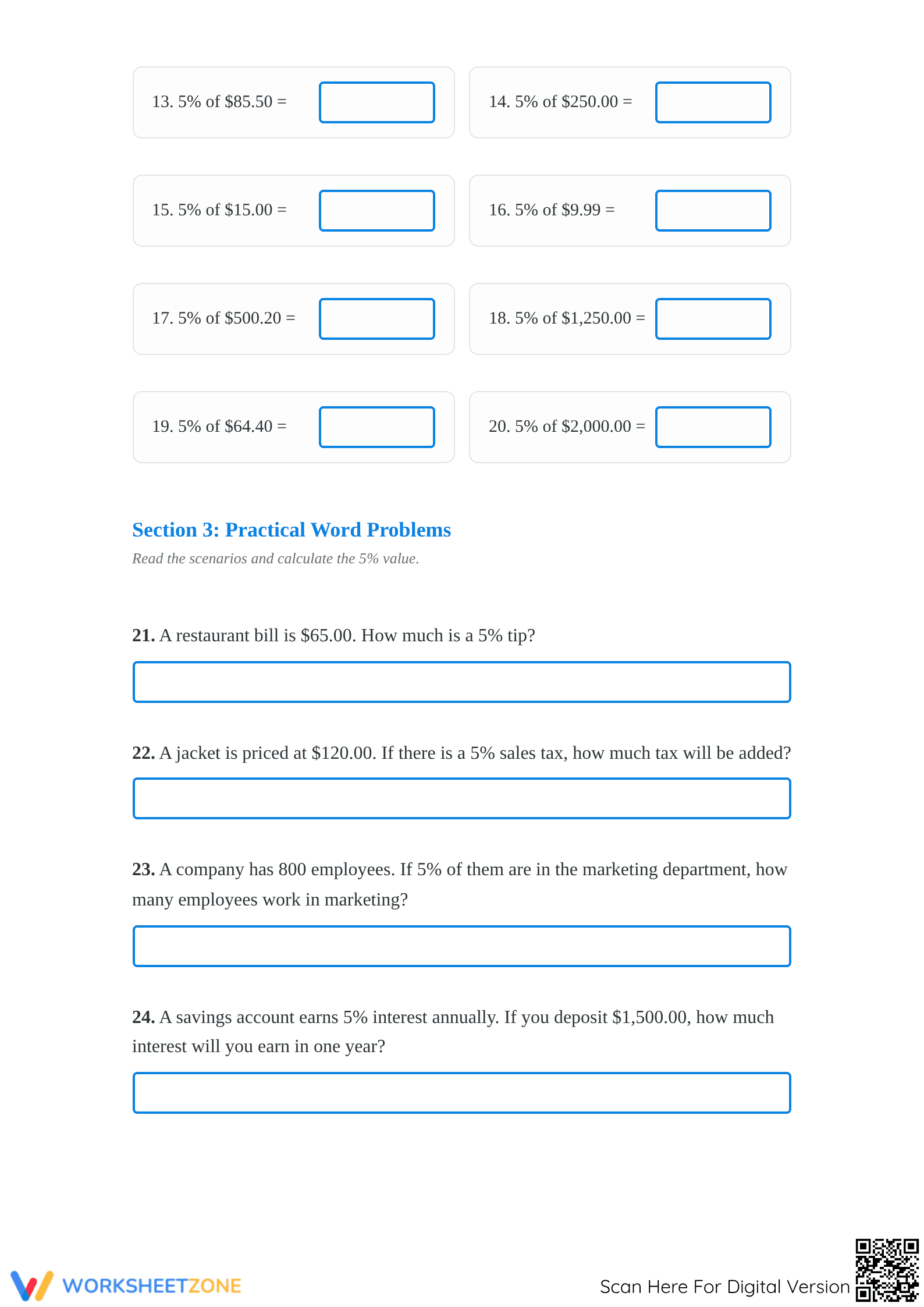
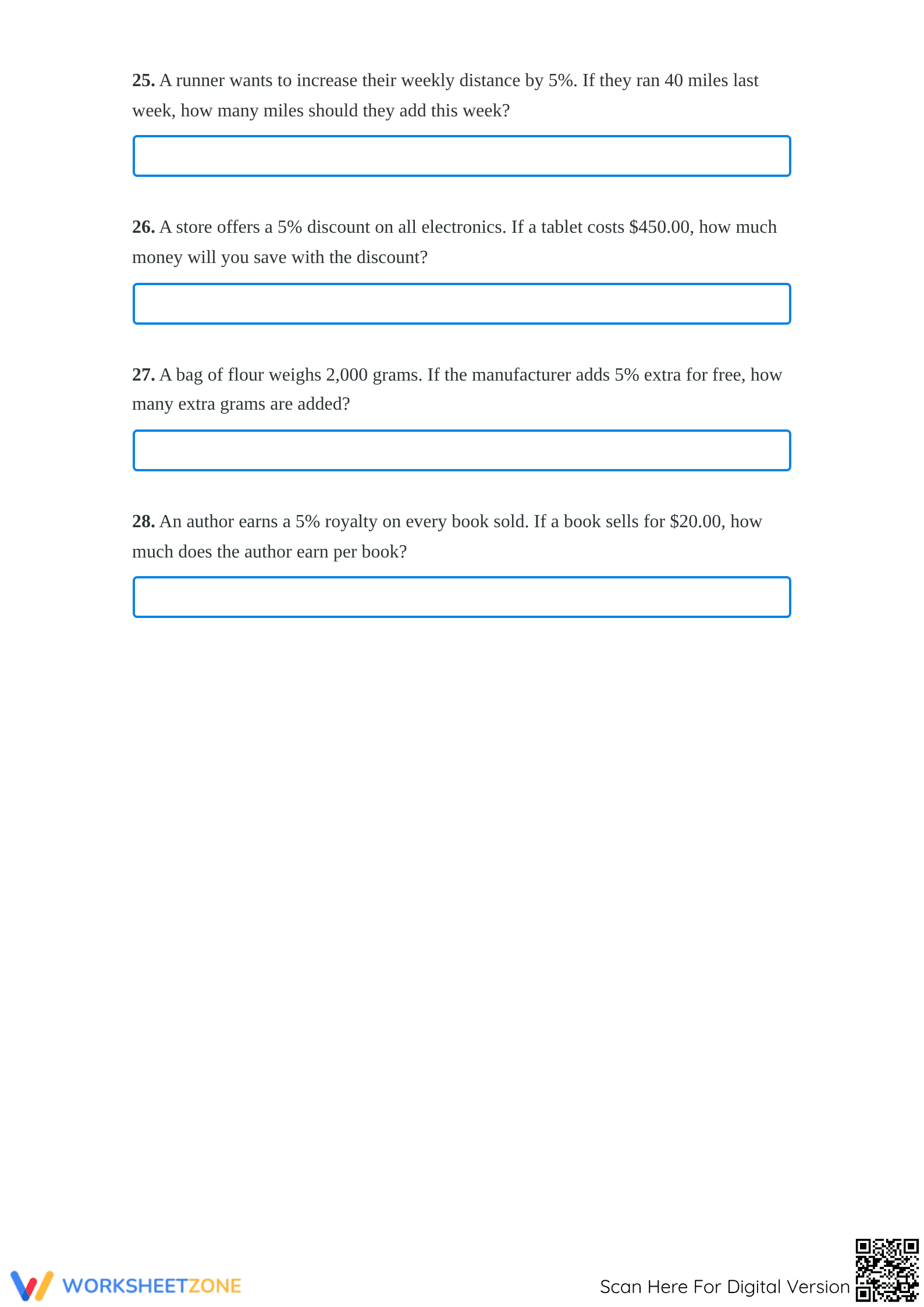
This 3-page PDF provides 28 structured tasks designed for high-impact practice. Section one features ten whole-number problems to cement basic calculation steps. Section two transitions into financial math with ten currency-based problems requiring precise decimal placement. The final section provides eight practical word problems covering restaurant tips, sales tax, annual interest, and business royalties, offering a robust curriculum experience with no teacher setup required.
The zero-prep workflow is designed for maximum teacher efficiency. First, print the three-page sequence (30 seconds). Second, distribute the worksheets for a 40-minute independent block (1 minute). Third, use the included comprehensive answer key to review results or facilitate student self-correction (1 minute). This streamlined process requires under two minutes of total preparation time, making it an ideal choice for emergency sub plans or last-minute lesson enhancements.
Aligned strictly to CCSS.MATH.CONTENT.6.RP.A.3.C, this worksheet requires students to "find a percent of a quantity as a rate per 100; solve problems involving finding the whole, given a part and the percent." It also supports foundational skills for Grade 7 ratios. Both standard codes can be copied directly into lesson plans, IEP goals, or district curriculum mapping tools to ensure documented compliance with state and national framework requirements.
To maximize instructional impact, use the word problem section as a formative assessment after direct instruction on decimal multiplication. Have students circle the keyword in each scenario—such as "tip," "tax," or "discount"—before beginning their calculations. The resource works best as a main lesson activity during a unit on ratios and proportions, typically taking students 40 minutes to complete with accuracy across all three varied sections.
This resource is tailored for Grade 6 students but serves as an excellent remedial tool for Grade 7 and 8 learners who need to strengthen their mental math and financial calculation skills. It pairs naturally with a lesson on sales tax or an anchor chart showing the relationship between fractions, decimals, and percentages. The inclusion of currency values provides immediate relevance for students interested in personal finance and consumer math.
According to research from Fisher & Frey (2014) on the gradual release of responsibility, structured practice that moves from abstract numbers to contextualized scenarios is vital for long-term retention. This 28-task resource follows that evidence-based model by scaffolding the 5% calculation through whole numbers, currency values, and finally, multi-step word problems. By mastering the CCSS.MATH.CONTENT.6.RP.A.3.C standard in these varied contexts, students build a durable mathematical schema that supports higher-order algebra and real-world financial decision-making. The 5% rate is a critical benchmark in consumer math, appearing in interest rates, service gratuities, and wholesale discounts. Providing students with this targeted practice ensures they can calculate rates accurately without total reliance on digital tools, fostering the numerical fluency required for secondary mathematics success and professional readiness in fields ranging from retail management to personal accounting.


