


























Views
Downloads

Essential 5 Percent Rate Math Worksheet | Printable
Paste this activity's link or code into your existing LMS (Google Classroom, Canvas, Teams, Schoology, Moodle, etc.).
Students can open and work on the activity right away, with no student login required.
You'll still be able to track student progress and results from your teacher account.
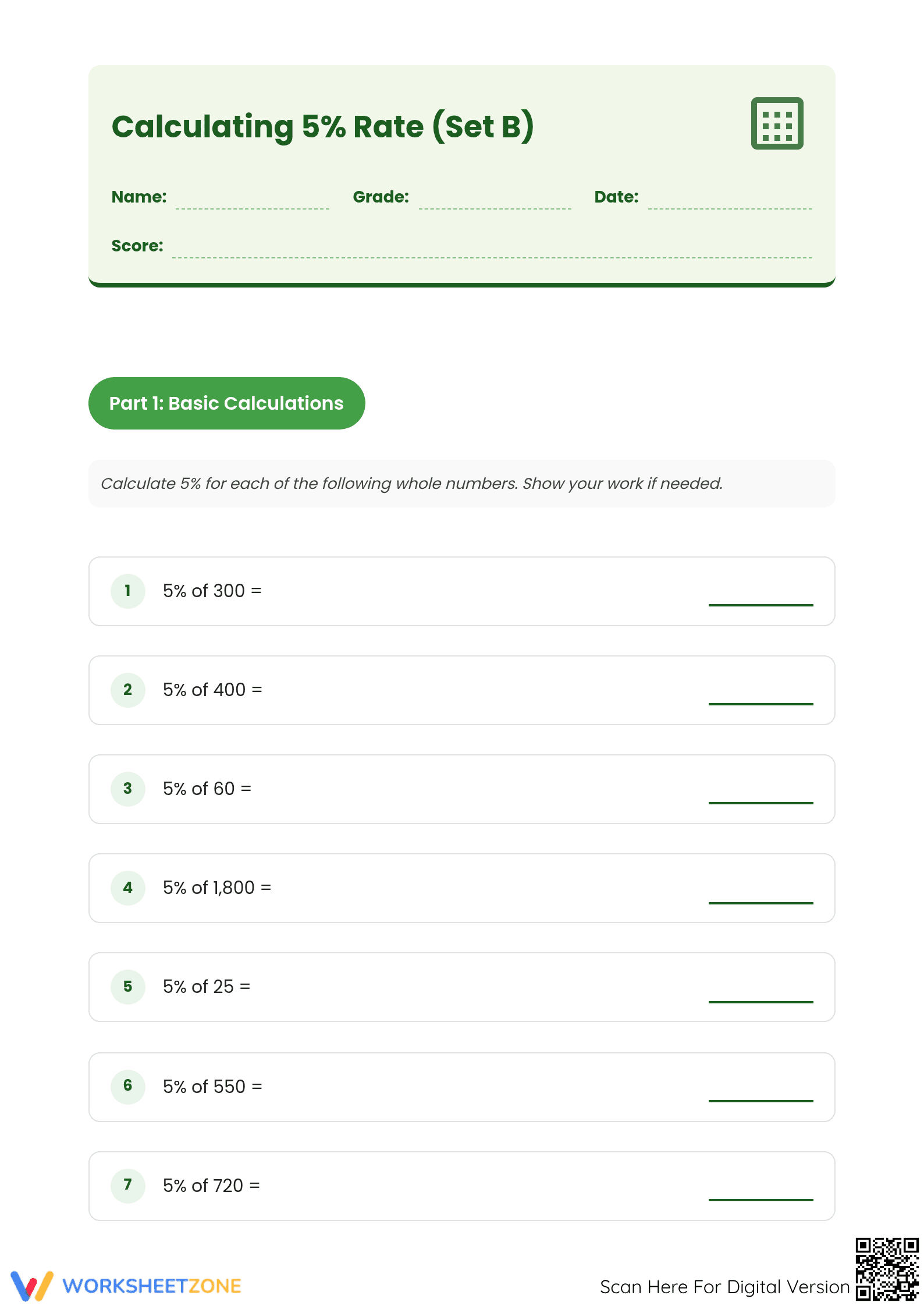
Mastering percentages is a foundational skill in middle school mathematics. This comprehensive 4-page worksheet focuses exclusively on calculating a 5% rate, guiding students from basic arithmetic to complex real-world application. By the end of these exercises, students will demonstrate mastery in finding five percent of any given value, including whole numbers and monetary amounts.
At a Glance
- Grade: 6 · Subject: Math
- Standard:
CCSS.MATH.CONTENT.6.RP.A.3.C— Find a percent of a quantity as a rate per 100- Skill Focus: Calculating a 5% Rate
- Format: 4 pages · 32 problems · Answer key included · PDF
- Best For: Independent practice, sub plans, and homework
- Time: 30–45 minutes
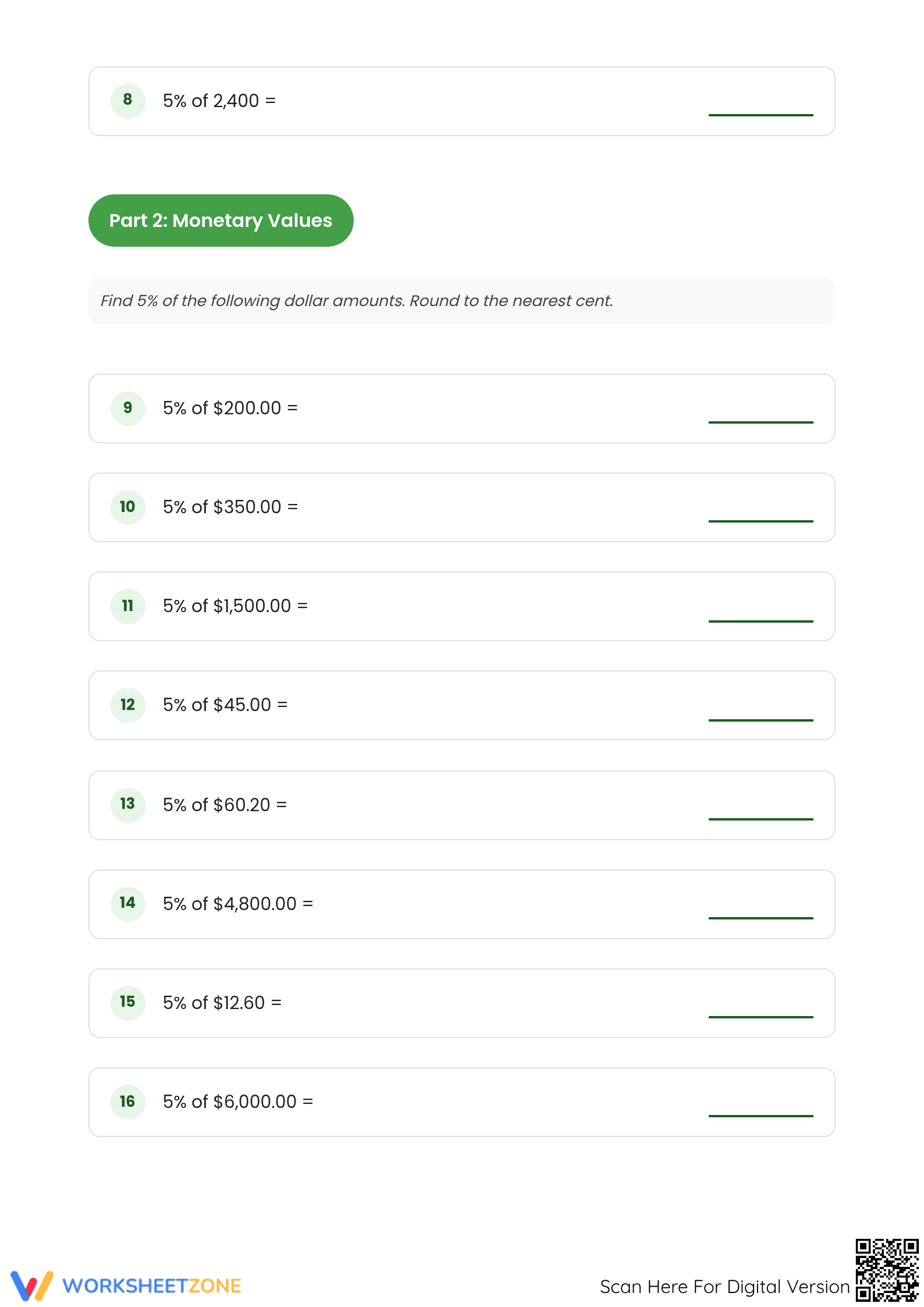
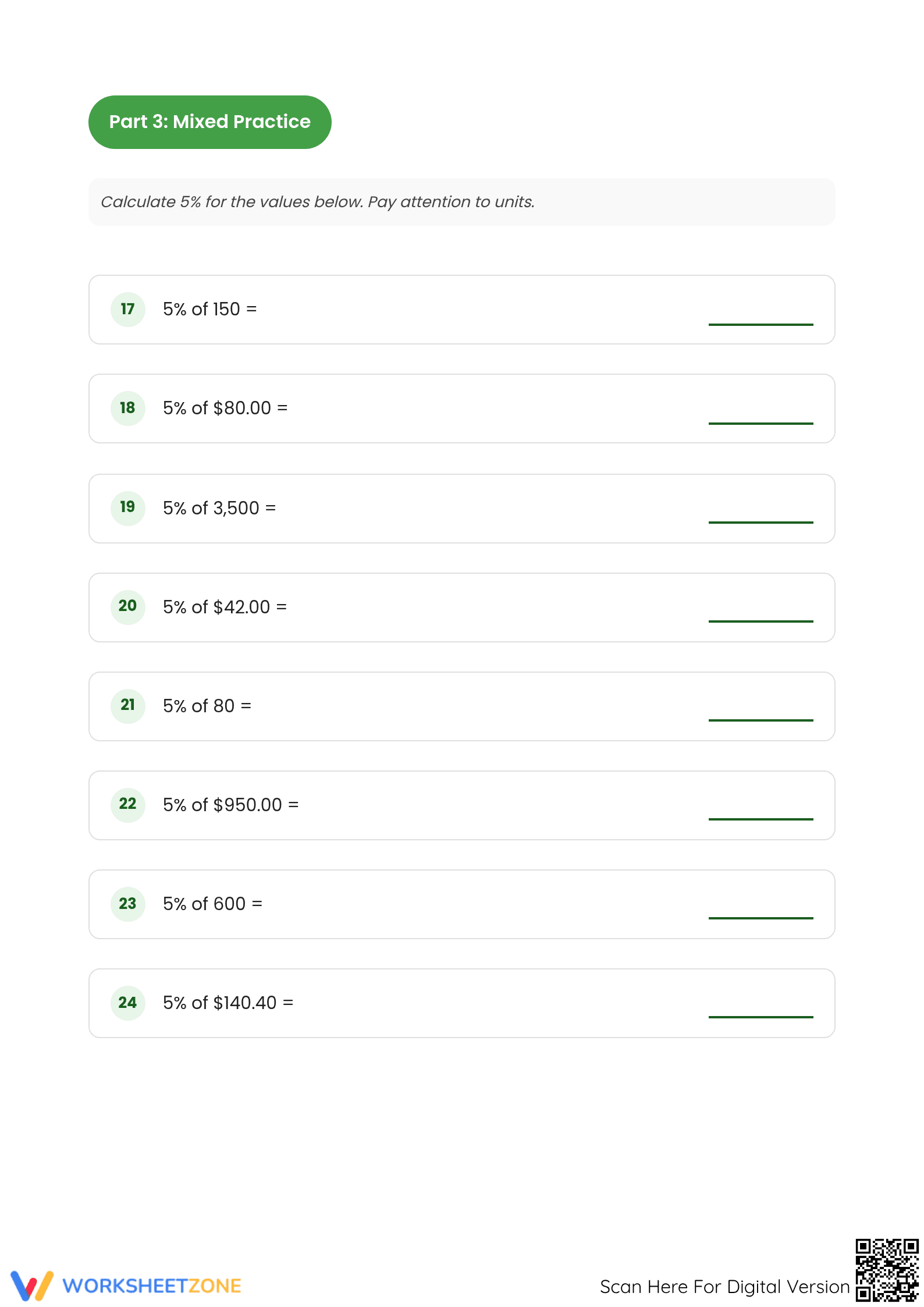
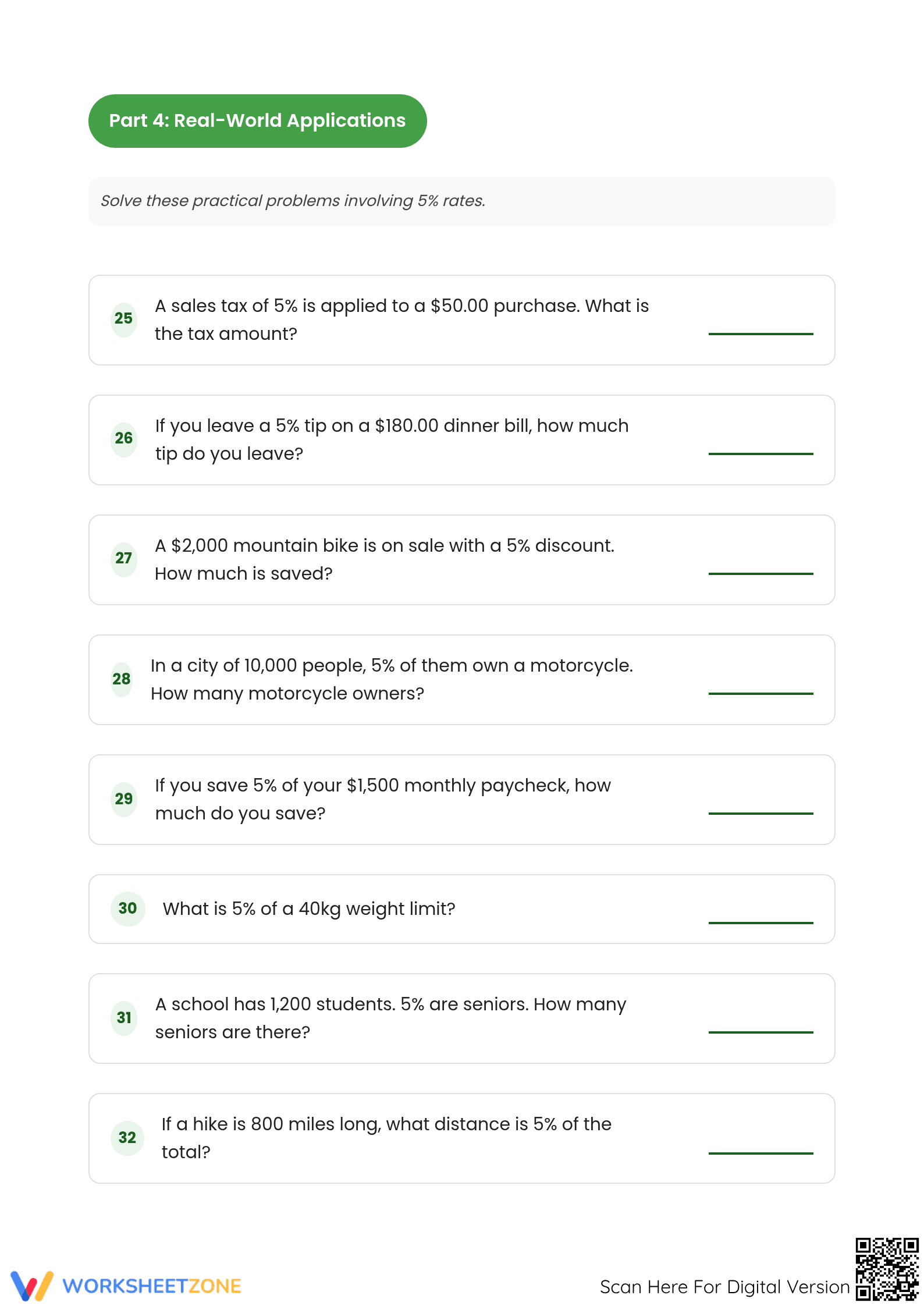
This packet contains four distinct sections designed to build student confidence and accuracy. It features 32 unique problems spread across four pages, ensuring ample practice without overwhelming the learner. The worksheet includes structured spaces for answers and prompts students to show their work. A full answer key is provided for immediate feedback and grading efficiency.
This resource is designed for immediate classroom implementation with zero teacher preparation. To use this in your classroom, follow these three simple steps: First, Print (1 minute) the four-page PDF for your students. Second, Distribute (30 seconds) the packets during your lesson on percentages or as a standalone activity. Third, Review (5 minutes) the answers using the included key. Total prep time is under two minutes, making it an ideal choice for emergency sub plans or busy instructional days.
The primary focus of this worksheet is `CCSS.MATH.CONTENT.6.RP.A.3.C`, which requires students to "Find a percent of a quantity as a rate per 100 (e.g., 30% of a quantity means 30/100 times the quantity); solve problems involving finding the whole, given a part and the percent." This resource provides targeted practice for the "percent of a quantity" component of the standard. This standard code can be copied directly into lesson plans, IEP goals, or district curriculum mapping tools.
Incorporate this worksheet during the independent practice portion of a lesson on percents. It serves as an excellent tool for identifying students who may need additional scaffolding with decimals or multi-digit multiplication. As a formative assessment tip, observe students as they transition to Part 2; if they struggle with the decimal placement in currency, provide a quick review on multiplying by 0.05. Students typically complete the full packet in 30 to 45 minutes.
This resource is tailored for students in Grade 6 who are first encountering percentage rates, though it provides valuable review for Grades 7 and 8. It is particularly effective for learners who benefit from repetitive, structured practice. This worksheet pairs naturally with a direct instruction lesson on converting percentages to decimals or a financial literacy unit on sales tax and tipping.
The ability to calculate percentages accurately is a critical component of mathematical literacy, as noted in the NAEP (National Assessment of Educational Progress) frameworks. Research from EdReports (2024) emphasizes that high-quality instructional materials must provide students with multiple opportunities to apply proportional reasoning in diverse contexts. This worksheet aligns with those findings by moving from abstract calculations (CCSS.MATH.CONTENT.6.RP.A.3.C) to practical, real-world scenarios involving currency, discounts, and tips. By practicing the 5% rate across 32 varied problems, students move beyond rote memorization to a conceptual understanding of percents as rates per hundred. This systematic approach supports the "gradual release of responsibility" model (Fisher & Frey, 2014), ensuring that learners develop the procedural fluency required for success in higher-level algebra and statistics. This resource provides the rigorous, standards-based practice necessary for middle school mastery.


