


























Views
Downloads



Essential Percent Rate Practice Worksheet | Grades 4-8
Paste this activity's link or code into your existing LMS (Google Classroom, Canvas, Teams, Schoology, Moodle, etc.).
Students can open and work on the activity right away, with no student login required.
You'll still be able to track student progress and results from your teacher account.
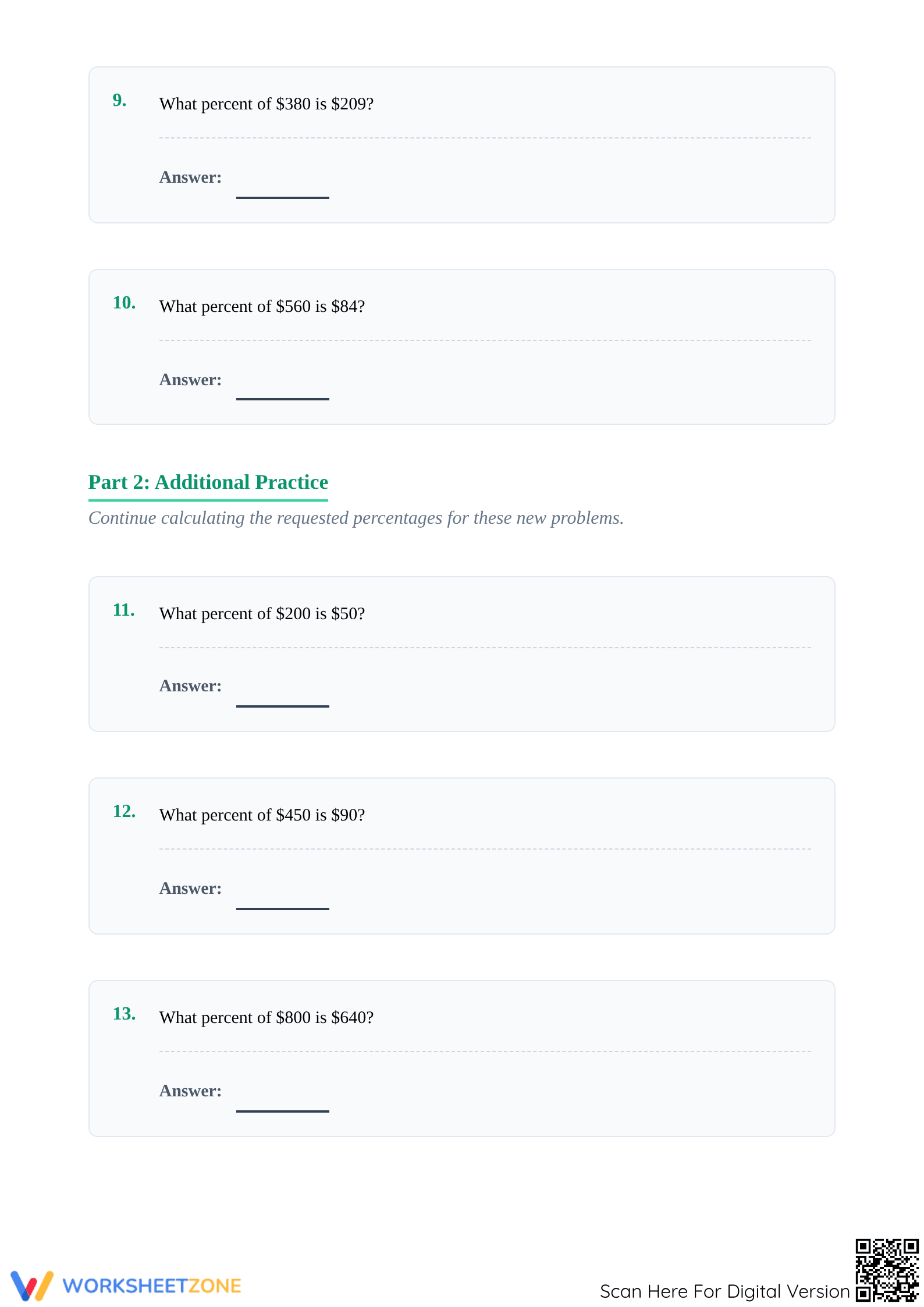
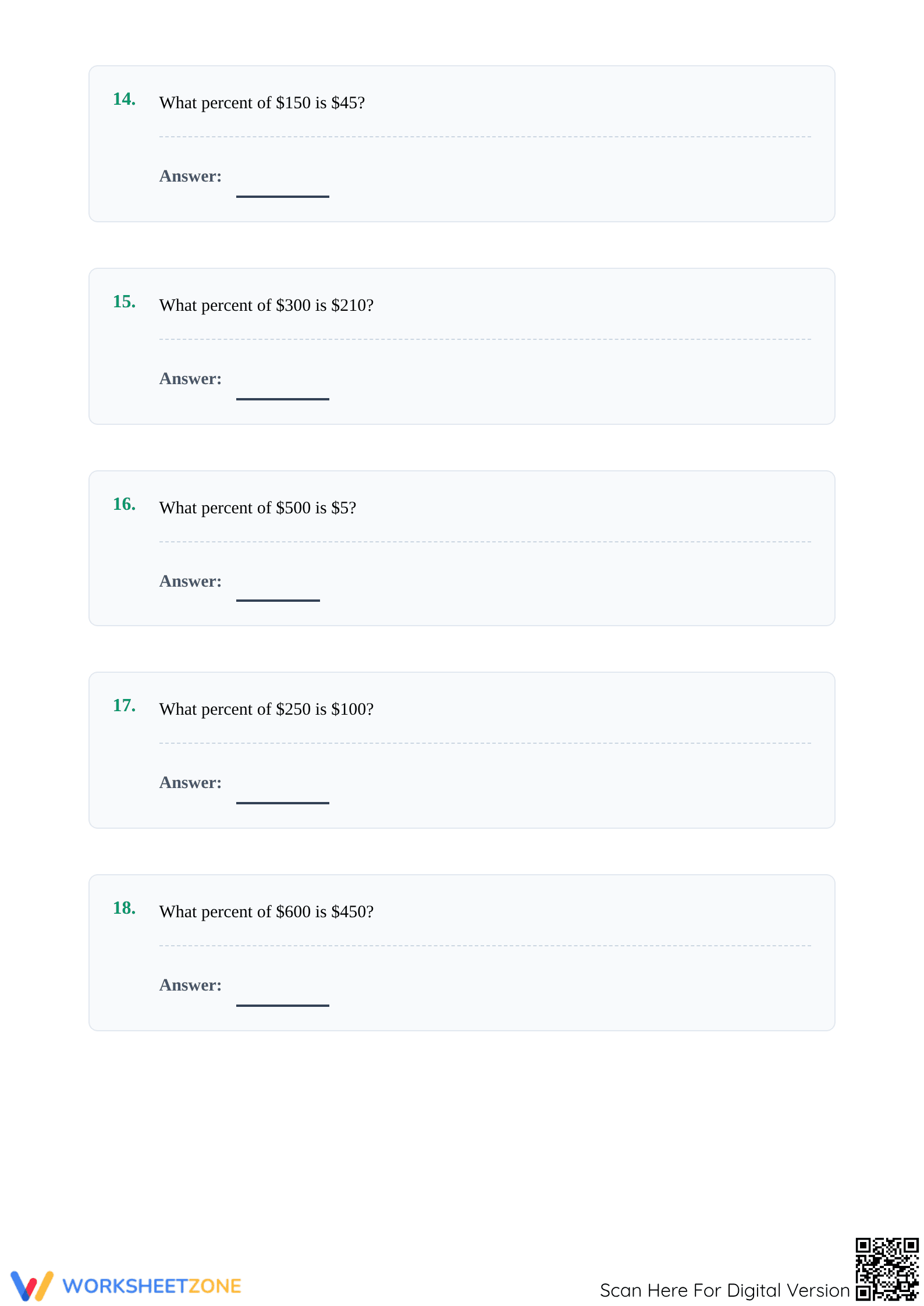
Mastering the calculation of percent rates is a fundamental skill for middle school mathematicians. This comprehensive 5-page worksheet provides students with 22 targeted problems designed to bridge the gap between abstract numbers and real-world application. Students will learn to determine what percentage one value represents of another, focusing specifically on currency and whole numbers.
At a Glance
- Grade: 6 · Subject: Math
- Standard:
CCSS.MATH.CONTENT.6.RP.A.3.C— Find a percent of a quantity as a rate per 100- Skill Focus: Calculating Percent Rates
- Format: 5 pages · 22 problems · Answer key included · PDF
- Best For: Independent practice and formative assessment
- Time: 30–45 minutes
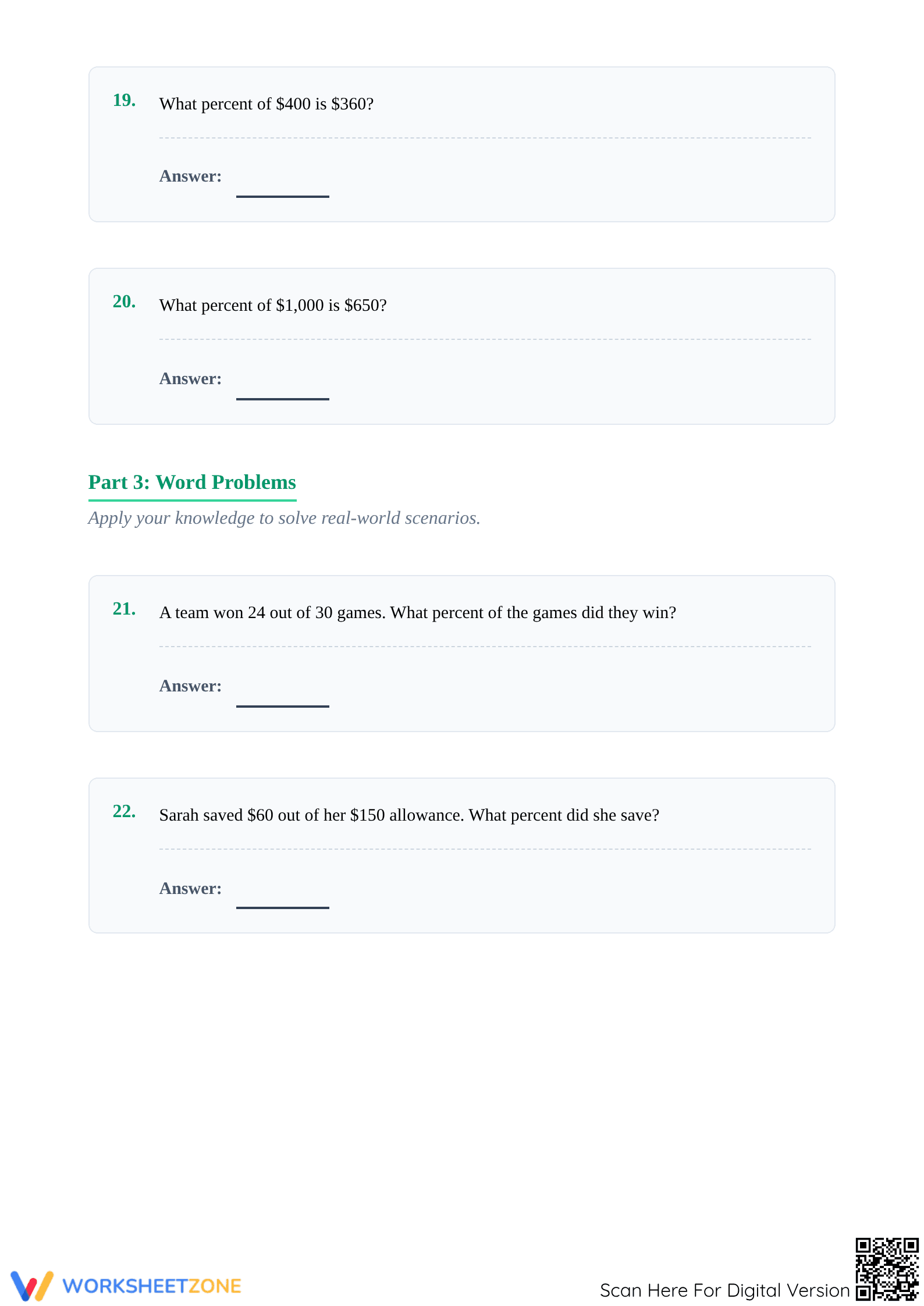
This packet includes five distinct pages of practice, moving from standard computational tasks to situational word problems. With 22 total items, the worksheet is divided into three parts: Standard Calculations (Part 1), Additional Practice (Part 2), and real-world Word Problems (Part 3). Each page features clear workspace and designated answer lines, accompanied by a full answer key for efficient grading and student self-correction.
Teachers can integrate this resource into their lesson plans in under two minutes. First, simply print the 5-page PDF or assign specific pages based on student needs. Second, distribute the materials during independent practice or as a ready-to-use substitute plan. Finally, review the solutions using the provided answer key, which allows for rapid feedback and data-driven instruction without any prior teacher setup.
This resource is strictly aligned with CCSS.MATH.CONTENT.6.RP.A.3.C: "Find a percent of a quantity as a rate per 100 (e.g., 30% of a quantity means 30/100 times the quantity); solve problems involving finding the whole, given a part and the percent." Both standard codes can be copied directly into lesson plans, IEP goals, or district curriculum mapping tools to ensure instructional consistency.
The worksheet is ideal for the "independent practice" phase of a gradual release model. After direct instruction on the part/whole/percent relationship, use Part 1 as a quick check for understanding. As a formative assessment tip, observe students on problems 21 and 22; their ability to translate text into a ratio indicates true conceptual mastery. Expect students to complete the full set in 30 to 45 minutes.
Designed for students in Grades 4 through 8, this resource supports varying levels of mathematical maturity. It is especially effective for learners who benefit from consistent formatting and scaffolded transitions from currency-based math to abstract numbers. It pairs naturally with a visual anchor chart illustrating the percent proportion or a direct instruction lesson on converting fractions to percentages.
Aligned to the CCSS.MATH.CONTENT.6.RP.A.3.C standard, this worksheet facilitates the development of proportional reasoning, a critical milestone identified in the NAEP framework for middle school mathematics. By focusing on finding the percent rate within currency and real-world contexts, the resource addresses the "rate per 100" conceptualization necessary for high school algebra readiness. Research from NAEP suggests that students who master the relationship between parts and wholes in varied formats show significantly higher success in complex data analysis. This 5-page practice set provides the volume of practice required to move from procedural fluency to conceptual application. The inclusion of word problems ensures that students are not merely performing operations but are interpreting mathematical relationships as defined by rigorous state and national standards. Educators can utilize the 22 included tasks to reliably measure student progress toward mastery of ratio and proportional relationship clusters.


