




























Views
Downloads



Essential Percent Rate and Currency Worksheet | Grades 4-8

Paste this activity's link or code into your existing LMS (Google Classroom, Canvas, Teams, Schoology, Moodle, etc.).
Students can open and work on the activity right away, with no student login required.
You'll still be able to track student progress and results from your teacher account.
Students master the critical skill of calculating percentage rates using real-world monetary values and decimals. This comprehensive worksheet guides learners through the process of determining what percent one currency amount represents of another, bridging the gap between abstract math and practical financial literacy. Learners achieve fluency in decimal manipulation and ratio reasoning through structured practice.
At a Glance
- Grade: 7 · Subject: Math
- Standard:
CCSS.MATH.CONTENT.7.RP.A.3— Use proportional relationships to solve multistep ratio and percent problems involving currency- Skill Focus: Calculating percent rates with currency
- Format: 5 pages · 22 problems · Answer key included · PDF
- Best For: Independent practice and financial literacy
- Time: 30–45 minutes
What's Inside
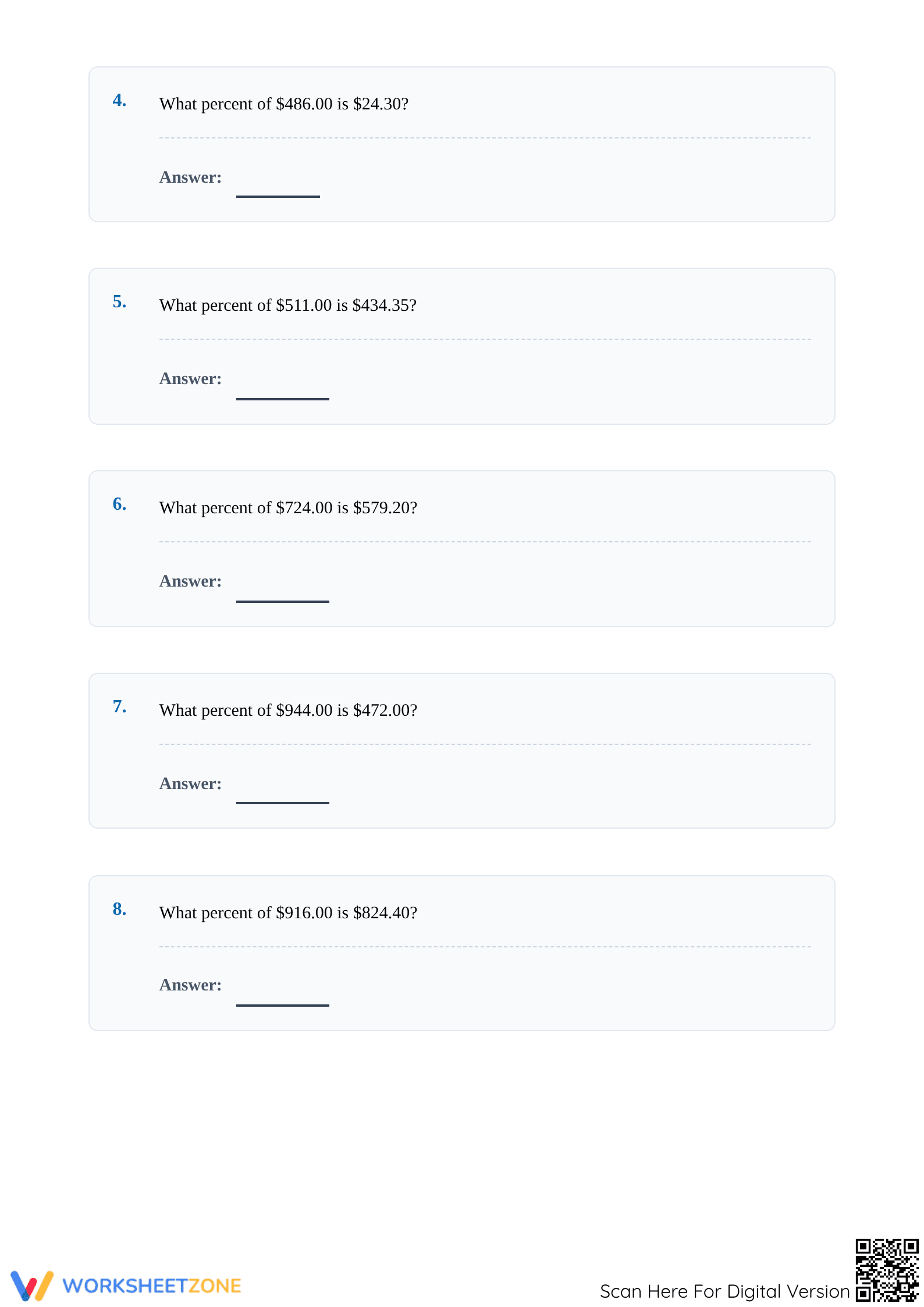
This five-page packet features 22 carefully constructed problems divided into three distinct sections. Part 1 provides ten standard calculations using larger currency values. Part 2 offers ten additional practice problems with varied decimal placements. Part 3 concludes with real-world word problems focused on sales discounts and restaurant tipping. A full answer key is included for immediate feedback and grading.
Skill Progression
- Guided practice: The initial set of 10 problems utilizes clear prompts and structured workspaces to help students internalize the formula for finding percent rates using currency amounts.
- Supported practice: The additional 10 problems in Part 2 increase in complexity, requiring students to maintain precision while working with diverse decimal values.
- Independent practice: The final section presents word problems that require students to apply their knowledge to authentic scenarios like calculating a discount or a tip.
This sequence follows the gradual-release model, moving from explicit skill application to autonomous problem-solving in real-world contexts.
Standards Alignment
The primary focus is CCSS.MATH.CONTENT.7.RP.A.3, which requires students to use proportional relationships to solve multistep ratio and percent problems. This includes applications such as simple interest, tax, markups, markdowns, and gratuities. Both standard codes can be copied directly into lesson plans, IEP goals, or district curriculum mapping tools.
How to Use It
This resource is ideal for use during the independent practice phase of a lesson on ratios and proportions. Teachers can assign the word problems as an exit ticket to gauge student ability to transfer skills to real-life situations. Expect students to spend approximately 35 minutes completing the full set, allowing for a focused formative assessment of their decimal precision.
Who It's For
Designed for middle school students in Grade 7, this worksheet is also appropriate for Grade 6 or Grade 8 learners needing a review of financial math. It pairs naturally with a direct instruction lesson on "Part over Whole" relationships or an anchor chart detailing the decimal-to-percent conversion process.
According to a ScienceDirect TpT Analysis (2024), providing students with contextualized math problems involving currency significantly increases engagement and retention of proportional reasoning skills. This worksheet directly addresses CCSS.MATH.CONTENT.7.RP.A.3 by challenging students to find the percent rate of one monetary value relative to another, a foundational component of financial literacy. By moving from isolated calculations to word problems involving sales and tips, learners develop the cognitive flexibility required for higher-order mathematics. The inclusion of decimals ensures that students maintain computational accuracy while navigating the complexities of currency-based ratios. This resource serves as an essential tool for educators seeking to align their curriculum with state and national standards while providing students with practical, transferable math skills that extend beyond the classroom. It effectively scaffolds the learning process, ensuring that students can achieve mastery in calculating percentages within realistic financial frameworks.


