


























Views
Downloads


Essential Percent Calculations Worksheet | Grades 6-8
Paste this activity's link or code into your existing LMS (Google Classroom, Canvas, Teams, Schoology, Moodle, etc.).
Students can open and work on the activity right away, with no student login required.
You'll still be able to track student progress and results from your teacher account.
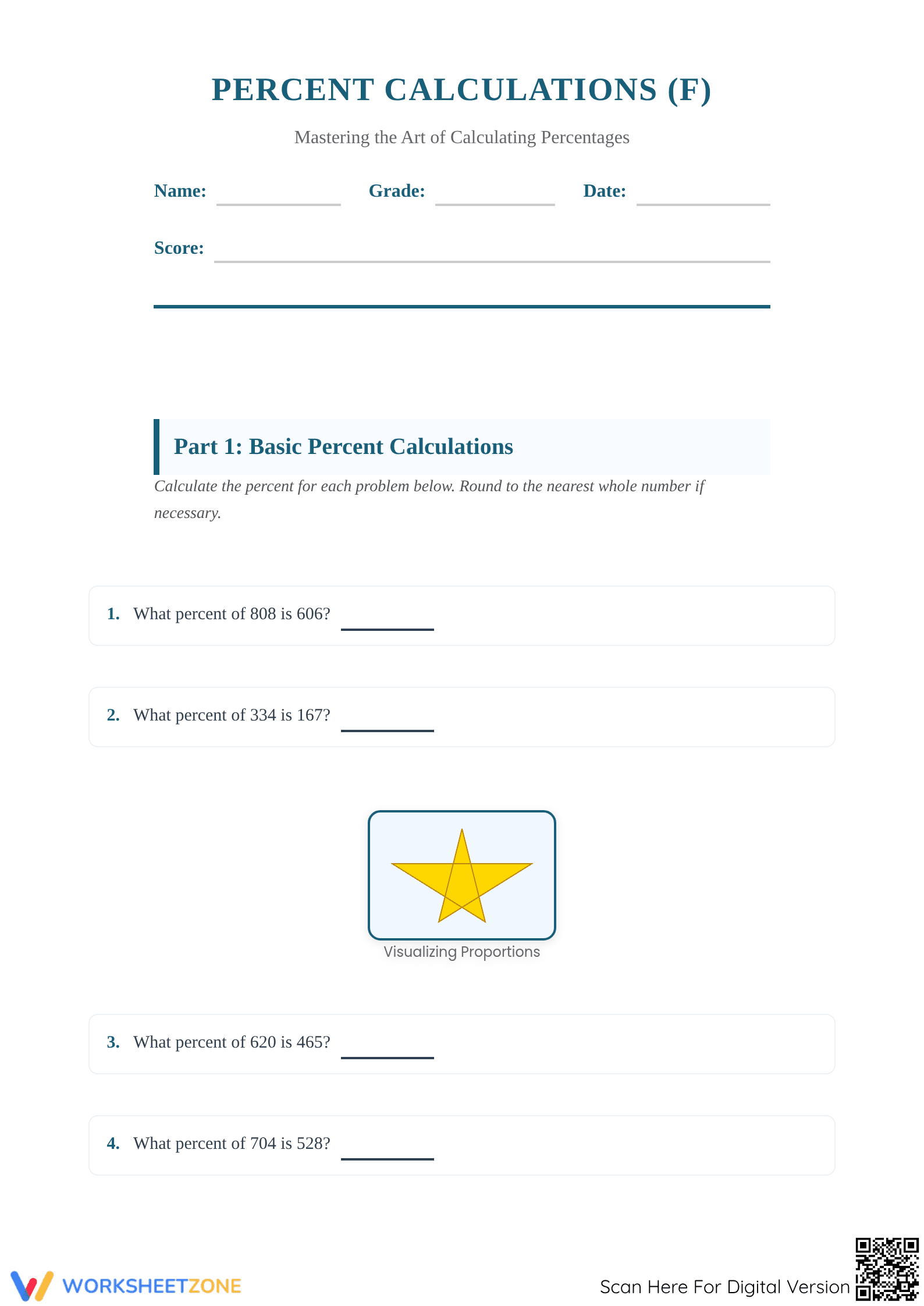
This comprehensive percentage calculation worksheet helps students master finding the percent of one number compared to another. By moving from basic whole-number ratios to complex word problems and large-number challenges, learners build deep fluency in rate-based reasoning. This resource ensures students can confidently calculate percentages in both academic and real-world contexts.
At a Glance
- Grade: 6–8 · Subject: Math
- Standard:
CCSS.MATH.CONTENT.6.RP.A.3.C— Find a percent of a quantity as a rate per 100- Skill Focus: Calculating percent rates from part-whole relationships
- Format: 5 pages · 35 problems · Answer key included · PDF
- Best For: Middle school math practice and assessments
- Time: 45–60 minutes
This 5-page PDF contains 35 structured problems designed to build mastery over a single class period. It includes ten basic calculations, ten intermediate discovery problems, five detailed word problems focusing on real-world scenarios like sales tax and stadium attendance, and a final ten-problem challenge round using larger numerical values. A full answer key is provided for immediate feedback.
This worksheet is designed for immediate classroom implementation with zero teacher preparation. 1. Print: Generating enough copies for a class of thirty takes less than three minutes. 2. Distribute: The clear section headers allow students to start immediately with minimal instruction. 3. Review: The organized answer key permits rapid grading or student self-correction, reducing the total administrative burden to under five minutes.
The primary standard addressed is CCSS.MATH.CONTENT.6.RP.A.3.C, which requires students to find a percent of a quantity as a rate per 100 (e.g., 30% of a quantity means 30/100 times the quantity) and solve problems involving finding the whole, given a part and the percent. This resource also supports ratio reasoning as students compare parts to wholes. Both standard codes can be copied directly into lesson plans, IEP goals, or district curriculum mapping tools.
Use this worksheet as a summative assessment after unit instruction to gauge mastery. During direct instruction, utilize the first section for guided practice and the "Challenge Round" as an extension for early finishers. A key formative assessment tip is to monitor if students correctly identify the "whole" in situational word problems. Most students will complete the 35 problems within 45 to 60 minutes.
This resource is ideal for 6th-grade students first learning percentage concepts, as well as 7th and 8th graders needing remedial review. It is particularly effective when paired with visual models like double number lines or tape diagrams. The word problems provide necessary context for English Language Learners to apply mathematical vocabulary to situational logic.
Aligned to CCSS.MATH.CONTENT.6.RP.A.3.C, this 35-problem worksheet targets the essential skill of calculating percent rates within the Ratios and Proportional Relationships domain. Research from the NAEP indicates that middle school students often struggle with proportional reasoning, specifically calculating parts of a whole. By providing a scaffolded progression from basic numeric pairs to contextualized word problems, this resource aligns with the "Gradual Release of Responsibility" model popularized by Fisher & Frey (2014). This structured approach ensures students develop both procedural fluency and conceptual understanding. The inclusion of a challenge round supports the high-expectations curricula recommended by EdReports 2024 for middle-level mathematics, ensuring students are prepared for advanced algebraic concepts. This capsule confirms the worksheet's utility as a standards-aligned tool for building functional mathematical literacy across the 6-8 grade band.


