


























Views
Downloads

Essential Percent Calculations Worksheet | Grade 6 Math
Paste this activity's link or code into your existing LMS (Google Classroom, Canvas, Teams, Schoology, Moodle, etc.).
Students can open and work on the activity right away, with no student login required.
You'll still be able to track student progress and results from your teacher account.
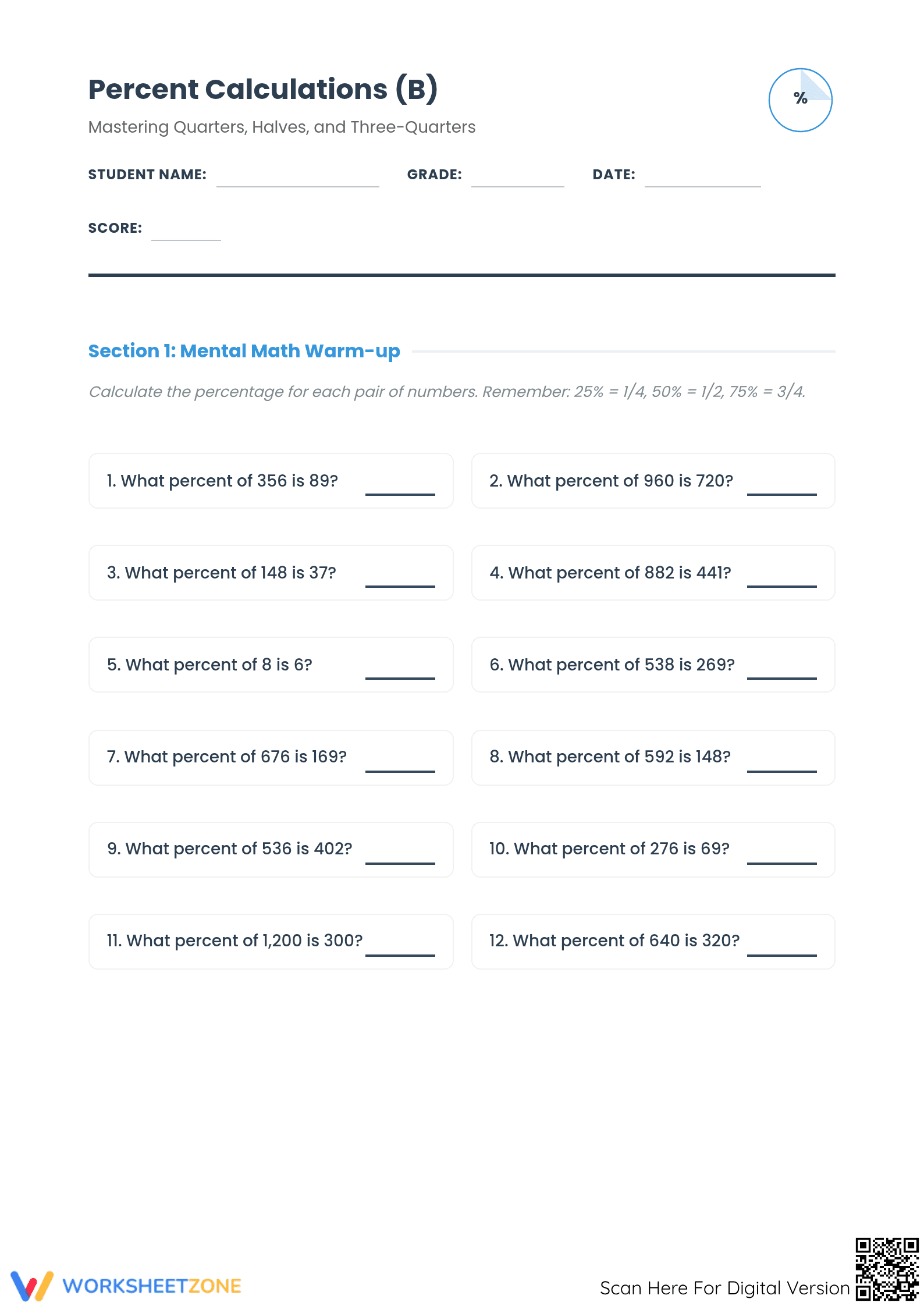
This essential Grade 6 math worksheet provides students with extensive practice in calculating percentage rates from whole numbers. By mastering these core skills, learners develop a deeper understanding of proportional relationships and financial literacy. The structured approach ensures students move confidently from mental math warm-ups to complex application problems with ease.
At a Glance
- Grade: 6 · Subject: Math
- Standard:
CCSS.MATH.CONTENT.6.RP.A.3.c— Calculate what percentage one whole number is of another- Skill Focus: Percent calculations with whole numbers
- Format: 4 pages · 40 problems · Answer key included · PDF
- Best For: Independent practice and formative assessment
- Time: 30–45 minutes
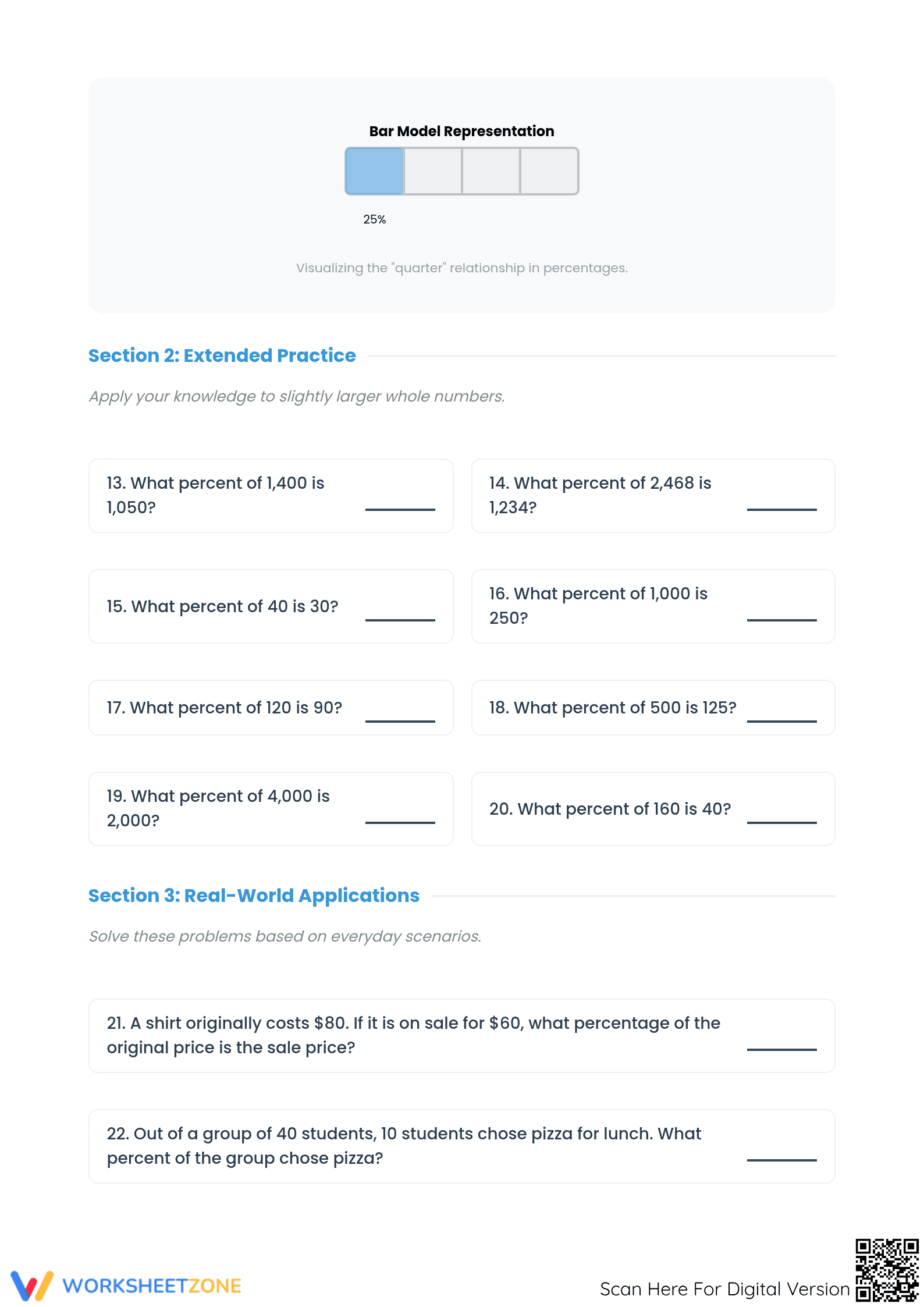
This comprehensive 4-page resource features 40 targeted problems designed to build mastery in percent calculations. The worksheet includes a mental math warm-up section, visual bar models to support conceptual understanding, real-world word problems involving sales and data, and a challenge section for logic-based comparisons. A full answer key is provided for efficient grading and student self-correction.
Skill Progression
- Guided Practice: The first 12 problems focus on mental math strategies using quarters, halves, and three-quarters to establish a strong conceptual foundation.
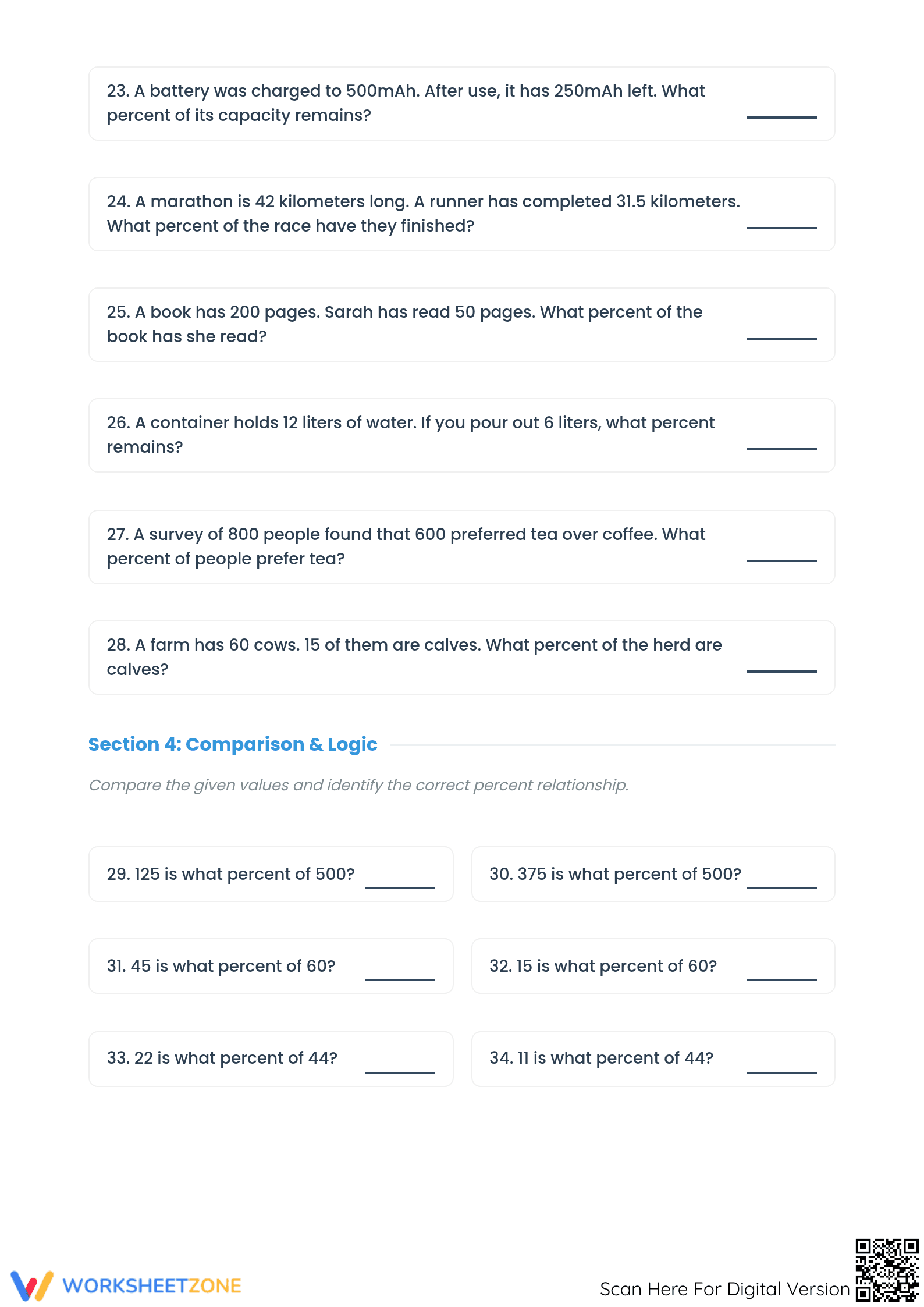
- Supported Practice: Problems 13 through 28 utilize visual bar models and relatable real-world scenarios, such as battery life and sale prices, to apply percentage logic to diverse contexts.
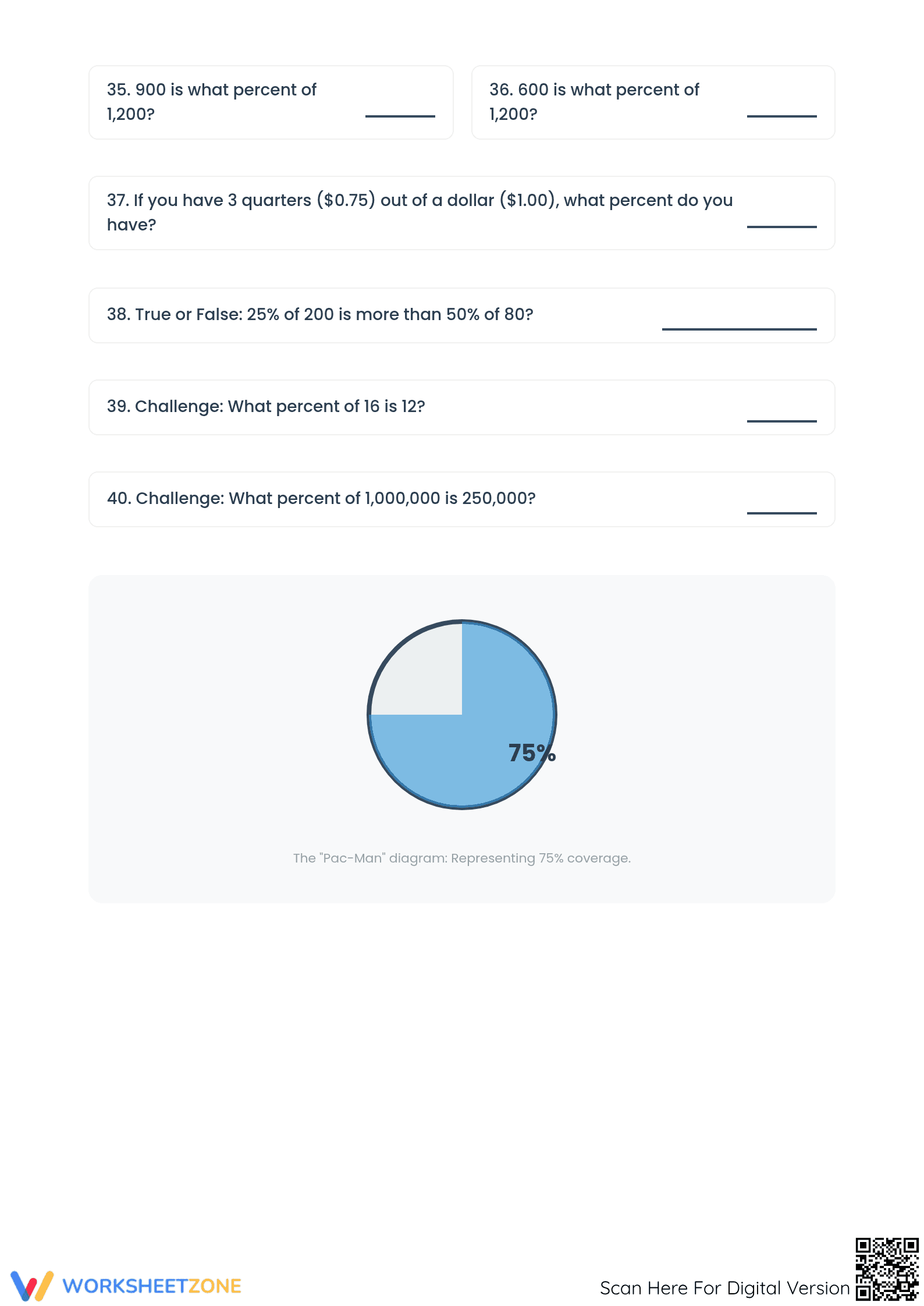
- Independent Practice: The final 12 problems require students to identify percent relationships and compare values, culminating in high-level challenge questions involving larger numbers.
This sequence follows a gradual-release model, moving from scaffolded computation to independent application.
Standards Alignment
The primary focus of this worksheet is CCSS.MATH.CONTENT.6.RP.A.3.c: "Find a percent of a quantity as a rate per 100 (e.g., 30% of a quantity means 30/100 times the quantity); solve problems involving finding the whole, given a part and the percent." This standard code can be copied directly into lesson plans, IEP goals, or district curriculum mapping tools.
How to Use It
Use this worksheet as a practice set during your unit on ratios and proportions. It works well as an assessment after introducing percentages as rates. For a formative assessment tip, observe students during the "Mental Math" section to see if they use fraction equivalents effectively. Expect completion within 30 to 45 minutes.
Who It's For
This resource is ideal for Grade 6 students but serves as an excellent review for Grade 7 and 8 learners who need to reinforce their proportional reasoning. It provides natural differentiation through the inclusion of visual models for struggling students and challenge problems for advanced learners. Pair this worksheet with a percentage bar model anchor chart for maximum instructional impact.
According to the RAND AIRS 2024 analysis of instructional materials, scaffolded practice in proportional reasoning is critical for middle school success. This worksheet directly supports CCSS.MATH.CONTENT.6.RP.A.3.c by requiring students to find the percent one number is of another, a fundamental skill in the Grade 6 curriculum. By integrating mental math with real-world application, the resource aligns with best practices for mathematical fluency. Fisher & Frey (2014) emphasize that the gradual release of responsibility—moving from guided mental warm-ups to independent logic problems—helps solidify student mastery of complex ratios. This 40-problem set provides the necessary volume of practice for students to recognize percentage patterns in everyday data. Educators can utilize the included answer key and visual models to provide immediate feedback, ensuring that learners bridge the gap between abstract calculation and practical application in financial and scientific contexts.


