


























Views
Downloads

Printable 25% Percentage of Decimals Worksheet | Grade 6
Paste this activity's link or code into your existing LMS (Google Classroom, Canvas, Teams, Schoology, Moodle, etc.).
Students can open and work on the activity right away, with no student login required.
You'll still be able to track student progress and results from your teacher account.
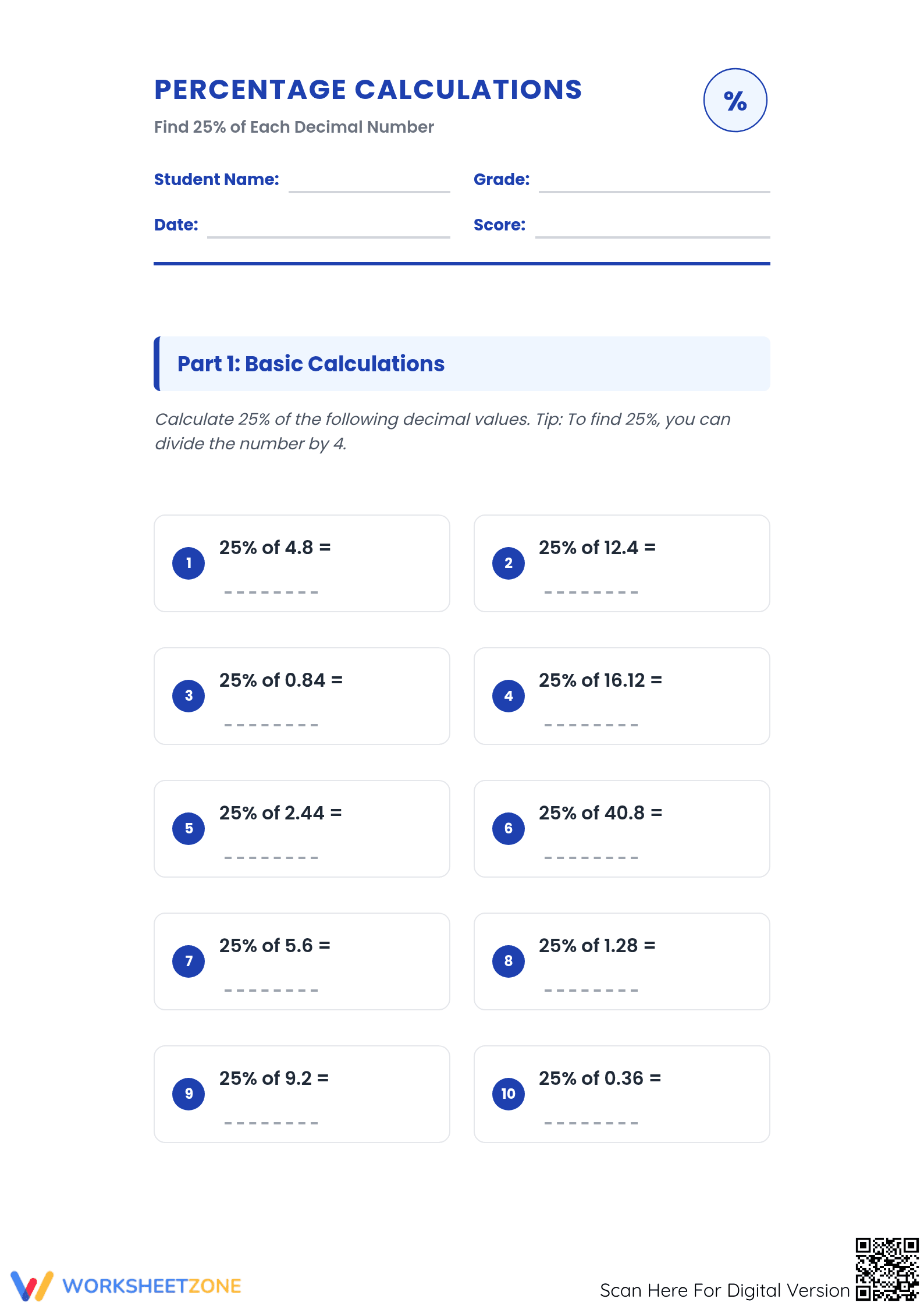
This 4-page worksheet provides essential practice for calculating 25% of various decimal numbers. By focusing on the specific rate of 25%, students develop a strong mental model for dividing values by four to find fractional parts. The exercises help learners transition from basic arithmetic to proportional reasoning in real-world contexts, ensuring they achieve fluency with decimal percentages.
At a Glance
- Grade: 6 · Subject: Math
- Standard:
6.RP.A.3.C— Find a percent of a quantity as a rate per 100- Skill Focus: Calculating 25% of decimal values
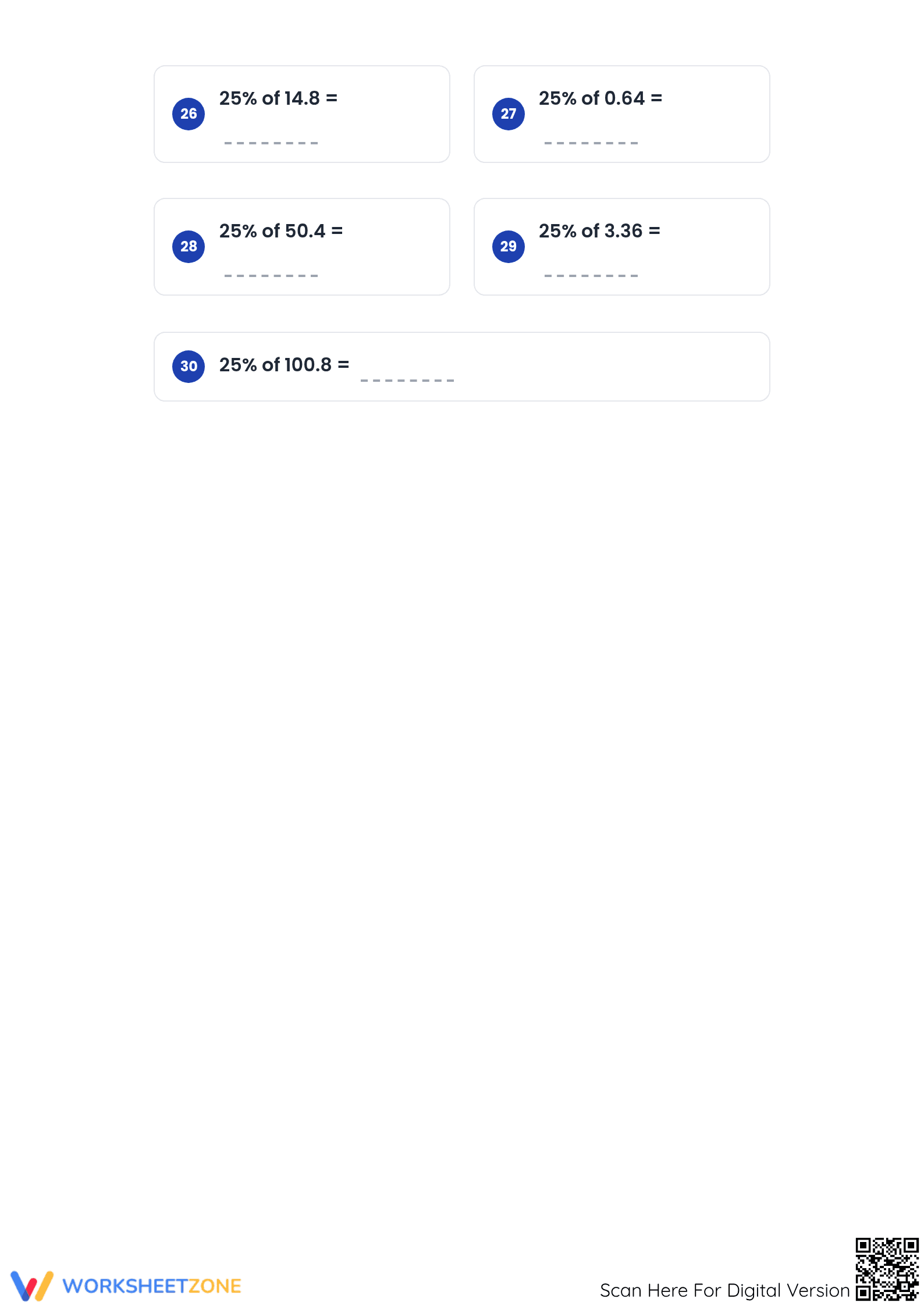
- Format: 4 pages · 30 problems · Answer key included · PDF
- Best For: Independent practice and decimal mastery
- Time: 25–40 minutes
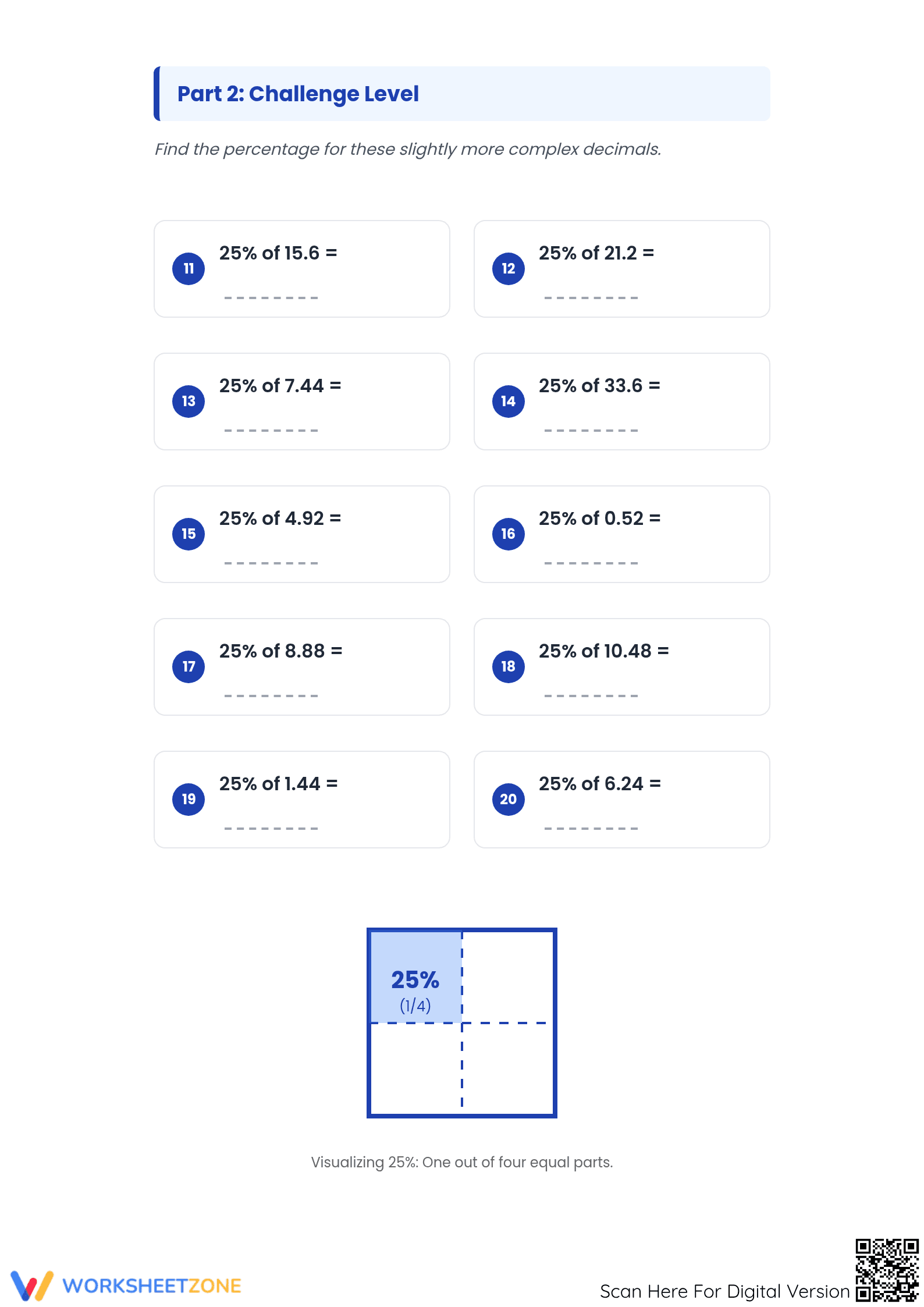
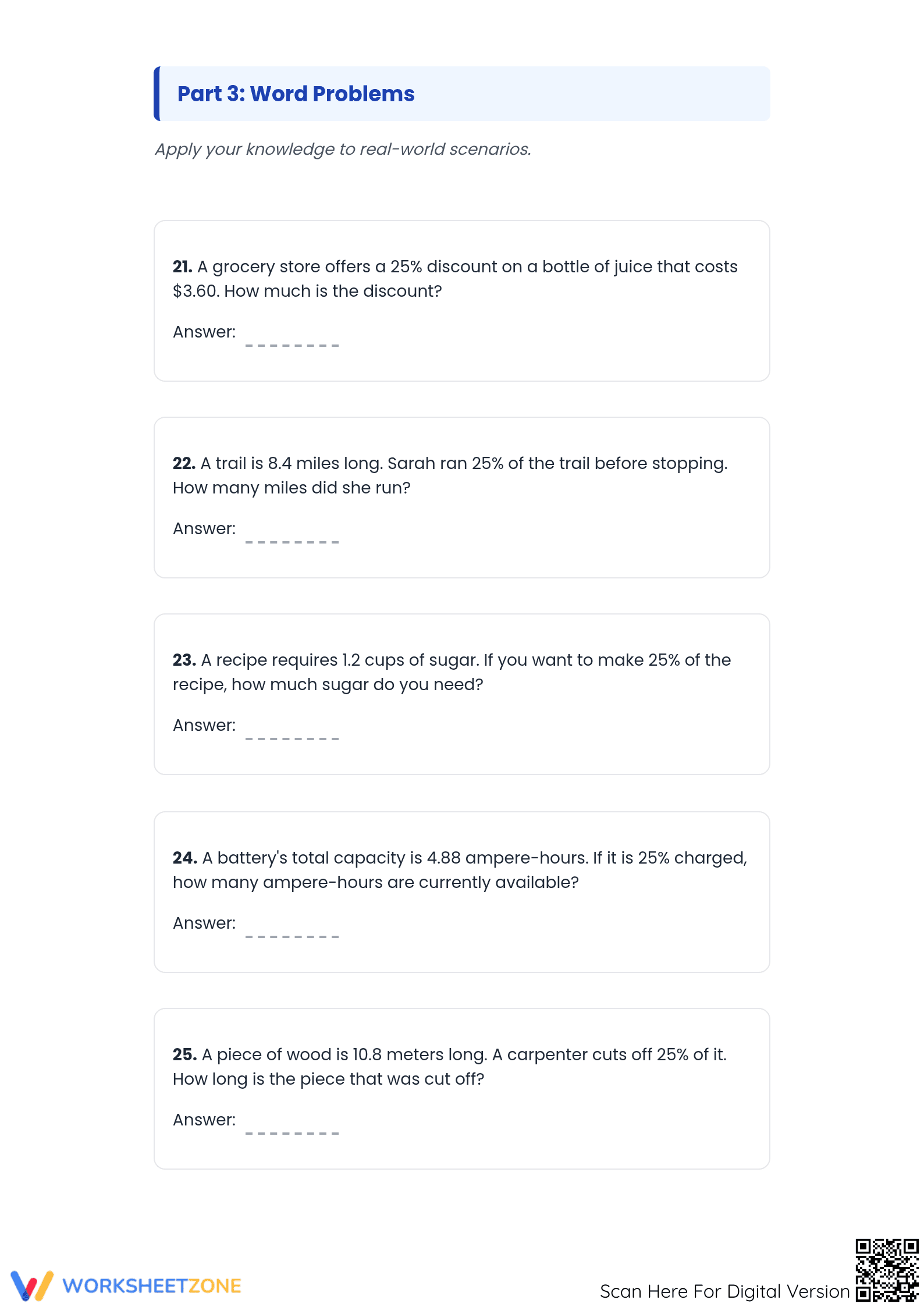
Inside this resource, you will find 30 structured problems distributed across four pages. The worksheet starts with a helpful tip to divide by four, then moves through basic decimal calculations, a "Challenge Level" section with multi-digit decimals, and finishes with five application word problems. A visualizing diagram is included to reinforce the conceptual link between percentages and fractions.
Skill Progression
- Guided Practice: Students begin with 10 basic decimal values like 4.8 and 12.4, applying the "divide by 4" strategy to find initial percentages.
- Supported Practice: Part 2 requires higher-order decimal division with 10 complex values like 7.44 and 33.6, building procedural accuracy.
- Independent Practice: The final sections conclude with word problems that apply percentage concepts to real-world grocery discounts, distances, and battery capacities.
This structure follows a gradual-release model of instruction, moving from simple mental math to complex quantitative applications.
Standards Alignment
This resource is strictly aligned to the Common Core State Standard CCSS.MATH.CONTENT.6.RP.A.3.C, which requires students to find a percent of a quantity as a rate per 100. It specifically targets the sub-skill of using percentages to solve problems involving decimal numbers. Both standard codes can be copied directly into lesson plans, IEP goals, or district curriculum mapping tools.
How to Use It
Use this worksheet during the independent practice phase of a lesson on proportional relationships. Provide this packet to students for 25 to 40 minutes of quiet work after demonstrating the 25% fraction equivalent. Teachers should observe students during Part 2 to ensure they are correctly placing the decimal point in their quotients, which serves as a vital formative assessment tip.
Who It's For
This tool is designed for 6th-grade students but is also highly effective for 5th-grade enrichment or 7-8th-grade remediation. It naturally pairs with a direct instruction lesson on decimal division or a visual anchor chart showing common percentage-fraction equivalencies. The varied difficulty levels allow teachers to assign specific sections based on individual student needs and current skill proficiency.
According to the instructional frameworks established by Fisher & Frey (2014), the gradual release of responsibility is paramount when students are mastering abstract mathematical concepts like the 6.RP.A.3.C standard. This worksheet implements that framework by providing 30 targeted tasks that move from basic decimal division to complex word problem applications. The focus on calculating 25% allows students to build procedural fluency while reinforcing the conceptual understanding that a percentage is a rate per 100. Research from the NAEP indicates that students who can fluidly navigate between fractions, decimals, and percentages demonstrate significantly higher success rates in algebra. By isolating the 25% rate, this resource reduces cognitive load, allowing students to focus on the mechanics of decimal manipulation. This standards-aligned practice is an essential component of a classroom curriculum designed to move students toward independent mastery of proportional reasoning and quantitative analysis in diverse academic and real-world scenarios.


