


























Views
Downloads
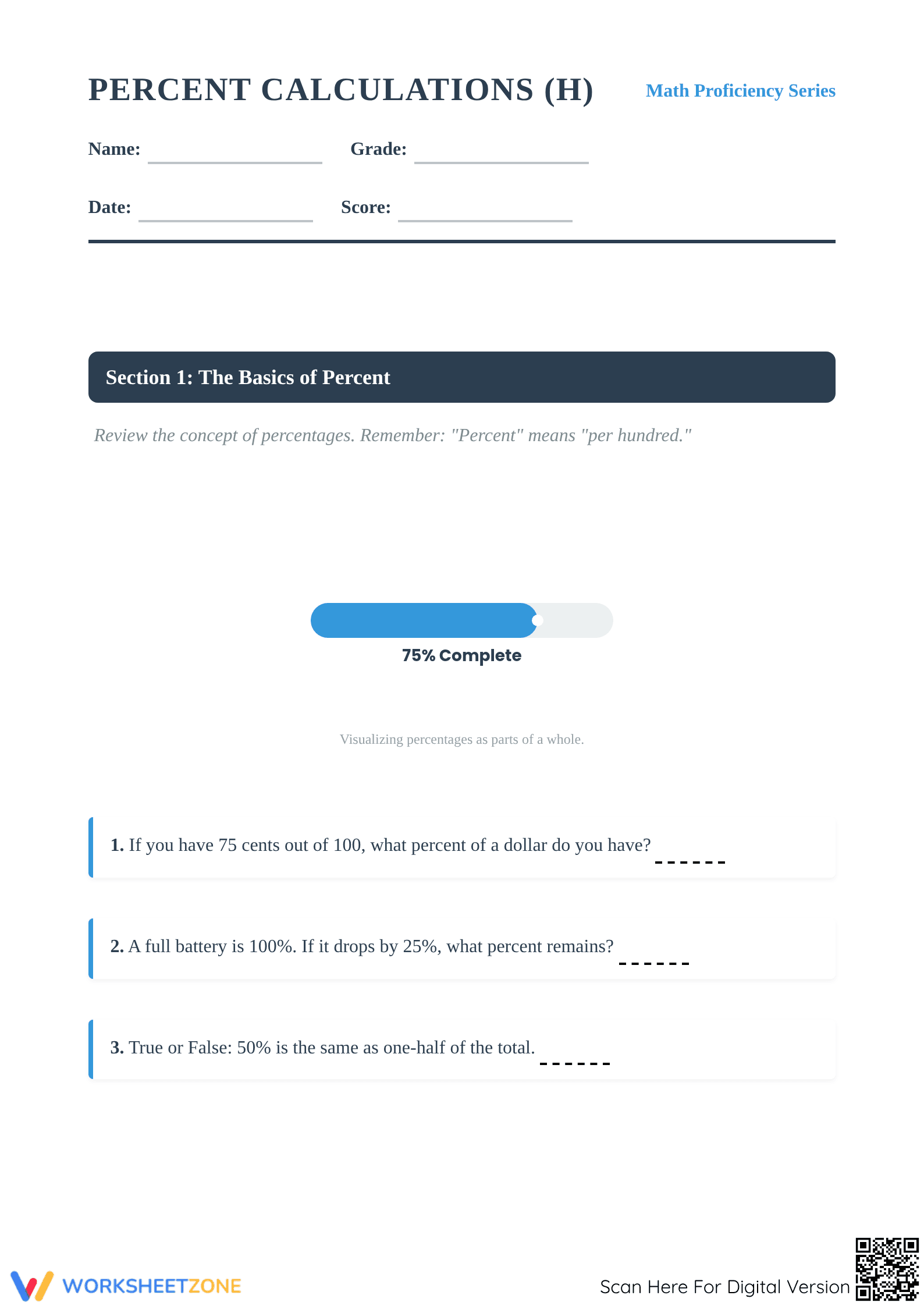
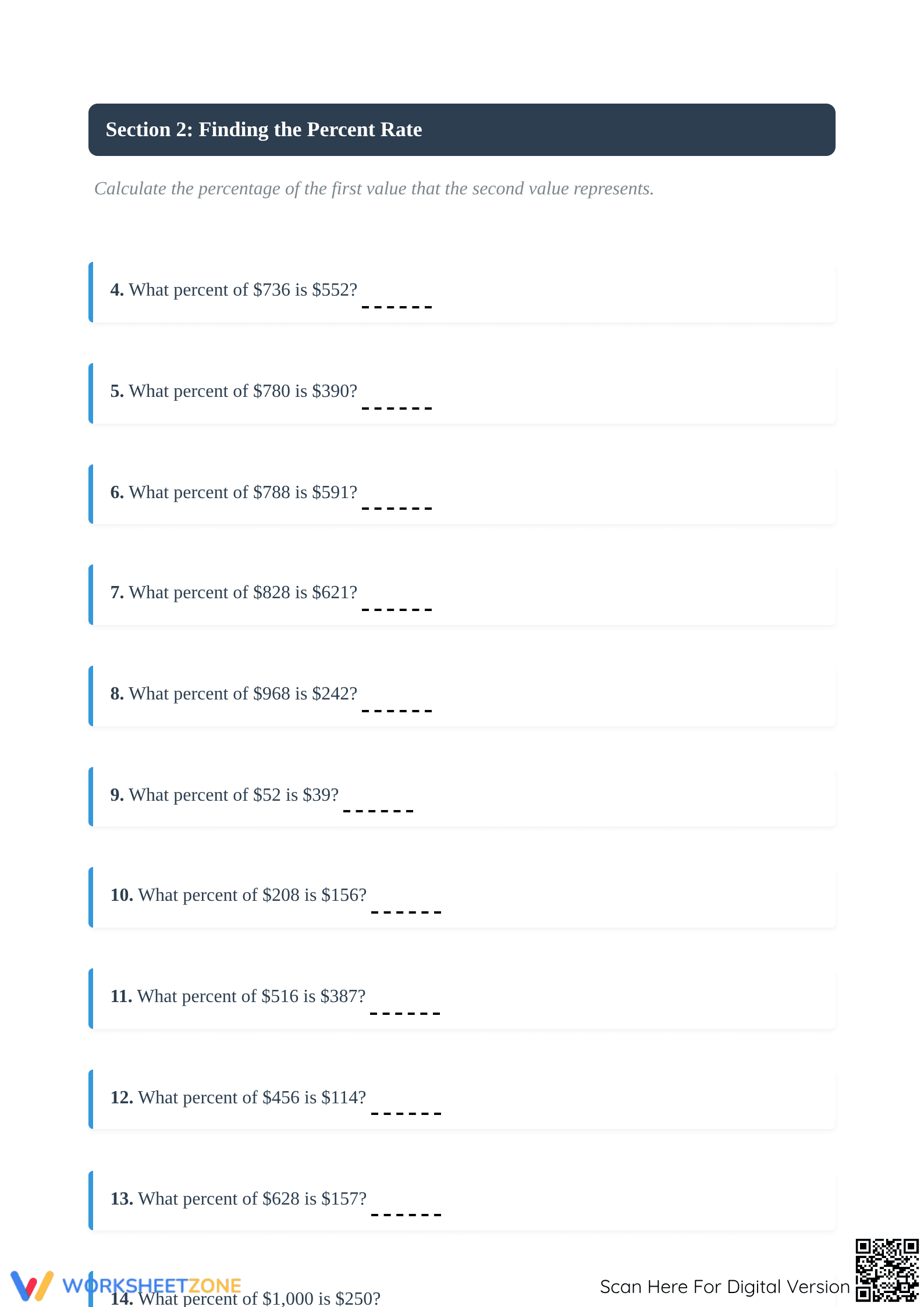
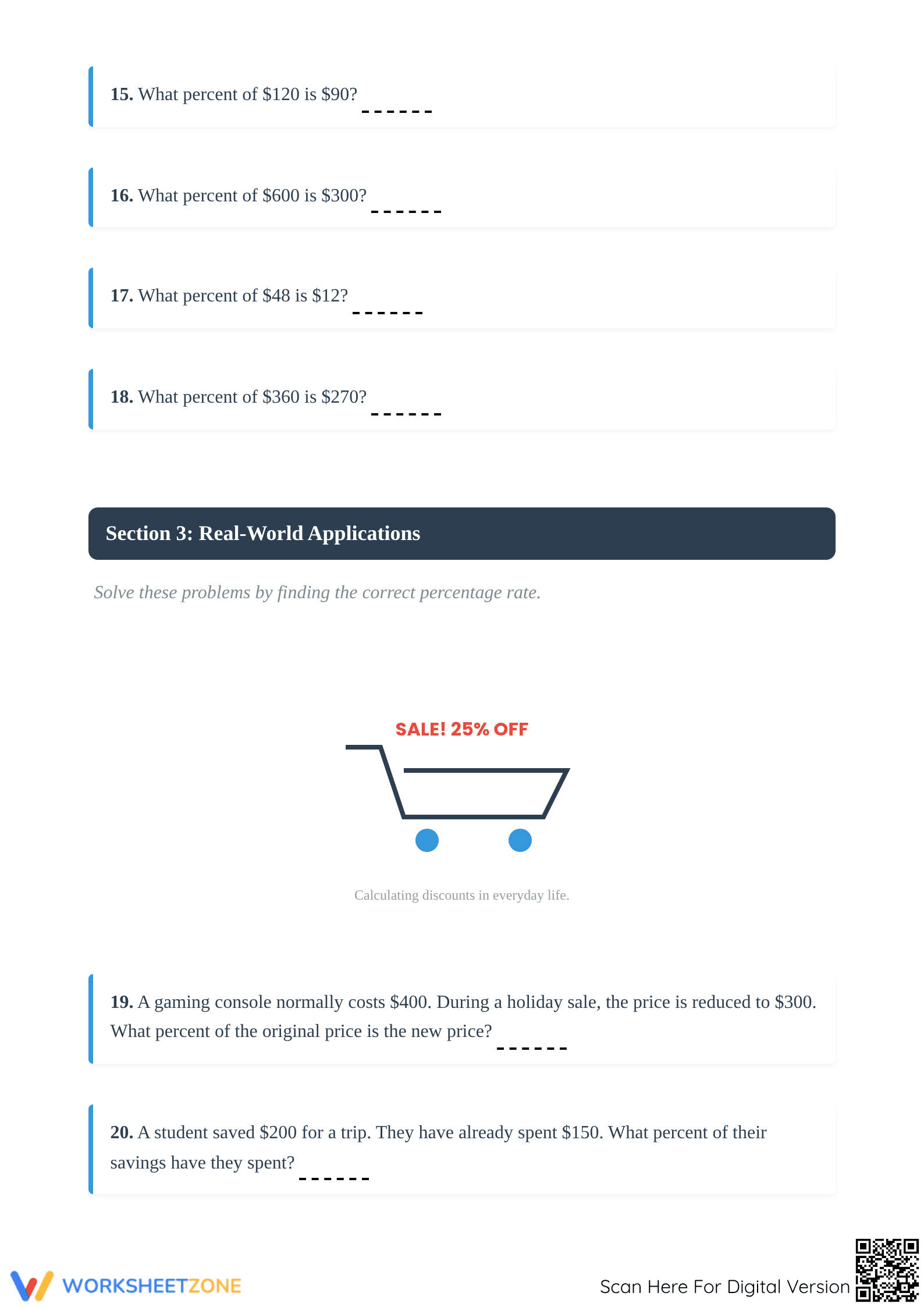
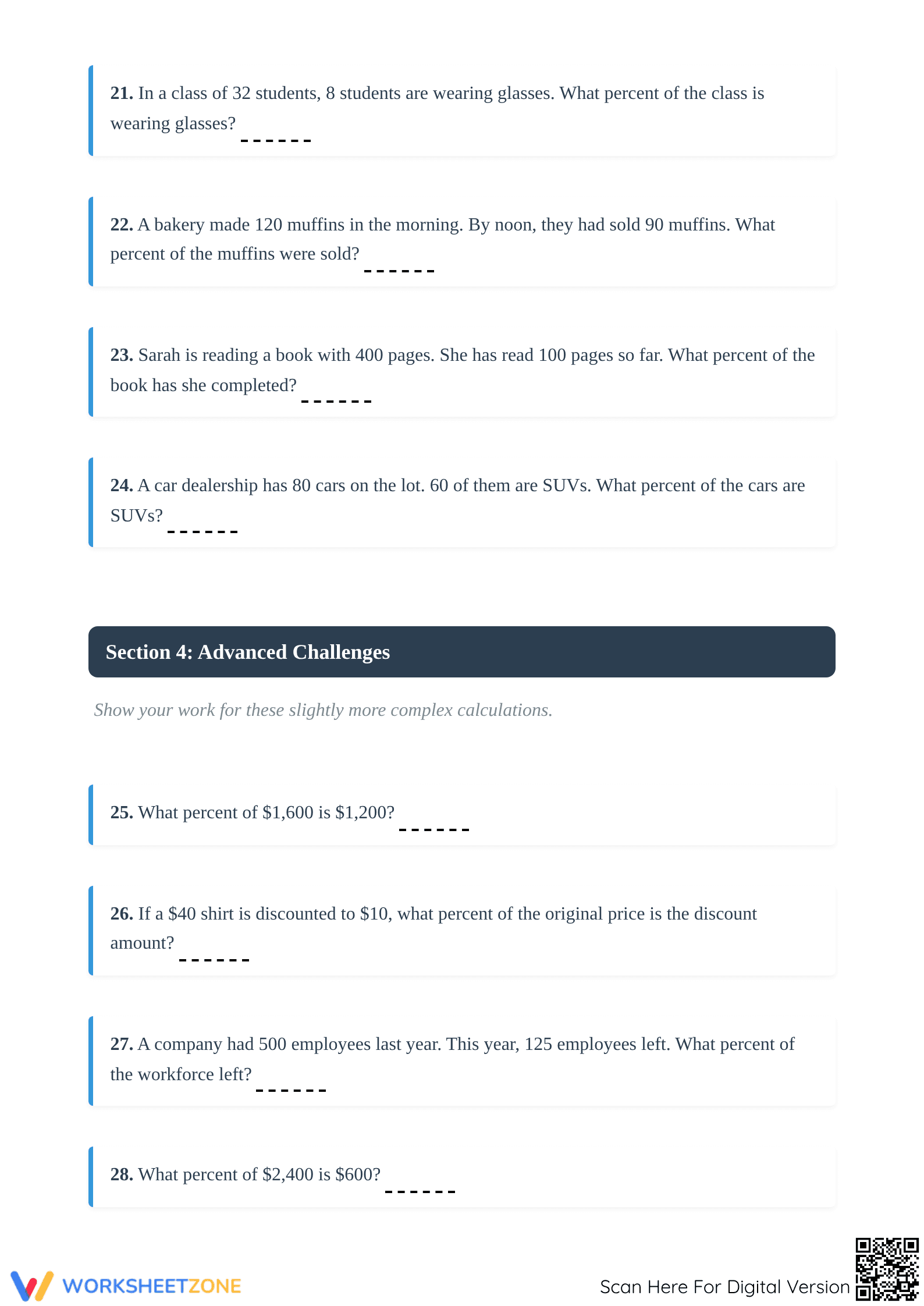

Essential Percent Rate Calculation Worksheet | Grades 4-8
Paste this activity's link or code into your existing LMS (Google Classroom, Canvas, Teams, Schoology, Moodle, etc.).
Students can open and work on the activity right away, with no student login required.
You'll still be able to track student progress and results from your teacher account.
Calculating percent rates is a foundational middle school math skill that bridges the gap between basic arithmetic and real-world financial literacy. This comprehensive 30-problem worksheet guides students through the mechanics of determining what percentage one number is of another, starting with visual conceptualization and ending with complex multi-step word problems involving currency.
At a Glance
- Grade: 6 · Subject: Math
- Standard:
6.RP.A.3.c— Find a percent of a quantity as a rate per 100- Skill Focus: Calculating percent rates and real-world applications
- Format: 5 pages · 30 problems · Answer key included · PDF
- Best For: Small group instruction and independent practice
- Time: 40–50 minutes
This packet includes five high-quality pages featuring four distinct sections: The Basics of Percent, Finding the Percent Rate, Real-World Applications, and Advanced Challenges. Students will encounter 30 tasks total, ranging from simple true/false conceptual checks to complex currency-based word problems. A full answer key is included for immediate feedback and efficient grading.
- Guided practice: Problems 1-3 use visual cues and simple dollar-to-cent conversions to anchor the "per hundred" concept with supported scaffolds.
- Supported practice: Problems 4-18 provide 15 direct calculation tasks involving whole numbers and currency values to build computational fluency and formula mastery.
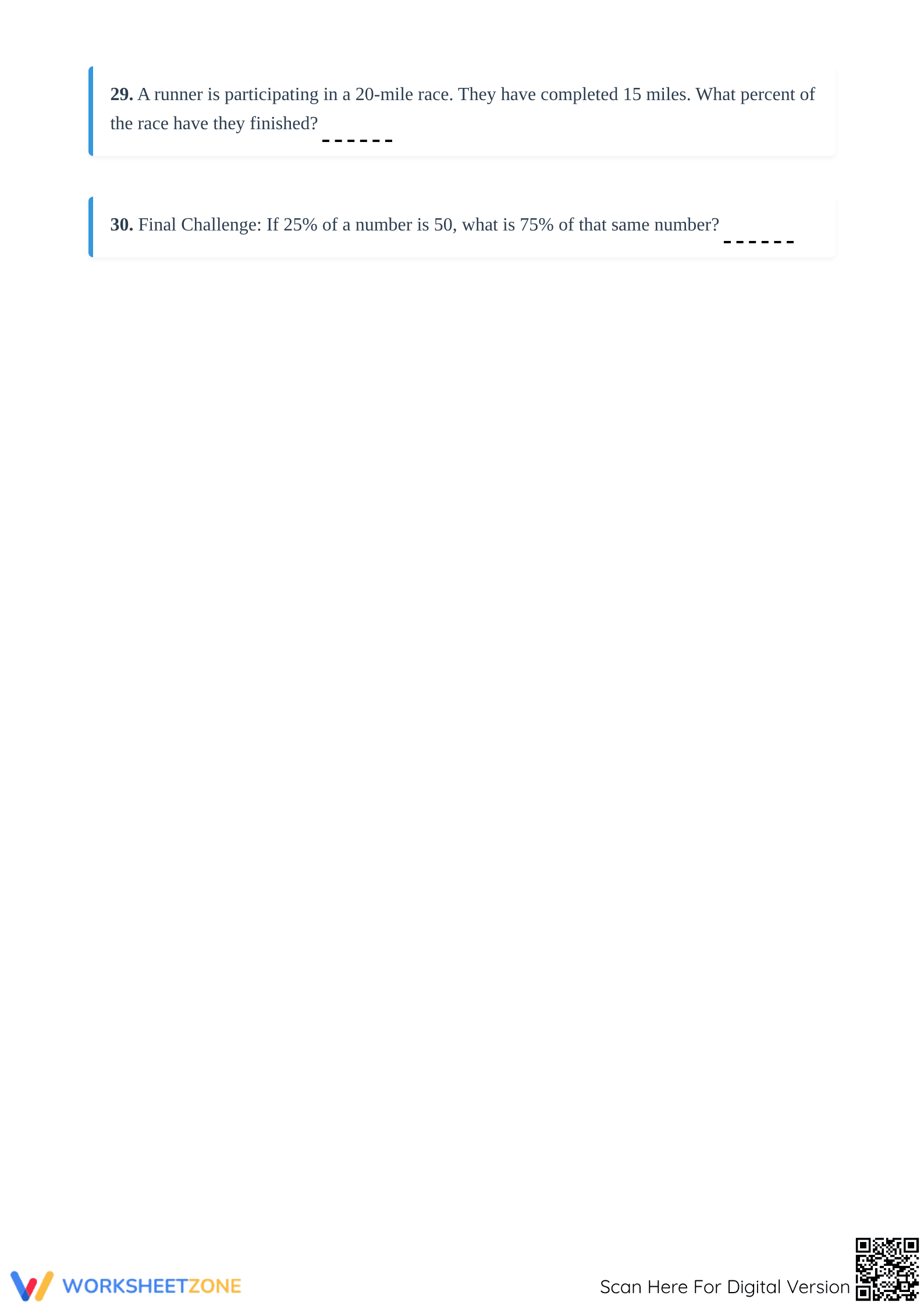
- Independent practice: Problems 19-30 challenge students to extract data from word problems and solve for the unknown percentage in shopping and travel scenarios.
This gradual release approach ensures that students master the "I Do, We Do, You Do" workflow before tackling the final challenge set.
The primary focus of this worksheet is 6.RP.A.3.c: "Find a percent of a quantity as a rate per 100; solve problems involving finding the whole, given a part and the percent." Students demonstrate mastery by calculating the percent one number is of another in abstract and concrete contexts. This standard code can be copied directly into lesson plans, IEP goals, or district curriculum mapping tools.
Incorporate this worksheet during the "You Do" phase of a lesson on ratios and proportions. After modeling the part-over-whole formula, assign the first two sections for independent work. Use the Section 3 word problems as a formative assessment to observe how well students translate text into mathematical equations. Completion usually takes 45 minutes for Grade 6 students.
This resource is designed for Grade 6 math classrooms, though it serves as excellent enrichment for Grade 5 or remediation for Grades 7 and 8. It pairs naturally with a base-ten block manipulative session or a direct instruction lesson on decimal-to-percent conversion. The scaffolded sections allow teachers to assign specific segments based on individual student readiness.
Effective mathematics instruction requires a balance of procedural fluency and conceptual understanding. Research from RAND AIRS 2024 indicates that scaffolded practice sets, which transition from direct computation to word problems, significantly improve long-term retention of percentage concepts among middle school learners. This worksheet targets the 6.RP.A.3.c standard by providing 30 high-repetition tasks that require students to find a percent of a quantity as a rate per 100. By integrating currency and real-world scenarios, the material aligns with Fisher & Frey's (2014) gradual release of responsibility model, moving students from basic visualization to complex independent problem-solving. This approach ensures that learners do not just memorize formulas but understand the underlying ratio relationship between numbers. Such structured practice is essential for building the mathematical foundations required for high school algebra and financial literacy skills in everyday life.


