


























Views
Downloads



Calculate Percent Rates Worksheet | Essential Grade 6 Math
Paste this activity's link or code into your existing LMS (Google Classroom, Canvas, Teams, Schoology, Moodle, etc.).
Students can open and work on the activity right away, with no student login required.
You'll still be able to track student progress and results from your teacher account.
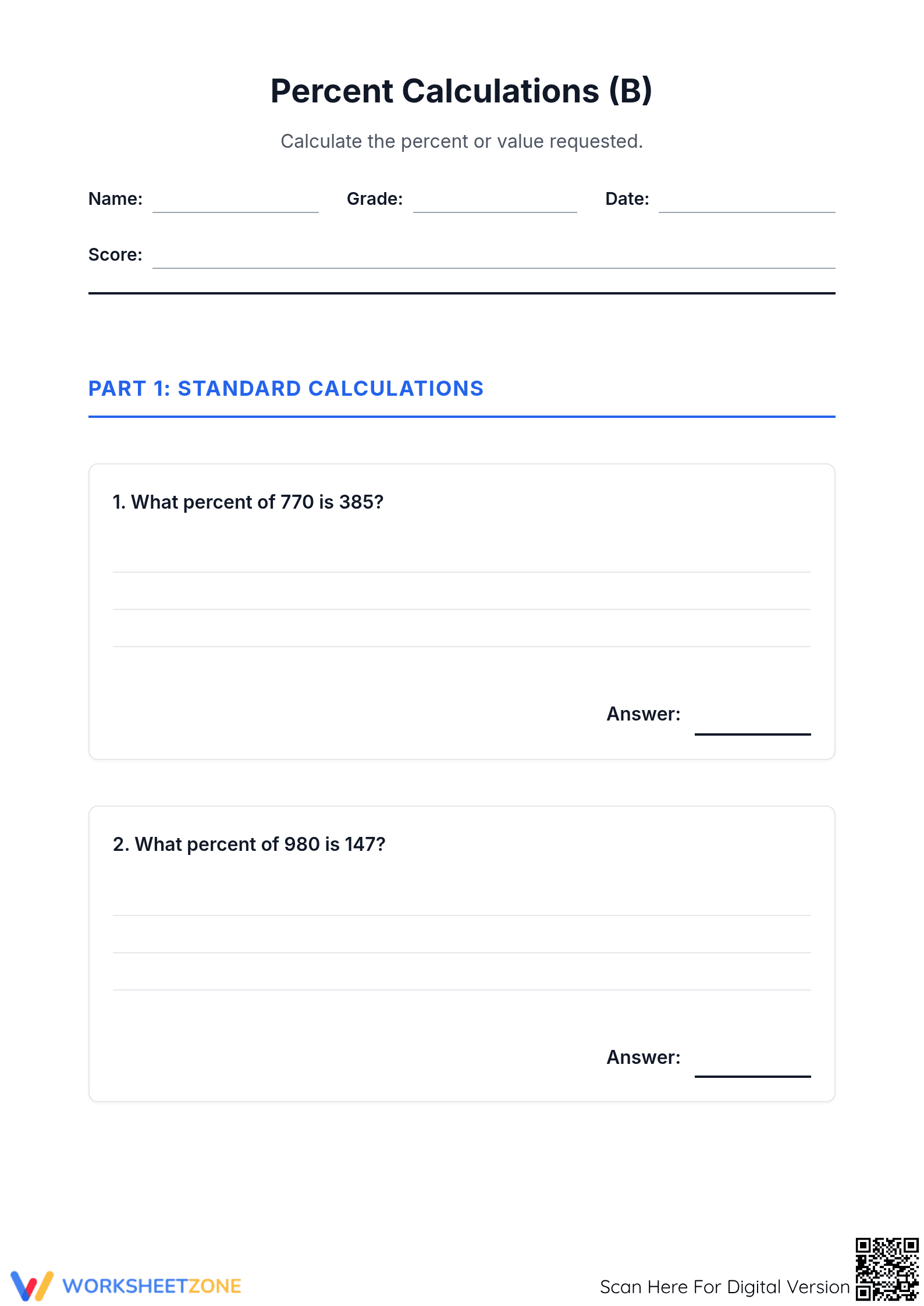
This essential math resource helps students master the core competency of finding the percentage of one whole number relative to another. Through structured computation, learners develop the proportional reasoning required to solve complex rate problems and prepare for algebraic expressions in higher mathematics.
At a Glance
- Grade: 6–7 · Subject: Math
- Standard:
CCSS.MATH.CONTENT.6.RP.A.3.C— Find a percent of a quantity as a rate per 100- Skill Focus: Calculating percent rates from parts and wholes
- Format: 5 pages · 14 problems · Answer key included · PDF
- Best For: Independent practice or homework
- Time: 20–35 minutes
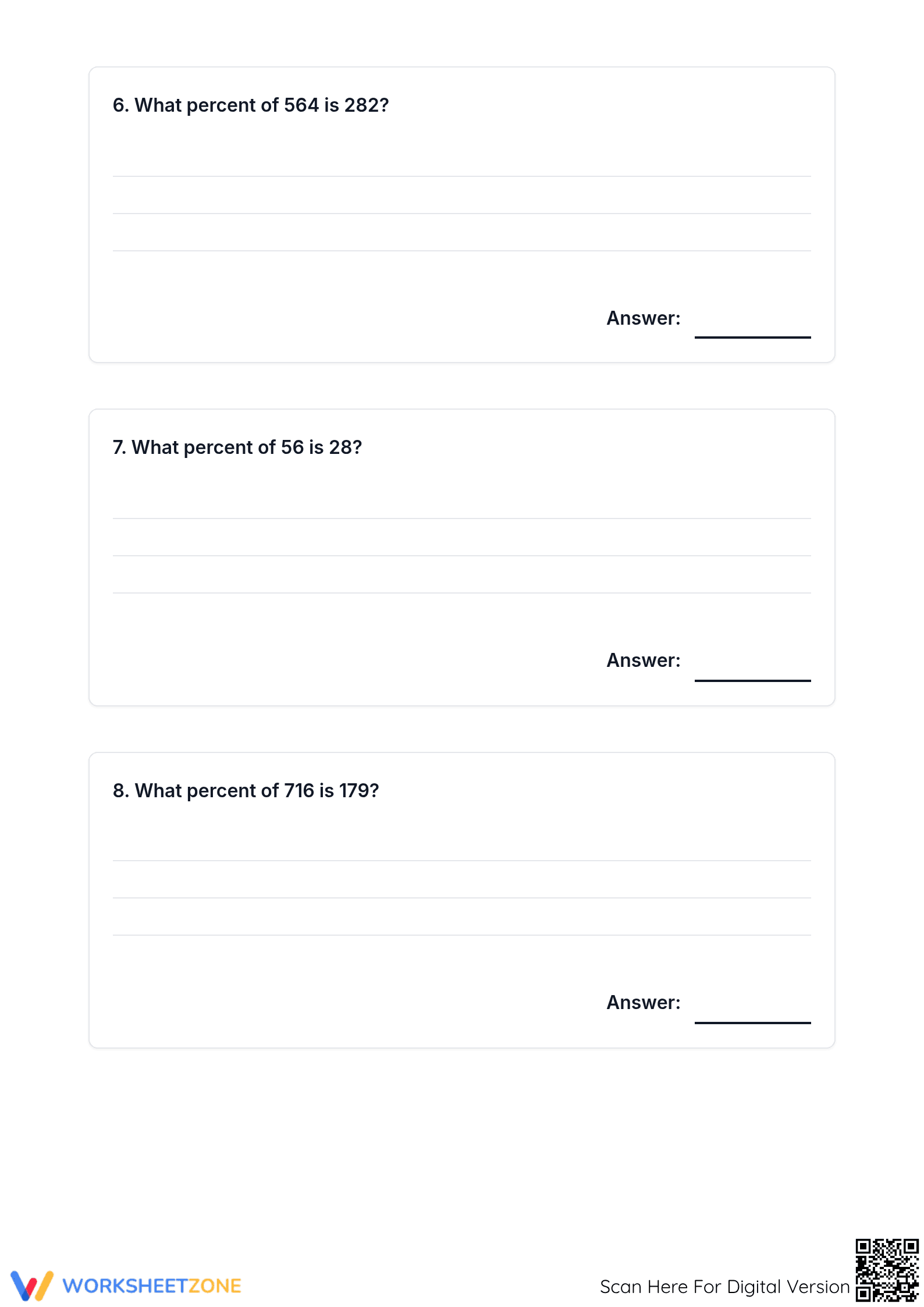
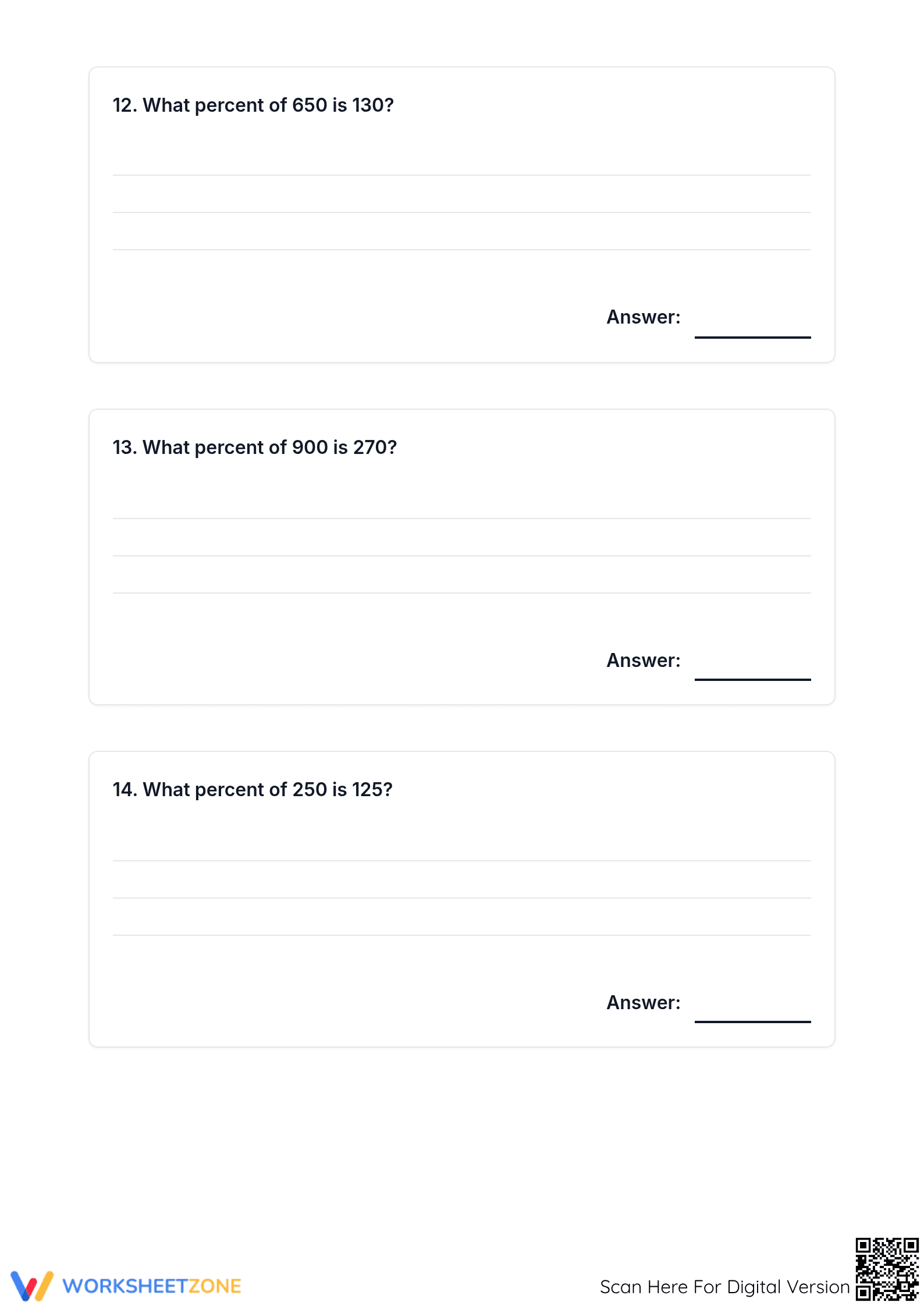
What's inside: This packet contains 14 focused computational tasks distributed across five clearly formatted pages. Section 1 features 10 standard calculations using a variety of whole numbers to build fluency. Section 2 provides 4 Challenge Calculations designed to test mastery with larger values and less intuitive ratios. A complete answer key is included for immediate feedback.
Skill Progression and Scaffolding
- Guided Practice: The first set of problems uses recognizable ratios, such as half-values (50%), to help students verify their mental math against their written work.
- Supported Practice: Mid-packet tasks introduce ratios that result in non-rounded percentages, requiring students to apply consistent division and multiplication steps.
- Independent Practice: The concluding challenge section removes scaffolds, asking students to determine percentages for large three-digit numbers with high precision.
This structure follows a gradual release model, ensuring students are confident in the basic mechanics before tackling more demanding arithmetic.
Standards Alignment
This worksheet is strictly aligned to CCSS.MATH.CONTENT.6.RP.A.3.C: "Find a percent of a quantity as a rate per 100 (e.g., 30% of a quantity means 30/100 times the quantity); solve problems involving finding the whole, given a part and the percent." This standard code can be copied directly into lesson plans, IEP goals, or district curriculum mapping tools to ensure instructional compliance.
How to Use It
Assign this worksheet as a formative assessment after introducing the part/whole equals percent/100 formula. Teachers should observe whether students are setting up the proportion correctly or attempting direct division. This resource is ideal for math centers or as a targeted intervention for students struggling with proportional thinking. The expected completion time for the full 14-problem set is approximately 30 minutes.
Who It's For
This resource is designed for middle school students in Grades 6 through 8 who require additional fluency practice with percent rates. It is particularly effective for learners who benefit from isolated skill practice before applying these concepts to word problems. It pairs naturally with a percent-bar anchor chart or a direct instruction lesson on ratios.
Fisher & Frey (2014) emphasizes the importance of repeated, focused practice in developing fluency with proportional relationships. This worksheet provides the requisite repetition for students to internalize the relationship between parts and wholes before moving to abstract algebraic tasks. According to RAND AIRS 2024 data, students who master foundational percent calculations in the middle grades show significantly higher proficiency in high school financial literacy and statistics modules. By isolating the calculation mechanic, this resource ensures that cognitive load is focused entirely on the percentage conversion process. Standard CCSS.MATH.CONTENT.6.RP.A.3.C serves as a critical gateway for Grade 7 Ratios and Proportions, making this worksheet a vital tool for preventing learning gaps in the secondary math sequence.


