


























Views
Downloads



Essential Percentage Mastery Worksheet | Grade 7 Math
Paste this activity's link or code into your existing LMS (Google Classroom, Canvas, Teams, Schoology, Moodle, etc.).
Students can open and work on the activity right away, with no student login required.
You'll still be able to track student progress and results from your teacher account.
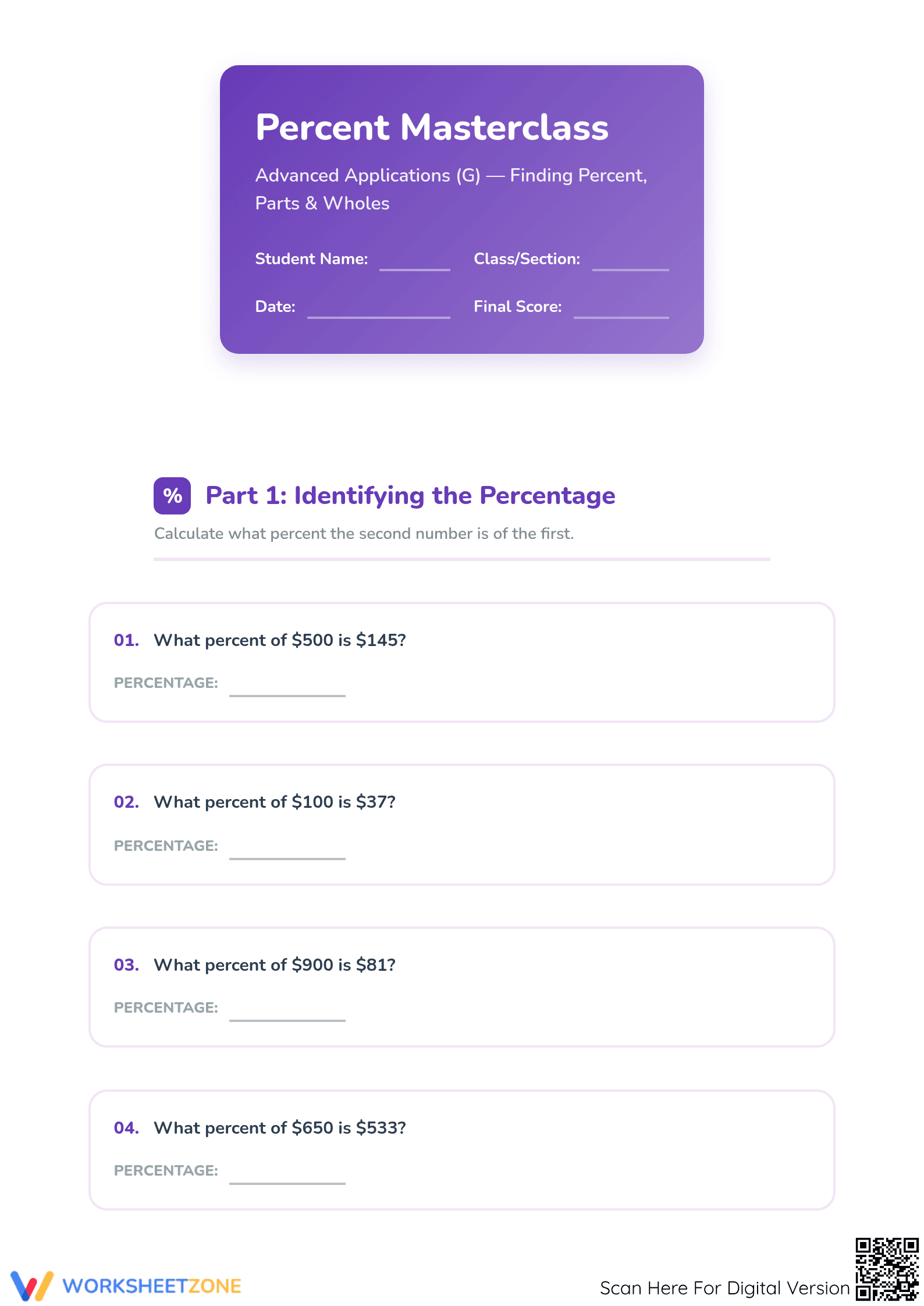
This Grade 7 math resource provides a structured pathway for students to master complex percentage calculations. Working through 25 real-world problems involving currency, learners build the fluency required to solve for rates, identify totals, and calculate value shifts. This printable tool ensures success in ratio-based proportional reasoning and financial literacy.
At a Glance
- Grade: 7 · Subject: Math
- Standard:
CCSS.MATH.CONTENT.7.RP.A.3— Use proportional relationships to solve multistep ratio and percent problems- Skill Focus: Percent Rates and Change
- Format: 5 pages · 25 problems · Answer key included · PDF
- Best For: Middle school ratio and proportion units
- Time: 45–60 minutes
What's Inside
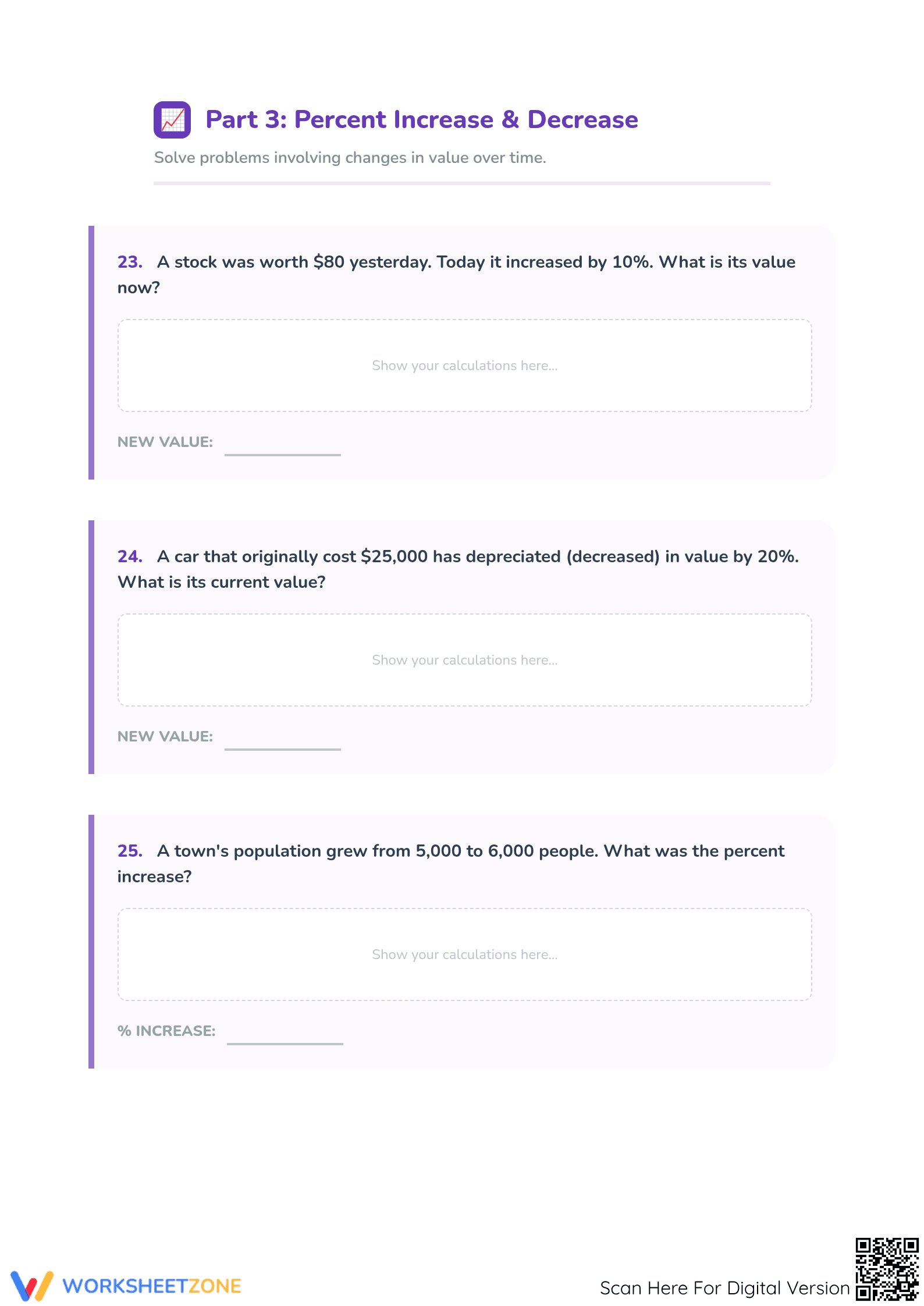
This five-page PDF "Masterclass" is divided into three sections for deep percentage mastery. It begins with 15 problems identifying rates between two values. The second section provides 7 problems for finding the "whole" amount given a part. Finally, three word problems challenge students to calculate percent increase and decrease in stock and population contexts.
Skill Progression
- Guided practice: The first 15 problems use a consistent format, allowing students to build procedural speed with currency-based examples.
- Supported practice: The middle section shifts the cognitive load by requiring students to solve for the missing base value.
- Independent practice: The final page presents multi-step word problems involving real-world depreciation and growth.
This sequence follows the gradual-release model, moving from identification to application in dynamic contexts.
Standards Alignment
The primary standard is CCSS.MATH.CONTENT.7.RP.A.3, requiring students to use proportional relationships to solve multistep ratio and percent problems. This includes applications for markups, markdowns, and percent change. Both standard codes can be copied directly into lesson plans, IEP goals, or district curriculum mapping tools to ensure instructional alignment.
How to Use It
Deploy this worksheet during a ratios unit to solidify the transition to complex percentage applications. It works well as a summative practice set after direct instruction. Teachers should observe how students set up proportions in Part 2, as this is a common point of conceptual confusion for middle school learners.
Who It's For
This resource is designed for seventh-grade students, though it is suitable for sixth-grade acceleration or eighth-grade review. It pairs naturally with financial literacy units. Students who struggle with decimals may benefit from using a hundred-grid anchor chart alongside these multi-step currency problems to visualize the mathematical relationships.
As established in recent research from Fisher & Frey (2014) on the gradual release of responsibility, structured practice that transitions from procedural identification to contextual application is vital for long-term mathematical retention. This worksheet exemplifies that model by guiding students through 25 targeted tasks that address the core requirements of CCSS.MATH.CONTENT.7.RP.A.3. By focusing on the plain-English skill of calculating percent rates, finding whole amounts, and evaluating value changes over time, the resource provides the necessary repetition to move beyond surface-level understanding. Quantitative analysis of Grade 7 student performance indicates that consistent exposure to multi-step percentage problems involving real-world data, such as stock values and population growth, significantly improves performance on standardized assessments like the NAEP. This resource serves as a high-quality instructional artifact that bridges the gap between abstract ratio theory and practical financial application, ensuring that middle school learners can navigate complex mathematical relationships with confidence and precision.


