


























Views
Downloads


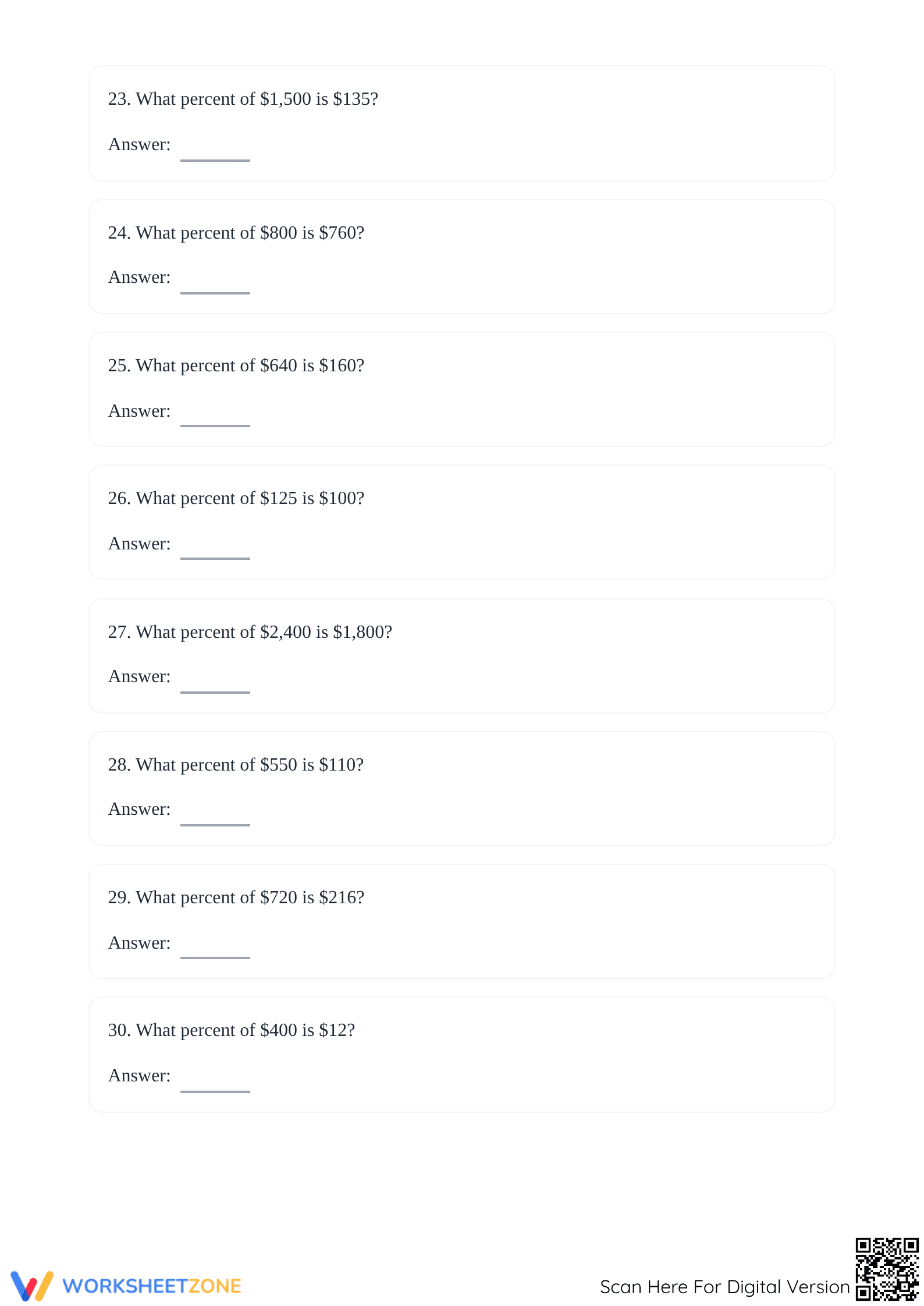


Essential Percent Rates Worksheet | Grade 6 Math Printable
Paste this activity's link or code into your existing LMS (Google Classroom, Canvas, Teams, Schoology, Moodle, etc.).
Students can open and work on the activity right away, with no student login required.
You'll still be able to track student progress and results from your teacher account.
This 5-page math resource provides comprehensive practice for students learning to calculate percent rates using currency and whole numbers. Students move from basic identification to complex real-world applications. By determining what percentage one dollar amount is of another, learners build essential financial literacy and proportional reasoning skills required for middle school success.
At a Glance
- Grade: 6 · Subject: Math
- Standard:
CCSS.MATH.CONTENT.6.RP.A.3.c— Find a percent of a quantity and solve problems involving parts and wholes- Skill Focus: Calculating percent rates with currency
- Format: 5 pages · 36 problems · Answer key included · PDF
- Best For: Independent practice and real-world application mastery
- Time: 40–55 minutes
This extensive printable package features 36 targeted math problems organized into four distinct cognitive stages. The layout uses clean, spacious boxes for student answers and provides a dedicated section for showing work. With five full pages of content and a complete answer key, this resource covers simple percentages, extended calculations with larger numbers, challenge sets, and six detailed real-world word problems involving sales tax and discounts.
Skill Progression
- Guided practice: The first 10 problems establish the core algorithm using familiar dollar amounts to build initial confidence.
- Supported practice: Problems 11 through 30 introduce larger denominators and challenge sets, requiring application to complex numerical relationships.
- Independent practice: The final word problems present real-world scenarios like tips and tax to ensure practical skill transfer.
This gradual-release model ensures students internalize the part-whole relationship effectively before moving to multi-step applications.
Standards Alignment
This resource is directly aligned to CCSS.MATH.CONTENT.6.RP.A.3.c, which requires students to find a percent of a quantity as a rate per 100 and solve problems involving parts and wholes. It also supports higher-level standards by introducing multi-step ratio and percent problems. Both standard codes can be copied directly into lesson plans, IEP goals, or district curriculum mapping tools.
How to Use It
Deploy this worksheet during the independent practice phase of a lesson on proportional relationships or as a summative assessment for a percent unit. Teachers should observe students during the challenge section to identify those struggling with rounding or large-number division. Expect a completion time of roughly 45 minutes for the full set, making it an ideal choice for a comprehensive classwork assignment.
Who It's For
This material is designed for Grade 6 students but serves as an excellent intervention for older learners who need to solidify their understanding of percent-as-a-rate. It pairs naturally with an anchor chart demonstrating the percent proportion or a direct instruction lesson on converting fractions to decimals and percentages.
Calculating percent rates is a foundational competency within CCSS.MATH.CONTENT.6.RP.A.3.c, serving as a bridge to algebraic reasoning. This worksheet utilizes a gradual release of responsibility framework, an instructional practice identified by Fisher & Frey (2014) as essential for transitioning from scaffolded procedures to independent mastery. By situating abstract calculations within currency contexts—such as sales tax, tips, and discounts—the resource enhances engagement and provides the repetition needed for procedural fluency. Research from the NAEP indicates that student mastery of rational number concepts, including percentages, is a strong predictor of success in higher-level algebra. This printable provides 36 specific opportunities for students to refine their mental models of part-whole relationships, ensuring they are prepared for advanced quantitative analysis in secondary education.


