


























Views
Downloads



Essential Percent Rate Calculation Worksheet | Grades 6-8
Paste this activity's link or code into your existing LMS (Google Classroom, Canvas, Teams, Schoology, Moodle, etc.).
Students can open and work on the activity right away, with no student login required.
You'll still be able to track student progress and results from your teacher account.
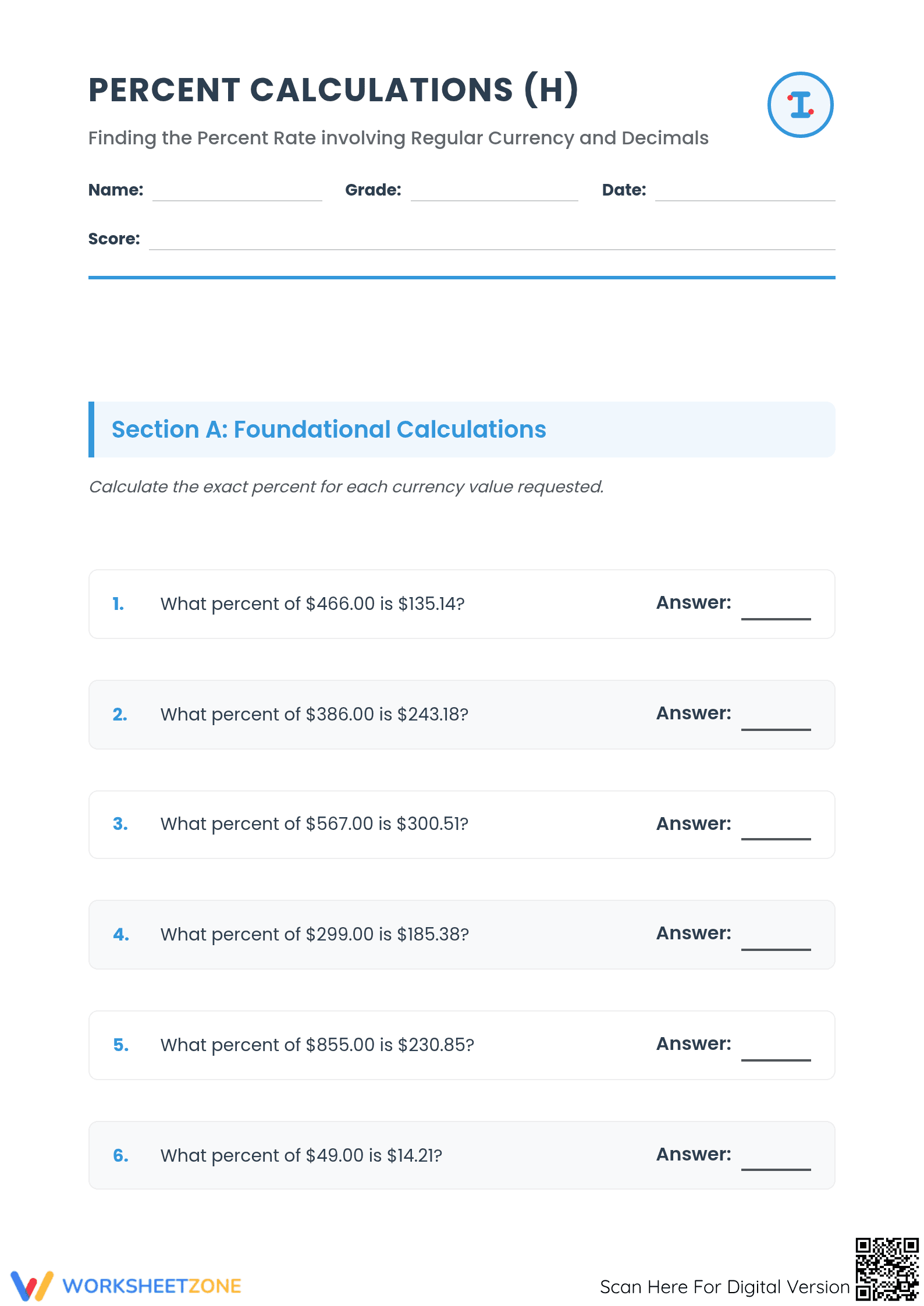
This Grade 6-8 math worksheet empowers students to master calculating percent rates using real-world currency values and decimals. By finding what percentage one number represents of another, learners build financial literacy and proportional reasoning. This resource provides a structured path toward mastery, ensuring students gain confidence in mathematical accuracy.
At a Glance
- Grade: 6-8 · Subject: Math
- Standard:
CCSS.MATH.CONTENT.6.RP.A.3.c— Find a percent of a quantity as a rate per 100- Skill Focus: Calculating Percent Rates with Currency
- Format: 4 pages · 30 problems · Answer key included · PDF
- Best For: Independent practice and financial math units
- Time: 45–60 minutes
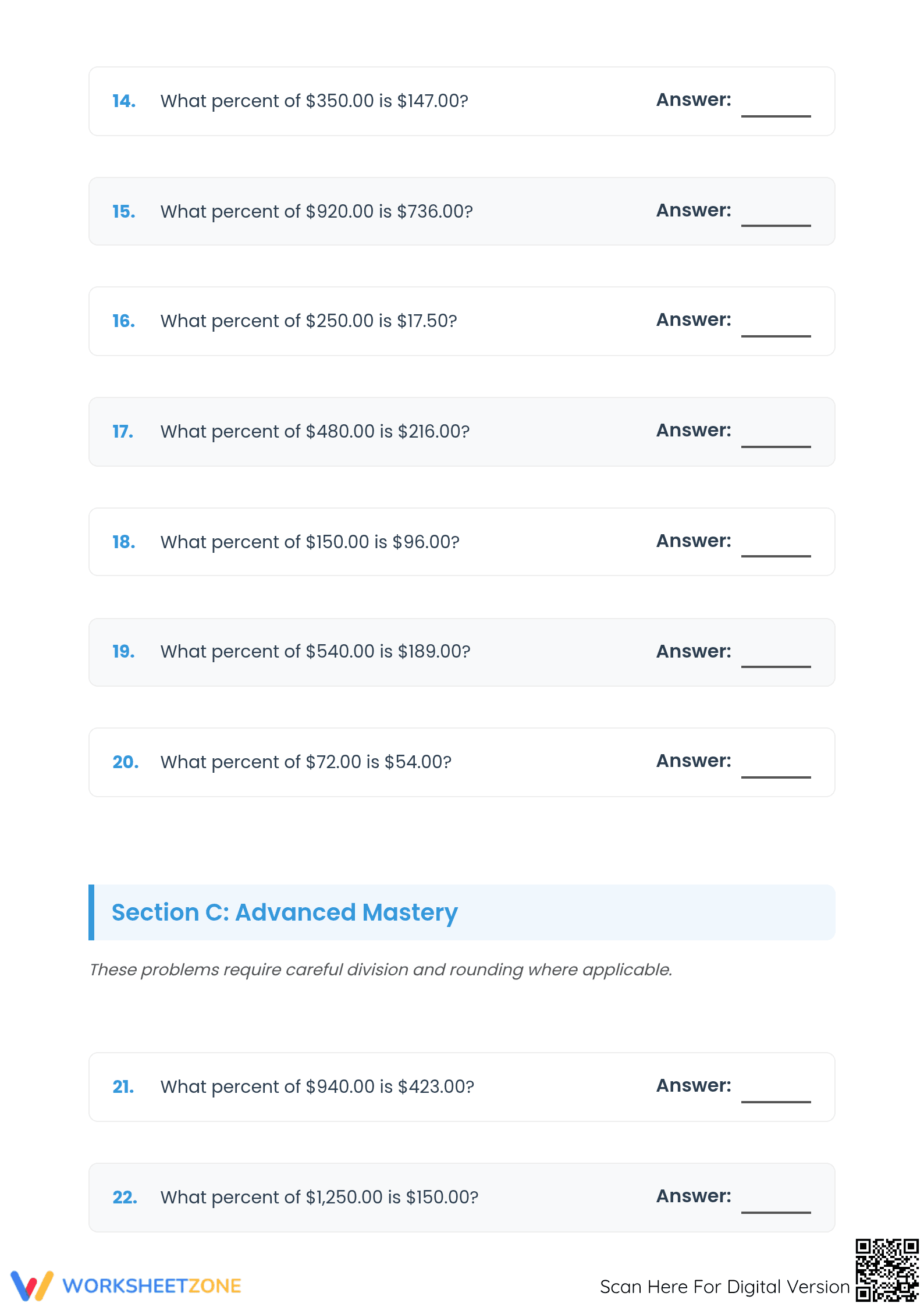
Inside this 4-page PDF are 30 problems organized into Foundational, Intermediate, and Advanced Mastery sections. The worksheet includes a formula reference box ("Rate = (Part ÷ Whole) × 100%") to support students during complex tasks. A complete answer key is included for quick grading or student self-correction.
- Foundational Practice: 10 problems applying the basic formula in a high-success environment to build initial confidence.
- Supported Practice: 10 problems introducing varied currency amounts to help learners internalize the part-to-whole relationship.
- Independent Mastery: 10 problems challenging students with larger decimal figures requiring precise division and rounding.
This progression follows a gradual-release model, moving from structured support toward independent fluency. This approach ensures that learners are not overwhelmed as the numeric complexity increases.
Aligned to CCSS.MATH.CONTENT.6.RP.A.3.c, this resource helps students "Find a percent of a quantity as a rate per 100." It also supports CCSS.MATH.CONTENT.7.RP.A.3 through proportional relationships in real-world contexts. Both standard codes can be copied directly into lesson plans, IEP goals, or district curriculum mapping tools.
Use this during the "elaborate" phase of a ratios lesson. It serves as an excellent formative assessment; observe if students correctly identify the "part" versus the "whole" before dividing. Expect completion in approximately 50 minutes, making it ideal for a full class period.
Designed for grades 6-8, this resource assists students needing decimal operation practice. It is effective for learners who benefit from clear headers and formulas. Pair this with a retail markup lesson or a currency word problem passage for a comprehensive experience.
According to the RAND AIRS 2024 report, high-quality math instructional materials that bridge abstract calculations with concrete currency contexts significantly improve student retention of proportional concepts. This worksheet directly addresses the "percent as a rate" requirement of CCSS.MATH.CONTENT.6.RP.A.3.c by asking students to calculate the specific percentage one currency value represents of another. By providing 30 unique problems, the resource ensures sufficient repetition to move the skill from short-term memory to long-term procedural fluency. Research from Fisher & Frey (2014) emphasizes that the gradual release of responsibility—mirrored here in the progression from foundational to advanced sections—is vital for student success in complex multi-step math tasks. Educators can cite this document as a reliable tool for building the mathematical foundations necessary for higher-level algebra and real-world financial decision-making, as it provides the specific scaffolds required for diverse learners to achieve mastery in percent rate calculations.


