


























Views
Downloads



Calculate Percent Rates Worksheet | Essential Grade 6 Math
Paste this activity's link or code into your existing LMS (Google Classroom, Canvas, Teams, Schoology, Moodle, etc.).
Students can open and work on the activity right away, with no student login required.
You'll still be able to track student progress and results from your teacher account.
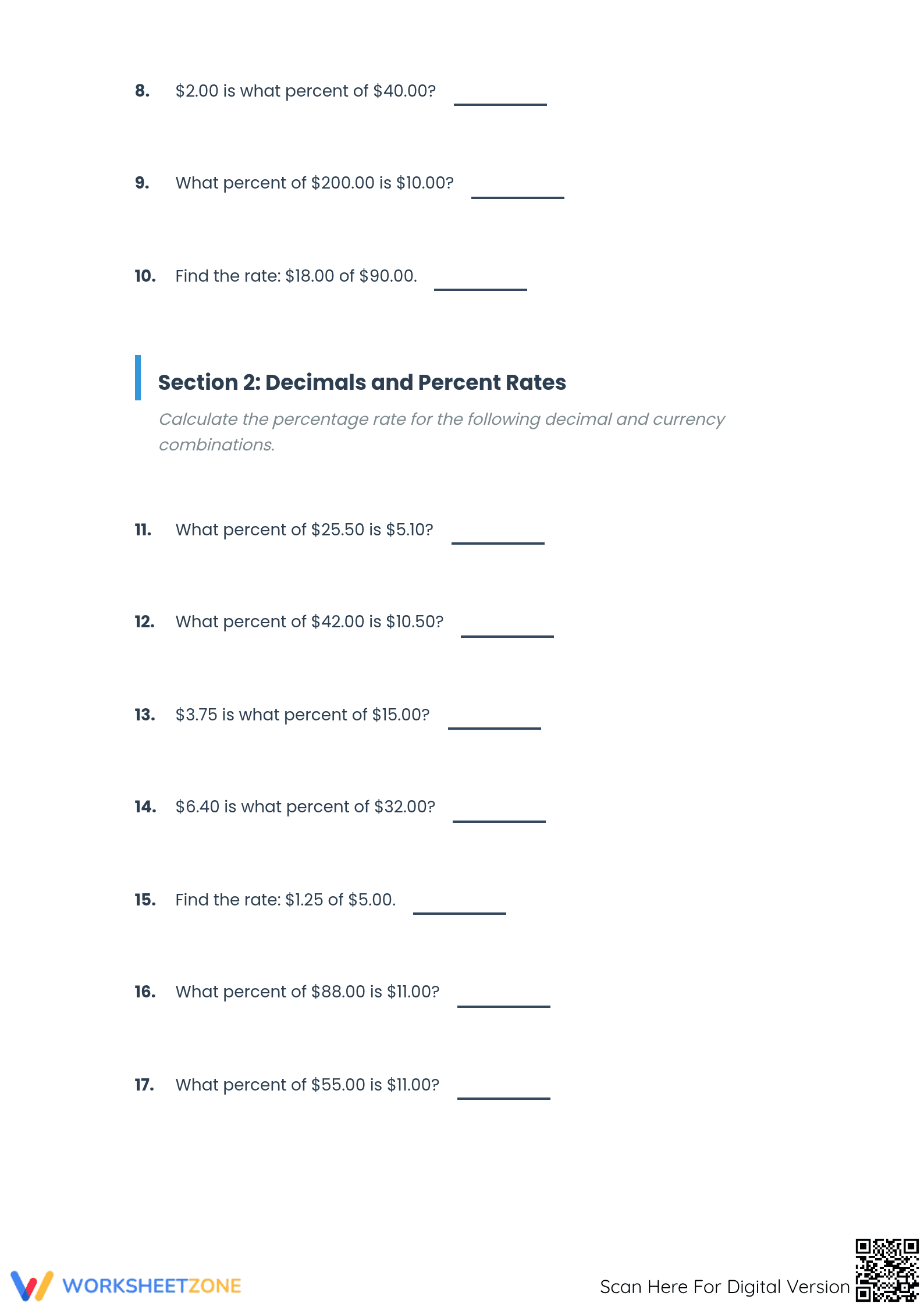
Calculate the percentage rate of one currency amount relative to another with this comprehensive practice set. Students master the relationship between parts and wholes by converting financial ratios into percentages. This resource focuses on precision, requiring learners to work with both whole currency values and complex decimal amounts to find exact rates.
At a Glance
- Grade: 6 · Subject: Math
- Standard:
6.RP.A.3.C— Find a percent of a quantity as a rate per 100- Skill Focus: Calculating percentage rates with currency
- Format: 4 pages · 30 problems · Answer key included · PDF
- Best For: Independent practice and financial literacy units
- Time: 25–40 minutes
This extensive four-page packet contains 30 targeted problems divided into three logical sections. The first section covers basic currency rates, the second introduces decimal combinations for increased complexity, and the final section applies these skills to real-world financial scenarios. A complete answer key is provided for rapid grading and student self-correction.
Skill Progression
- Guided practice: Problems 1 through 10 establish the foundation by using whole currency values like $50.00 and $10.00, allowing students to visualize the ratio before calculating the rate.
- Supported practice: Problems 11 through 20 introduce decimal currency values, such as $25.50 and $5.10, requiring students to apply division algorithms to more precise figures.
- Independent practice: The final 10 problems present word-based scenarios involving discounts, savings, and quiz scores, forcing students to identify the part and whole without visual cues.
The instructional design follows a gradual-release model, moving from explicit mathematical prompts to contextualized application.
Standards Alignment
This worksheet aligns with 6.RP.A.3.C, which requires students to find a percent of a quantity as a rate per 100 and solve problems involving finding the whole, given a part and the percent. By using currency, the resource provides a concrete foundation for understanding these abstract proportional relationships. Both standard codes can be copied directly into lesson plans, IEP goals, or district curriculum mapping tools.
How to Use It
Use this resource during the independent practice phase of a lesson on percent rates to transition students from basic computation to application. Teachers should observe whether students correctly identify the "whole" (the base number) versus the "part" (the number being compared), as this is the most common point of misconception. Expected completion time ranges from 25 to 40 minutes depending on calculator use.
Who It's For
This math resource is designed for Grade 6 students but serves as an excellent remedial tool for Grade 7 and 8 learners who need to reinforce their understanding of financial ratios. It pairs naturally with a grocery store circular or a restaurant menu for a natural extension activity.
According to a ScienceDirect TpT Analysis (2024), contextualizing percentage calculations within financial frameworks like currency significantly increases student engagement and long-term retention of proportional reasoning skills. This worksheet addresses the common pedagogical challenge of helping students distinguish between the part and the whole by using familiar dollar signs and decimal formats. By mastering the 6.RP.A.3.C standard through 30 diverse problems, students build the computational fluency required for more advanced algebraic concepts. The transition from abstract number sets to concrete currency amounts allows learners to apply logic-based checking—asking if a $10.00 discount on $50.00 feels like 20%—which serves as a critical self-regulation strategy in mathematical problem-solving. This resource provides the high-repetition practice necessary for students to internalize the division-to-percentage algorithm, ensuring they can move beyond simple calculations to complex financial analysis in higher grade levels.


