


























Views
Downloads
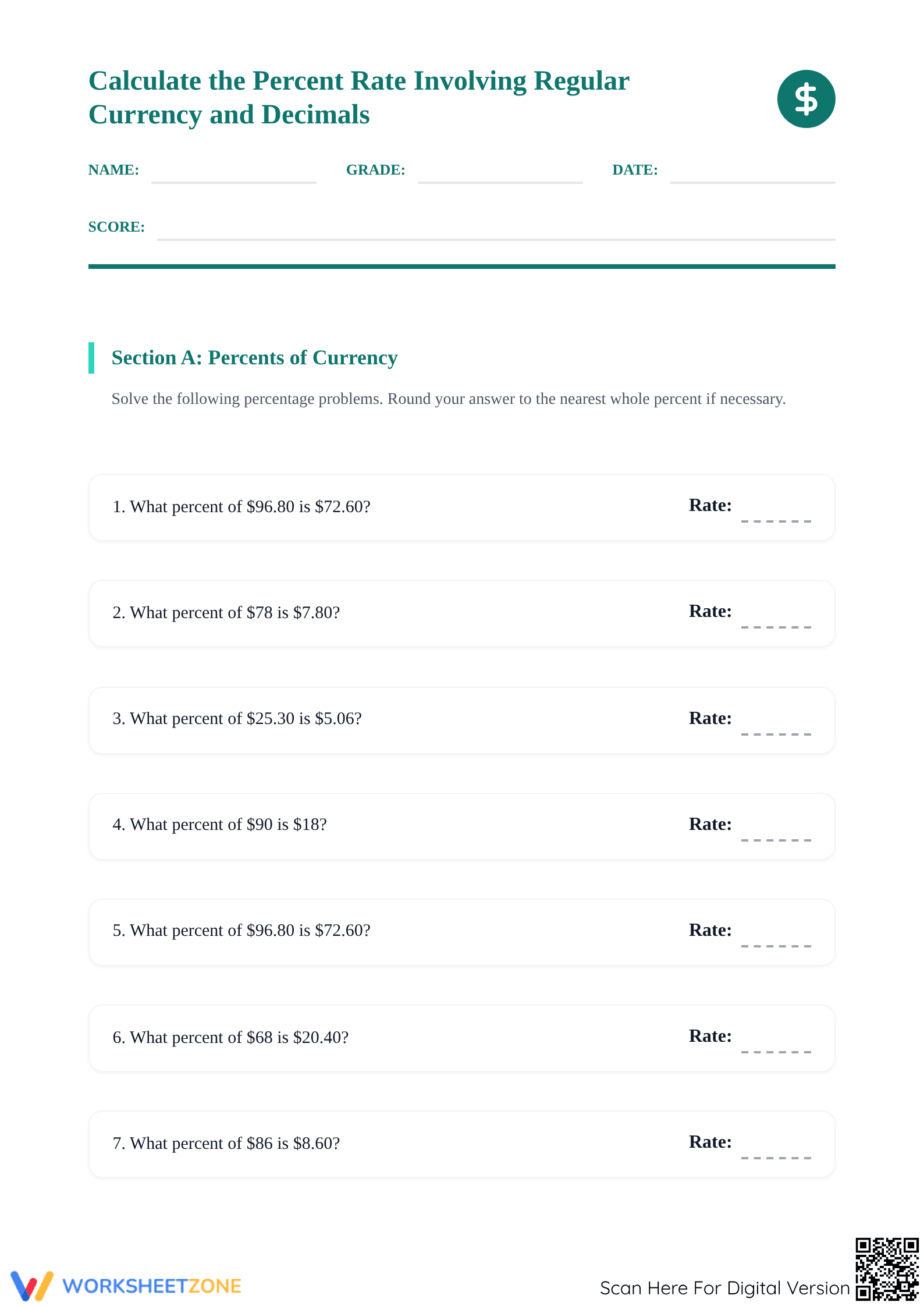


Essential Percent Rate Worksheet | Grades 4-8 Math
Paste this activity's link or code into your existing LMS (Google Classroom, Canvas, Teams, Schoology, Moodle, etc.).
Students can open and work on the activity right away, with no student login required.
You'll still be able to track student progress and results from your teacher account.
Master the art of calculating percentages with this comprehensive math worksheet. Students practice finding the percent rate between two values using real-world currency and decimal figures. This essential resource builds fluency in ratios and proportions, ensuring learners can confidently determine what percent one number is of another in practical, financial contexts.
At a Glance
At a Glance
- Grade: 4–8 · Subject: Math · Data
- Standard:
CCSS.MATH.CONTENT.6.RP.A.3.C— Solve problems to find a percent of a quantity as a rate per 100- Skill Focus: Calculating percent rates with currency and decimals
- Format: 5 pages · 44 problems · Answer key included · PDF
- Best For: Middle school math ratio and proportion practice
- Time: 30–45 minutes
What's Inside
This 5-page PDF contains 44 structured math problems divided into two focused sections. Section A provides initial practice with percentages of currency, while Section B offers extended practice to reinforce mastery. Every problem is designed with a clear "Rate" answer line, and the document includes a full answer key for immediate feedback and grading.
Skill Progression
- Guided Practice: The first 18 problems in Section A focus on standard currency values, providing a familiar entry point for calculating rates.
- Supported Practice: Section B introduces 26 additional problems that incorporate more complex decimal figures, requiring higher precision.
- Independent Mastery: Students work through 44 total items, moving from foundational currency math to abstract decimal percentages.
This resource follows a gradual-release model to ensure students move from initial understanding to independent fluency.
Standards Alignment
This resource is primary aligned to CCSS.MATH.CONTENT.6.RP.A.3.C, which requires students to find a percent of a quantity as a rate per 100 and solve problems involving finding the whole, given a part and the percent. The worksheet also supports the broader Ratios and Proportional Relationships domain. Both standard codes can be copied directly into lesson plans, IEP goals, or district curriculum mapping tools.
How to Use It
Use this worksheet as a primary practice tool during a unit on ratios or as a summative assessment to check for computational accuracy. During instruction, teachers can observe students' ability to correctly set up the division required for finding a percent. Expect students to spend approximately 35 minutes completing the full 44-problem set during an independent work block.
Who It's For
This resource is ideal for upper elementary and middle school students (Grades 4-8) working on financial literacy or general percent computation. It provides necessary scaffolding for students requiring extra practice with decimal placement and is a perfect companion to a direct instruction lesson on "Part over Whole" math strategies.
Aligned to CCSS.MATH.CONTENT.6.RP.A.3.C, this worksheet targets the essential skill of calculating percent rates using currency and decimal data. Research from NAEP suggests that persistent practice with diverse numerical formats, including currency, is critical for students to internalize the proportional relationships inherent in percentages. By engaging with 44 distinct problems, learners build the computational stamina required for higher-order algebraic thinking. Fisher & Frey (2014) emphasize that the gradual release model, as seen in the transition between sections, effectively supports long-term retention of procedural knowledge. This document serves as a robust tool for educators aiming to bridge the gap between abstract percentage concepts and real-world financial applications. The inclusion of an answer key facilitates both self-directed learning and efficient teacher assessment, making it a staple for any middle-school mathematics curriculum or intervention program.


