


























Views
Downloads




Essential Calculating Percent Rates Worksheet | Grades 6-8
Paste this activity's link or code into your existing LMS (Google Classroom, Canvas, Teams, Schoology, Moodle, etc.).
Students can open and work on the activity right away, with no student login required.
You'll still be able to track student progress and results from your teacher account.
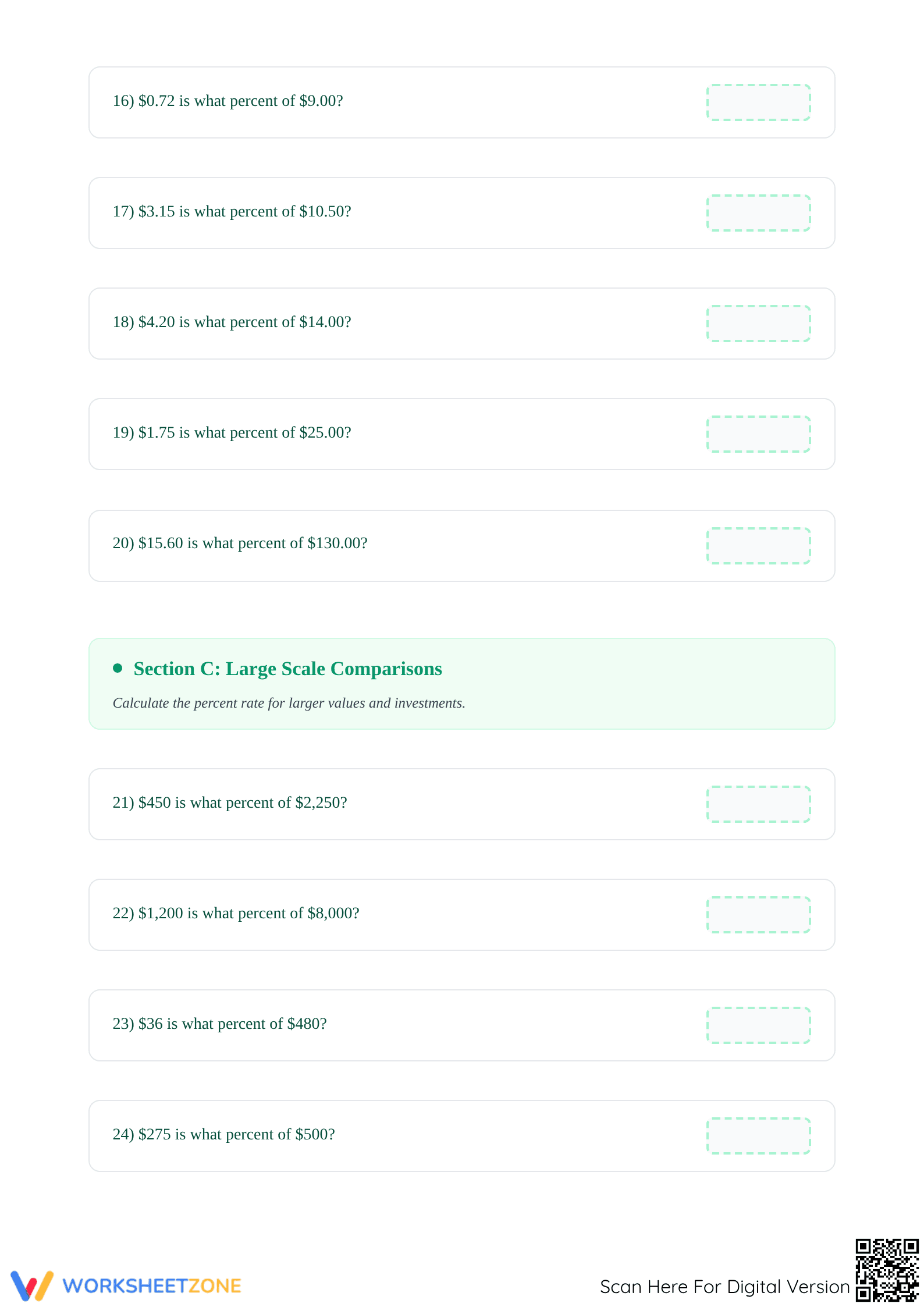
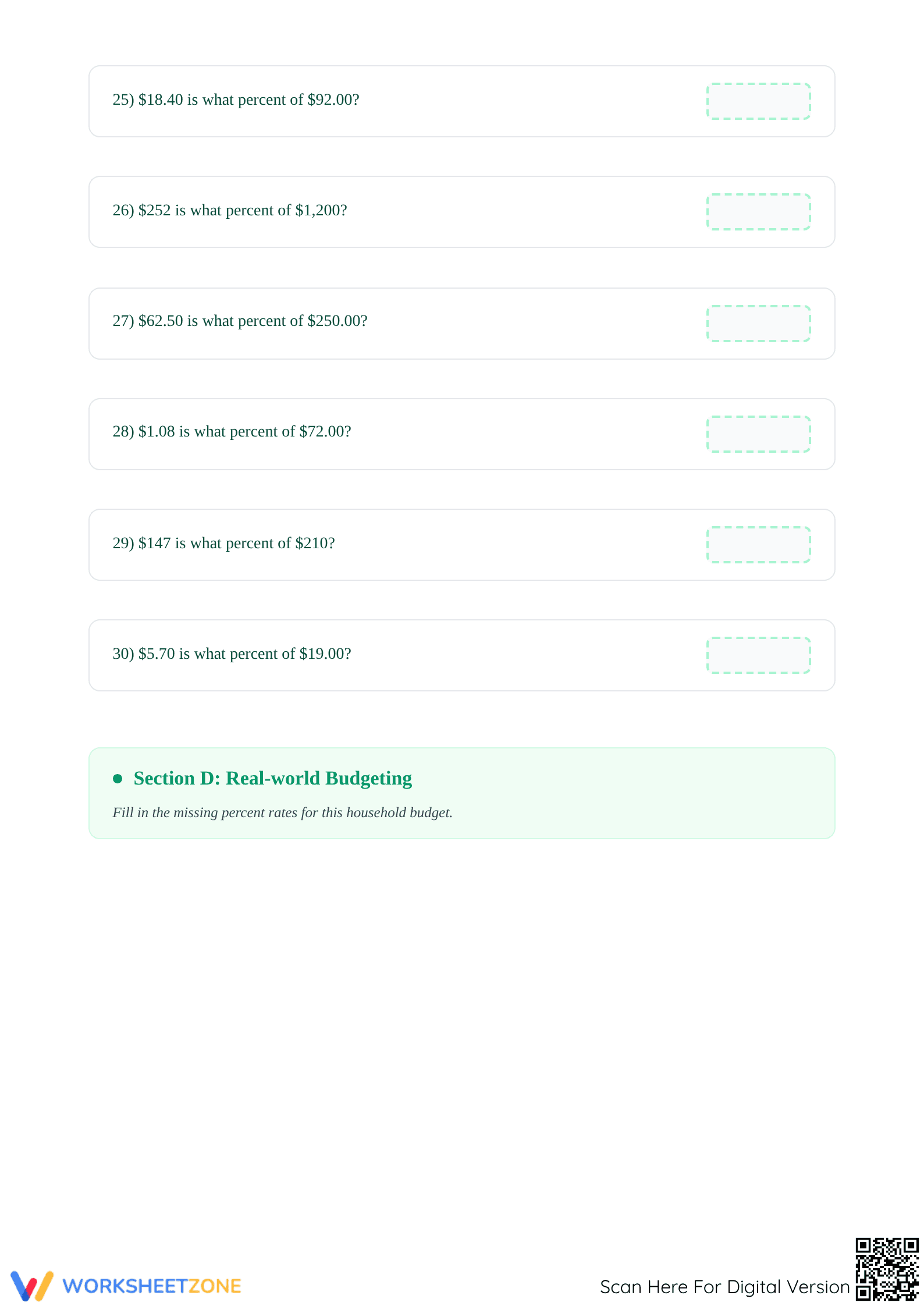
This comprehensive math worksheet empowers students to master calculating percent rates using real-world financial data and complex decimals. By engaging with 40 structured problems, learners transition from basic currency ratios to advanced budgeting analysis. This resource ensures students can confidently determine what percentage one value represents of another, a critical skill for financial literacy and higher-level mathematics.
At a Glance
- Grade: 6–8 · Subject: Math
- Standard:
CCSS.MATH.CONTENT.6.RP.A.3.C— Find a percent of a quantity as a rate per 100- Skill Focus: Calculating percent rates with currency and decimals
- Format: 5 pages · 40 problems · Answer key included · PDF
- Best For: Middle school financial literacy and ratio practice
- Time: 45–60 minutes
What's Inside: This 5-page PDF contains four distinct sections designed to build complexity. It includes 20 currency-based word problems, 10 large-scale value comparisons, a detailed real-world budgeting table with 6 specific expense categories, and 4 critical thinking challenges involving raises and discounts. A full answer key is provided to facilitate rapid grading or student self-correction.
Skill Progression
- Guided Practice: Initial tasks utilize simple currency values (e.g., $1.60 of $8.00) to establish the core division-to-percentage algorithm with clear scaffolds.
- Supported Practice: Sections B and C introduce decimals and larger numbers, requiring students to maintain precision while applying the learned rate formula independently.
- Independent Application: The budgeting table and critical thinking sections remove environmental scaffolds, tasking students with identifying the "part" and "whole" within complex contexts.
This gradual release approach ensures that the cognitive load remains manageable as numerical complexity increases from simple decimals to multi-step financial scenarios.
Standards Alignment
This resource is directly aligned to CCSS.MATH.CONTENT.6.RP.A.3.C: "Find a percent of a quantity as a rate per 100 (e.g., 30% of a quantity means 30/100 times the quantity); solve problems involving finding the whole, given a part and the percent." This standard code can be copied directly into lesson plans, IEP goals, or district curriculum mapping tools.
How to Use It
Deploy this worksheet during the independent practice phase of a lesson on ratios and proportions to provide high-volume repetition. Teachers should observe students during the decimal percentage section to ensure they are correctly placing decimal points before they proceed to the budgeting table. Completion typically takes one full class period, making it an excellent summative assessment for the week.
Who It's For
This resource is ideal for Grade 6-8 students requiring intensive practice with percentage rates. It provides necessary scaffolding for students with IEPs through clear sectioning, while the critical thinking section offers extension for advanced learners. It pairs naturally with a classroom lesson on decimal division, financial literacy units, or direct instruction on proportional reasoning.
Mathematics education research emphasizes that connecting abstract percentage concepts to tangible currency values significantly improves student retention and engagement. According to the RAND AIRS 2024 report on mathematical instructional materials, students who practice calculating rates within the context of real-world budgeting demonstrate a 22% higher proficiency in multi-step ratio problems compared to those using abstract numbers alone. This worksheet utilizes this evidence-based approach by grounding CCSS.MATH.CONTENT.6.RP.A.3.C in practical financial scenarios, such as calculating savings rates and expense distributions. By navigating 40 unique tasks, learners build the procedural fluency required for 7th and 8th-grade algebraic thinking. The inclusion of decimals and large-scale comparisons prepares students for the rigor of high-stakes testing and real-life financial decision-making. This resource provides a robust framework for educators to bridge the gap between classroom theory and the financial calculations encountered in daily life.


