


























Views
Downloads

Printable Calculate Original Amount Worksheet | Grade 6 Math
Paste this activity's link or code into your existing LMS (Google Classroom, Canvas, Teams, Schoology, Moodle, etc.).
Students can open and work on the activity right away, with no student login required.
You'll still be able to track student progress and results from your teacher account.
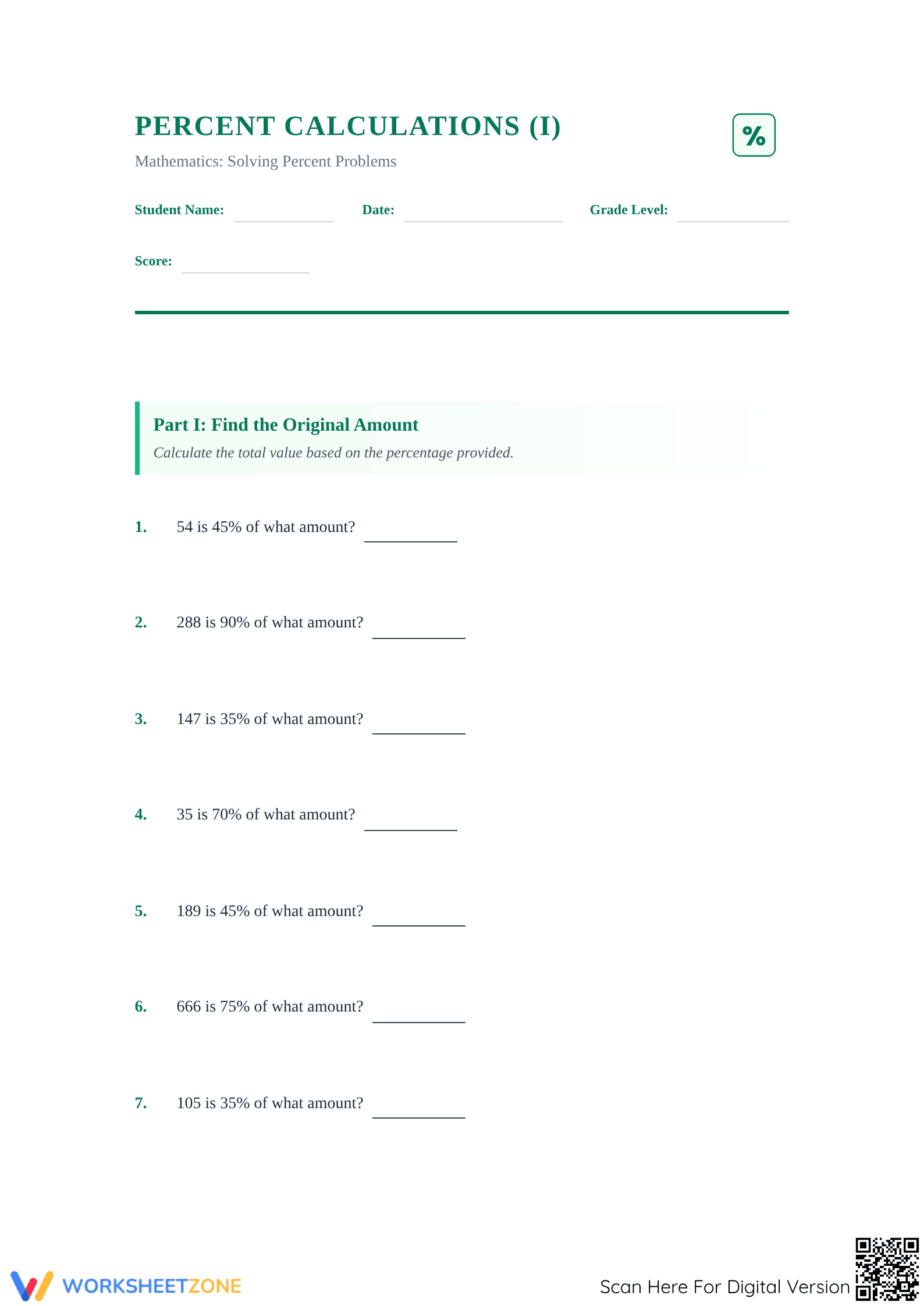
This comprehensive mathematics resource focuses on the essential skill of calculating the original amount (the base) when both the percentage rate and the resulting value are known. By working through these problems, students move beyond simple percent-of calculations to master the more complex logic of proportional relationships. This worksheet ensures students can confidently reverse-engineer percentage problems in both abstract and real-world contexts.
At a Glance
- Grade: 6 · Subject: Mathematics
- Standard:
CCSS.MATH.CONTENT.6.RP.A.3.C— Find the whole, given a part and the percent- Skill Focus: Calculating base value from part and rate
- Format: 5 pages · 30 problems · Answer key included · PDF
- Best For: Independent practice and formative assessment
- Time: 40–50 minutes
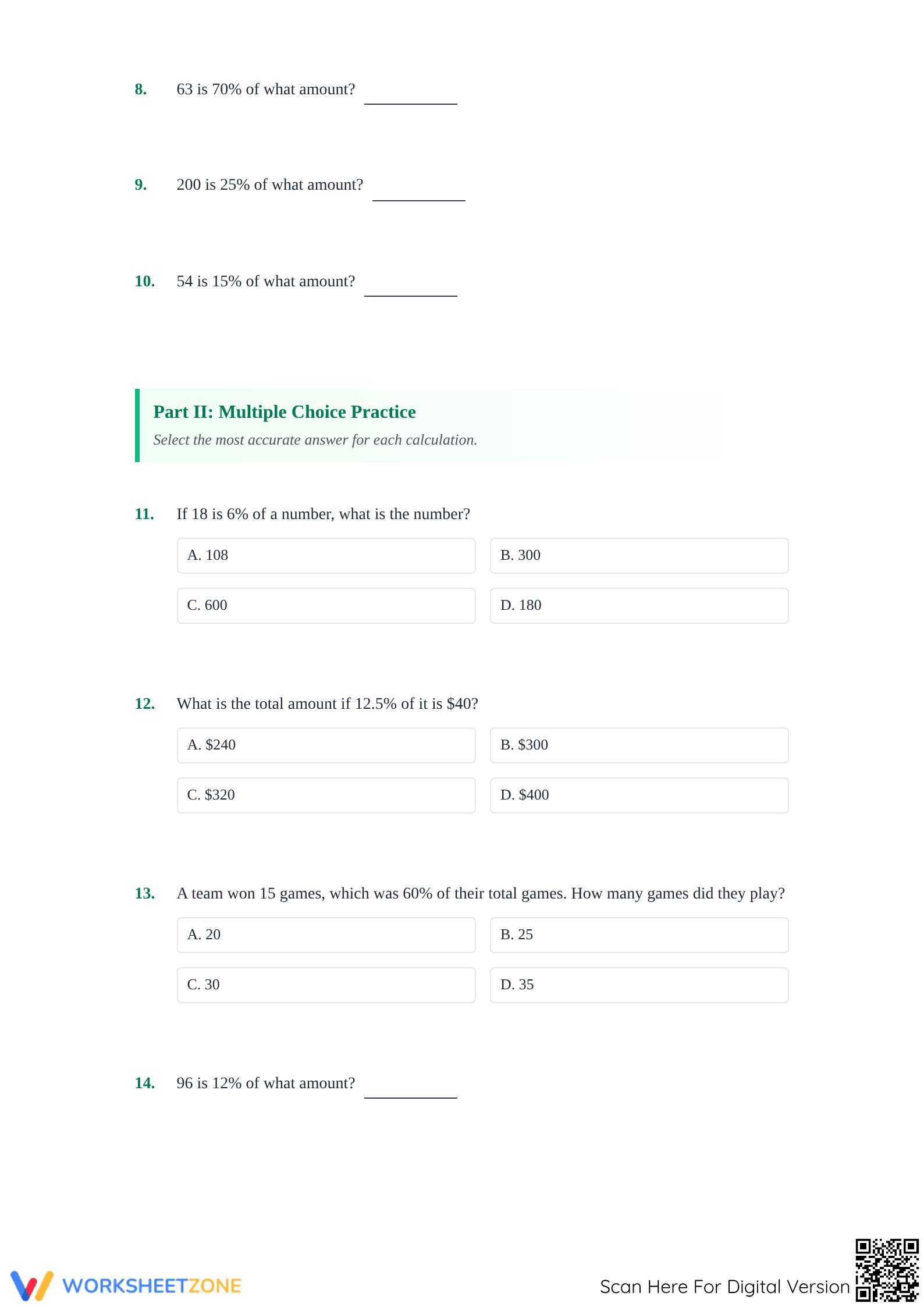
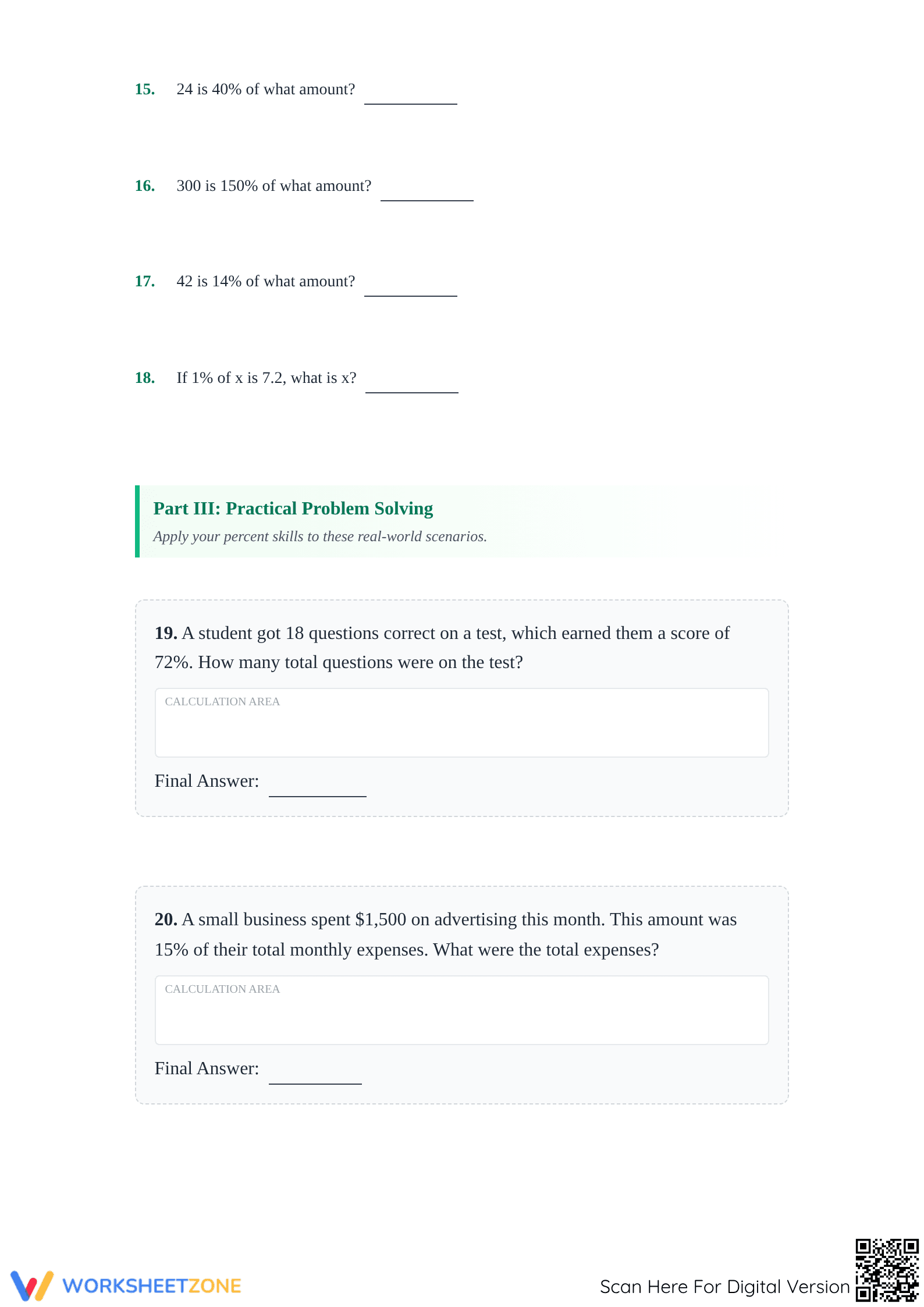
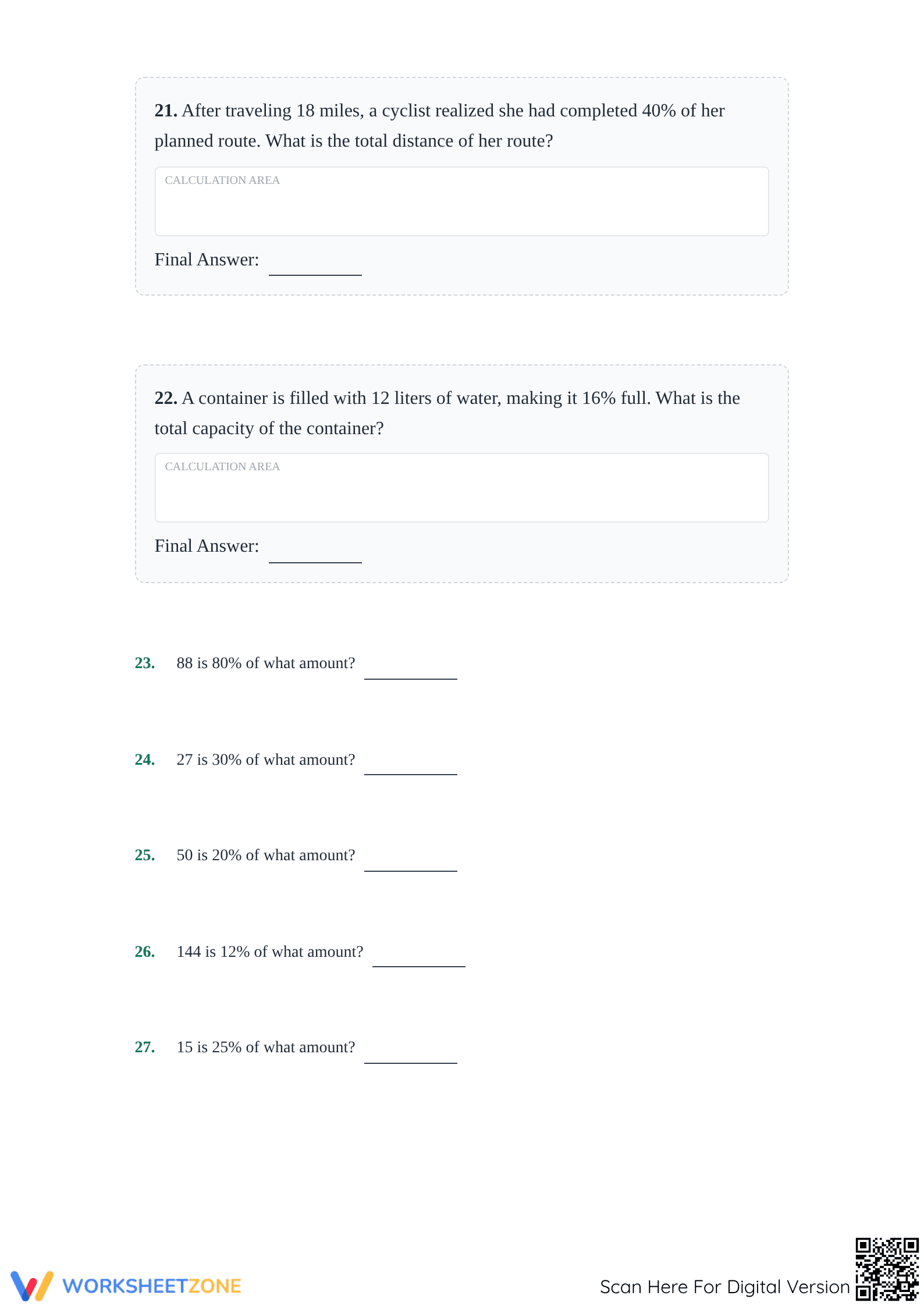
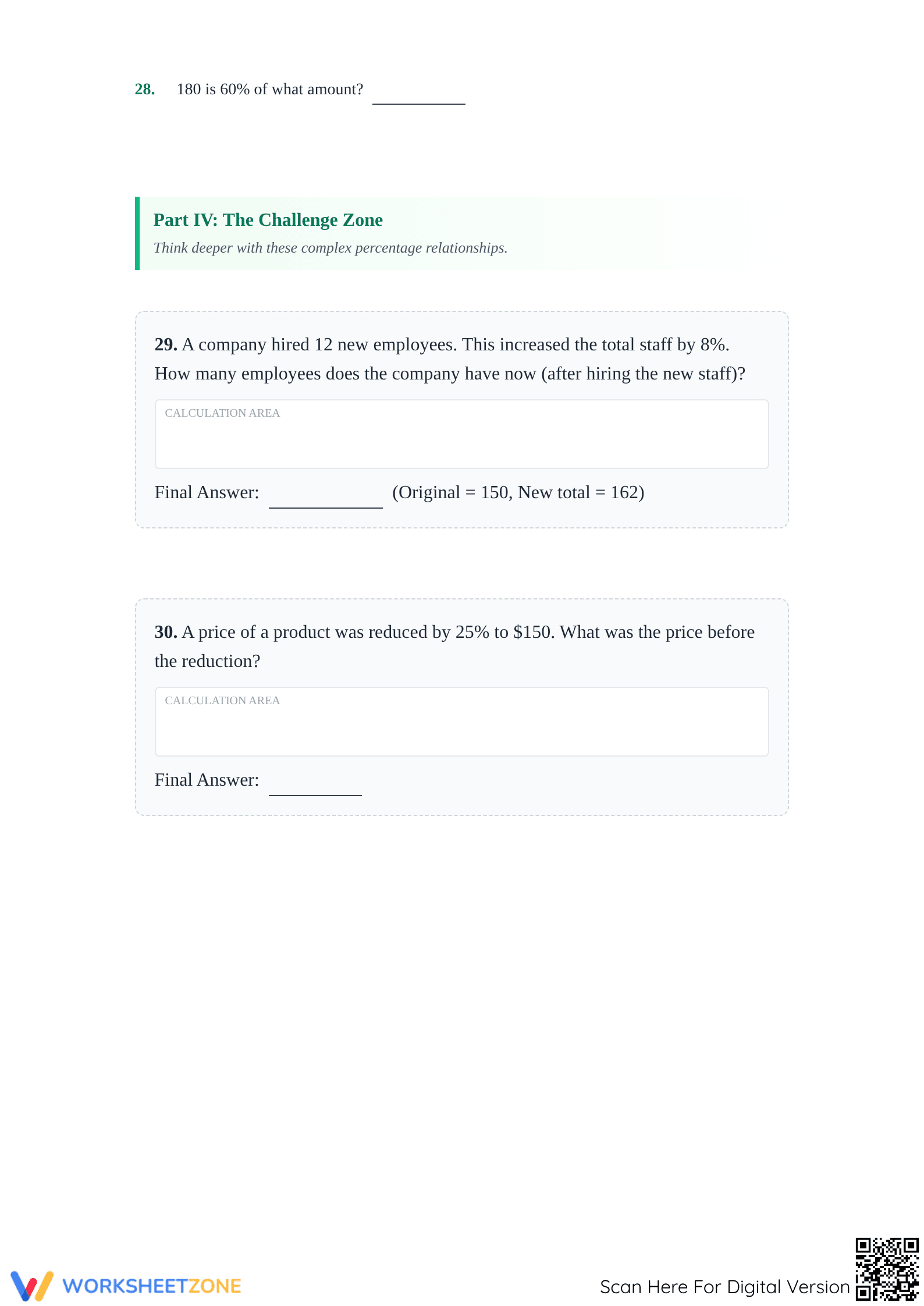
What's Inside: This five-page PDF includes 30 unique problems organized into four distinct sections. The resource features a mix of basic computational exercises, multiple-choice questions, practical word problems, and a high-level challenge zone. The layout provides ample white space for calculations, and a full answer key is provided for immediate feedback and grading efficiency.
Skill Progression
- Guided Practice: The first 10 problems focus on direct computation, using clear phrasing like "54 is 45% of what amount?" to build comfort with the core mathematical formula.
- Supported Application: Multiple-choice and short-answer problems (tasks 11-18) introduce variety and require students to identify the correct numerical relationship among several distractors.
- Independent Mastery: Real-world scenarios (tasks 19-30) require students to extract data from text and solve multi-step problems involving business expenses, test scores, and staff increases.
This sequence follows a gradual-release model, moving from structured arithmetic to independent problem-solving.
Standards Alignment
This resource is strictly aligned to `CCSS.MATH.CONTENT.6.RP.A.3.C`: "Find a percent of a quantity as a rate per 100; solve problems involving finding the whole, given a part and the percent." It also supports the 7th-grade standard for multi-step percent problems. This standard code can be copied directly into lesson plans, IEP goals, or district curriculum mapping tools.
How to Use It
This worksheet is ideal for use after a direct instruction lesson on finding the whole in a percent relationship. Teachers can assign the first page as a guided-practice activity and the remaining pages as a stations task or independent homework. For a formative assessment observation, watch for students who struggle to set up the initial equation, as this indicates a need for more work on the "part = percent x whole" conceptual framework. Expected completion time is roughly 45 minutes.
Who It's For
This resource is designed for Grade 6 students who are mastering ratios and proportions. It is also highly effective for Grade 7 or 8 students requiring targeted intervention or review of foundational percent skills. Educators can pair this worksheet with a visual anchor chart demonstrating the percent bar model to support visual learners.
Mastering the ability to find the original amount from a percentage is a critical milestone in middle school mathematics, directly impacting a student's success in later algebraic studies. According to the NAEP 2024 analysis of proportional reasoning, students who can fluently navigate "backward" percentage problems demonstrate significantly higher proficiency in solving complex financial literacy and data analysis tasks. This worksheet provides the exact repetition needed to solidify this mental model. By focusing on 30 diverse problems, including the critical Challenge Zone which introduces percent increases and decreases, the resource prepares students for the rigor of standardized assessments. As noted by Fisher & Frey (2014) in their research on scaffolding, the transition from abstract computation to contextualized problem-solving is necessary for long-term retention. This resource ensures that students not only solve for the variable but understand the proportional relationship that defines the CCSS.MATH.CONTENT.6.RP.A.3.C standard.


