


























Views
Downloads

Essential Grade 6 Percent Worksheet: Find Original Amount
Paste this activity's link or code into your existing LMS (Google Classroom, Canvas, Teams, Schoology, Moodle, etc.).
Students can open and work on the activity right away, with no student login required.
You'll still be able to track student progress and results from your teacher account.
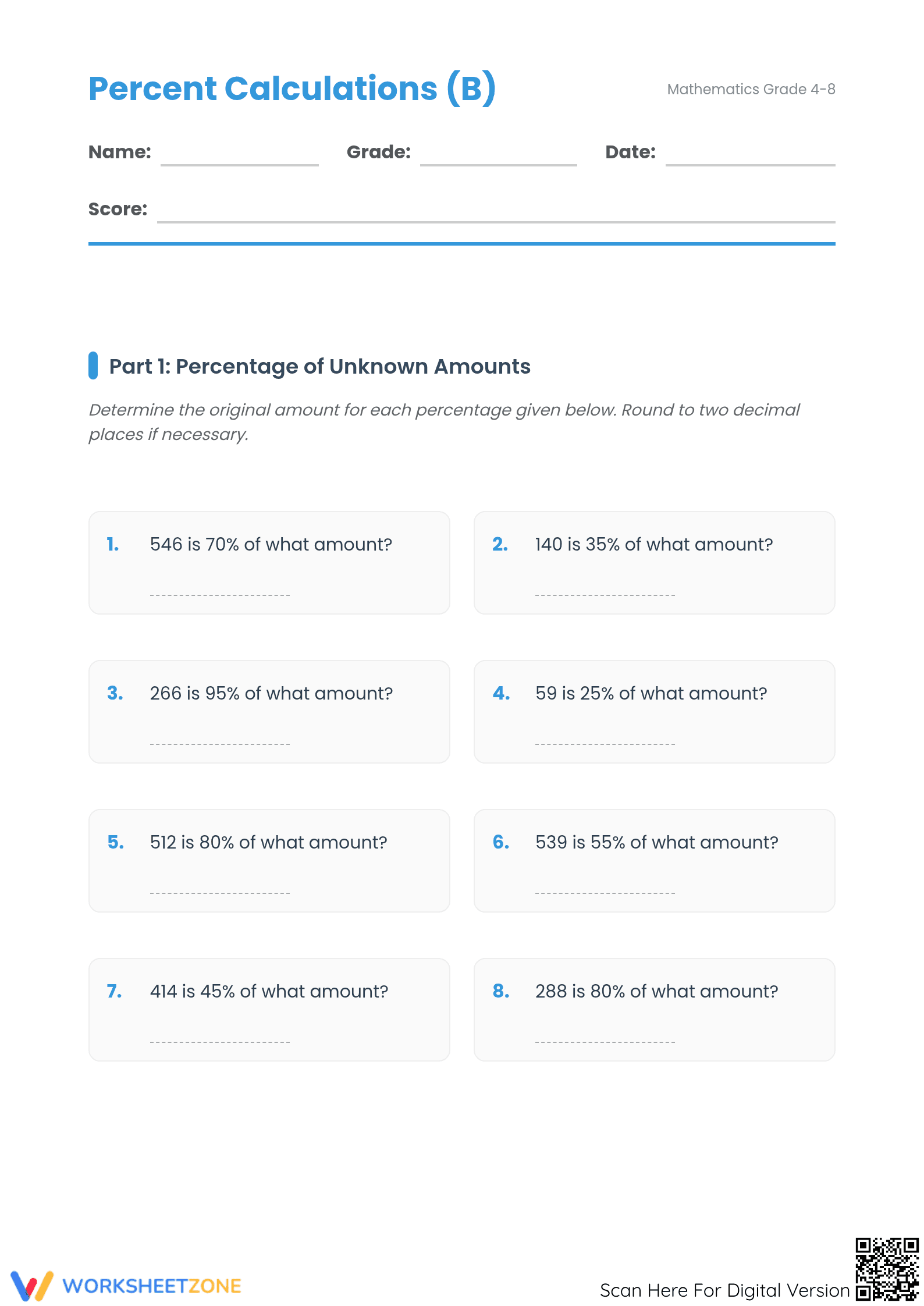
This Grade 6 math worksheet focuses on the critical skill of finding the original whole amount when given a part and its corresponding percentage. Students move beyond simple calculation to understand the inverse relationship of percentages, applying the part-divided-by-percent formula to 28 unique problems. It is an essential tool for building algebraic reasoning and real-world financial literacy.
At a Glance
- Grade: 6 · Subject: Math
- Standard:
CCSS.MATH.CONTENT.6.RP.A.3.C— Find a percent of a quantity as a rate per 100 and find the whole- Skill Focus: Calculating original amounts (backtracking percentages)
- Format: 4 pages · 28 problems · Answer key included · PDF
- Best For: Independent practice, homework, and formative assessment
- Time: 30–45 minutes
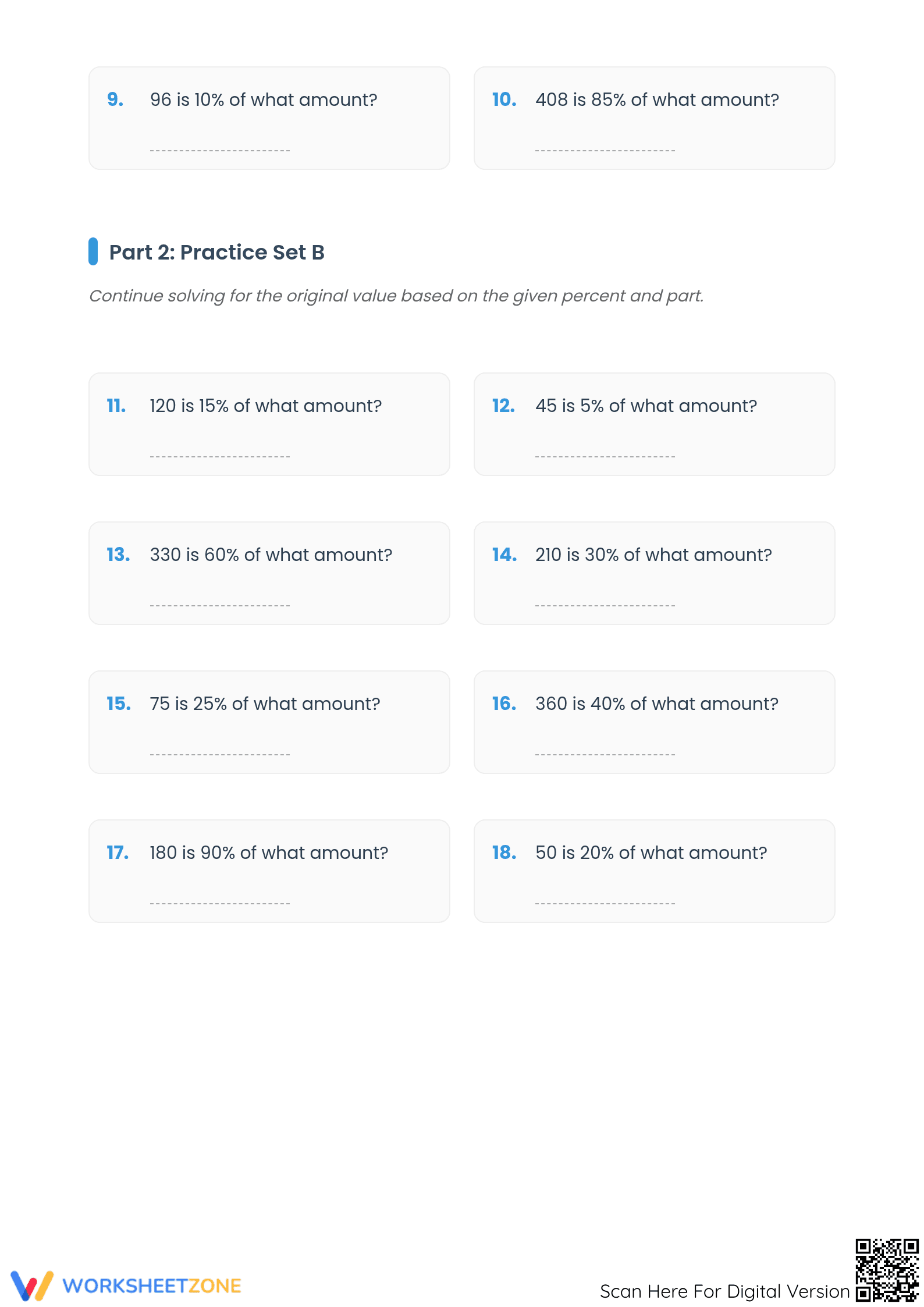
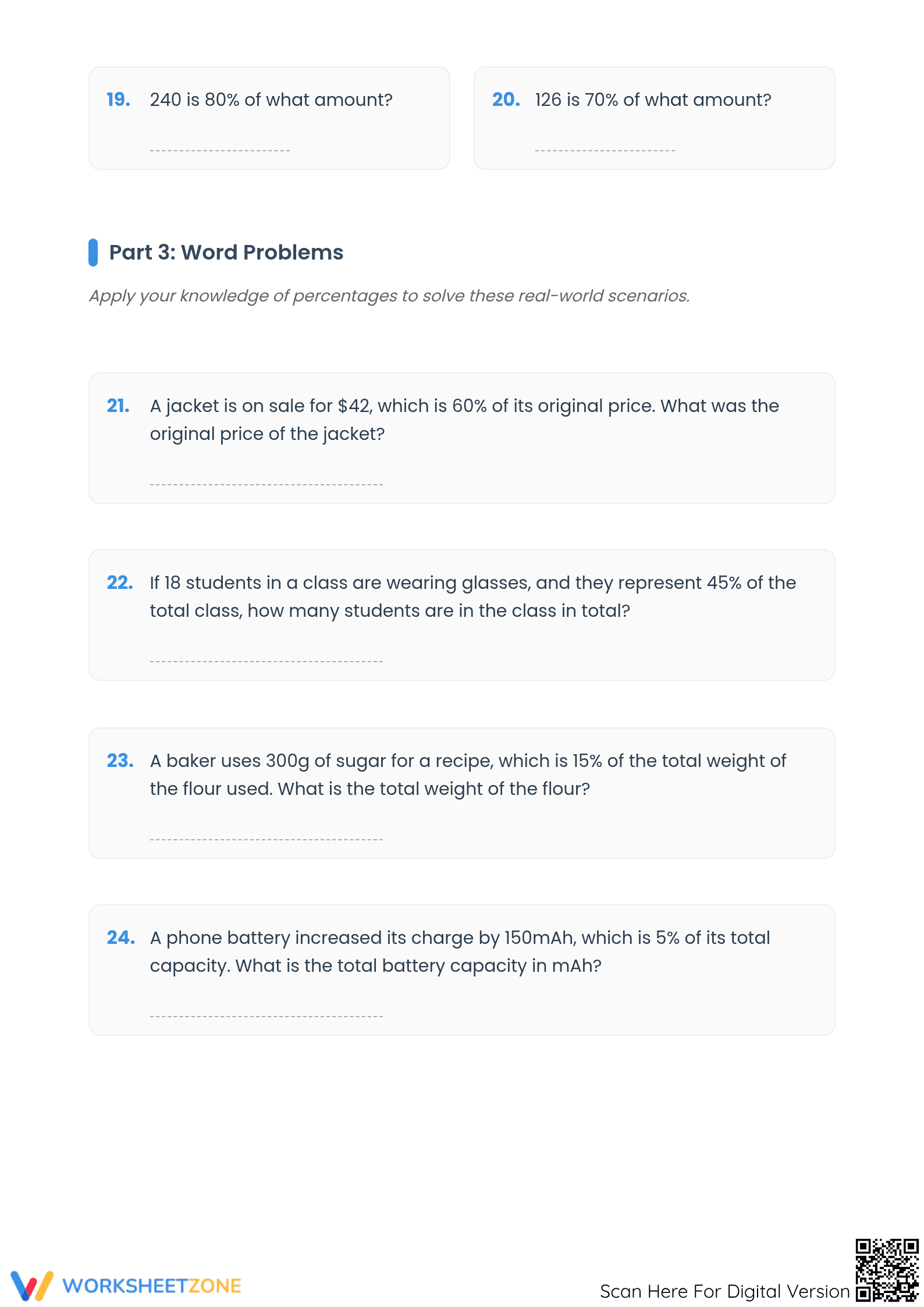
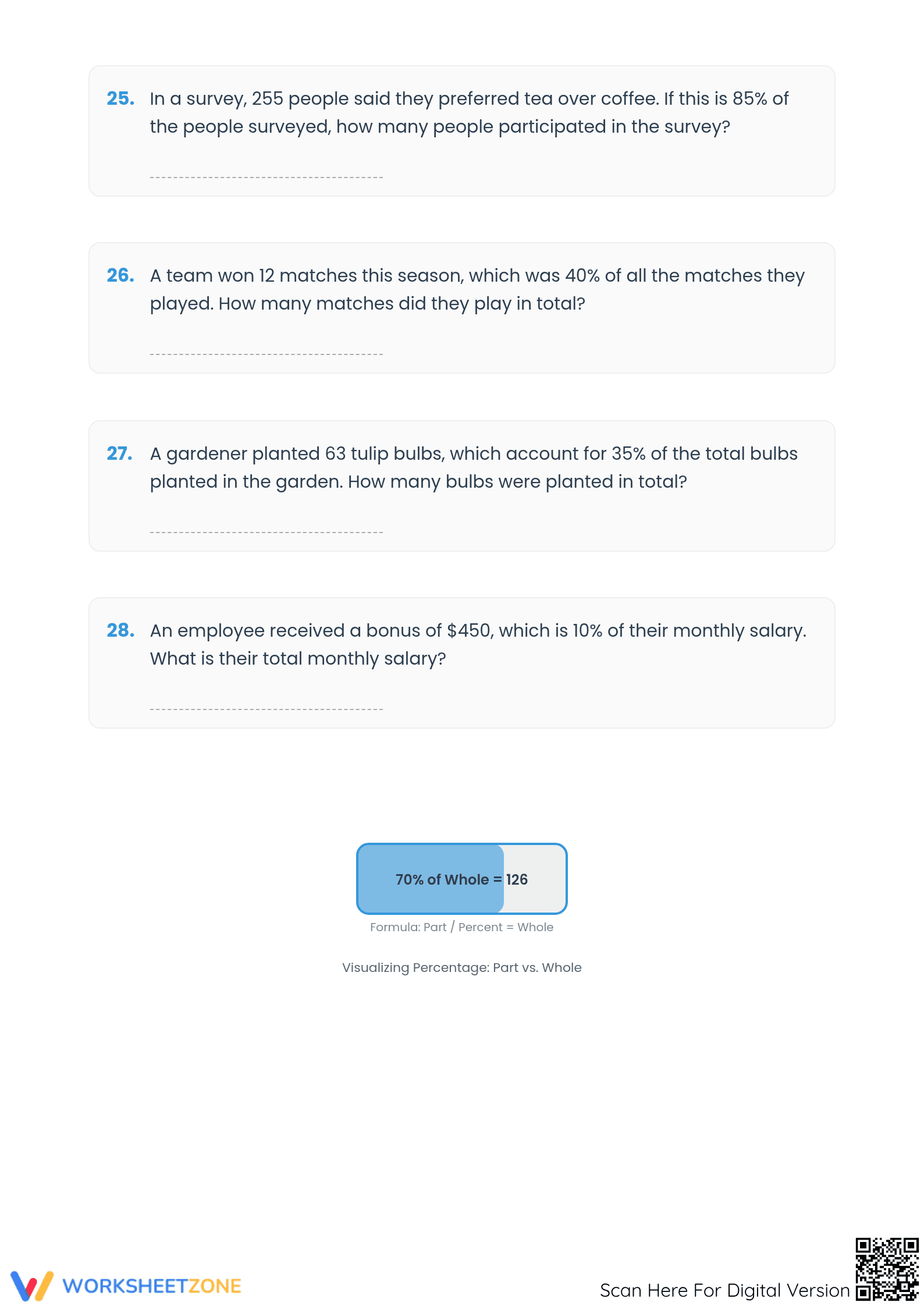
This four-page printable PDF features 28 targeted problems designed to solidify student understanding of base calculations. The resource includes 20 direct numerical problems (e.g., "546 is 70% of what amount?") and 8 contextual word problems involving sales, ratios, and measurements. A clear visual formula diagram is provided on the final page to support student self-correction, alongside a complete answer key for rapid teacher review.
Skill Progression
- Guided practice: The first 10 problems provide a consistent sentence structure that mirrors the core formula, allowing students to internalize the relationship between parts and wholes with high support.
- Supported practice: Problems 11 through 20 remove immediate visual scaffolds, requiring students to independently identify which values represent the part versus the percentage rate across 10 additional exercises.
- Independent practice: The final 8 tasks transition into real-world word problems, forcing students to extract data from narrative contexts and apply the "Part / Percent = Whole" formula.
Students follow a gradual-release model that builds the confidence needed to tackle multi-step percentage applications.
Standards Alignment
The primary focus of this worksheet is `CCSS.MATH.CONTENT.6.RP.A.3.C`, which requires students to "find a percent of a quantity as a rate per 100; solve problems involving finding the whole, given a part and the percent." This standard is a foundational pillar for middle school ratio and proportional relationship strands. Both standard codes can be copied directly into lesson plans, IEP goals, or district curriculum mapping tools.
How to Use It
Assign this worksheet during the "You Do" phase of a lesson on proportional reasoning or as a targeted intervention for students struggling with the "backtracking" concept. Teachers should observe students during the word problems to ensure they identify the "whole" versus the "part". Total completion time is roughly 40 minutes.
Who It's For
This resource is ideal for Grade 6 students following common core standards, though it serves as excellent review for Grade 7 and 8 students preparing for algebraic equations. It pairs naturally with a percent bar model anchor chart or a short reading passage on consumer math.
The ability to calculate an original amount from a given percentage part is a high-leverage skill that bridges the gap between arithmetic and early algebra. According to the RAND AIRS 2024 report, students who master the inverse relationships of ratios and percentages in middle school demonstrate significantly higher proficiency in secondary functions and data analysis. This Grade 6 worksheet aligns with CCSS.MATH.CONTENT.6.RP.A.3.C by providing 28 rigorous tasks that require students to find the whole, given a part and the percent. By moving from abstract numerical sentences to complex real-world word problems, the resource ensures that the mathematical concept is rooted in practical application rather than rote memorization. Educators can use these tasks to identify specific misconceptions regarding the placement of decimal points during division, a common hurdle identified in NAEP performance data. This focused practice provides the repetition necessary for long-term procedural fluency in proportional reasoning.


