


























Views
Downloads

Calculate Original Amount (5%) Printable Worksheet | Grade 6
Paste this activity's link or code into your existing LMS (Google Classroom, Canvas, Teams, Schoology, Moodle, etc.).
Students can open and work on the activity right away, with no student login required.
You'll still be able to track student progress and results from your teacher account.
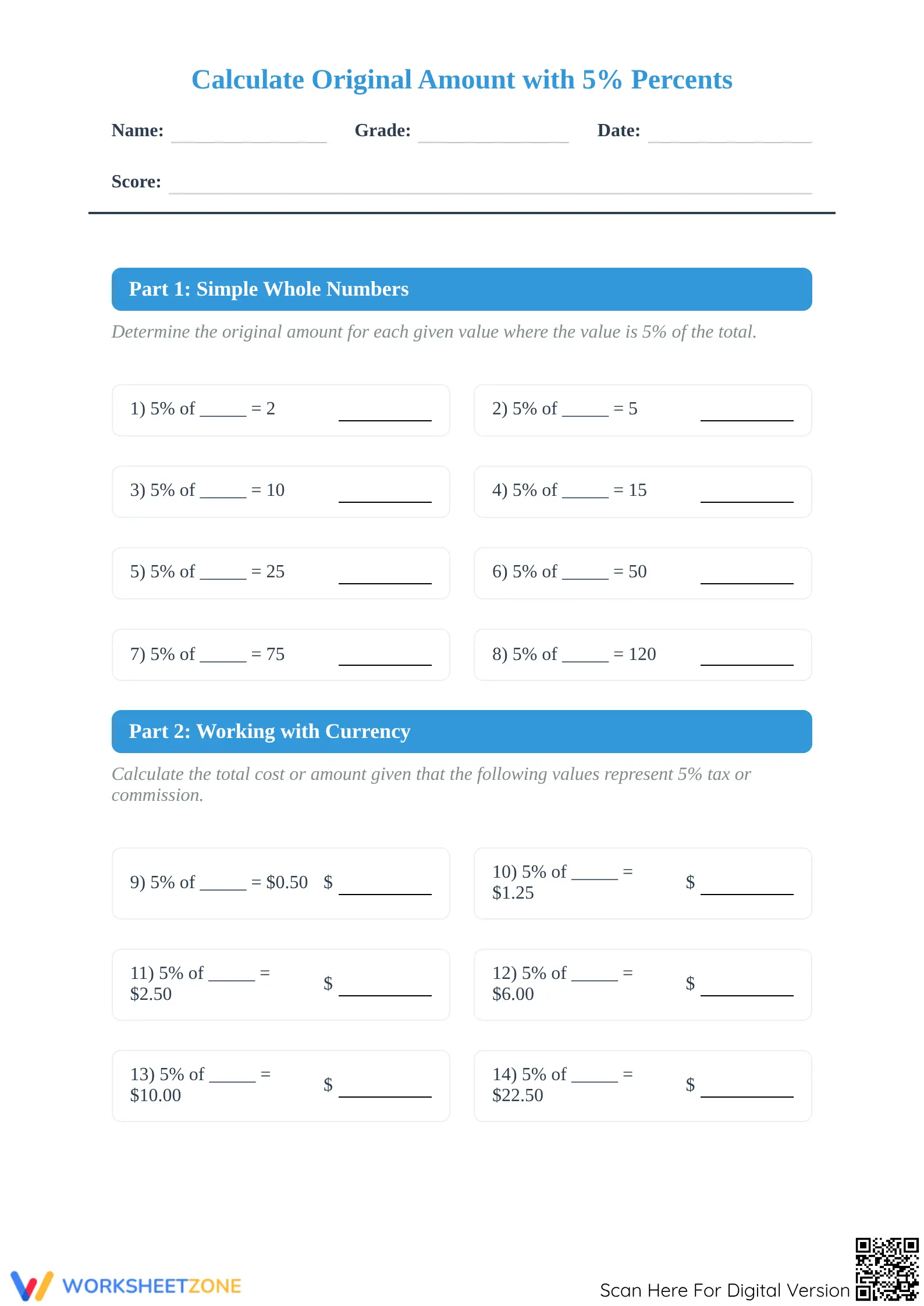
This comprehensive Grade 6 math worksheet empowers students to master the logic required to calculate original amounts when a 5% part is known. By transitioning from whole numbers to currency and word problems, learners build a conceptual understanding of percentage relationships and algebraic reasoning.
At a Glance
- Grade: 6 · Subject: Math
- Standard:
CCSS.6.RP.A.3.C— Find the whole quantity given a part and the percent- Skill Focus: Finding original amounts from 5% parts
- Format: 3 pages · 28 problems · Answer key included · PDF
- Best For: Formative assessment
- Time: 30–45 minutes
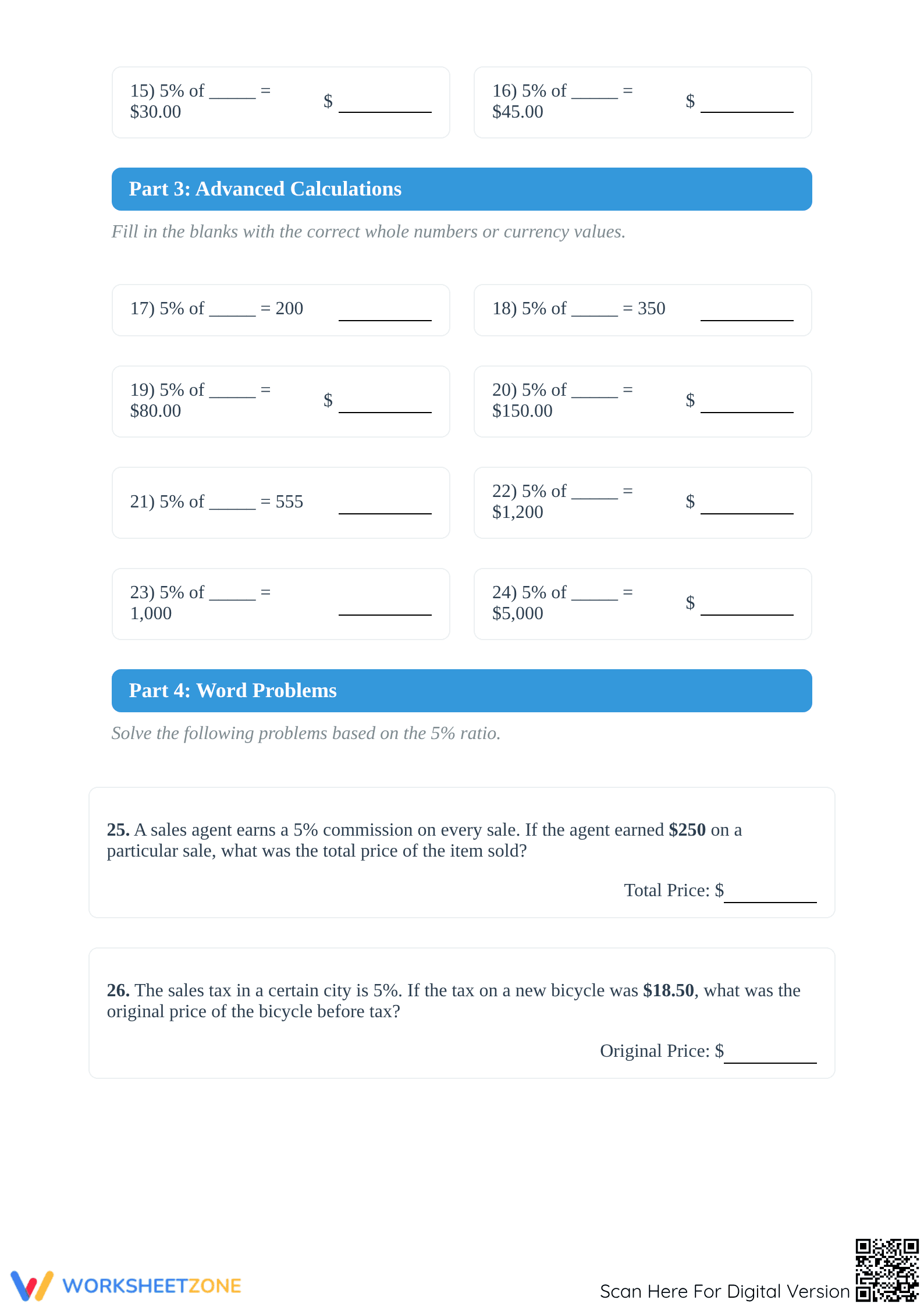
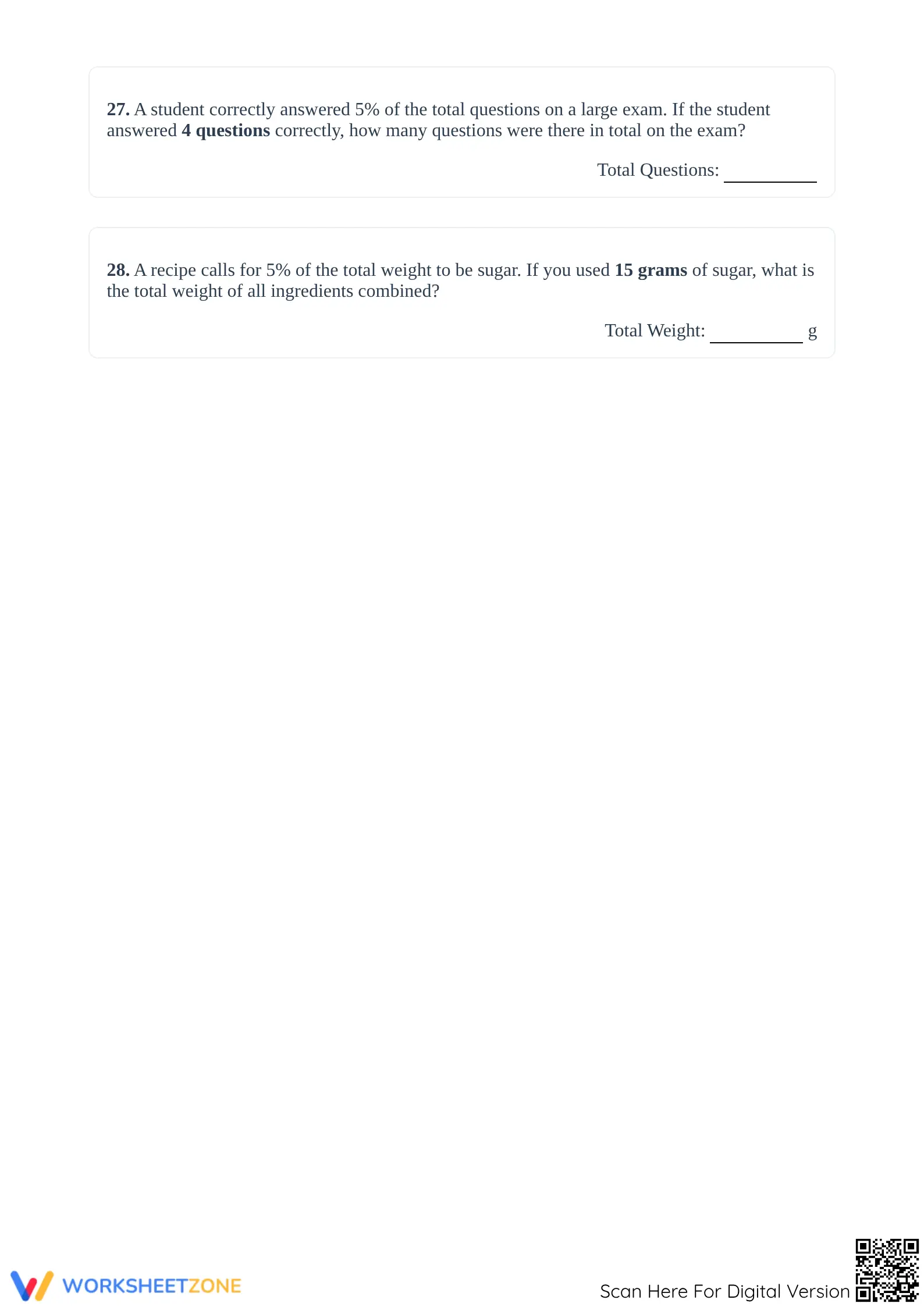
This 3-page PDF resource contains four sections designed to scaffold learning. Inside, you will find 28 total tasks: 8 simple equations, 8 currency-based calculations, 8 advanced multi-digit problems, and 4 real-world word problems. A full answer key is included for rapid grading and immediate student feedback.
Skill Progression
- Guided Practice: The first 8 problems use a structural frame, asking students to fill in blanks for equations like "5% of ____ = 10," focusing purely on division-by-percent logic.
- Supported Practice: Parts 2 and 3 introduce currency and larger integers, requiring students to apply strategies to tax and commission contexts.
- Independent Practice: Final word problems remove scaffolding, challenging students to extract data and solve scenarios involving exam scores and recipes.
This packet follows a gradual-release model, moving from structured patterns to independent application.
Standards Alignment
This worksheet focuses on `CCSS.MATH.CONTENT.6.RP.A.3.C`: "Find a percent of a quantity as a rate per 100; solve problems involving finding the whole, given a part and the percent." It provides targeted practice for calculating total quantities from 5% rates. This standard code can be copied directly into lesson plans, IEP goals, or district curriculum mapping tools.
How to Use It
Use this worksheet as a formative assessment after introducing ratio tables. Teachers should observe if students are multiplying by 20 or dividing by 0.05 to identify operational fluency. Expect students to complete the 3-page packet within 45 minutes of instructional time.
Who It's For
This resource is for Grade 6 students and serves as remediation for Grades 7-8 students struggling with inverse percentages. It pairs naturally with "Percent of a Number" anchor charts or financial literacy lessons on sales tax and commissions.
Finding the original value from a percentage part is a foundational skill for algebraic readiness. Research from ScienceDirect TpT Analysis highlights that students mastering inverse percentage relationships demonstrate higher accuracy in multi-step ratio problems. This Grade 6 worksheet aligns with `CCSS.MATH.CONTENT.6.RP.A.3.C` by requiring students to find the whole quantity when 5% is the known part. By presenting 28 problems across four levels of complexity—from whole numbers to abstract word problems—this resource facilitates the cognitive shift from "finding a part" to "deriving the whole." This skill is essential for real-world applications such as calculating total costs before tax or identifying total samples from data subsets. Educational frameworks prioritize this backtracking logic as it bridges the gap between arithmetic operations and variable-based thinking required for middle school success.


