


























Views
Downloads
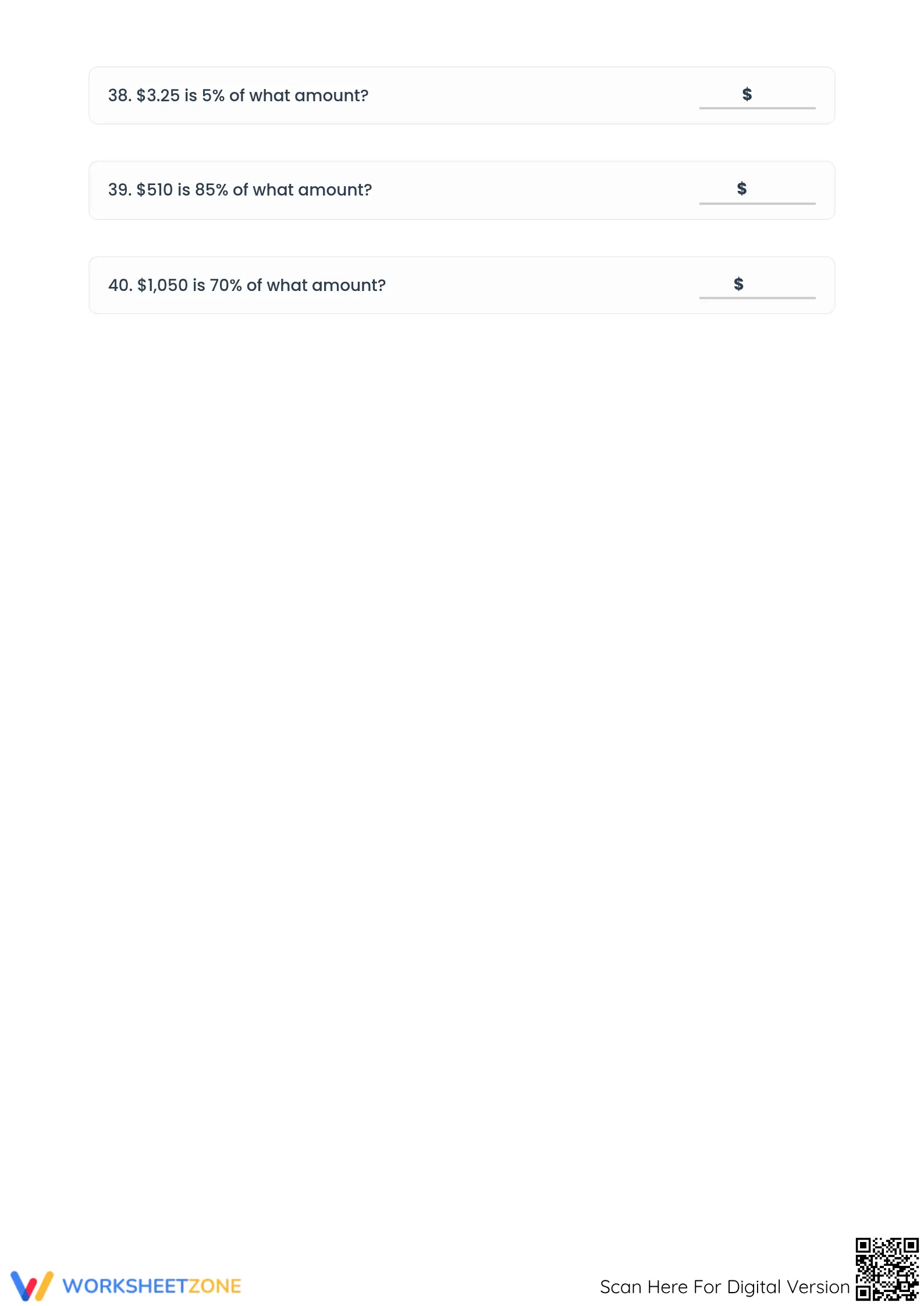

Printable Percent Worksheet: Finding Original Amount
Paste this activity's link or code into your existing LMS (Google Classroom, Canvas, Teams, Schoology, Moodle, etc.).
Students can open and work on the activity right away, with no student login required.
You'll still be able to track student progress and results from your teacher account.
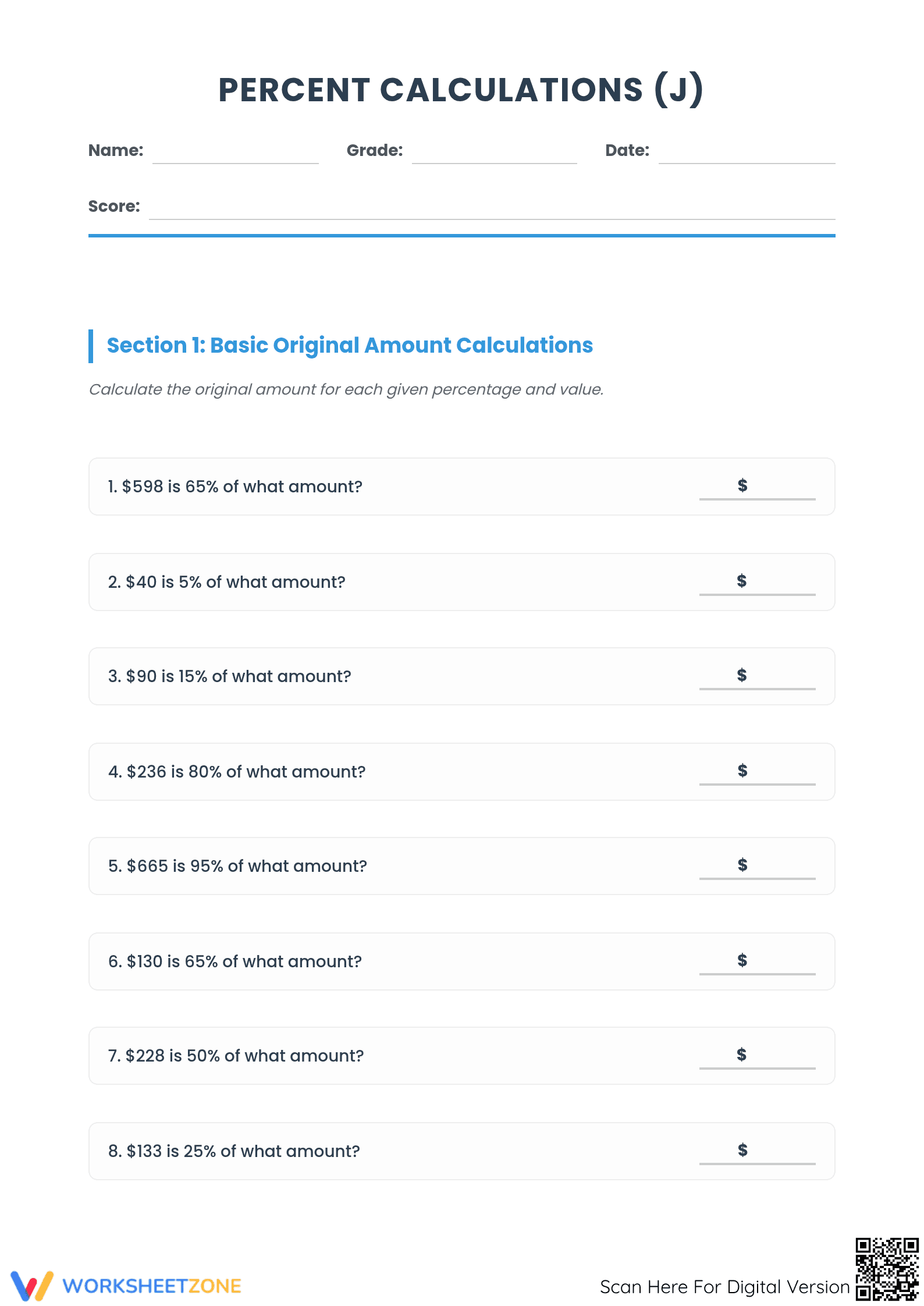
This Grade 6 Math worksheet provides comprehensive practice for students to calculate the original amount when a part and its corresponding percentage are known. By working through 40 structured problems, learners develop a deep understanding of backtracking percentage calculations, a critical skill for algebraic thinking and real-world financial literacy. This resource ensures students can confidently solve for the whole in various contexts.
At a Glance
- Grade: 6 · Subject: Math
- Standard:
CCSS.MATH.CONTENT.6.RP.A.3.C— Find a percent of a quantity as a rate per 100 and solve problems finding the whole- Skill Focus: Finding the base (original amount)
- Format: 5 pages · 40 problems · Answer key included · PDF
- Best For: Independent practice, homework, or formative assessment
- Time: 30–45 minutes
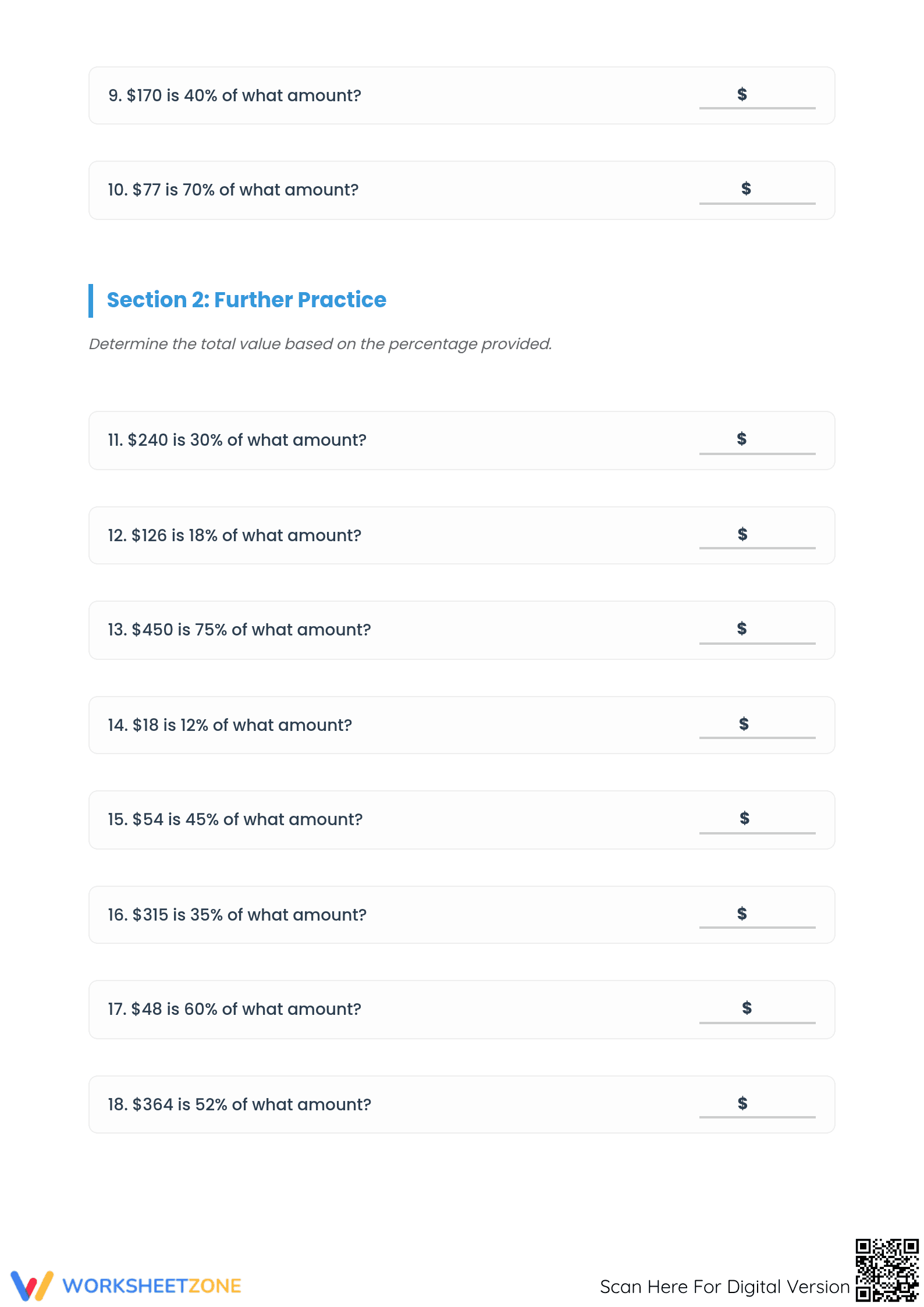
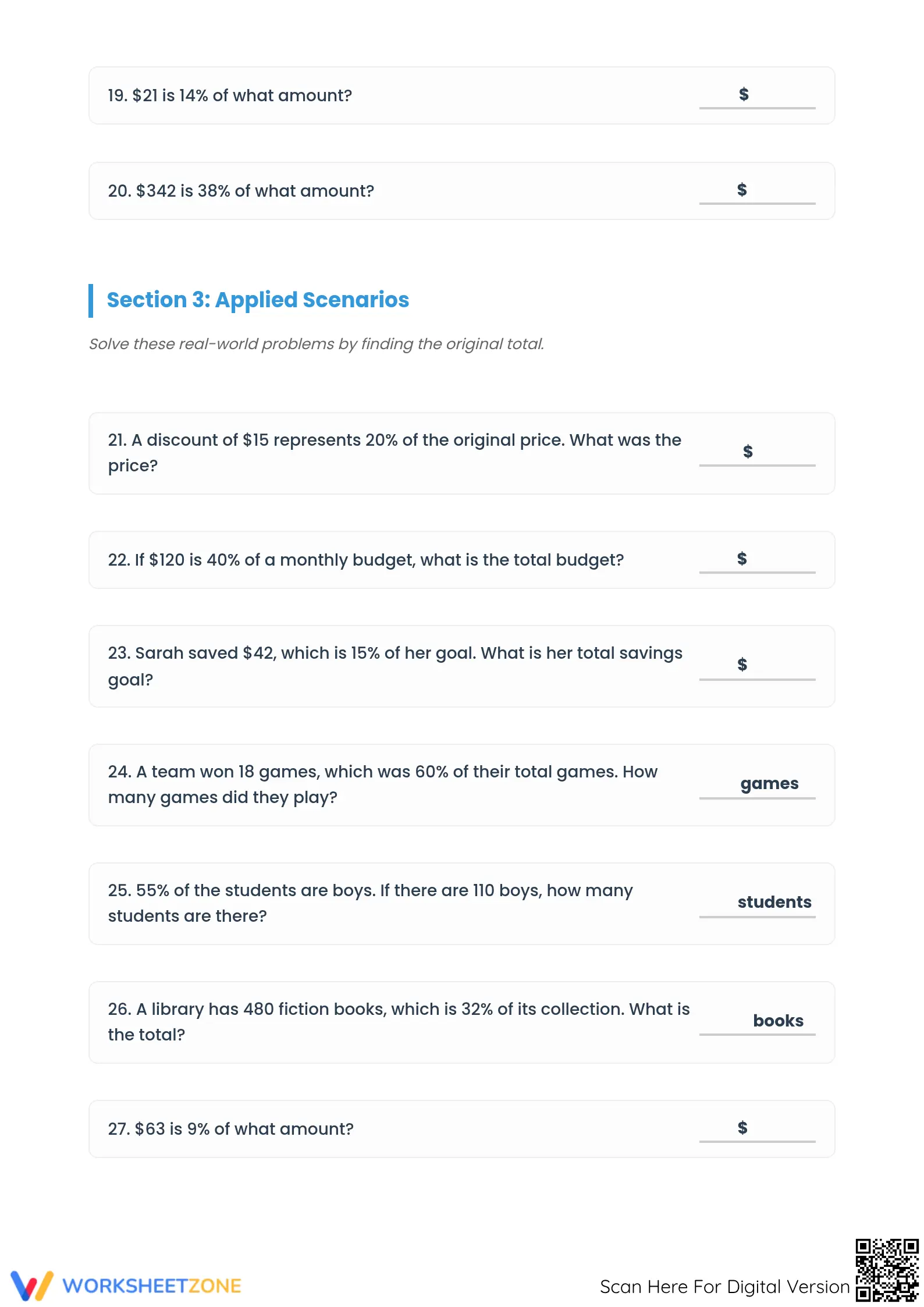
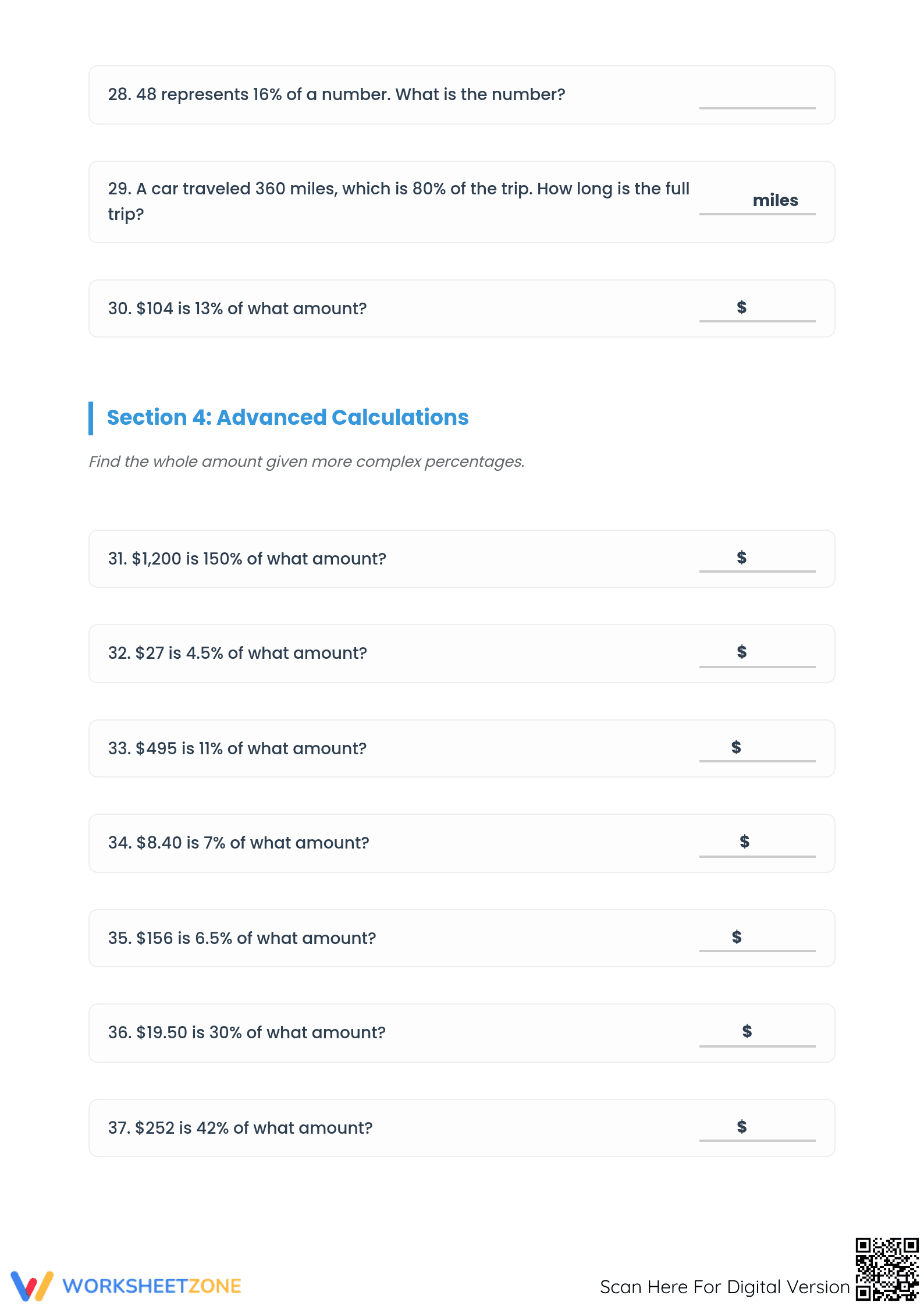
The worksheet is organized into four distinct sections that increase in complexity. It includes straightforward numerical calculations, applied real-world scenarios involving currency and miles, and advanced problems with decimal percentages and values greater than 100%. The five-page layout provides ample workspace for each of the 40 tasks, and a full answer key is included for immediate feedback and grading efficiency.
Skill Progression
- Guided Practice (10 problems): Basic original amount calculations focusing on friendly whole numbers and common percentages to build initial confidence.
- Supported Practice (10 problems): Further practice with a wider variety of percentages, encouraging students to apply consistent calculation methods.
- Independent Practice (20 problems): Applied scenarios and advanced calculations that require students to extract information from word problems and handle complex numerical values.
This structure follows a gradual-release model, moving from isolated skill practice to authentic application, ensuring students master the underlying concept before tackling higher-order demands.
Standards Alignment
This resource is strictly aligned with `CCSS.MATH.CONTENT.6.RP.A.3.C`: "Find a percent of a quantity as a rate per 100 (e.g., 30% of a quantity means 30/100 times the quantity); solve problems involving finding the whole, given a part and the percent." It also supports foundational algebraic reasoning by requiring students to solve for an unknown variable in the percentage formula. Both standard codes can be copied directly into lesson plans, IEP goals, or district curriculum mapping tools.
How to Use It
Use this worksheet after direct instruction on the relationship between parts, wholes, and percentages. It is ideal for the "You Do" phase of a lesson or as a review activity before an assessment. For a formative assessment observation, check if students are correctly identifying which value is the "part" and which is the "percent" before beginning their calculations. Expected completion time is 30 to 45 minutes depending on student proficiency.
Who It's For
This practice set is designed for Grade 6 students but is also appropriate for Grade 7 and 8 learners who require remediation or extra fluency practice with percentage concepts. It serves as an excellent resource for general education classrooms, small group intervention, or as a structured supplement to a core curriculum passage or anchor chart on ratios and proportional relationships.
The ability to find the original amount is a cornerstone of proportional reasoning, as emphasized in the NAEP framework. Research from Fisher & Frey (2014) indicates that scaffolded practice, moving from basic computation to word-problem application, significantly improves retention of mathematical procedures. By engaging with 40 diverse tasks, students reinforce the inverse relationship between multiplication and division within the context of percentages. This worksheet addresses common misconceptions, such as confusing the part for the whole, by providing clear section headers and varied problem types.


