


























Views
Downloads

Essential Reverse Percentage Worksheet | Grade 6-7 Math
Paste this activity's link or code into your existing LMS (Google Classroom, Canvas, Teams, Schoology, Moodle, etc.).
Students can open and work on the activity right away, with no student login required.
You'll still be able to track student progress and results from your teacher account.
Students master the critical financial skill of finding the whole when given a part and a percentage. This comprehensive worksheet guides learners through reverse calculations using currency and decimal values, ensuring they can backtrack from a known interest or discount to the original principal amount. It provides the structured practice needed for real-world mathematical literacy.
At a Glance
- Grade: 6–7 · Subject: Math
- Standard:
6.RP.A.3.c— Find the whole, given a part and the percent- Skill Focus: Reverse Percentage Calculations
- Format: 4 pages · 44 problems · Answer key included · PDF
- Best For: Financial math and ratio mastery
- Time: 40–50 minutes
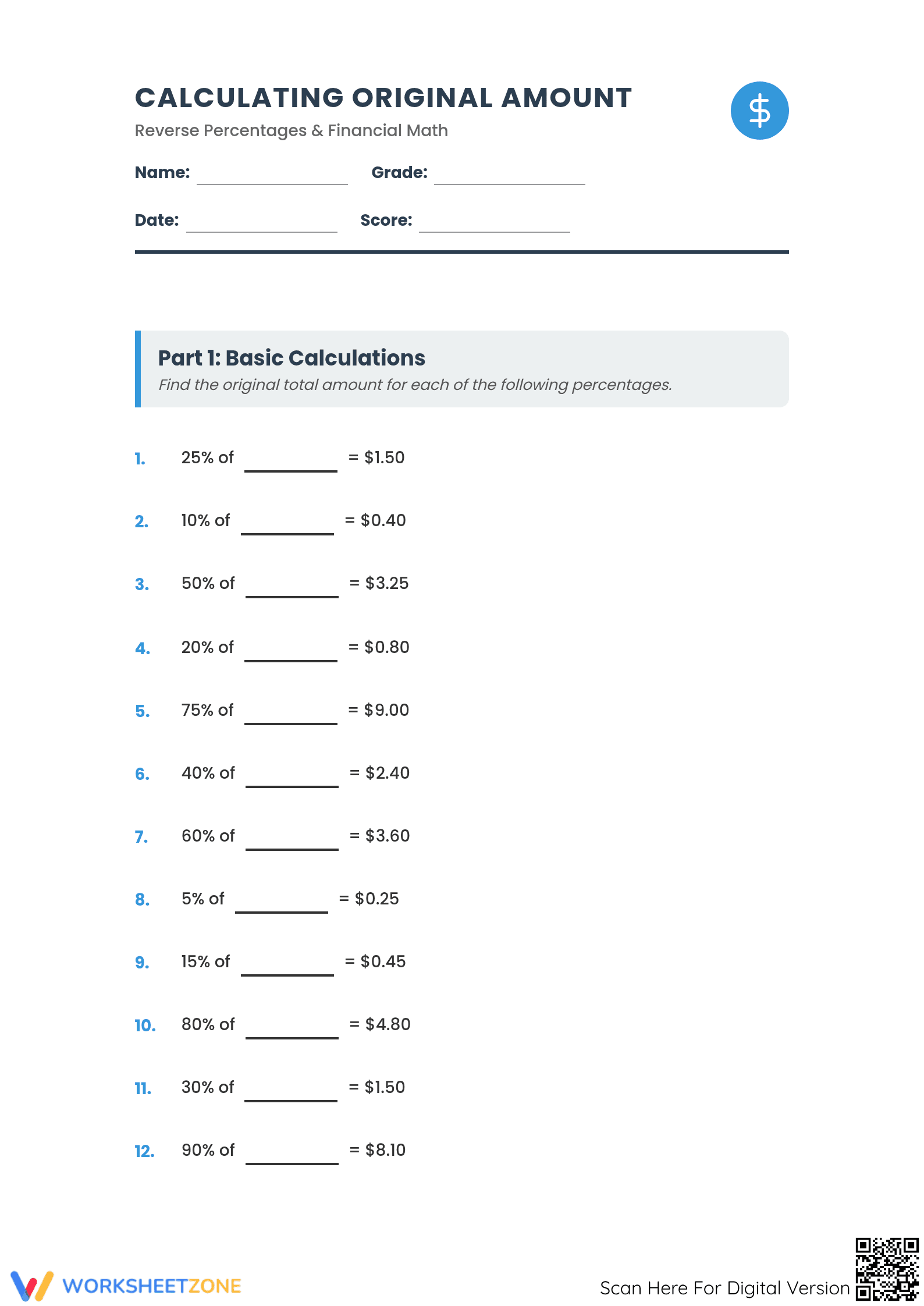
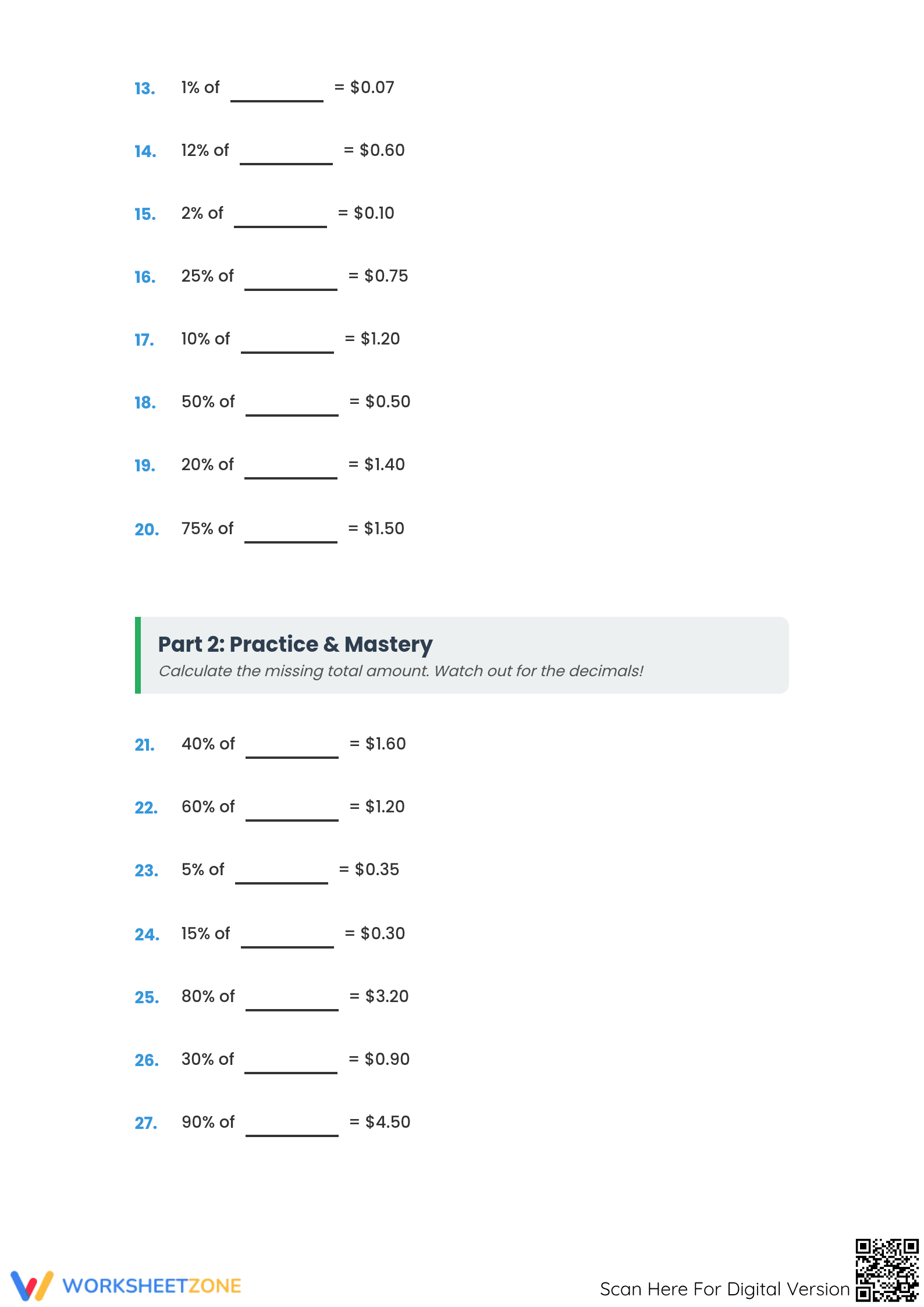
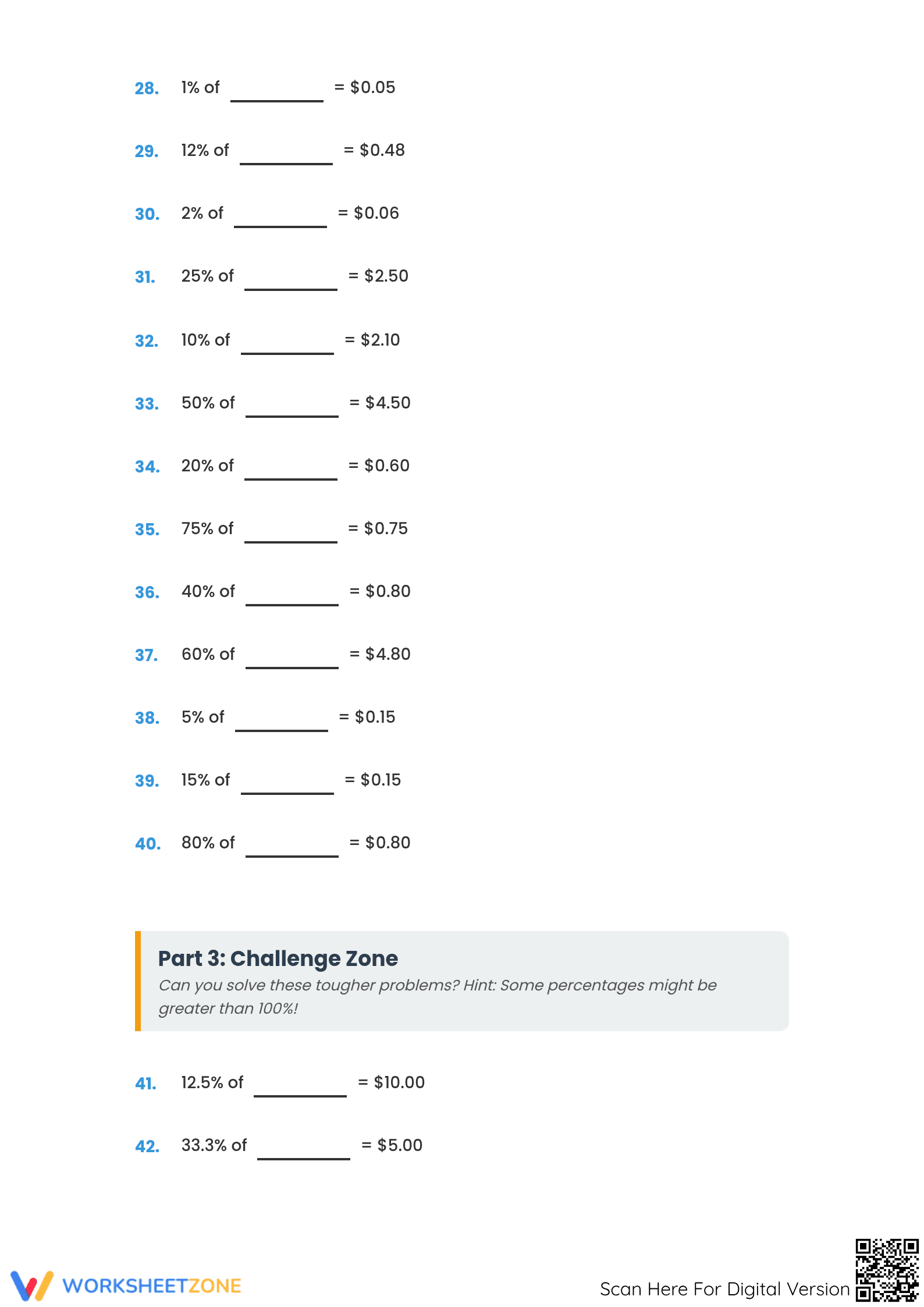
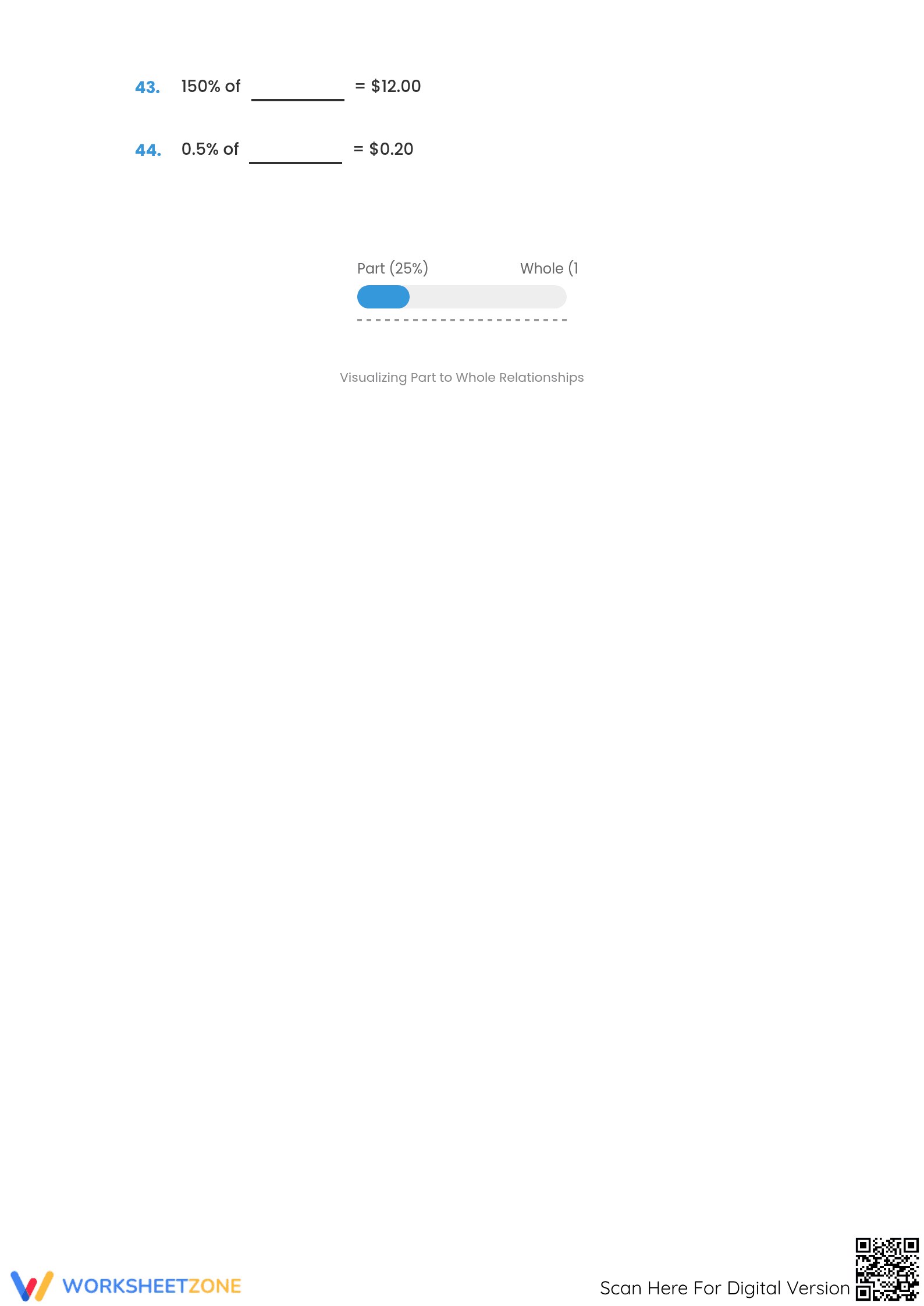
The resource features four pages of increasingly complex problems divided into three distinct sections. Students start with basic currency-based reverse percentages, move into practice and mastery with more varied decimal values, and finish with a challenge zone including percentages above 100%. A clear visual diagram at the end reinforces the part-to-whole relationship, and a complete answer key simplifies the grading process.
Skill Progression
- Guided Practice: Problems 1 through 20 focus on introductory calculations with common percentages like 10%, 25%, and 50% using currency. These tasks establish the fundamental procedural steps for dividing the value by the percentage rate to find the whole.
- Supported Practice: Problems 21 through 40 introduce more varied rates and decimal results. Students must maintain precision while applying the "backtracking" method to determine the original total amount.
- Independent Practice: The Challenge Zone features high-rigor problems with fractional percentages like 12.5% and 33.3%, as well as values greater than 100%. These ensure true conceptual mastery of proportional relationships.
This structure follows the gradual-release model, moving from scaffolded currency problems to complex independent calculations.
Standards Alignment
This resource is primarily aligned with 6.RP.A.3.c, which requires students to find the whole, given a part and the percent. The inclusion of currency and decimals also supports 7.RP.A.3 by applying proportional relationships to solve multi-step ratio and percent problems. Both standard codes can be copied directly into lesson plans, IEP goals, or district curriculum mapping tools.
How to Use It
Use this worksheet as an independent practice set after a direct instruction lesson on finding the whole. It is particularly effective when students struggle to distinguish between calculating a percent of a number and performing reverse calculations. For a formative observation, check if students are correctly converting the percentage to a decimal before dividing. This 4-page set typically takes 45 minutes to complete.
Who It's For
This set is designed for Grade 6 and Grade 7 students practicing ratios and proportional reasoning. It is ideal for general education classrooms, small group intervention, or as an accelerated activity for Grade 5 learners. Pair this with a visual percentage bar model or anchor chart to support students who need additional scaffolding for the Challenge Zone problems.
Finding the original amount from a percentage requires high-level cognitive "backtracking" that transitions students from procedural arithmetic to algebraic thinking. Mastery of reverse percentages is a key indicator of readiness for high school financial literacy. This 44-problem worksheet leverages the gradual-release model to reduce cognitive load, ensuring students reach the fluency threshold for real-world applications such as calculating original prices before discounts or principal amounts before interest. This worksheet meets modern rigorous assessment criteria by providing a clear progression toward mastery through structured financial math exercises.


