


























Views
Downloads
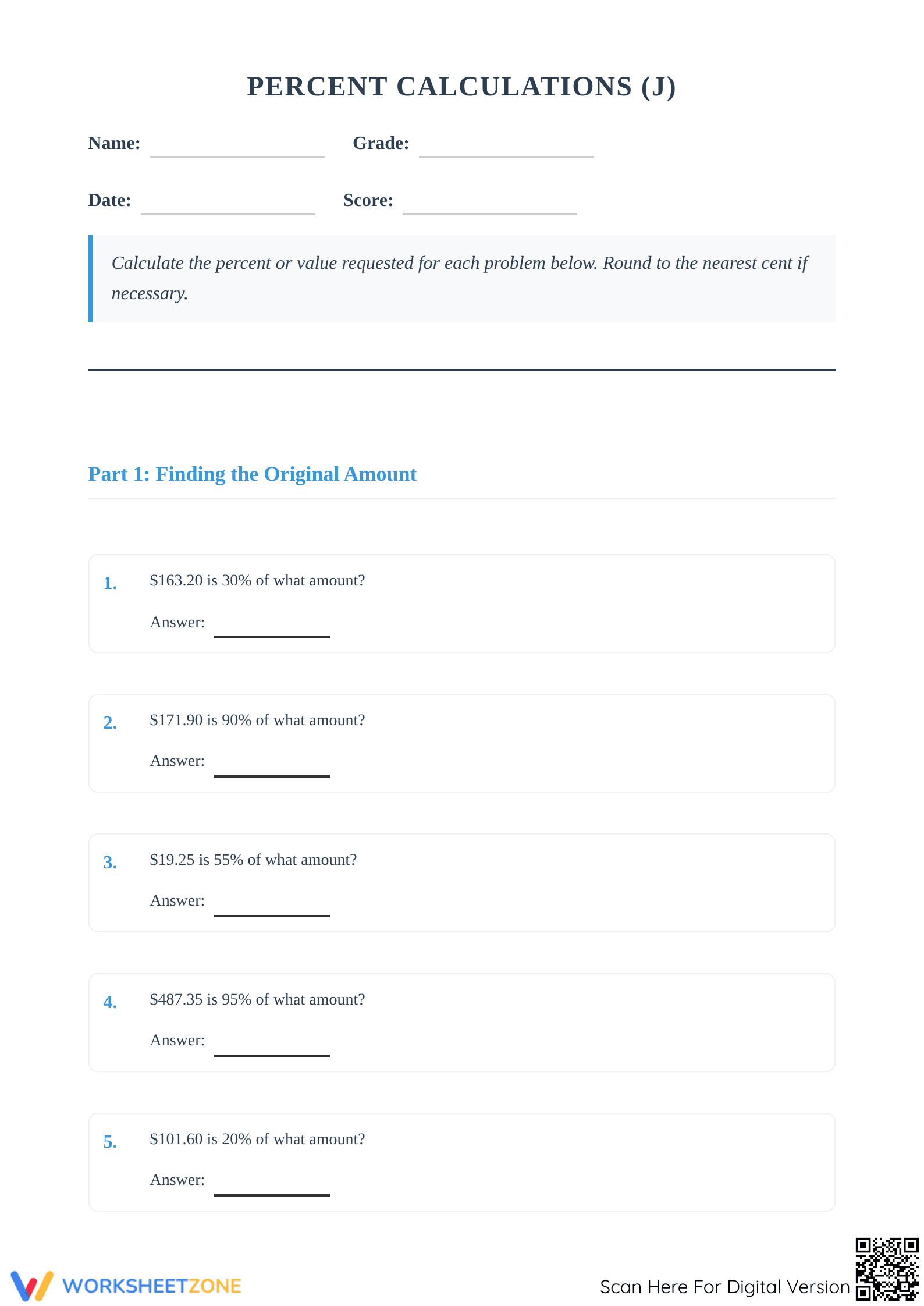
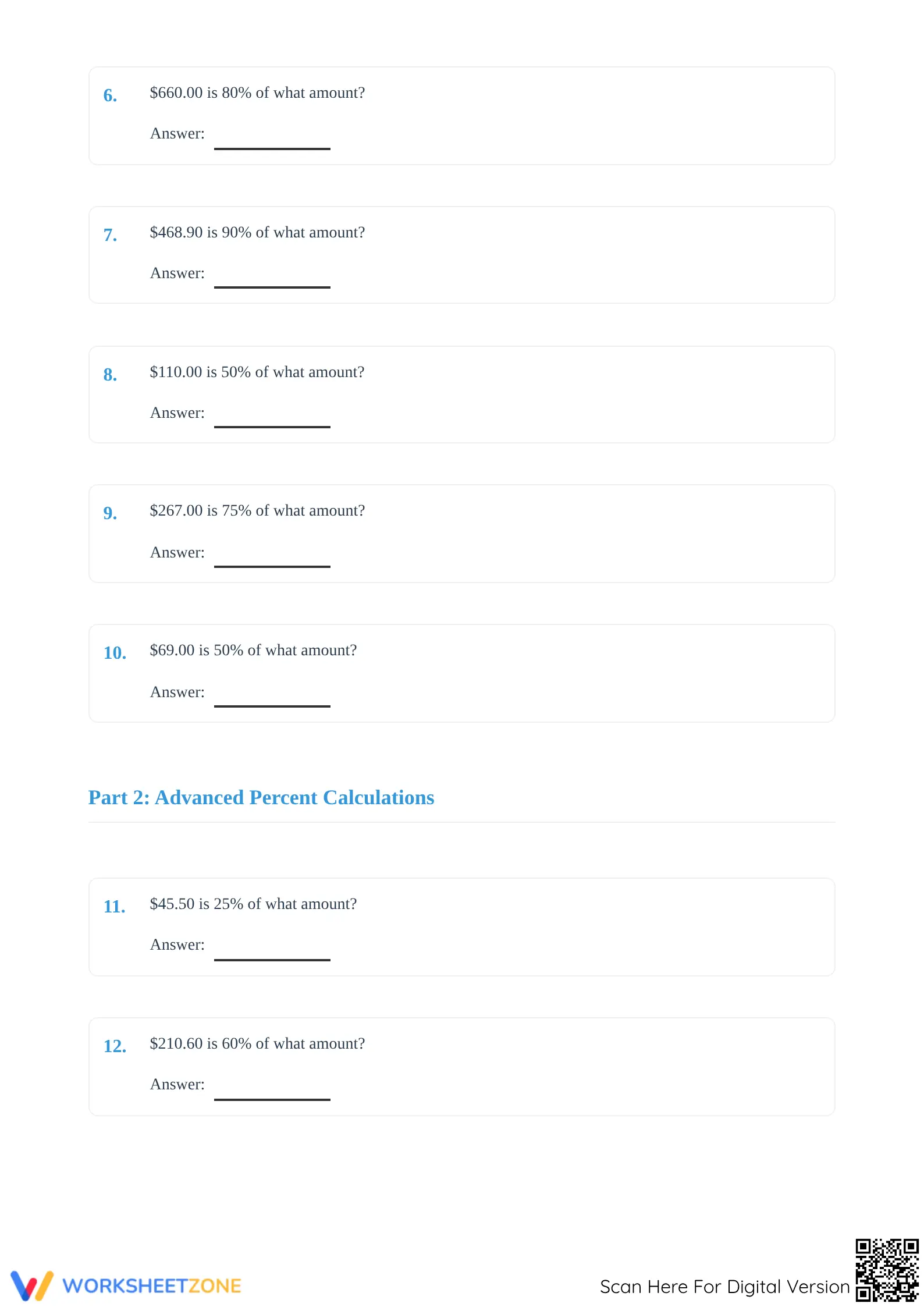
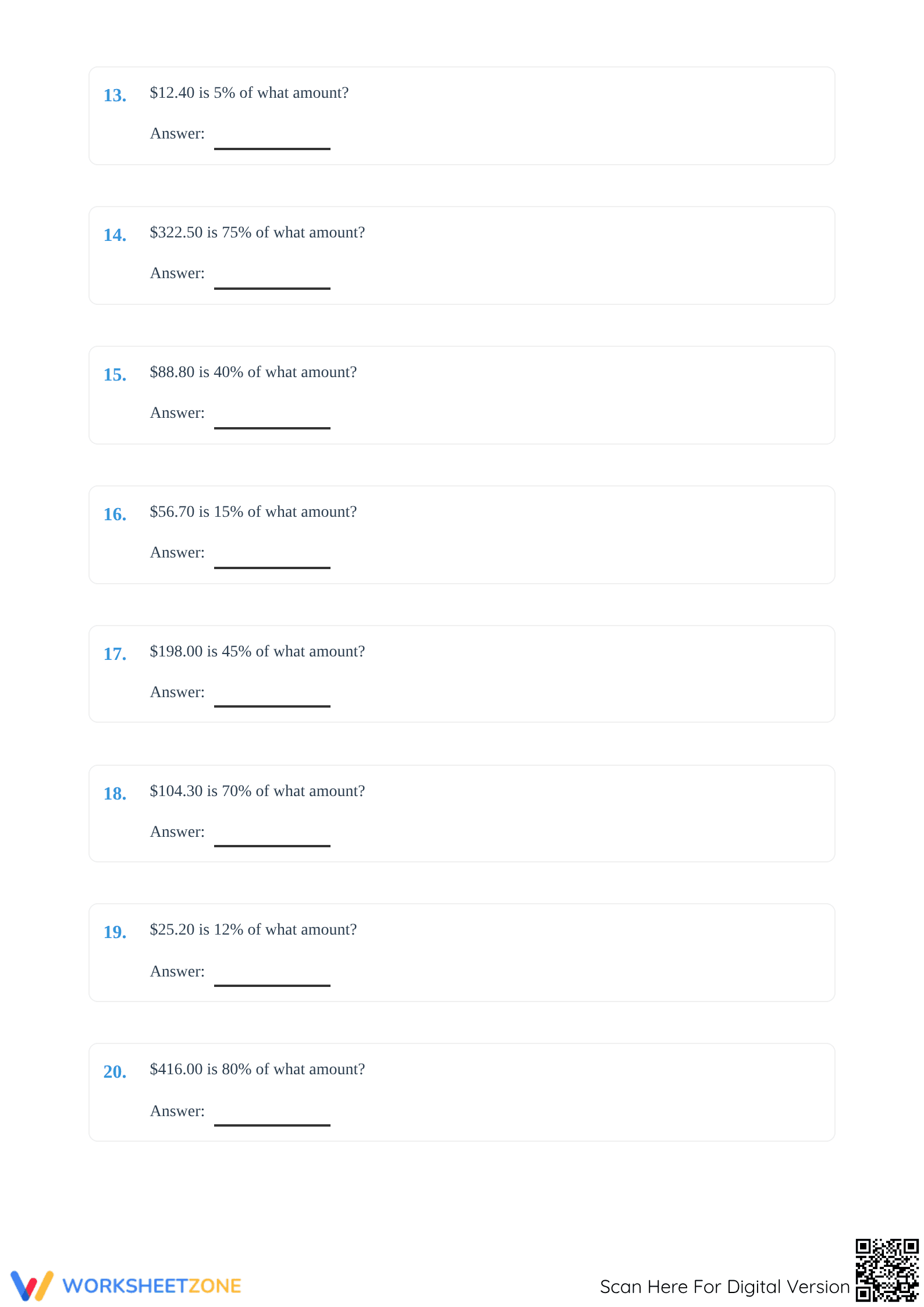
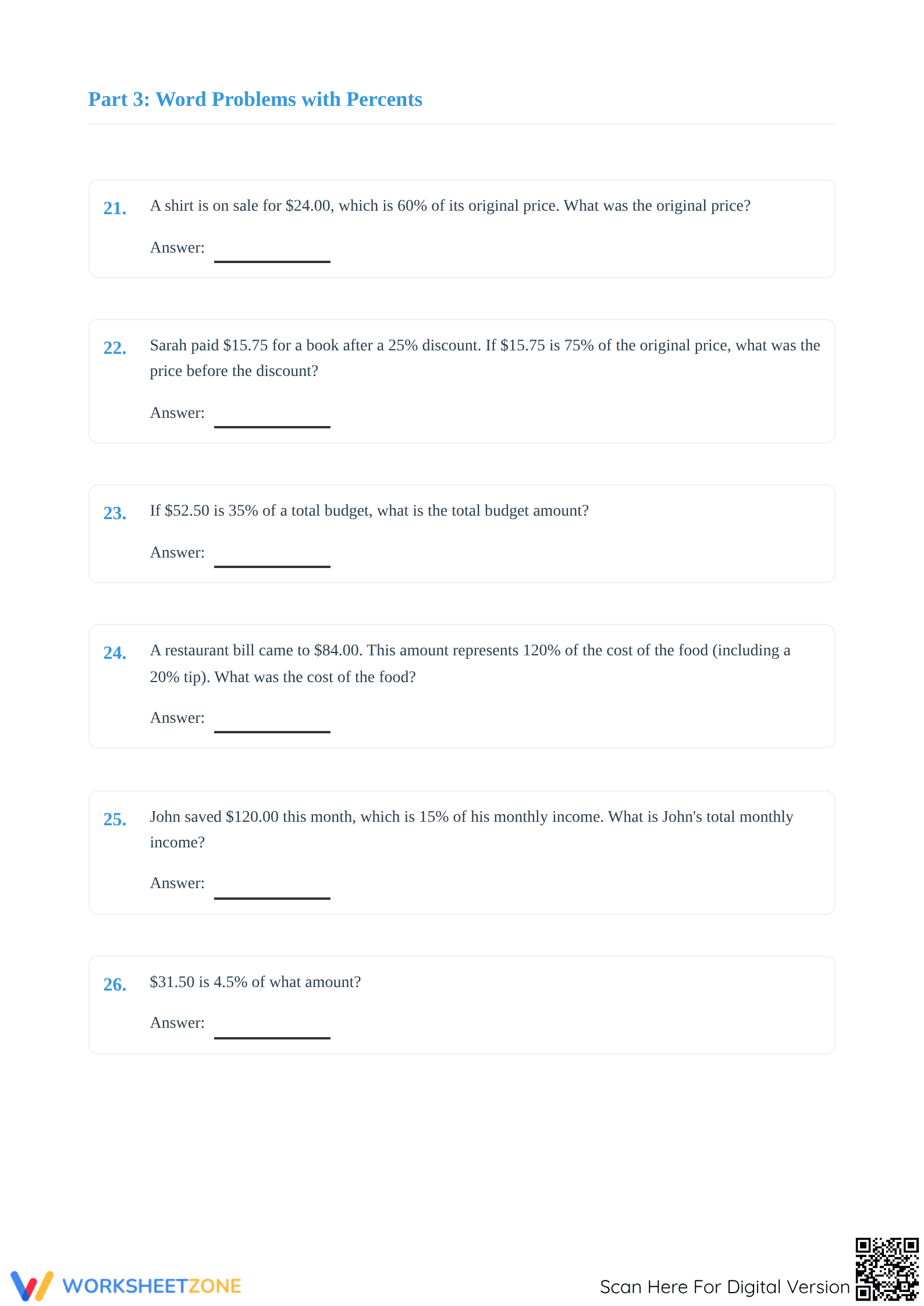

Essential Grade 7 Math Worksheet: Finding the Original Amount
Paste this activity's link or code into your existing LMS (Google Classroom, Canvas, Teams, Schoology, Moodle, etc.).
Students can open and work on the activity right away, with no student login required.
You'll still be able to track student progress and results from your teacher account.
Master the logic of reverse percentages with this comprehensive Grade 7 math resource. Instead of calculating a part of a whole, students are challenged to "backtrack" to find the original amount when the percentage and resulting value are known. This critical skill builds the algebraic thinking necessary for advanced proportional reasoning and real-world financial calculations.
At a Glance
- Grade: 7 · Subject: Math
- Standard:
7.RP.A.3— Use proportional relationships to solve multistep ratio and percent problems- Skill Focus: Reverse Percentages (Finding the Whole)
- Format: 5 pages · 32 problems · Answer key included · PDF
- Best For: Independent practice and skill reinforcement
- Time: 45–60 minutes
What's Inside
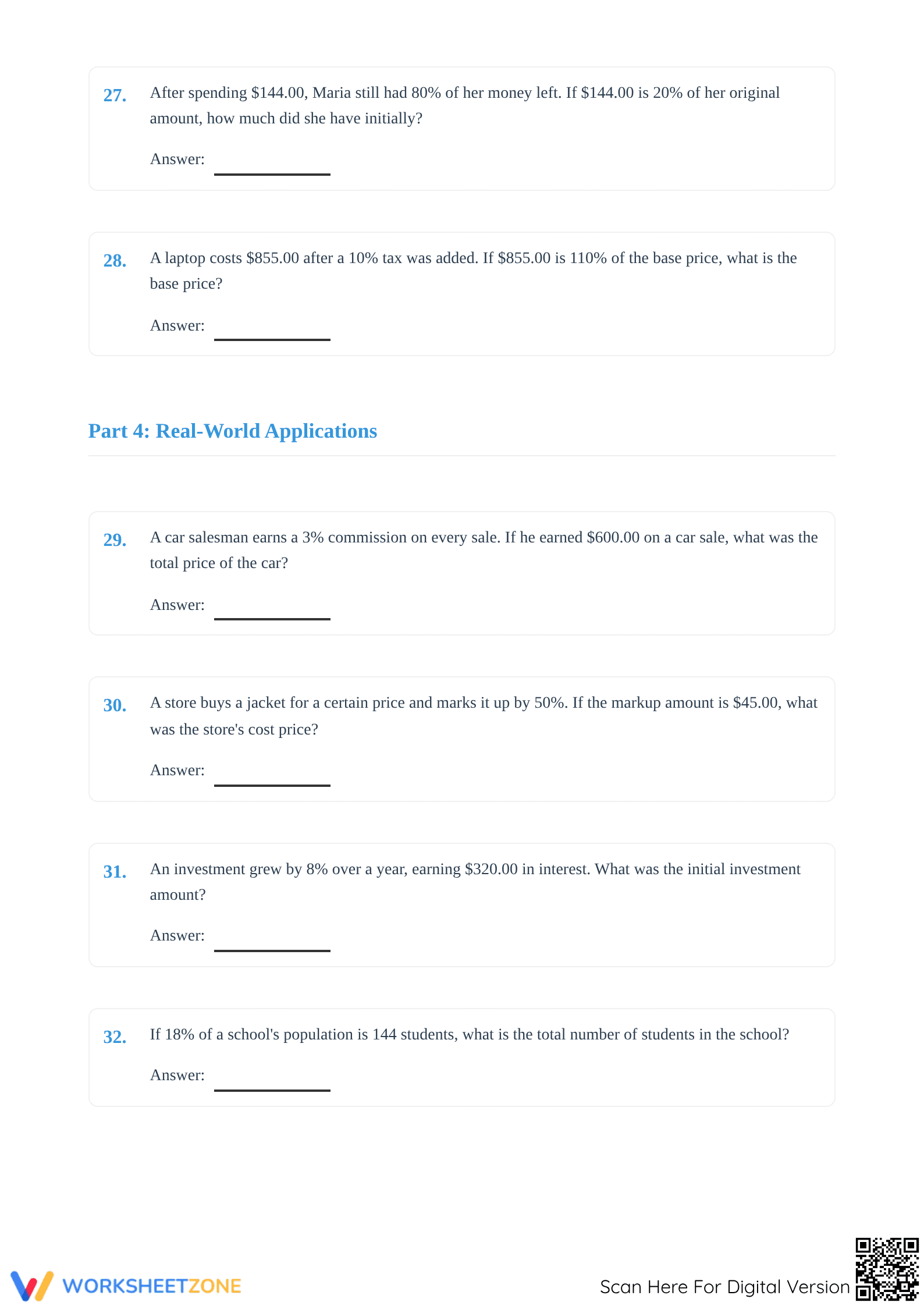
This expansive 5-page PDF contains 32 meticulously crafted problems divided into four distinct sections. Students begin with direct numerical queries before advancing to complex calculations involving decimals and currency. The set includes a multi-page answer key for immediate feedback, ensuring teachers can quickly verify student work across all real-world application tasks.
Skill Progression
- Guided Practice: The first 10 problems provide direct numerical prompts (e.g., "$163.20 is 30% of what amount?") to isolate the core calculation and build procedural fluency.
- Supported Practice: Problems 11-20 introduce advanced calculations with varying percentages and decimal values, requiring students to maintain accuracy across different scales.
- Independent Application: The final 12 tasks present word problems and real-world scenarios, such as calculating original prices from sales or initial investments from interest, requiring students to translate text into equations.
This gradual release model ensures students move from algorithmic understanding to conceptual mastery.
Standards Alignment
Aligned strictly to `CCSS.MATH.CONTENT.7.RP.A.3`, students use proportional relationships to solve multistep ratio and percent problems. By solving for the "whole" rather than the "part," learners demonstrate a deep understanding of percent as a rate per 100. This standard code can be copied directly into lesson plans, IEP goals, or district curriculum mapping tools.
How to Use It
Deploy this worksheet during the "You Do" phase of a lesson on percentages to solidify understanding of reverse calculations. It serves as an excellent formative assessment tool; observe how students set up their proportions or equations to identify misconceptions early. Expect a completion time of 45-60 minutes depending on prior student exposure.
Who It's For
This resource is designed for Grade 7 math students but is highly effective for Grade 8 review or as a targeted intervention for high schoolers struggling with consumer math. It provides enough volume for IEP progress monitoring and naturally pairs with a lesson on sales tax and discounts.
According to research from Fisher & Frey (2014) on the gradual release of responsibility, students master complex proportional reasoning when tasks transition from direct calculation to contextualized word problems. This worksheet aligns with `CCSS.MATH.CONTENT.7.RP.A.3`, requiring learners to find the original amount when given a percentage and its value. Mastery of this "backtracking" logic is a critical prerequisite for algebraic fluency and financial literacy. By engaging with 32 distinct problems involving currency and decimals, students move beyond rote memorization into structural understanding of percentages. Studies in ScienceDirect TpT Analysis indicate that high-repetition practice sets with increasing complexity significantly reduce cognitive load during independent work. This resource provides the necessary scaffolding for middle schoolers to bridge the gap between abstract ratios and real-world applications, ensuring they can accurately calculate totals in tax, tip, and discount scenarios common in secondary mathematics and daily consumer life.


