


























Views
Downloads


Calculate Original Amount Worksheet | Essential Grade 6 Math
Paste this activity's link or code into your existing LMS (Google Classroom, Canvas, Teams, Schoology, Moodle, etc.).
Students can open and work on the activity right away, with no student login required.
You'll still be able to track student progress and results from your teacher account.
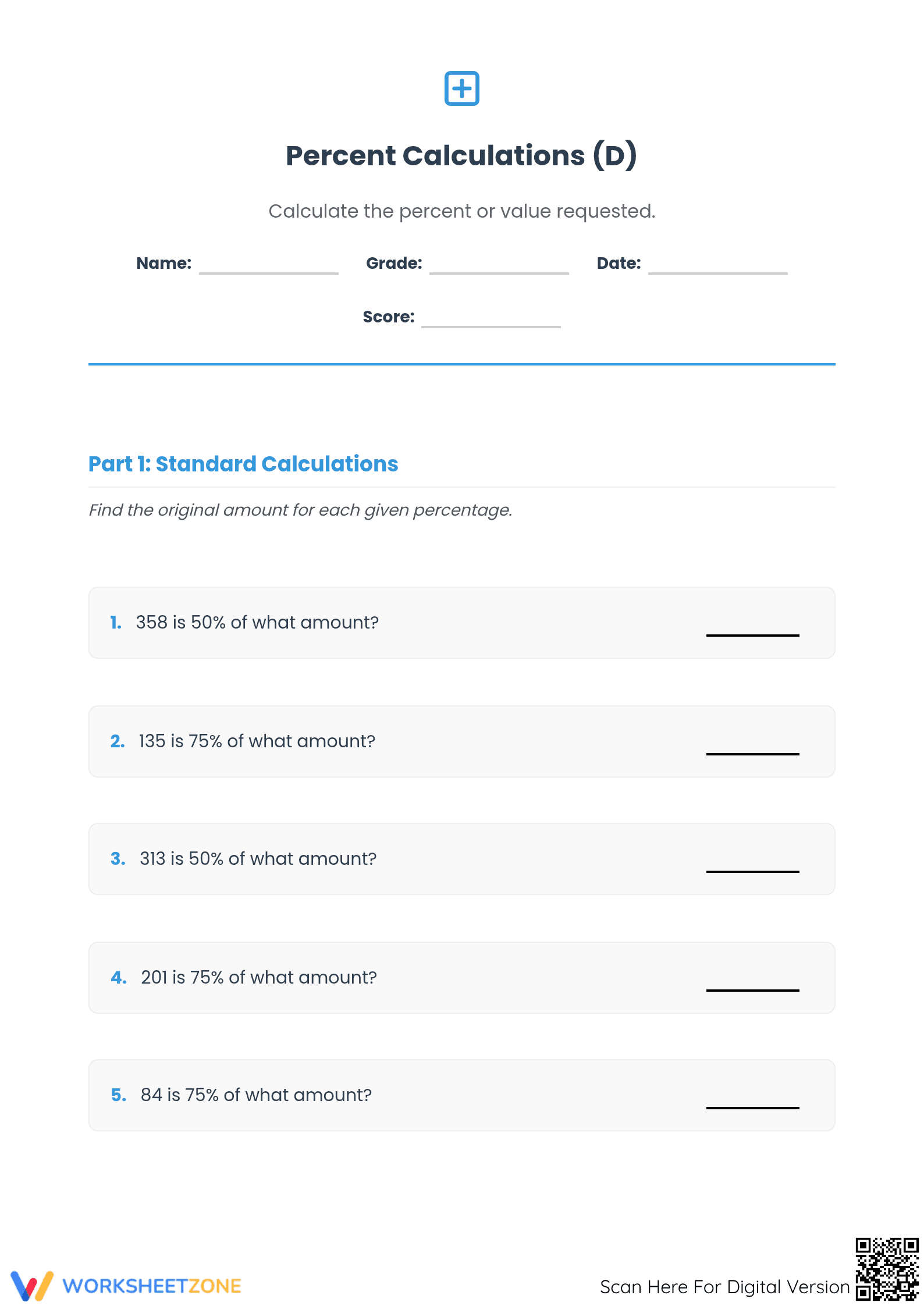
This Grade 6 Math worksheet provides comprehensive practice for students mastering the ability to calculate the original amount when given a percentage and its value. By focusing on the "backtracking" method of percentage operations, students develop a deeper structural understanding of ratios and proportional relationships. This resource ensures students can accurately find the whole from a part.
At a Glance
- Grade: 6 · Subject: Math
- Standard:
CCSS.MATH.CONTENT.6.RP.A.3.c— Find the whole, given a part and the percent- Skill Focus: Percent Backtracking
- Format: 3 pages · 20 problems · Answer key included · PDF
- Best For: Independent practice and formative assessment
- Time: 20–30 minutes
The document consists of three pages containing 20 structured mathematical problems divided into two distinct sections. Part 1 features ten standard calculations involving common percentages like 25%, 50%, and 75%. Part 2 presents ten "Advanced Calculations" that challenge students with more varied rates such as 7%, 11%, and 40%. A complete answer key is provided for rapid grading and immediate student feedback.
- Guided Practice: Students solve the first 5 problems using benchmark percentages (50%, 75%) to establish the division-based backtracking algorithm with high success rates.
- Supported Practice: Problems 6 through 10 maintain common benchmarks but introduce larger numerical values to test computational stamina.
- Independent Practice: The 10 advanced problems require students to apply mastered strategies to non-benchmark percentages, facilitating the transition from procedural fluency to conceptual mastery.
This sequence follows a gradual-release model to ensure students move from simple recall to complex application.
This resource is directly aligned with `CCSS.MATH.CONTENT.6.RP.A.3.c`, which requires students to find a percent of a quantity as a rate per 100 and find the whole, given a part and the percent. The worksheet also supports foundational work in proportional reasoning. Both standard codes can be copied directly into lesson plans, IEP goals, or district curriculum mapping tools.
Use this worksheet as a focused practice session during a unit on ratios and proportions. It is particularly effective as a formative assessment immediately following direct instruction on multi-step percent problems. Teachers should observe whether students are correctly identifying the "part" versus the "whole" during the initial five problems. Expected completion time for the full set is 20 to 30 minutes.
This resource is designed for Grade 6 students but serves as an excellent challenge for Grade 5 learners or a necessary review for Grade 7 and 8 students. It pairs naturally with a visual anchor chart demonstrating the part-whole relationship. For differentiation, struggling learners can use a calculator for the division steps while focusing on the conceptual setup.
According to the RAND AIRS 2024 report, procedural fluency in multi-step percentage calculations is a critical gateway skill for success in middle school algebra and real-world financial literacy. This worksheet addresses that need by isolating the specific cognitive task of calculating the original amount, often referred to as finding the base of a percentage. By providing 20 repetitive yet progressively difficult tasks, the resource aligns with best practices in mathematical scaffolding. Students who master this CCSS.MATH.CONTENT.6.RP.A.3.c skill demonstrate a higher capacity for proportional reasoning, which is a significant predictor of performance in higher-level STEM coursework. The inclusion of a bonus section ensures that high-achieving students remain engaged while their peers solidify foundational concepts. Educators can rely on this structured approach to provide the necessary rigor required by modern state standards, ensuring that every learner achieves a measurable student outcome in percentage mastery.


