


























Views
Downloads

Essential 25% Percentage Worksheet | Grade 4-8 Math
Paste this activity's link or code into your existing LMS (Google Classroom, Canvas, Teams, Schoology, Moodle, etc.).
Students can open and work on the activity right away, with no student login required.
You'll still be able to track student progress and results from your teacher account.
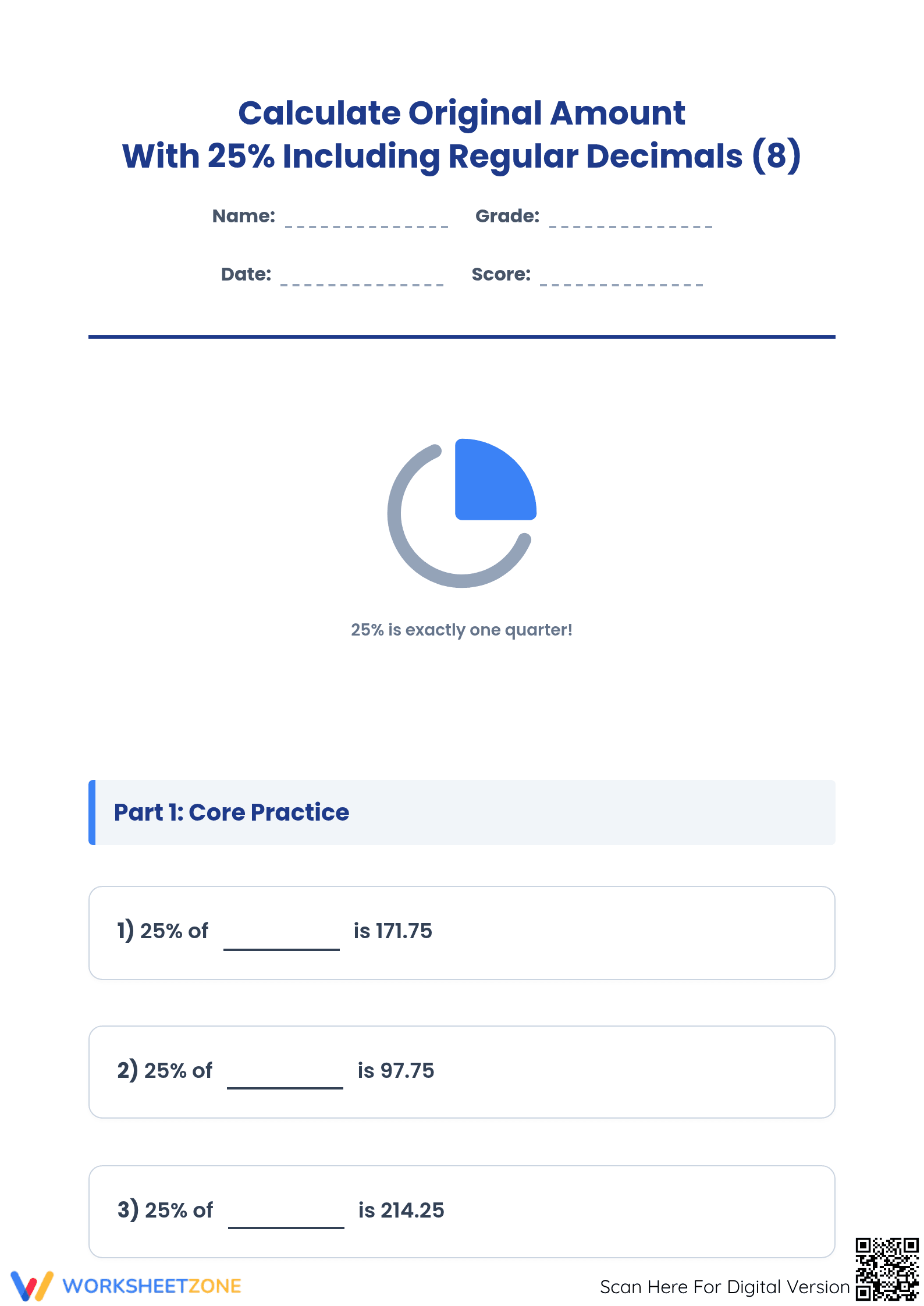
Mastering percentage calculations is a foundational requirement for middle school mathematics. This worksheet focuses on calculating the original amount when given a 25% part, a concept known as backtracking. By solving 24 problems, students develop the mental models necessary to understand proportionality and the inverse relationship between parts and wholes in varied decimal contexts.
At a Glance
- Grade: 4–8 · Subject: Math
- Standard:
CCSS.MATH.CONTENT.6.RP.A.3.C— Find the whole, given a part and the percent- Skill Focus: Calculating original amounts from 25% values
- Format: 4 pages · 24 problems · Answer key included · PDF
- Best For: Independent practice and formative assessment
- Time: 25–40 minutes
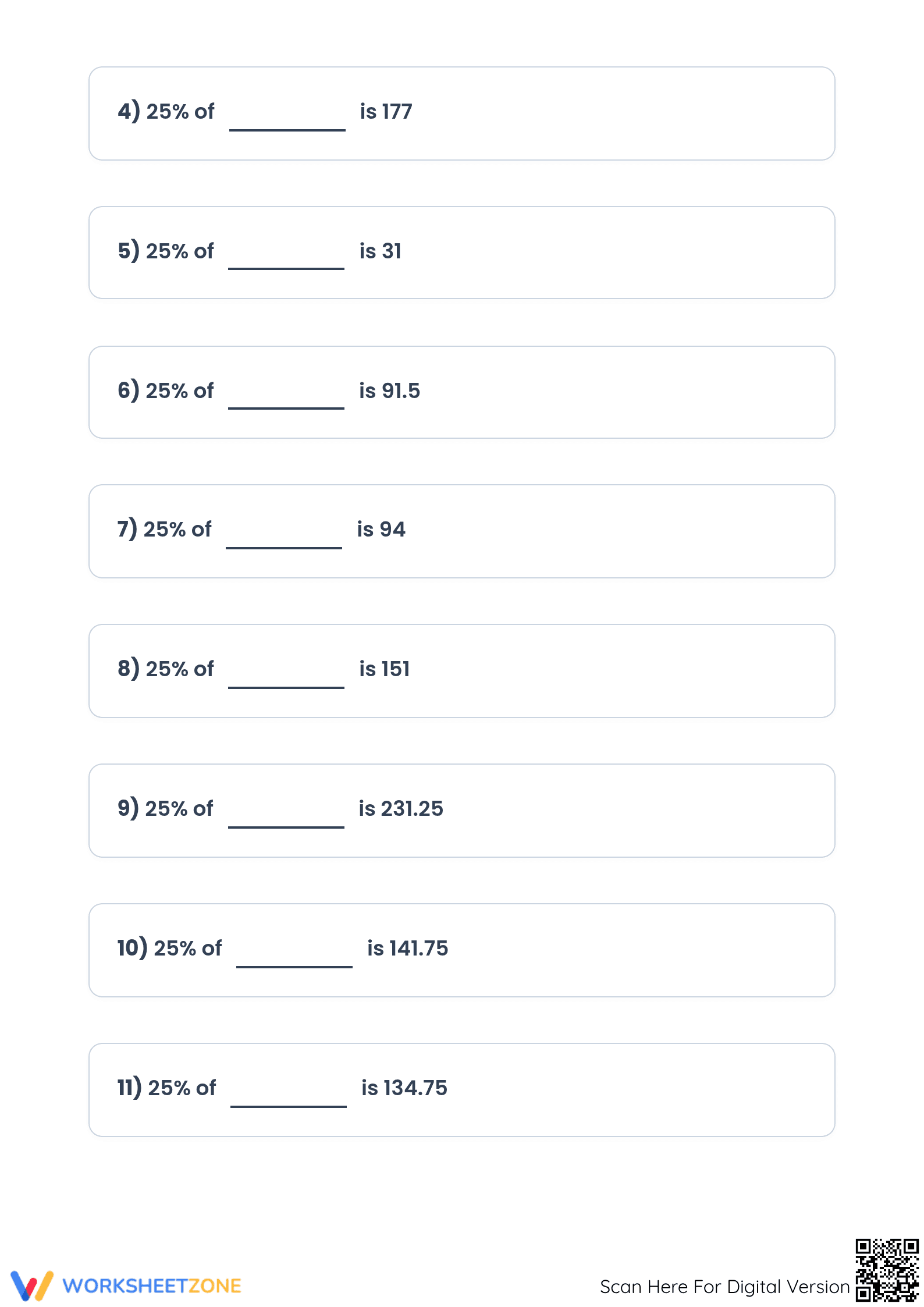
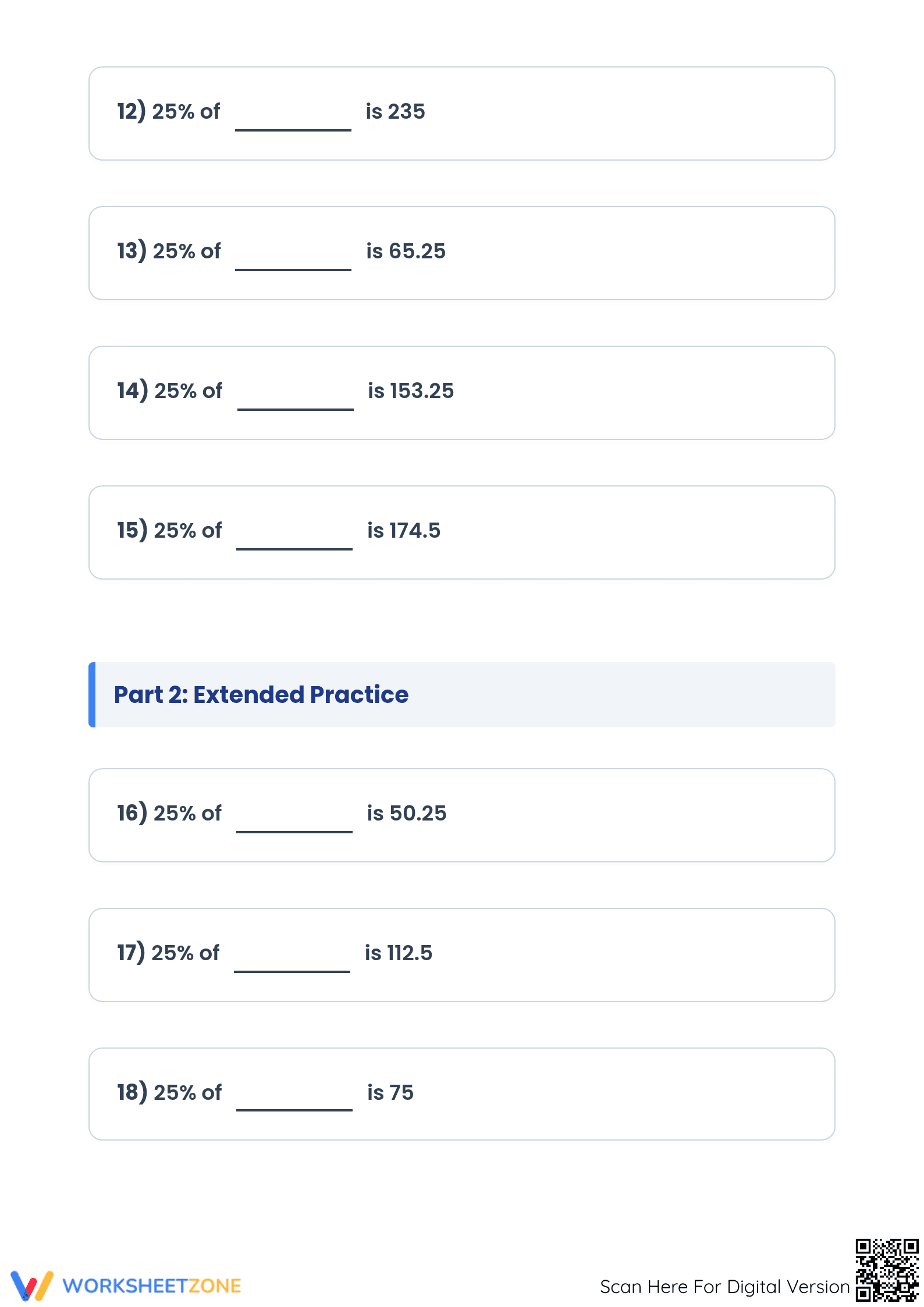
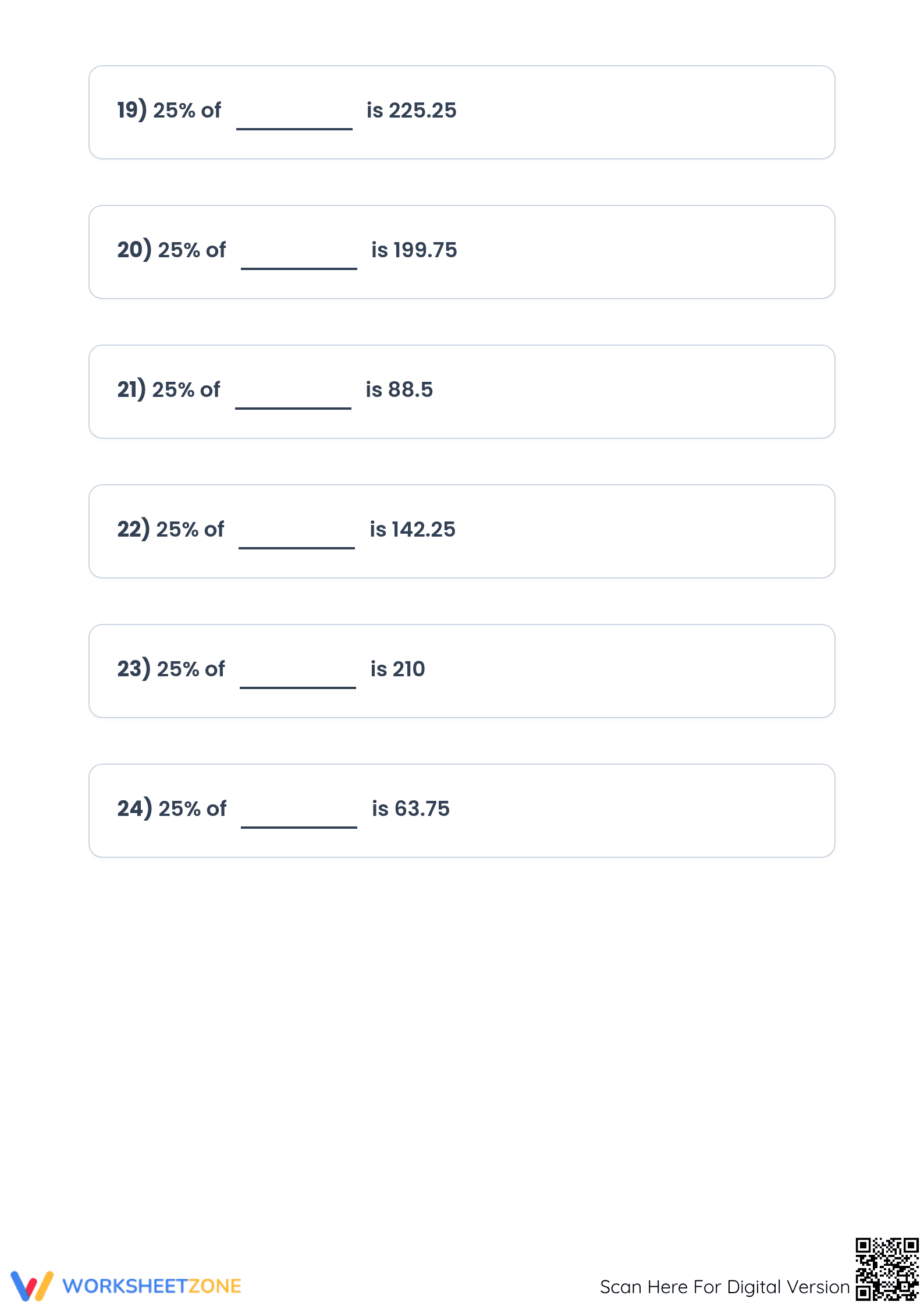
This comprehensive 4-page PDF contains two distinct sections of practice. The first fifteen problems focus on core mastery, providing a predictable structure to help students internalize the calculation method. The final nine problems offer extended practice to ensure students can handle regular decimals with precision. A full answer key is included for rapid grading and immediate student feedback.
The exercise set is structured for a natural skill progression through 24 tasks. First, students engage in guided practice by solving the initial set of fifteen problems which emphasize the core mechanics of dividing by 0.25 or multiplying by four. Then, supported practice continues in the extended section where students refine their accuracy. Finally, independent practice is achieved as students complete the full set without teacher intervention.
This resource is aligned to `CCSS.MATH.CONTENT.6.RP.A.3.C`, which requires students to find a percent of a quantity as a rate per 100 and find the whole, given a part and the percent. The worksheet provides focused evidence of student understanding for this specific sub-skill. Both standard codes can be copied directly into lesson plans, IEP goals, or district curriculum mapping tools.
Use this worksheet as a formative assessment after introducing the concept of percentages as rates. Teachers can observe the first five problems to identify students struggling with decimal division before allowing the class to work independently. Expected completion time ranges from 25 to 40 minutes, making it an ideal choice for a single-period activity or a substantial homework assignment.
This activity is for students in Grade 4 through Grade 8 developing proportional reasoning skills. It is effective for learners who benefit from structured practice to build procedural fluency. For best results, pair this worksheet with an anchor chart showing the relationship between 25%, one-quarter, and the decimal 0.25.
The ability to solve for the whole in percentage relationships is a critical indicator of proportional reasoning proficiency in middle school. This worksheet targets CCSS.MATH.CONTENT.6.RP.A.3.C by requiring learners to calculate original amounts when 25% is known. Consistent application of the inverse relationship between multiplication and division within a percentage context strengthens the understanding of how decimal values relate to a complete set. The structured format provides 24 opportunities for repetition, which Fisher & Frey (2014) suggests is essential for procedural fluency. For Grade 4 through 8 students, mastering this logic ensures they can move confidently toward multi-step algebraic expressions. This resource serves as a bridge between basic percentage calculation and advanced coursework, providing clear evidence of student mastery as noted in RAND AIRS 2024 research.


