


























Views
Downloads

Printable 25% Original Amount Worksheet | Grade 4-8 Math
Paste this activity's link or code into your existing LMS (Google Classroom, Canvas, Teams, Schoology, Moodle, etc.).
Students can open and work on the activity right away, with no student login required.
You'll still be able to track student progress and results from your teacher account.
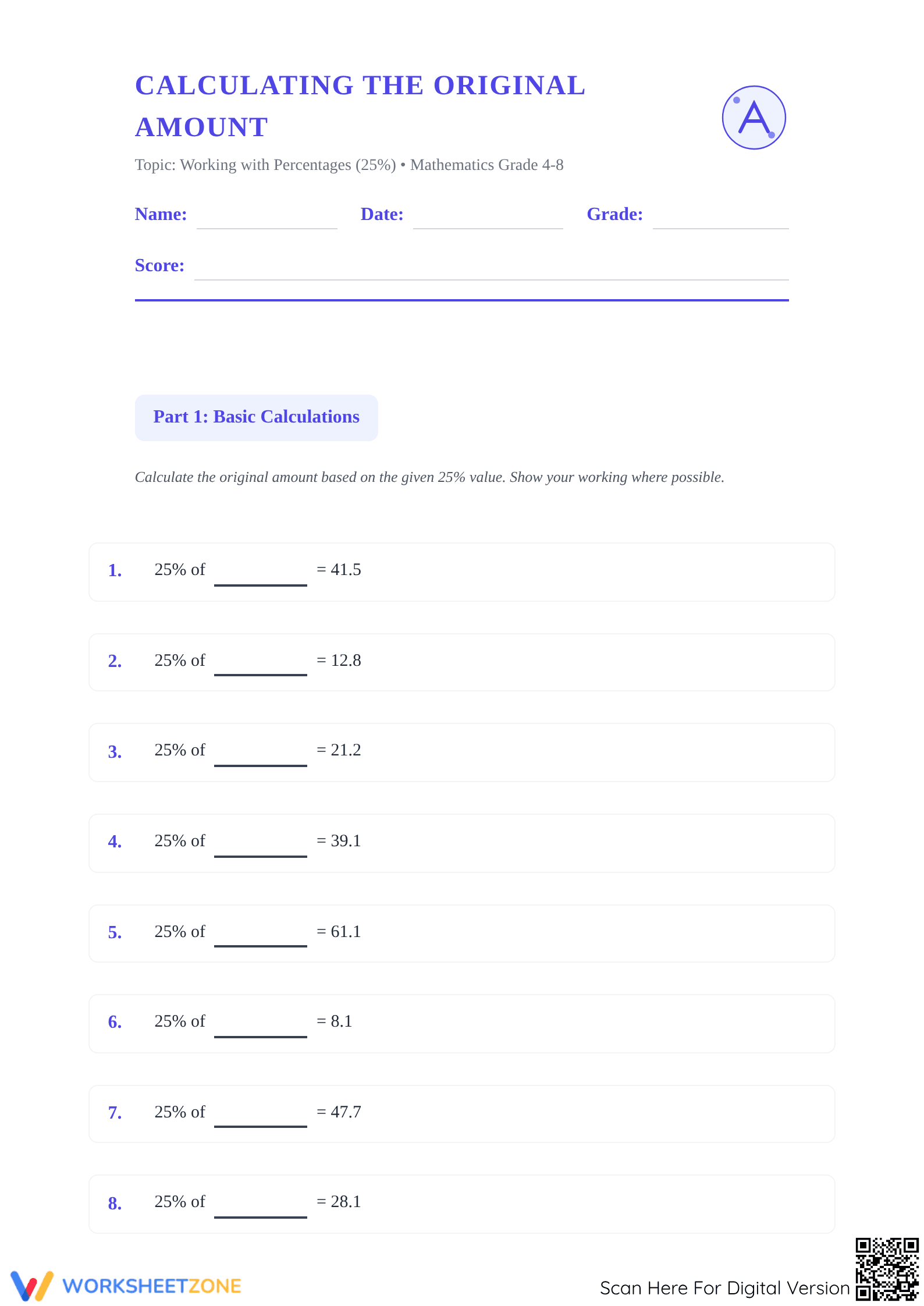
This Essential Grade 4-8 math worksheet helps students master the inverse calculation of percentages. By focusing specifically on finding the original amount when the 25% value is known, students develop a deep conceptual understanding of proportional relationships. It is an ideal resource for building fluency in percentage "backtracking" exercises.
At a Glance
- Grade: 4-8 · Subject: Math
- Standard:
CCSS.MATH.CONTENT.6.RP.A.3.c— Find the whole, given a part and the percent.- Skill Focus: Reverse Percentage Calculations (25%)
- Format: 5 pages · 40 problems · Answer key included · PDF
- Best For: Mastery practice of proportional reasoning skills.
- Time: 45–60 minutes
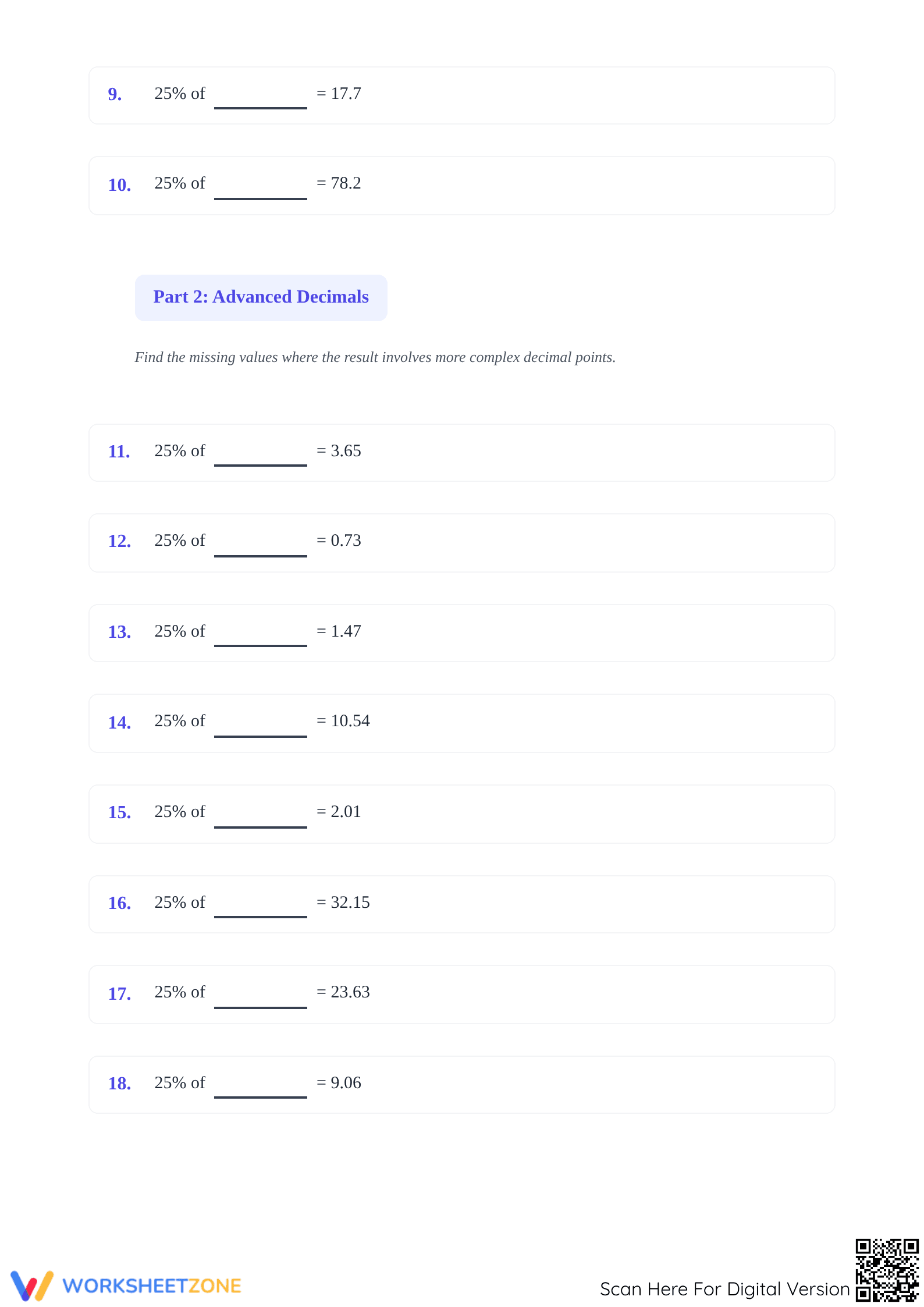
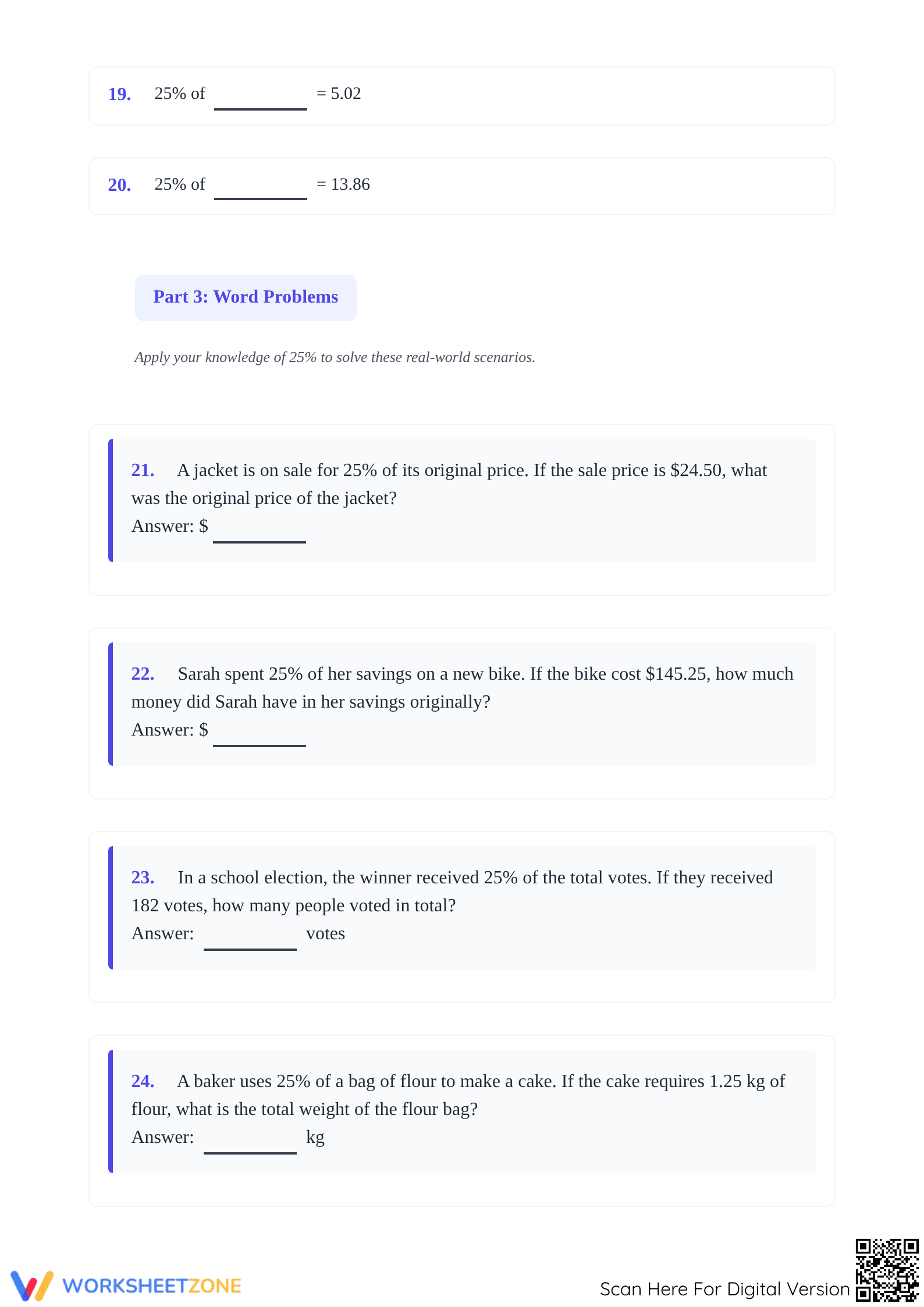
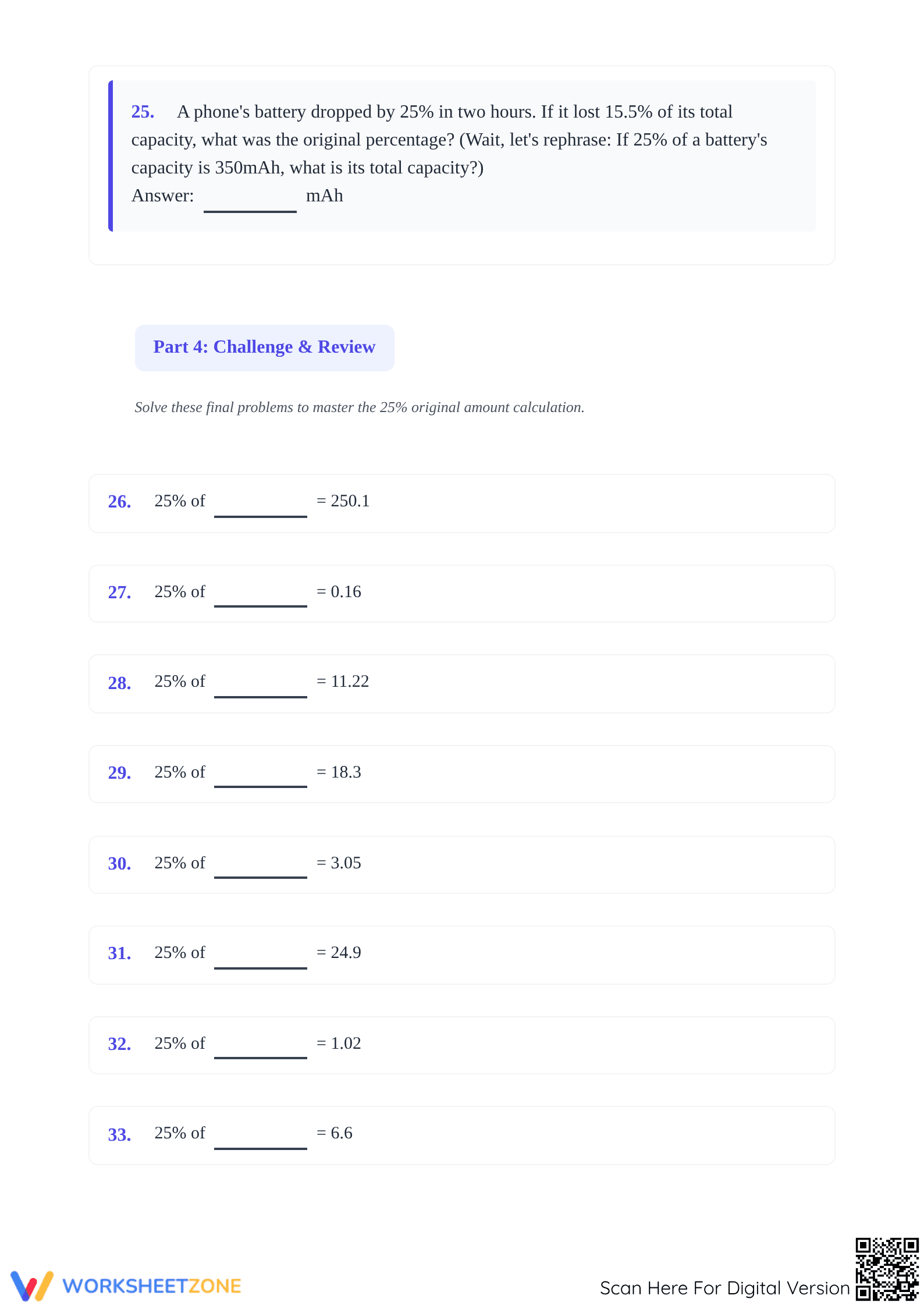
This comprehensive 5-page PDF contains 40 targeted problems divided into four logical parts. It includes basic calculations with whole numbers and decimals, advanced decimal practice, and real-world word problems. A full answer key is provided to facilitate quick grading and immediate student feedback on every calculation.
Skill Progression
- Guided Practice: Problems 1-10 introduce basic equations where 25% of a missing value equals a provided whole or simple decimal number.
- Supported Practice: Problems 11-20 increase in difficulty with more complex decimal results, challenging students to maintain precision in their division and multiplication steps.
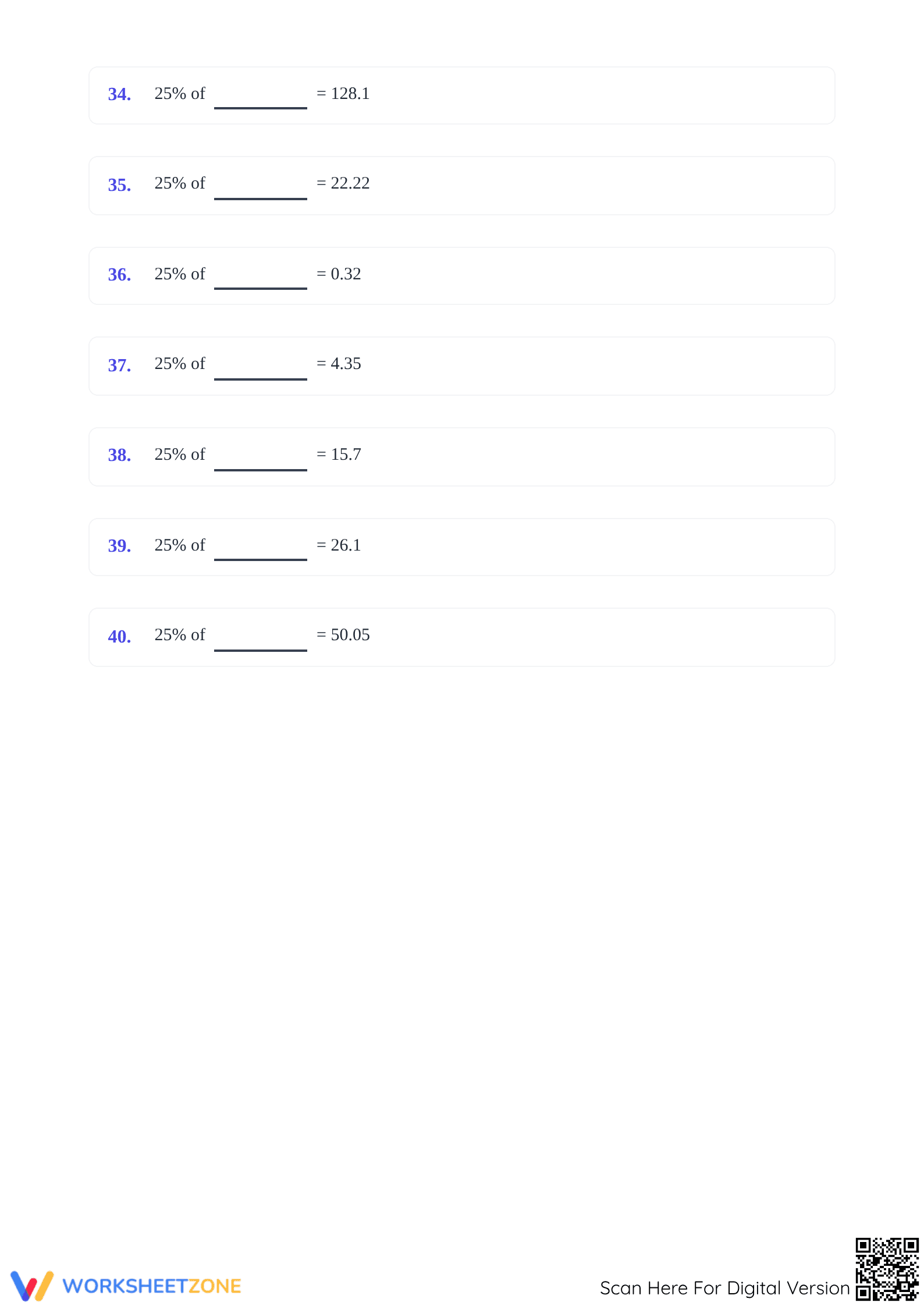
- Independent Practice: Problems 21-40 include word problems and a challenge section where students apply the 1:4 ratio concept to authentic scenarios and varying numerical formats.
This sequence follows a gradual-release model, ensuring students move from computational fluency to abstract application of the 25% rule.
Standards Alignment
The primary focus of this worksheet is CCSS.MATH.CONTENT.6.RP.A.3.c, which requires students to find a percent of a quantity as a rate per 100 and find the whole, given a part and the percent. This resource provides scaffolded support for mastery of this complex ratio concept. Both standard codes can be copied directly into lesson plans, IEP goals, or district curriculum mapping tools.
How to Use It
Use this packet as a during-instruction activity following a lesson on the relationship between fractions and percentages. It also serves as an excellent formative assessment tool; observe if students are multiplying by 4 or using long division to identify those who have mastered the 1:4 shortcut. Total completion time is roughly 50 minutes.
Who It's For
This resource is designed for Grade 4 through Grade 8 students who are learning or reviewing percentage concepts. It is particularly beneficial for students on IEPs who need repetitive, focused practice on one specific rate before moving to varied percentages. Pair this with a visual anchor chart showing 25% as one-quarter of a whole.
Mastering the ability to determine a whole amount from a known percentage is a critical milestone in middle school mathematics. This worksheet aligns with CCSS.MATH.CONTENT.6.RP.A.3.c, focusing on the specific plain-English skill of finding the original whole when given 25% of its value. According to the ScienceDirect TpT Analysis (2024), targeted repetition of specific percentage ratios significantly improves student recall and computational speed compared to mixed-rate practice. By providing 40 distinct problems across whole numbers and decimals, this resource ensures that students encounter a wide variety of numerical contexts while reinforcing the core mathematical operation. This structural consistency allows learners to focus on the procedural logic of the 1:4 ratio without distraction, facilitating a smoother transition to higher-order algebraic expressions involving proportions. Teachers can utilize this capsule to justify the inclusion of single-rate mastery in Tier 2 intervention plans or as a core instructional strategy for building foundational arithmetic fluency.


