


























Views
Downloads
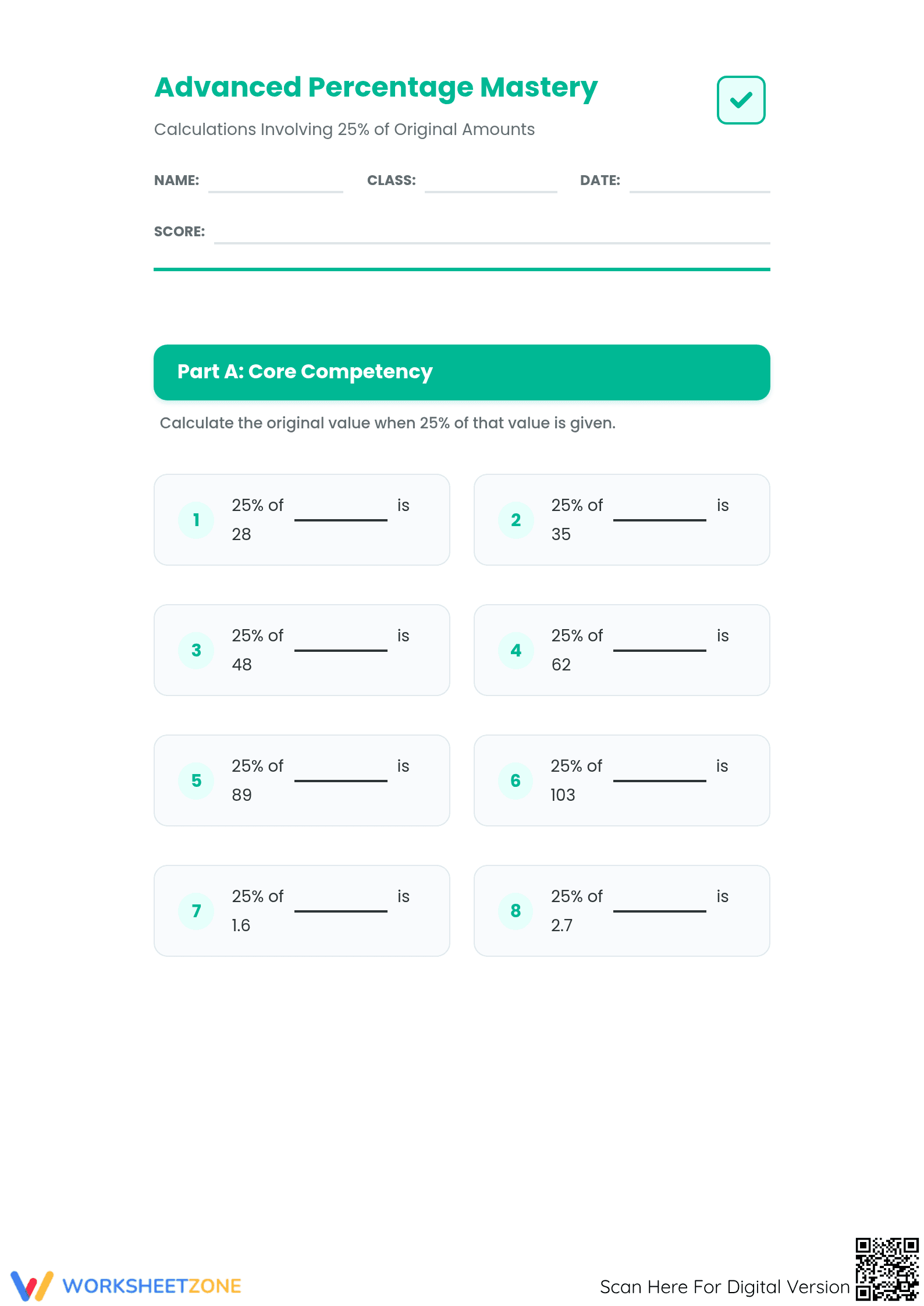


Essential Reverse Percentage: 25% Worksheet for Grade 6
Paste this activity's link or code into your existing LMS (Google Classroom, Canvas, Teams, Schoology, Moodle, etc.).
Students can open and work on the activity right away, with no student login required.
You'll still be able to track student progress and results from your teacher account.
Calculating the whole from a part is a critical middle school milestone. This worksheet focuses specifically on the 25% benchmark, allowing students to build conceptual fluency before moving to more complex rates. By identifying that 25% is equivalent to one-fourth, learners develop mental math strategies to backtrack to the original amount efficiently and accurately.
At a Glance
- Grade: 6 · Subject: Math
- Standard:
6.RP.A.3.C— Find the whole, given a part and the percent of a quantity- Skill Focus: Reverse Percentage (25% Benchmark)
- Format: 4 pages · 36 problems · Answer key included · PDF
- Best For: Independent practice and decimal precision mastery
- Time: 30–45 minutes
This comprehensive four-page packet contains 36 structured problems divided into four distinct sections. It starts with core competency integer calculations, moves into decimal precision tasks, incorporates multi-step real-world word problems, and concludes with a high-rigor challenge round. The document includes a full answer key, ensuring quick grading and immediate feedback for student self-correction during independent work time.
Skill Progression
- Guided Practice: The first 8 problems provide a clear "25% of ___ is X" frame, focusing on whole number outcomes to build initial confidence and procedural muscle memory.
- Supported Practice: Problems 9-16 introduce decimal values, requiring students to apply division rules or scaling strategies while maintaining the same percentage rate.
- Independent Mastery: The final sections move from scaffolded equations to complex word problems and a challenge round with 16 high-difficulty items that test the limits of student precision and logic.
This set follows a gradual-release model, transitioning students from simple computation to abstract reasoning and application.
Standards Alignment
This resource is strictly aligned to 6.RP.A.3.C, which requires students to "find a percent of a quantity as a rate per 100; solve problems involving finding the whole, given a part and the percent." By focusing on the 25% benchmark, the worksheet addresses a key component of proportional reasoning. This standard code can be copied directly into lesson plans, IEP goals, or district curriculum mapping tools.
How to Use It
Assign this packet as a mid-unit practice set after students have mastered basic percentage-of-value calculations. During instruction, observe how students handle the transition to decimals in Part B; if they struggle, suggest using the "multiply by 4" mental strategy as a cross-check. This set serves as an excellent formative assessment for identifying students who require further scaffolding in multi-step problem solving.
Who It's For
Designed for Grade 6 math students, this resource is also appropriate for Grade 7 or 8 learners needing targeted intervention on rational number operations. It pairs naturally with an anchor chart detailing benchmark percentage-to-fraction conversions (e.g., 25% = 1/4). The inclusion of word problems makes it suitable for advanced 5th graders looking for an extension challenge.
According to the RAND AIRS 2024 report on instructional materials, procedural fluency in percentage benchmarks is a significant predictor of success in algebra and higher-order mathematics. This worksheet addresses the specific skill of finding the whole when given a 25% part, a foundational concept in the 6.RP.A.3.C standard. By utilizing 36 diverse problems—ranging from simple integer equations to complex word problems involving battery life and agricultural yields—this resource ensures that students move beyond rote memorization toward a deeper conceptual understanding of proportional relationships. The inclusion of decimal precision and real-world scenarios mirrors the rigorous demands of national assessments, providing the "backtracking" practice necessary to master the inverse relationship between parts and wholes. Research indicates that targeted practice on specific benchmarks, such as one-fourth or 25%, allows for the cognitive offloading required for students to eventually tackle non-standard percentage rates with greater ease and fewer computational errors.


