


























Views
Downloads
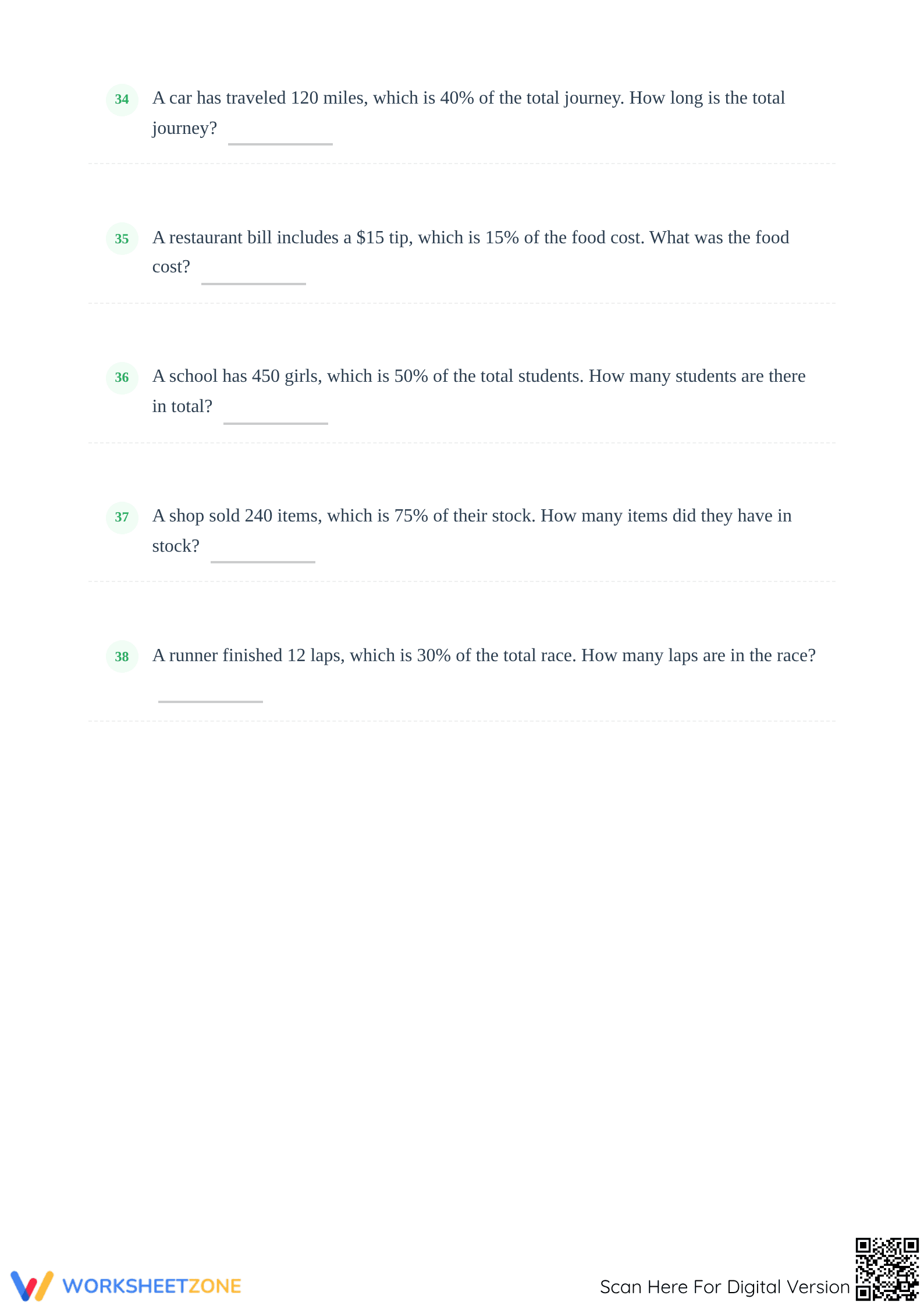

Essential Percent Calculations Worksheet | Grade 6 Math
Paste this activity's link or code into your existing LMS (Google Classroom, Canvas, Teams, Schoology, Moodle, etc.).
Students can open and work on the activity right away, with no student login required.
You'll still be able to track student progress and results from your teacher account.
This Grade 6 Math worksheet helps students master finding the whole amount when a part and a percentage are known. By working through structured exercises involving currency, whole numbers, and real-world word problems, students build a deep conceptual understanding of percentage relationships. This resource ensures learners move past rote calculation toward functional mathematical literacy.
At a Glance
- Grade: 6 · Subject: Math
- Standard:
6.RP.A.3.c— Find the whole, given a part and the percent of a quantity- Skill Focus: Calculating original amounts (backtracking percentages)
- Format: 5 pages · 38 problems · Answer key included · PDF
- Best For: Independent practice and formative assessment
- Time: 45–60 minutes
What's Inside
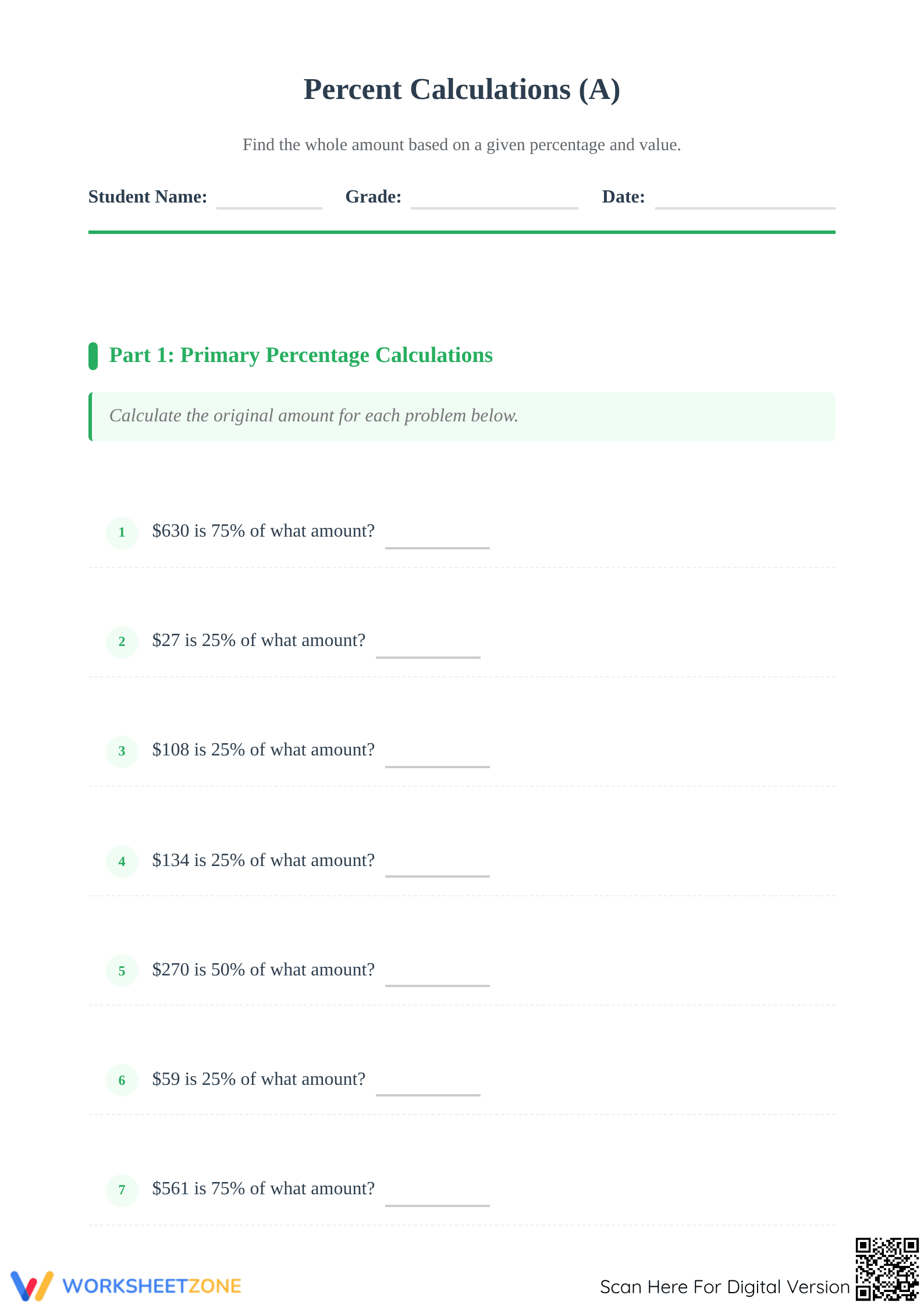
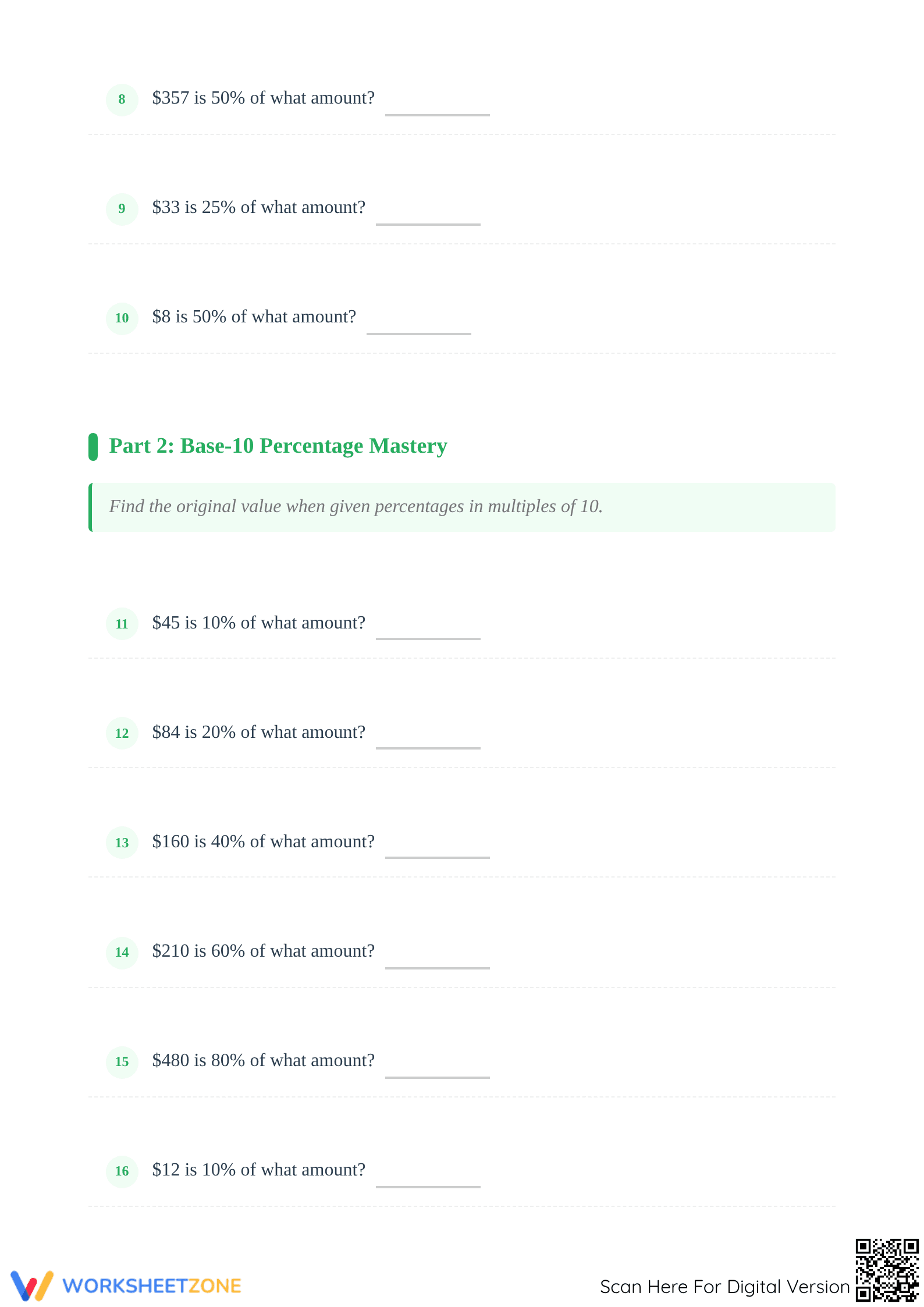
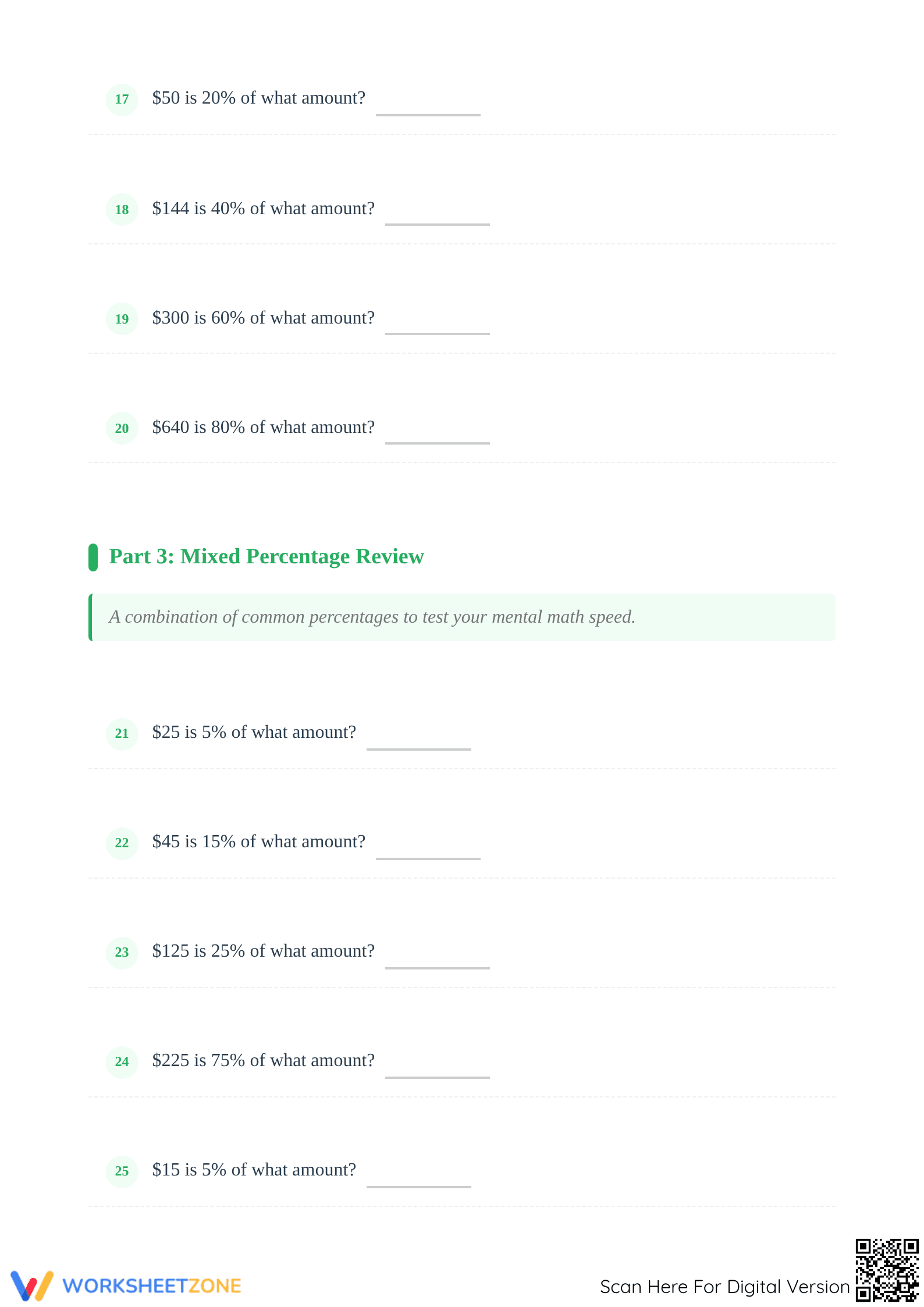
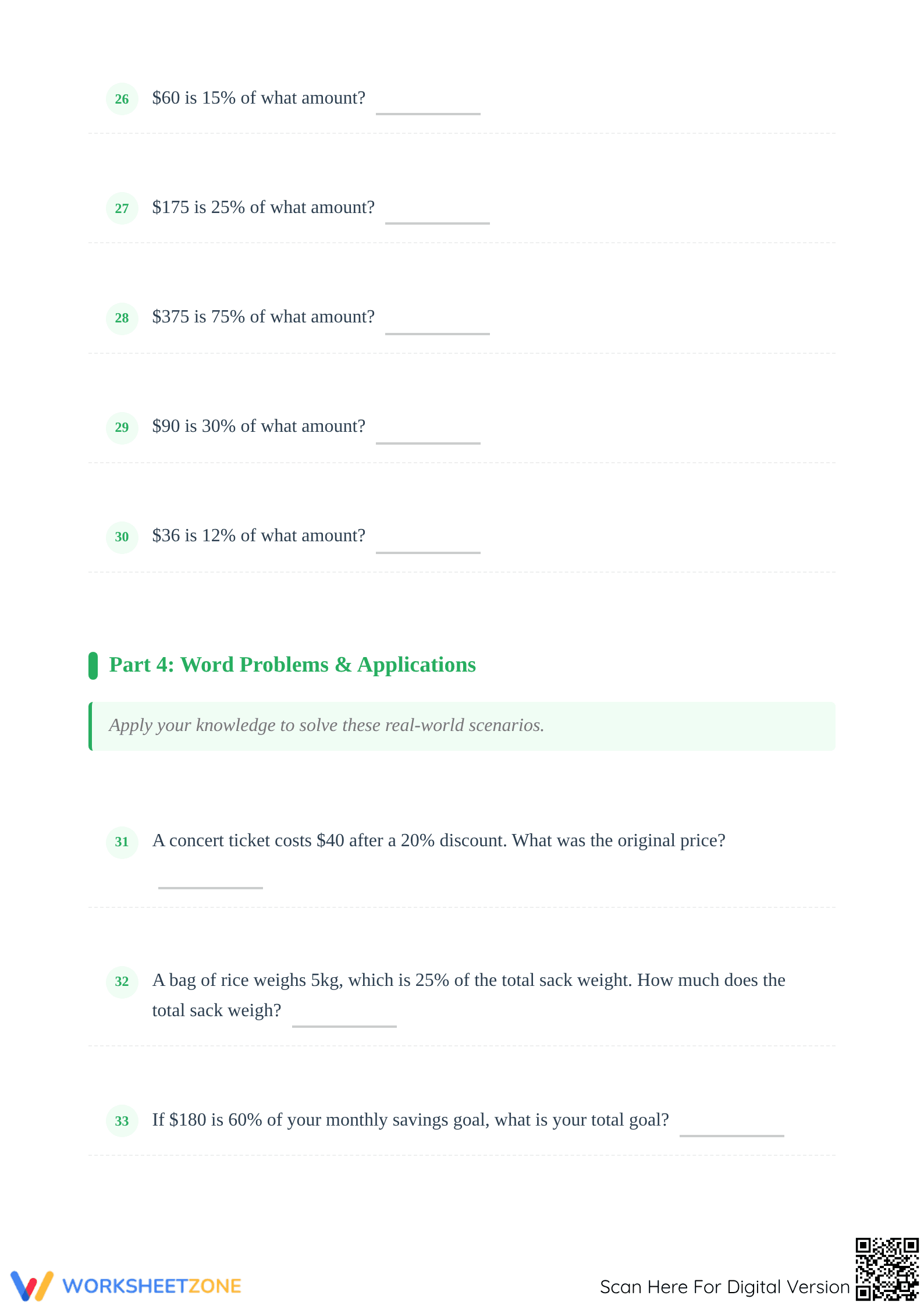
The PDF contains 5 pages of comprehensive practice divided into four distinct sections. Students start with primary percentage calculations focusing on common benchmarks, move to base-10 mastery, tackle mixed percentage reviews, and finally apply their knowledge to 8 detailed word problems. A full answer key is provided for quick grading or student self-correction.
Skill Progression
- Guided Practice: Problems 1–10 focus on simple benchmarks like 25%, 50%, and 75% using dollar amounts to provide a familiar and concrete context for early success.
- Supported Practice: Problems 11–30 increase complexity by using multiples of 10 and mixed percentages (5%, 15%, 12%), requiring students to apply consistent mathematical strategies.
- Independent Practice: The final 8 problems are word-based applications involving travel distances, population counts, and retail discounts, forcing students to translate text into equations.
This structure follows a gradual release model, moving students from basic computation to abstract application.
Standards Alignment
The primary focus is 6.RP.A.3.c, which requires students to "Find a percent of a quantity as a rate per 100; solve problems involving finding the whole, given a part and the percent." This standard is a critical building block for later algebraic reasoning and financial literacy. Both standard codes can be copied directly into lesson plans, IEP goals, or district curriculum mapping tools.
How to Use It
This resource is ideal for the independent practice phase of a lesson on percentage ratios. Assign the first two sections during class to observe student strategies—specifically watching for those who use equivalent fractions versus those who use decimal multiplication. Use the final word problem section as a homework assignment or a formative assessment to verify that students can apply the skill in non-computational contexts.
Who It's For
This is designed for Grade 6 general education students, but serves as an excellent remedial tool for Grade 7 or 8 learners who struggle with backtracking percentages. It pairs naturally with an anchor chart demonstrating the "Part / Whole = Percent / 100" proportion method or a direct instruction lesson on visual models for percentages.
Mastery of the 6.RP.A.3.c standard is essential for transitioning from arithmetic to algebraic thinking. According to the RAND AIRS 2024 report, students who struggle with finding the original amount often lack a robust understanding of ratios as multiplicative comparisons, which can lead to significant hurdles in high school mathematics. This worksheet addresses that gap by forcing students to move beyond finding part of a whole and instead conceptualize the whole as the unknown variable. Fisher & Frey (2014) emphasize that structured practice involving multiple representations—ranging from simple currency calculations to complex word problems—is vital for ensuring that skills transfer to real-world applications. By providing 38 targeted problems, this resource offers the high-repetition practice necessary for cognitive automaticity. Educators can use this tool to bridge the gap between abstract percentage theory and the practical calculations required in finance and science.


