


























Views
Downloads

Printable Reverse Percentage Worksheet | Grade 7 Math
Paste this activity's link or code into your existing LMS (Google Classroom, Canvas, Teams, Schoology, Moodle, etc.).
Students can open and work on the activity right away, with no student login required.
You'll still be able to track student progress and results from your teacher account.
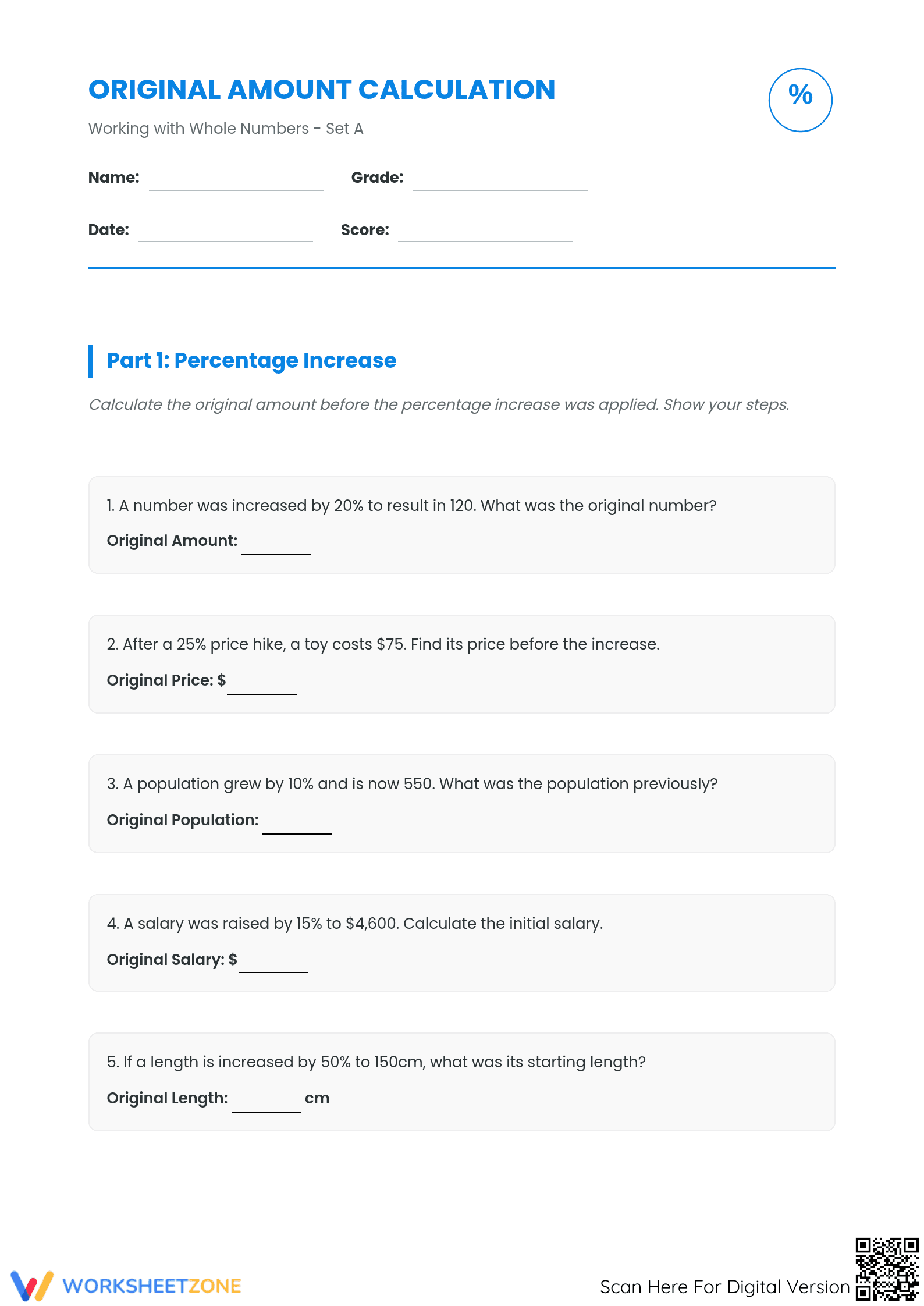
This Grade 7 math worksheet empowers students to master the complex skill of calculating original amounts from percentage changes. Instead of simple forward calculations, learners tackle "backtracking" problems where the final value and percentage rate are known. By solving 24 structured problems, students build a deep conceptual understanding of proportional relationships and algebraic reasoning in real-world contexts.
At a Glance
- Grade: 7 · Subject: Math
- Standard:
7.RP.A.3— Use proportional relationships to solve multi-step percent increase and decrease problems- Skill Focus: Reverse Percentage Calculations
- Format: 4 pages · 24 problems · Answer key included · PDF
- Best For: Independent practice and formative assessment
- Time: 45–60 minutes
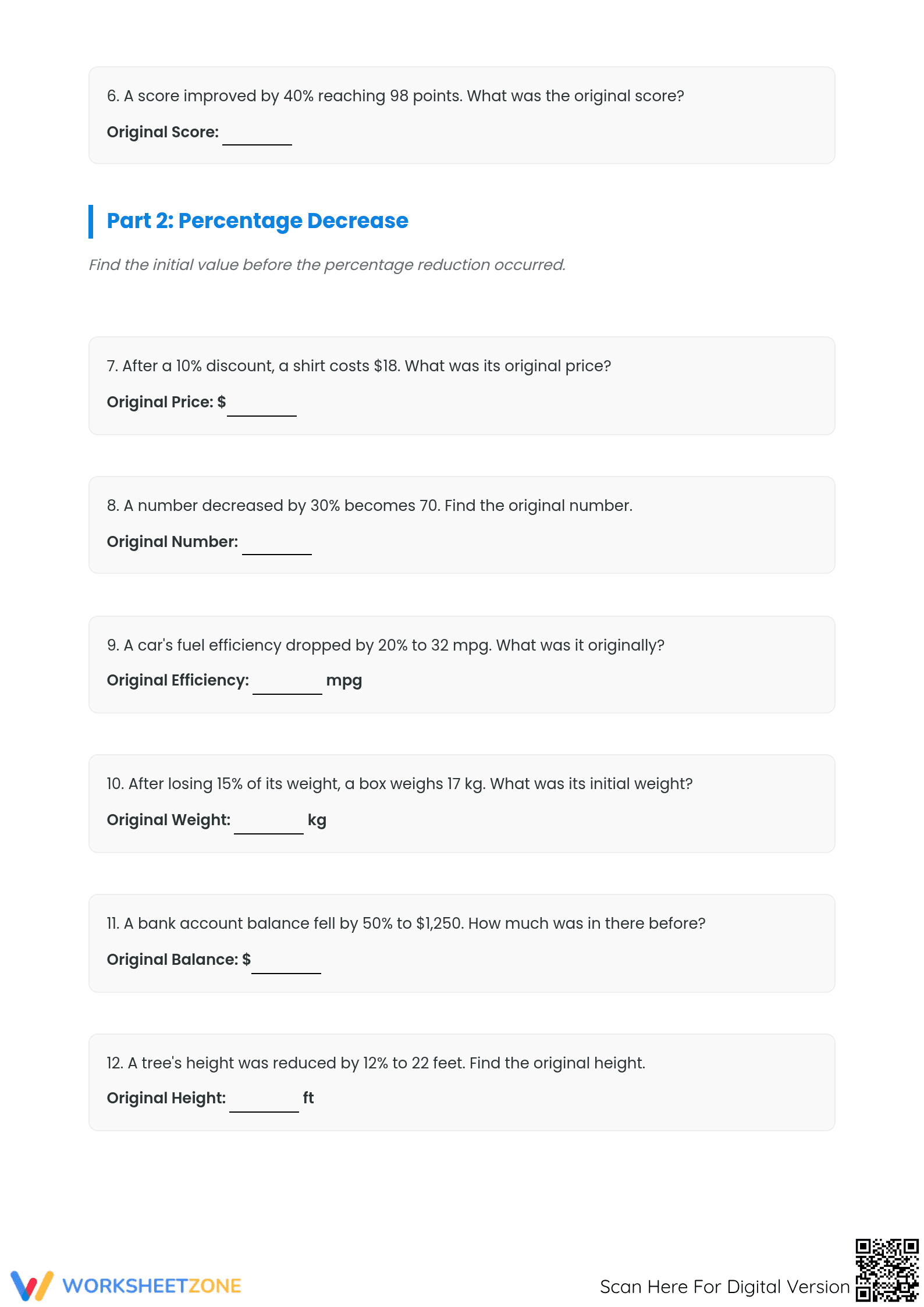
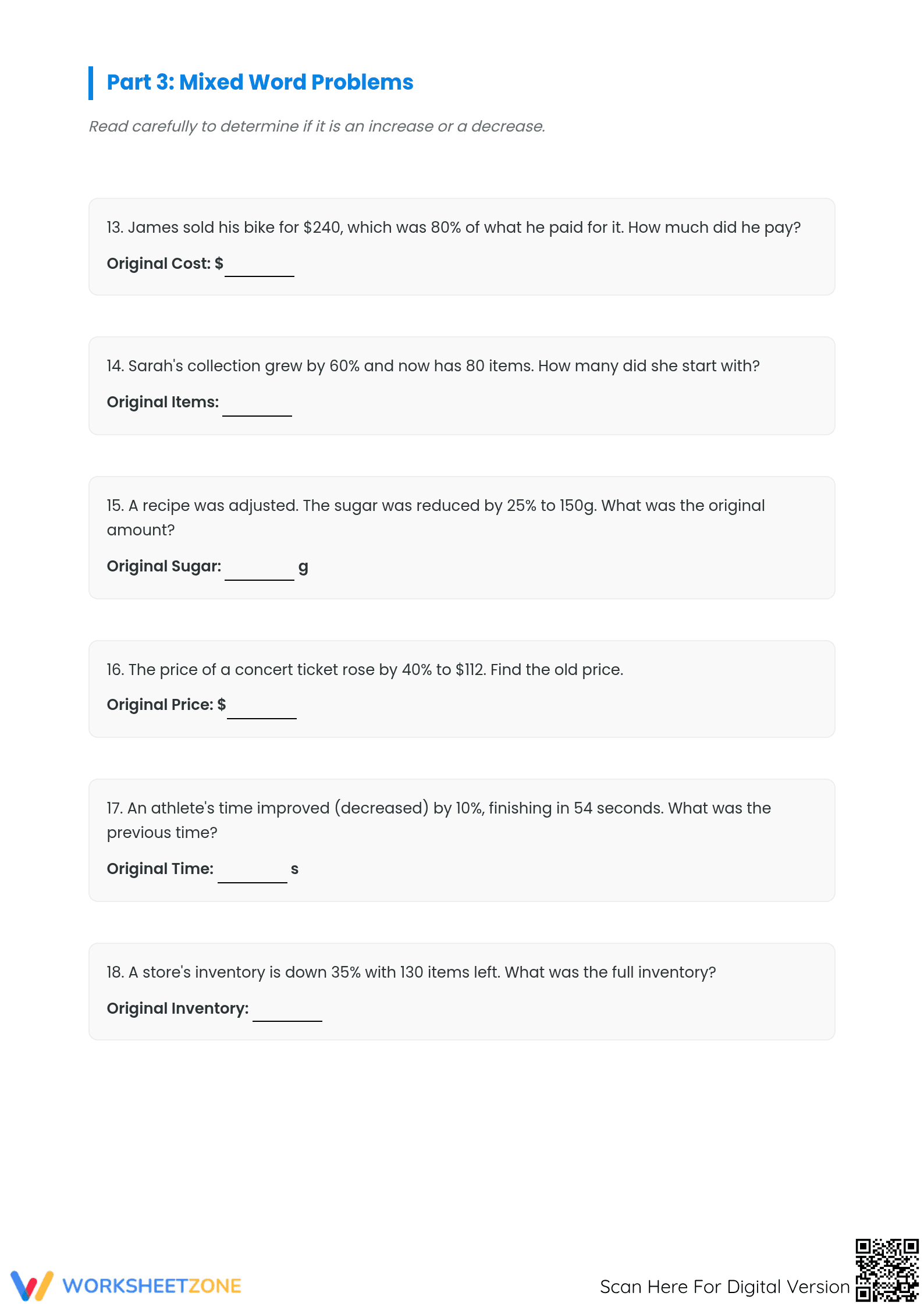
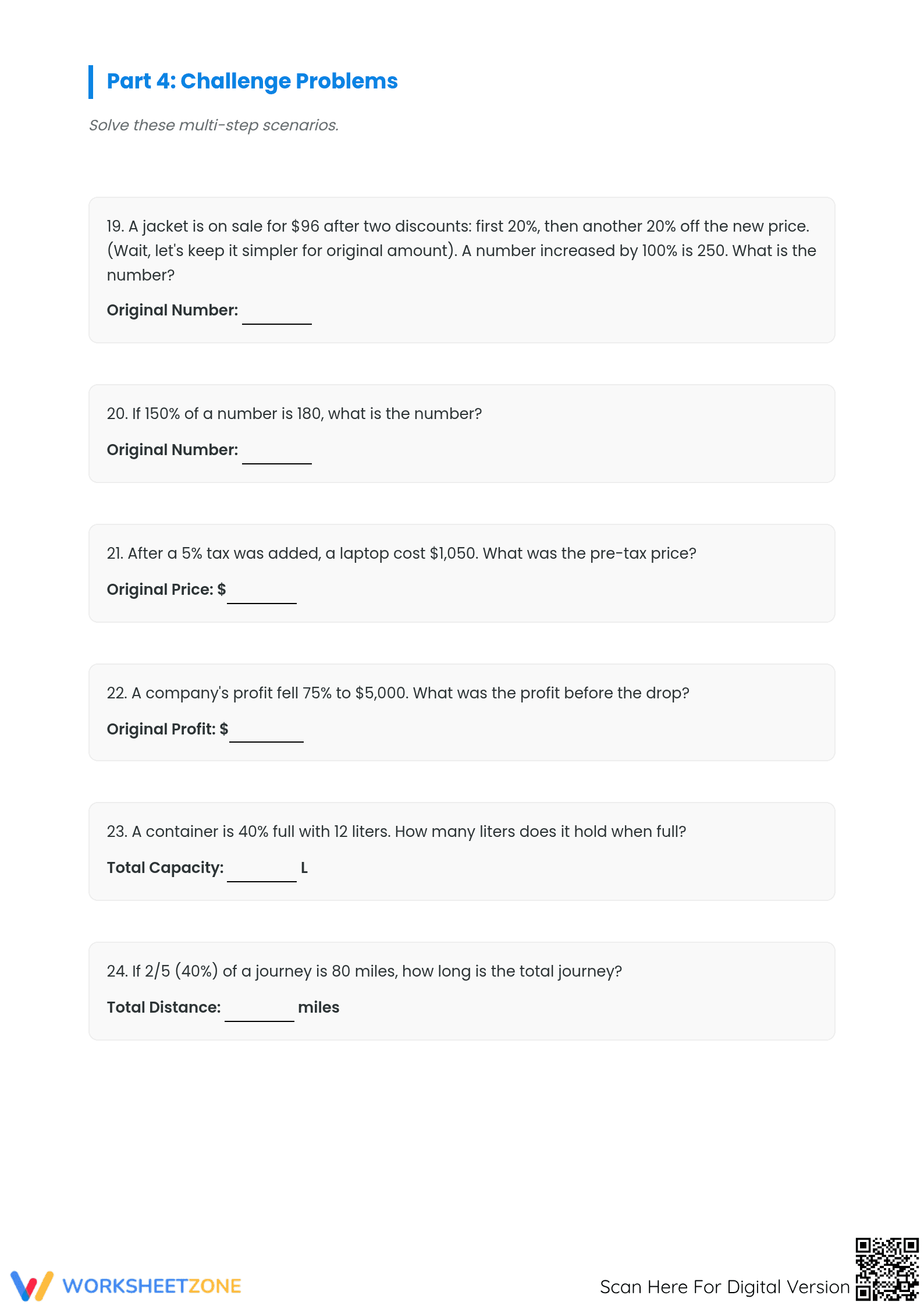
This comprehensive four-page resource is divided into logical segments to facilitate learning. Part 1 focuses on percentage increases, Part 2 targets percentage decreases, Part 3 provides mixed word problems, and Part 4 offers high-level challenge scenarios. Each section contains 6 unique problems, totaling 24 tasks that range from simple numeric increases to complex multi-step financial and measurement scenarios. A full 4-page answer key is included for rapid grading.
The worksheet follows a zero-prep workflow designed for busy educators. You can print the 4-page set in under 30 seconds and distribute it immediately to your class. Students can work through the sections independently, requiring less than 2 minutes of teacher setup to explain the "original amount" concept. The clear partitioning makes it an ideal sub plan or a quiet-time activity that provides high-value standards alignment without heavy lifting.
The primary focus is `7.RP.A.3`, which requires students to use proportional relationships to solve multistep ratio and percent problems, specifically including percent increase and decrease. The worksheet also supports `6.RP.A.3.C` by asking students to find the whole, given a part and the percent. Both standard codes can be copied directly into lesson plans, IEP goals, or district curriculum mapping tools.
Assign this worksheet during the "You Do" phase of a gradual release lesson to verify that students can apply reverse percentage logic without teacher scaffolding. It also serves as an excellent formative assessment at the end of a unit on ratios and proportions. Teachers should observe whether students are setting up their equations as Original * (1 + rate) = Final to identify those needing targeted intervention.
This resource is designed for Grade 7 students practicing core standards, but it also provides excellent enrichment for Grade 6 learners or essential remediation for Grade 8 students. It pairs naturally with a visual anchor chart demonstrating the "100% +/- percent change" multiplier method to help students visualize the relationship between initial and final values.
According to the NAEP framework, proficiency in solving multi-step percentage problems is a key indicator of readiness for high school algebra. Fisher & Frey (2014) emphasize that structured practice in "backtracking" or reverse-operations problems helps solidify students' understanding of mathematical properties and proportional reasoning. This Grade 7 worksheet addresses standard `7.RP.A.3` by providing 24 scaffolded opportunities to calculate original amounts after increases and decreases. Research from ScienceDirect TpT Analysis suggests that partitioned worksheets with clear headers, like this increase-decrease-mixed structure, improve student task completion rates by reducing cognitive load during complex multi-step procedures. By moving from isolated skills to mixed application and finally challenge problems, learners develop the procedural fluency and conceptual depth required by state and national standards. This resource ensures that learners can fluently navigate between parts and wholes in diverse contexts, from financial discounts to population growth statistics.


