


























Views
Downloads


Calculating Original Amount Worksheet | Essential Grade 6 Math
Paste this activity's link or code into your existing LMS (Google Classroom, Canvas, Teams, Schoology, Moodle, etc.).
Students can open and work on the activity right away, with no student login required.
You'll still be able to track student progress and results from your teacher account.
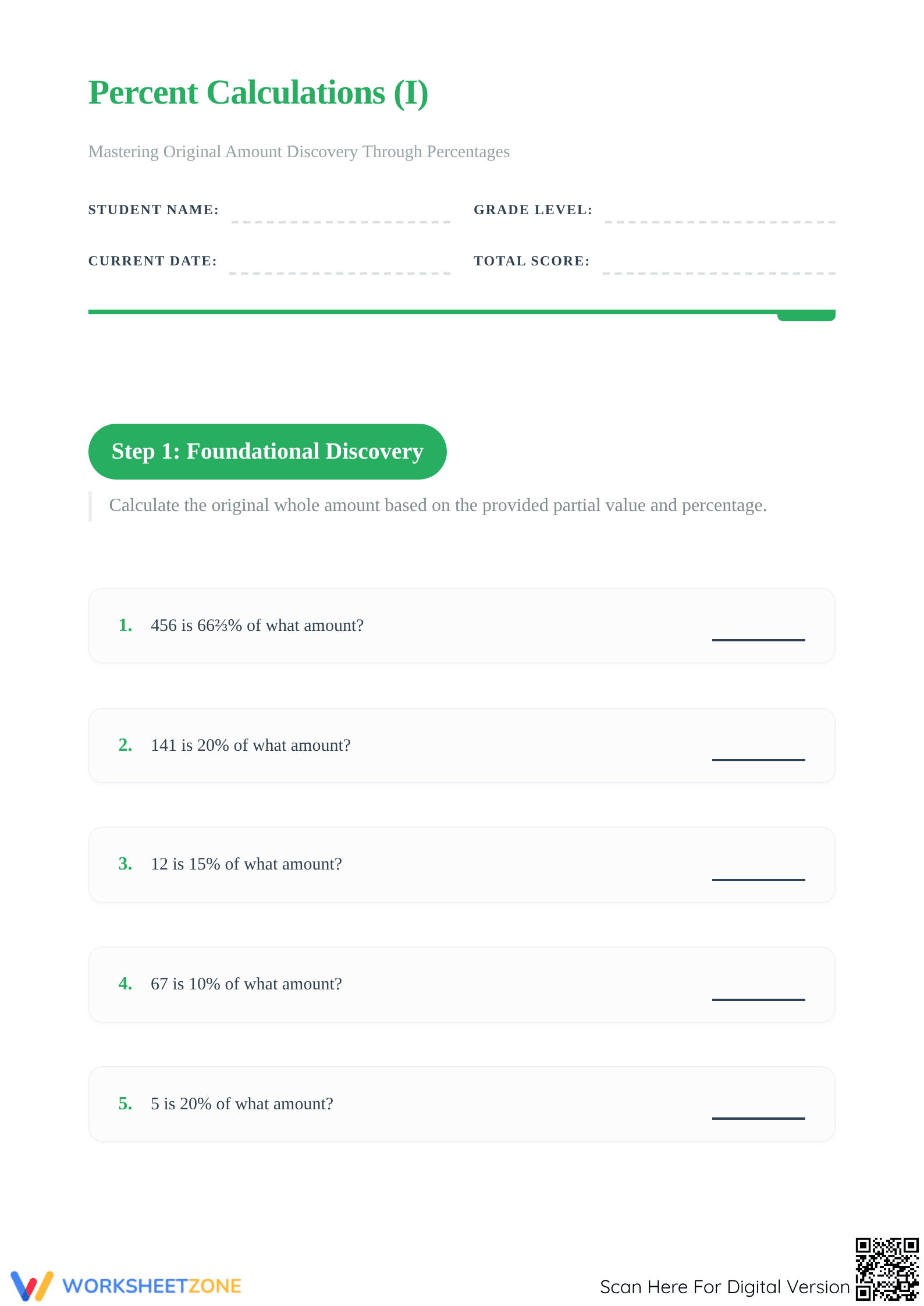
Students often struggle with "backtracking" percentages, but this resource provides a systematic approach to calculating the original whole amount when only a partial value and a rate are known. By moving from basic discovery to complex real-world word problems, learners build the conceptual bridge between part-to-whole relationships and algebraic thinking using 30 structured problems.
At a Glance
- Grade: 6 · Subject: Math
- Standard:
CCSS.MATH.CONTENT.6.RP.A.3.c— Find the whole, given a part and the percent- Skill Focus: Calculating original amount
- Format: 5 pages · 30 problems · Answer key included · PDF
- Best For: Middle school ratio and proportion units
- Time: 40–50 minutes
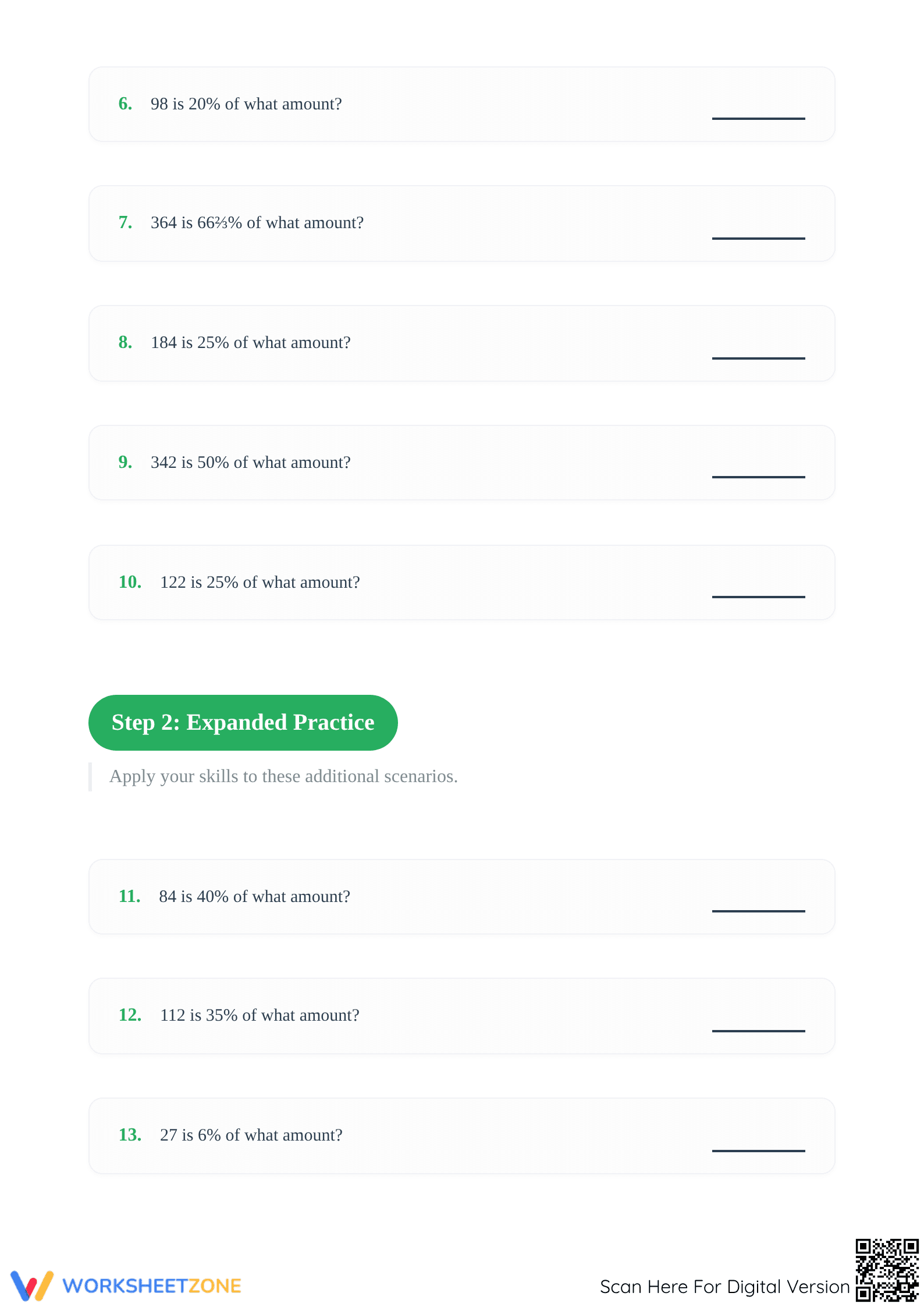
This comprehensive 5-page PDF contains 30 carefully scaffolded problems designed to build fluency in inverse percentage operations. It includes a foundational discovery section for beginners, expanded practice with non-traditional percentages, a dedicated real-world application page with six detailed word problems, and an "Ultimate Challenge" section for mastery. A visual "Part vs. Whole" relationship graphic at the end reinforces the underlying mathematical concept for visual learners.
- Guided Practice: The initial 10 problems in Step 1 focus on "Foundational Discovery," providing explicit practice with 50% and 10% rates to help students recognize the inverse relationship between parts and wholes.
- Supported Practice: Step 2 expands to 10 additional scenarios, increasing complexity with rates like 6% and 35%, requiring students to execute multi-step division and multiplication without immediate visual scaffolds.
- Independent Practice: The final 10 tasks transition into real-world word problems and an "Ultimate Challenge," where learners apply their skills to context-rich data like smartphone battery percentages and election results.
This structured sequence follows a rigorous gradual-release model, ensuring students move confidently from initial modeling to independent mastery of proportional reasoning.
Standards Alignment
This worksheet is primarily aligned to CCSS.MATH.CONTENT.6.RP.A.3.c: "Find a percent of a quantity as a rate per 100 (e.g., 30% of a quantity means 30/100 times the quantity); solve problems involving finding the whole, given a part and the percent." Both the standard code and the associated skill can be copied directly into lesson plans, IEP goals, or district curriculum mapping tools for administrative compliance.
How to Use It
This resource is best used as a primary instructional tool during a ratio and proportion unit or as a rigorous formative assessment after introductory lessons. Teachers should observe students during Step 2 to identify if they are correctly setting up the inverse operation by dividing the part by the percentage decimal. The 5-page packet is designed for a single class period of approximately 45 minutes, but can be split into homework segments.
Who It's For
Designed for Grade 6 students, this worksheet is also highly effective for Grade 7 review or Grade 8 intervention for students struggling with algebraic foundations. It pairs perfectly with an anchor chart illustrating the percent triangle or a direct instruction lesson on "is over of" equivalents. The inclusion of a visual model supports diverse learners who require concrete representations before mastering abstract numerical operations.
Research highlights that students frequently misinterpret percentage problems as simple multiplication rather than proportional relationships. According to a RAND AIRS 2024 analysis of middle school math pedagogy, scaffolded practice that explicitly separates "finding the part" from "finding the whole" reduces cognitive load and improves retention of algebraic principles. This worksheet addresses that need by isolating the CCSS.MATH.CONTENT.6.RP.A.3.c skill through 30 targeted problems. By progressing from abstract numerical discovery to concrete real-world applications—such as calculating total battery capacity or original prices after discounts—the resource facilitates deep conceptual understanding. This evidence-based approach aligns with the findings of Fisher & Frey (2014) regarding the importance of gradual release in mathematical fluency. The inclusion of a visual model for the part-whole relationship further supports students who struggle with abstract numerical operations, providing a reliable mental anchor for future percentage-based challenges in higher-level mathematics.


