


























Views
Downloads

Essential Original Amount Percentage Worksheet | Grades 6-8
Paste this activity's link or code into your existing LMS (Google Classroom, Canvas, Teams, Schoology, Moodle, etc.).
Students can open and work on the activity right away, with no student login required.
You'll still be able to track student progress and results from your teacher account.
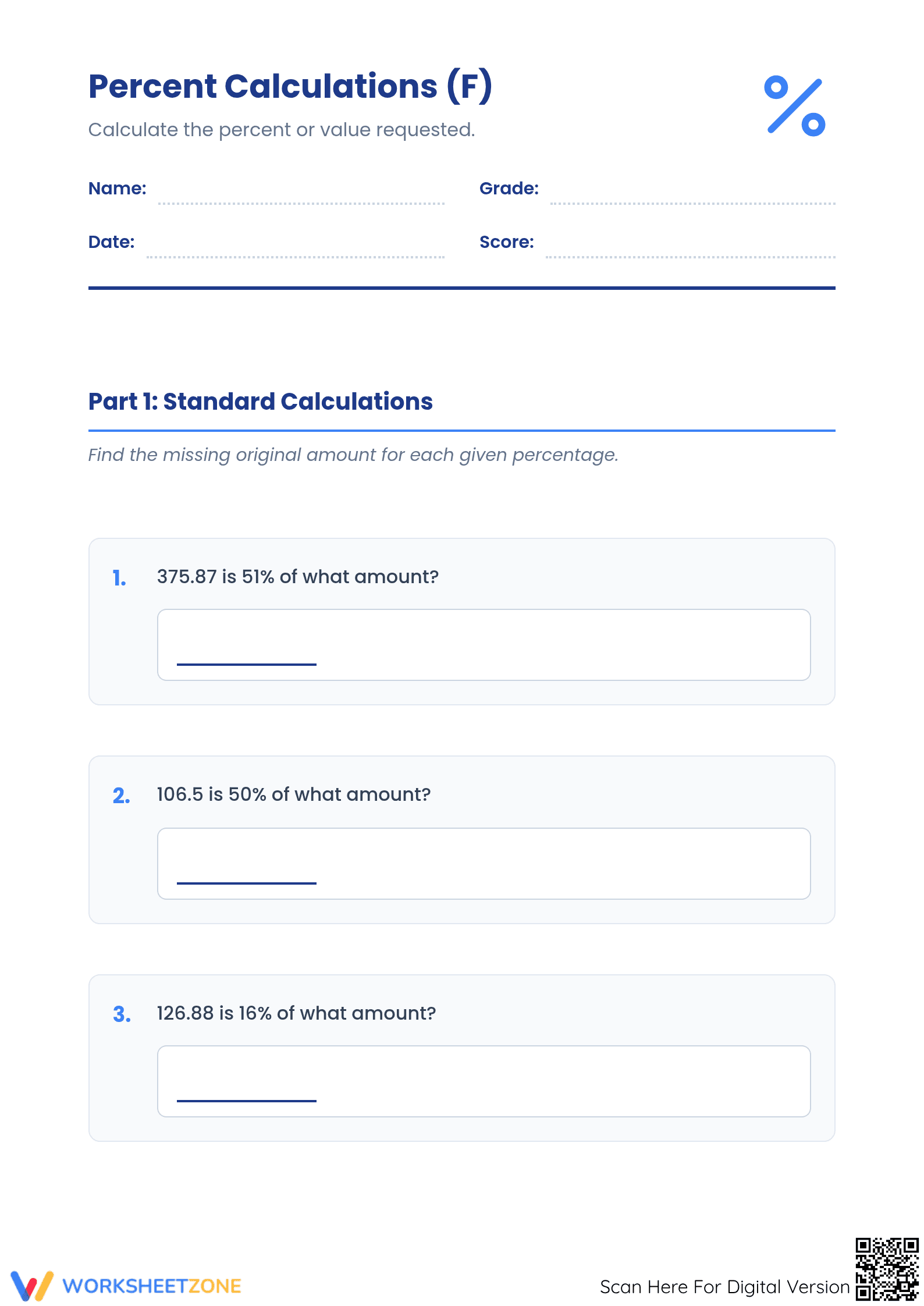
This comprehensive Grade 6-8 math worksheet empowers students to master the critical skill of calculating original amounts from given percentages and decimal values. By working through structured practice, learners bridge the gap between basic percentage calculation and algebraic reasoning, ensuring they can solve complex, multi-step real-world problems with confidence and accuracy.
At a Glance
- Grade: 6-8 · Subject: Math
- Standard:
CCSS.MATH.CONTENT.6.RP.A.3.c— Find the whole, given a part and the percent of a quantity- Skill Focus: Calculating original amounts (base)
- Format: 5 pages · 20 problems · Answer key included · PDF
- Best For: Individual practice or formative assessment
- Time: 30–45 minutes
What's Inside
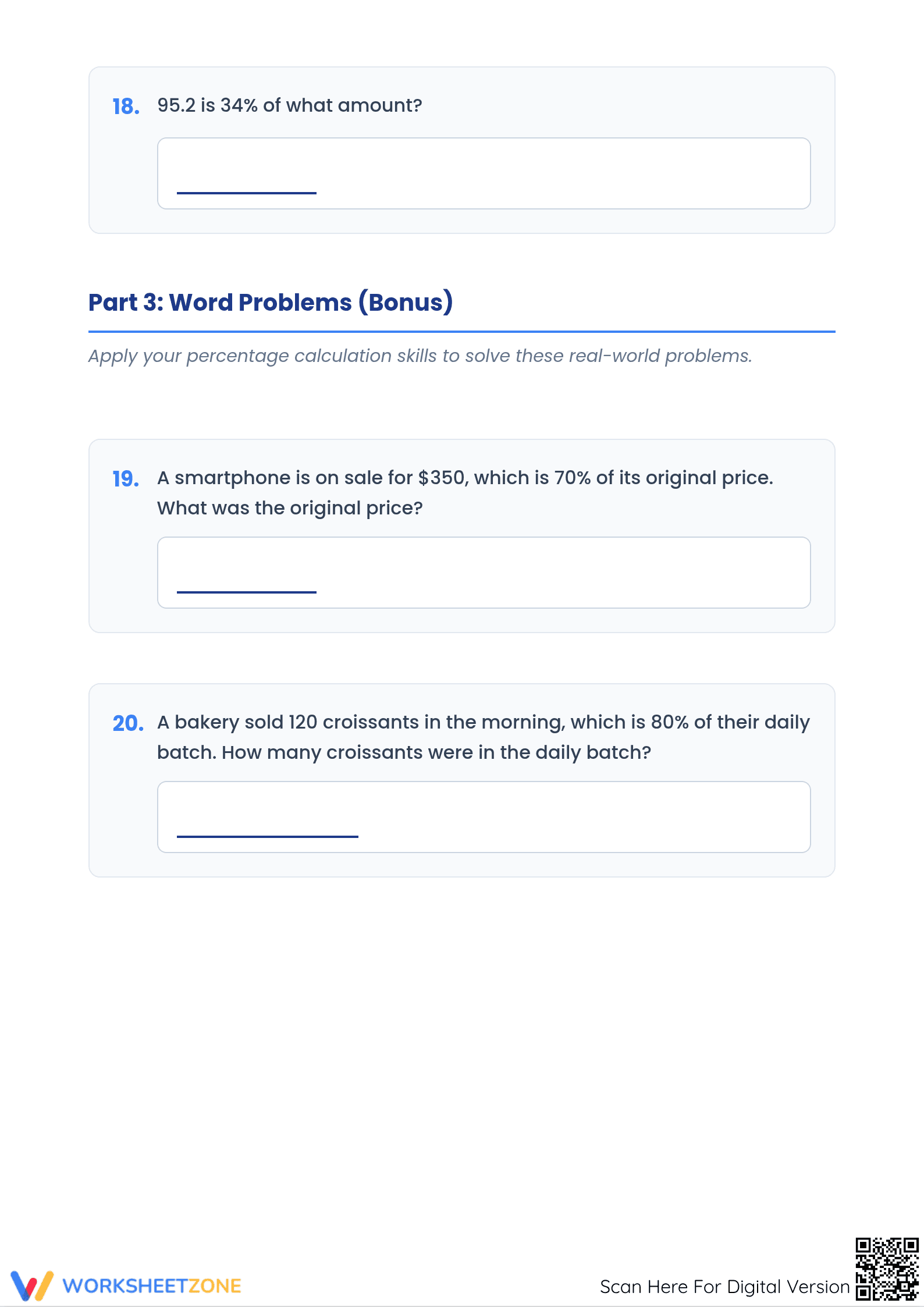
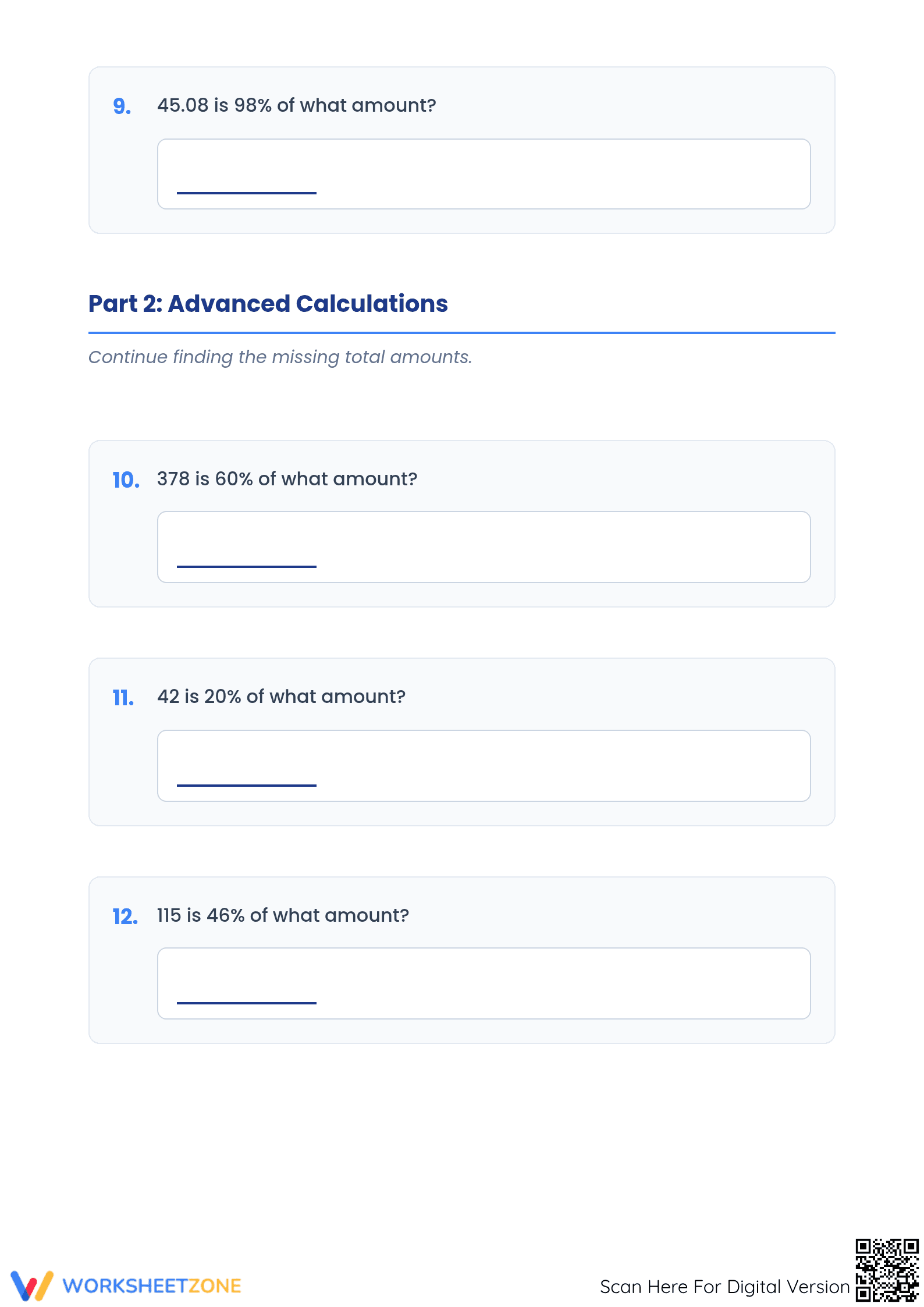
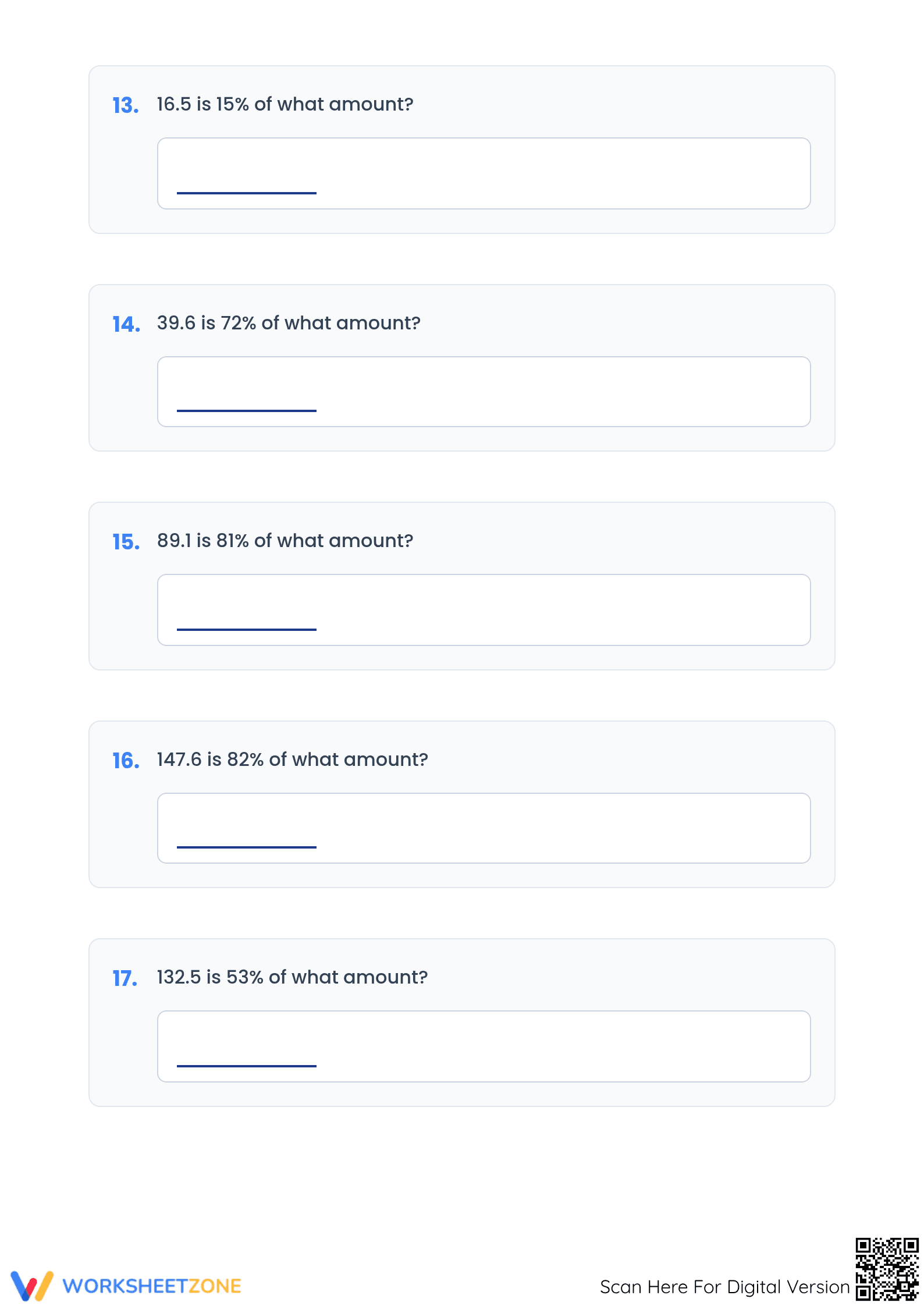
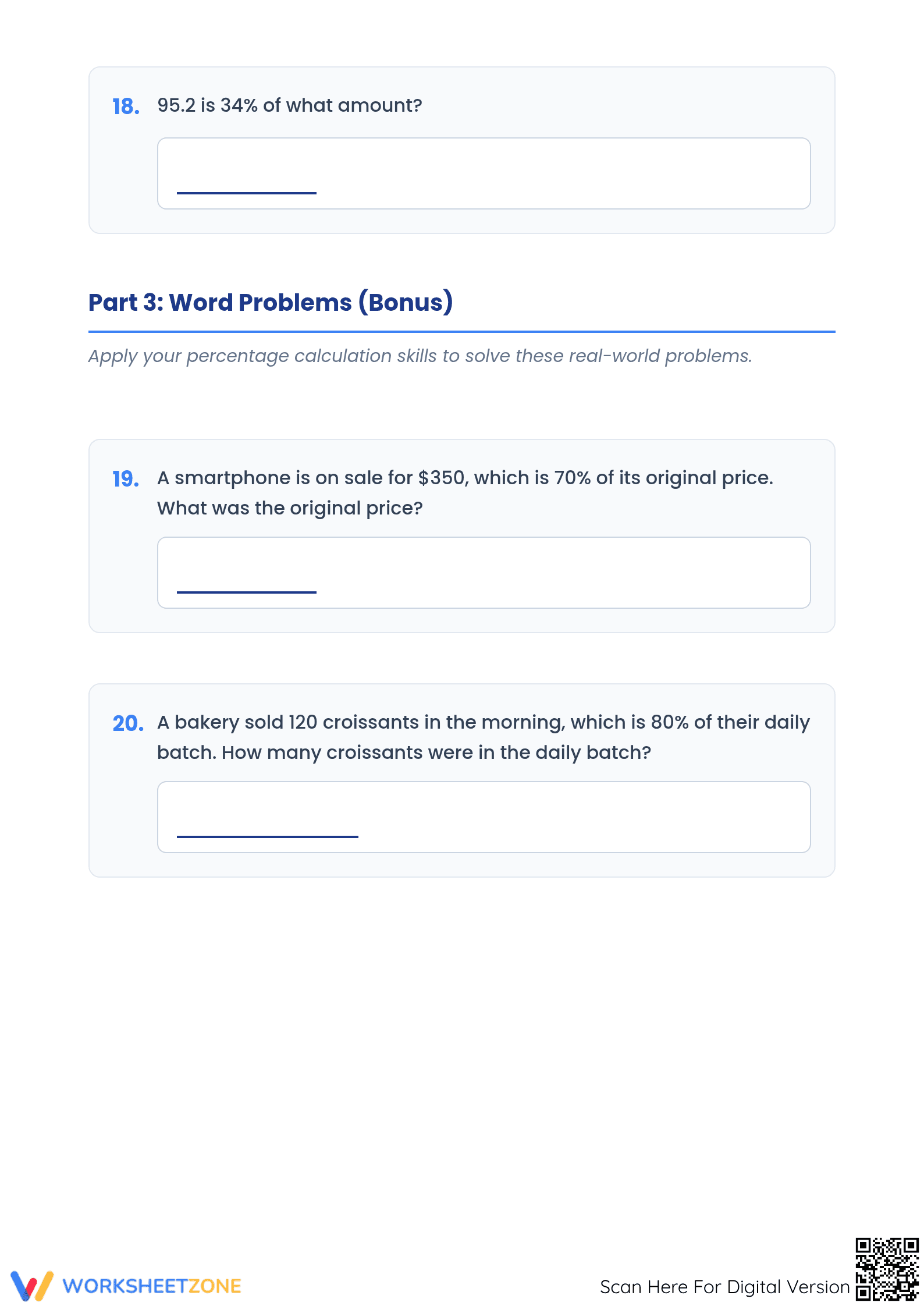
This 5-page resource features 20 carefully curated problems designed to build procedural fluency and conceptual understanding. The worksheet is divided into three logical parts: Standard Calculations for foundational practice, Advanced Calculations involving more complex decimals, and real-world Word Problems to demonstrate practical application. A complete answer key is included for immediate feedback and grading.
Zero-Prep Workflow
The zero-prep workflow for this resource is designed for maximum teacher efficiency. First, print the multi-page PDF (approx. 1 minute). Second, distribute to students as a bell-ringer or independent practice set (approx. 1 minute). Third, use the provided answer key for rapid grading or student self-correction at the end of the period (approx. 2 minutes).
Standards Alignment
This worksheet is strictly aligned to CCSS.MATH.CONTENT.6.RP.A.3.c. Students must find a percent of a quantity as a rate per 100 (e.g., 30% of a quantity means 30/100 times the quantity); solve problems involving finding the whole, given a part and the percent. Both standard codes can be copied directly into lesson plans, IEP goals, or district curriculum mapping tools.
How to Use It
1. Formative Assessment: Assign the "Standard Calculations" section mid-lesson to gauge student understanding of the inverse percentage concept before moving to word problems. 2. Independent Practice: Use the entire 20-problem set as a post-instructional activity to solidify the backtracking method. Observe if students are correctly identifying which value represents the "part" versus the "percent."
Who It's For
This resource is ideal for middle school students in Grades 6 through 8 who are developing their ratio and proportional relationship skills. It provides necessary scaffolding for learners who benefit from clear section headers and transitions from abstract computation to contextualized word problems, supported by an anchor chart or direct instruction lesson.
According to recent findings from the RAND AIRS 2024 analysis of educational materials, structured drill practice in middle school mathematics significantly correlates with higher retention of proportional reasoning skills. This worksheet focuses on CCSS.MATH.CONTENT.6.RP.A.3.c, requiring students to find the original whole amount when given a specific part and its corresponding percentage. By transitioning from decimal-based calculations to realistic word problems, such as calculating sale prices or production batches, the resource ensures that students develop both procedural efficiency and the ability to apply mathematical concepts in diverse contexts. Mastering these "backtracking" exercises is a prerequisite for success in early algebra and personal finance units. Research indicates that providing clear, multi-step practice helps mitigate the cognitive load associated with learning abstract percentage concepts, allowing for a smoother transition to high-school level mathematics. This resource provides the rigorous, standards-aligned practice necessary for classroom mastery.


