


























Views
Downloads



Calculate Original Amount Worksheet | Essential Grade 6 Math
Paste this activity's link or code into your existing LMS (Google Classroom, Canvas, Teams, Schoology, Moodle, etc.).
Students can open and work on the activity right away, with no student login required.
You'll still be able to track student progress and results from your teacher account.
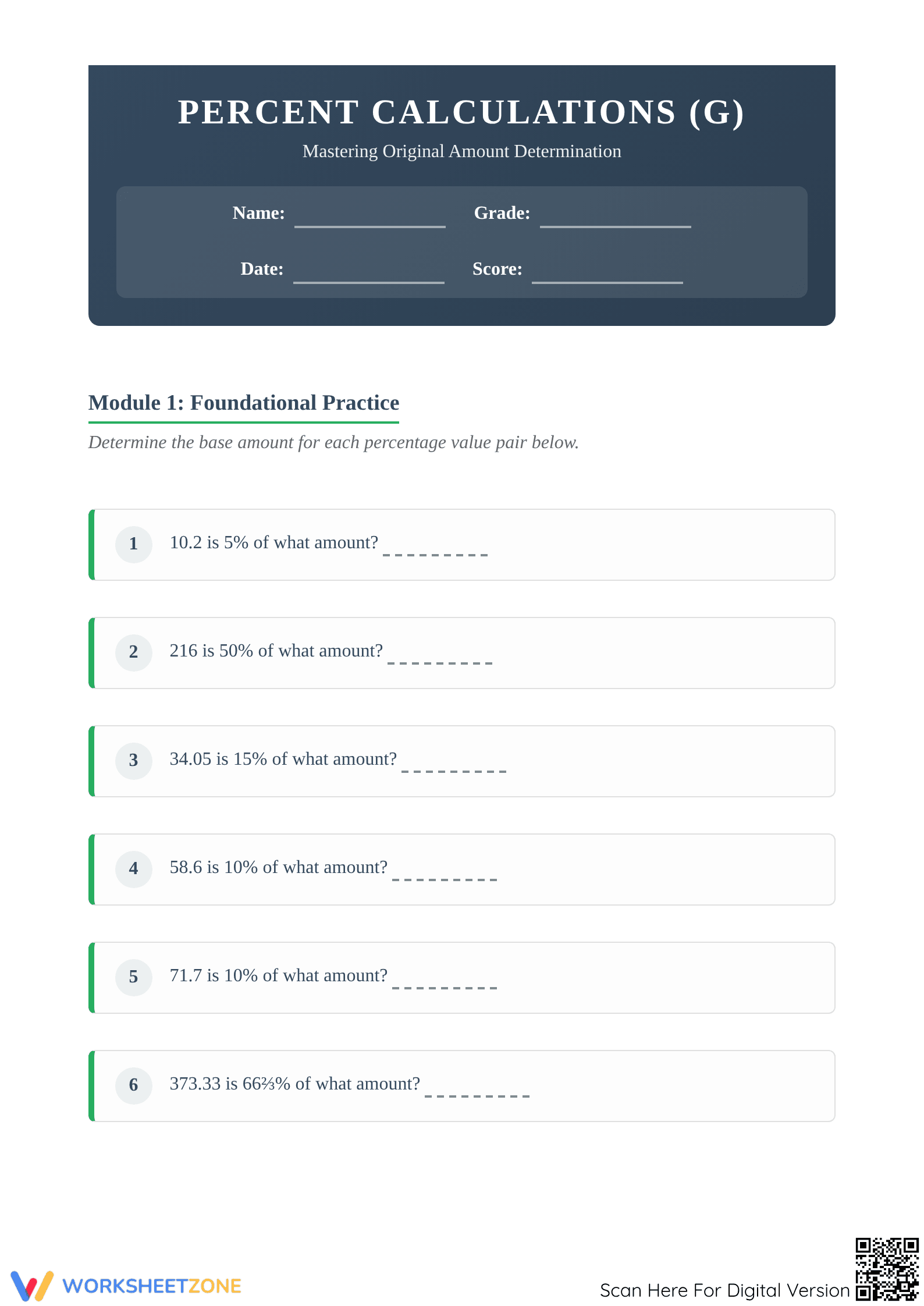
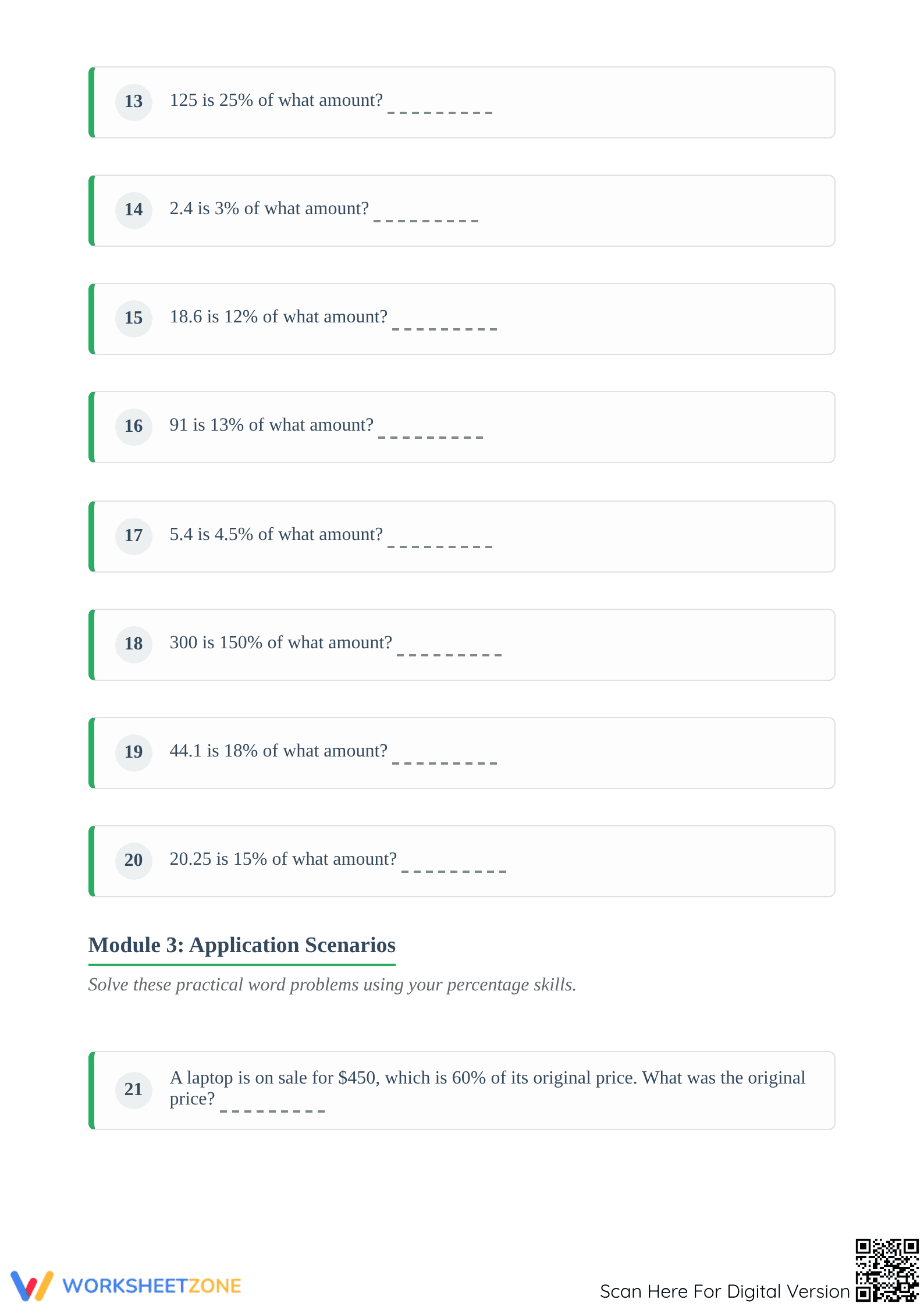
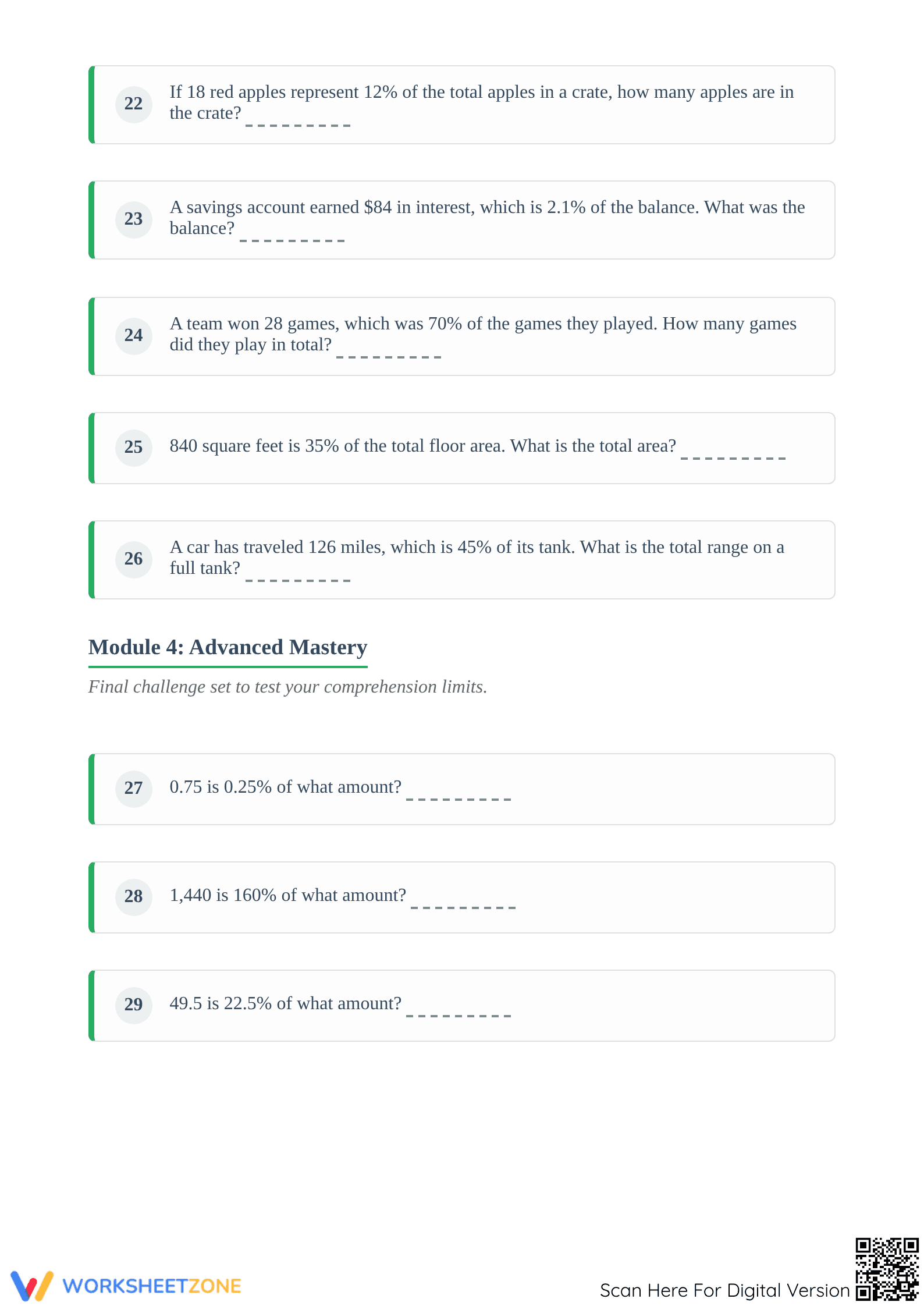
This comprehensive 5-page math worksheet focuses on calculating the original whole amount when only a part and its corresponding percentage are known. Students build mastery through thirty-two problems ranging from foundational equations to complex real-world application scenarios. The structured layout ensures learners internalize the inverse relationship between multiplication and division within percentage concepts.
At a Glance
- Grade: 6–8 · Subject: Math
- Standard:
6.RP.A.3.c— Solve problems involving finding the whole, given a part and the percent- Skill Focus: Calculating original amounts (Reverse Percentages)
- Format: 5 pages · 32 problems · Answer key included · PDF
- Best For: Scaffolded independent practice or spiral review
- Time: 45–60 minutes
Five pages of content contain thirty-two unique math problems divided into four modules of increasing difficulty. Each module features clear instructional headers, visual cycle diagrams, and ample workspace. A full answer key is included for rapid grading or student self-correction.
Skill Progression
- Guided Practice (Module 1): Ten foundational problems introduce the "backtracking" concept using friendly numbers and clear prompts to identify the relationship between the part and the whole.
- Supported Practice (Module 2): Ten refinement exercises require students to explicitly apply the division-based formula to solve for the original amount using regular decimals.
- Independent Practice (Modules 3-4): Twelve high-level tasks include multi-step word problems and advanced calculations involving complex percentages like 66 2/3%, pushing students toward full conceptual fluency.
This gradual-release approach follows the "I Do, We Do, You Do" framework, allowing teachers to check for understanding before students move to independent mastery.
Standards Alignment
This worksheet aligns with 6.RP.A.3.c: "Find a percent of a quantity as a rate per 100; solve problems involving finding the whole, given a part and the percent." This standard code can be copied directly into lesson plans, IEP goals, or district curriculum mapping tools.
How to Use It
Implement this resource after direct instruction on basic percentages to introduce the concept of "finding the whole." Use the first page as a guided warm-up, and assign the word problems as a formative assessment. Expected completion time is approximately one hour of focused instructional time.
Who It's For
Primary for 6th-grade students, this also serves as effective remedial support for 7th and 8th graders needing to strengthen proportional reasoning. It pairs naturally with an anchor chart detailing the percentage circle or triangle visualization.
The mastery of "backtracking" calculations—specifically determining the original whole from a known percentage and value—represents a significant cognitive shift for middle school mathematicians. This Grade 6 worksheet directly addresses the rigorous demands of 6.RP.A.3.c by moving students through a structured four-module progression. By transitioning from basic numerical identification to complex word problems involving discounts and interest, learners build the abstract reasoning required for high school algebra and financial literacy. According to Fisher & Frey (2014), the gradual release of responsibility within math practice—moving from foundational drills to independent application—is essential for long-term retention of proportional reasoning. This resource provides the necessary volume of practice, featuring 32 distinct problems that challenge students to apply the percentage formula in diverse contexts. Educational research suggests that consistent exposure to these "reverse" percentage problems reduces the common error of misidentifying the base amount in multi-step equations.


