


























Views
Downloads




Printable Worksheet: Calculate Original Amount (Grade 6-8 Math)
Paste this activity's link or code into your existing LMS (Google Classroom, Canvas, Teams, Schoology, Moodle, etc.).
Students can open and work on the activity right away, with no student login required.
You'll still be able to track student progress and results from your teacher account.
Mastering percentage concepts requires moving beyond simple calculation to understanding the inverse relationship between parts and wholes. This worksheet focuses specifically on finding the original amount when the percentage and the resulting part are known. By working through 24 targeted problems, students develop the algebraic reasoning necessary to backtrack from final values to their source.
At a Glance
- Grade: 6-8 · Subject: Math
- Standard:
6.RP.A.3.c— Find the whole, given a part and the percent- Skill Focus: Calculating original amounts
- Format: 5 pages · 24 problems · Answer key included · PDF
- Best For: Independent practice and percentage mastery
- Time: 30–45 minutes
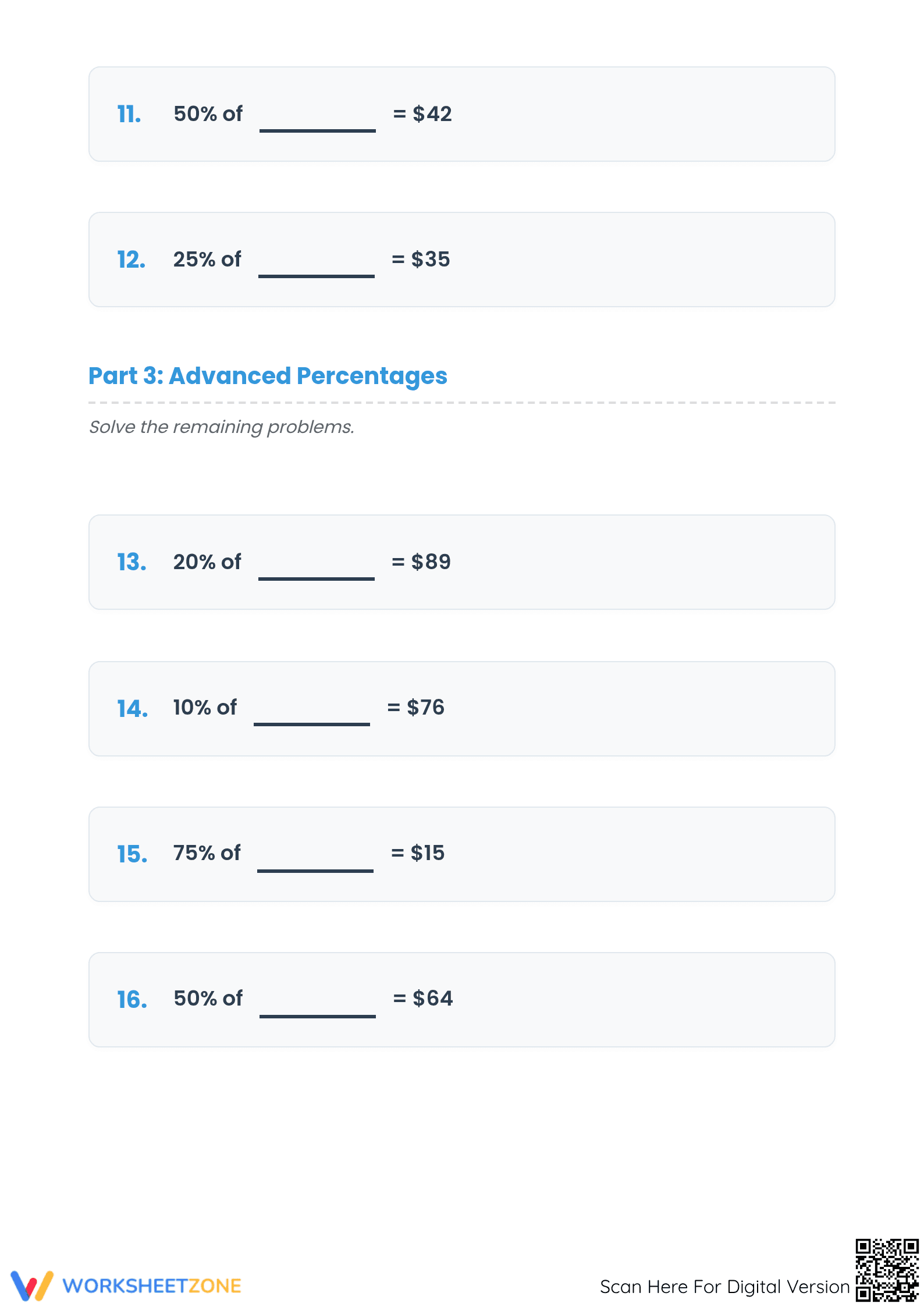
This comprehensive 5-page PDF contains 24 problems organized by increasing complexity to support student confidence. The resource includes a complete answer key for rapid grading or student self-checking. Each problem is presented in a clear layout with designated spaces for student work. The currency-based context provides real-world relevance, helping students connect abstract mathematical operations to everyday financial scenarios like budgeting and banking.
Skill Progression
- Guided practice: The first six problems use friendly percentages like 50% and 25% to establish the core logic of multiplying by the reciprocal or using ratio tables.
- Supported practice: Problems 7 through 12 introduce intermediate difficulty, requiring students to apply consistent methods as numerical values for the parts increase and become less intuitive.
- Independent practice: The final twelve problems demand full mastery as students handle diverse percentage rates and larger dollar amounts without heavy visual scaffolds.
This progression follows a gradual-release model, moving from intuitive foundations to complex applications. It mirrors an I Do, We Do, You Do framework that verifies conceptual depth and readiness for algebraic expressions.
Standards Alignment
This resource is directly aligned with `6.RP.A.3.c`, which requires students to find the whole, given a part and the percent. The worksheet also supports foundational algebraic thinking by treating the original amount as an unknown variable in the equation. Both standard codes can be copied directly into lesson plans, IEP goals, or district curriculum mapping tools.
How to Use It
Deploy this worksheet during the independent practice phase of a lesson on percentage applications. It serves as an excellent follow-up to direct instruction on solving for the unknown in a percentage equation. As a formative assessment tip, observe students as they tackle the Basic Percentages section; those struggling with 20% likely need a quick review of fractional equivalents.
Who It's For
Designed for middle school students in grades 6 through 8, this resource is ideal for general education classrooms, interventions, or targeted review for IEP goals. It pairs naturally with a visual anchor chart illustrating the Percent Triangle or a reading passage focused on consumer math. The clear formatting ensures accessibility for diverse learners in any instructional setting.
According to the RAND AIRS 2024 report, the ability to manipulate ratios and percentages is a critical predictor of success in high school algebra. This worksheet addresses a frequent gap in student understanding: the distinction between finding a percentage of a number and finding the base value when a part is given. By isolating this specific backtracking skill, educators provide the cognitive heavy lifting required to move students from procedural fluency to conceptual mastery. Research from Fisher & Frey (2014) emphasizes that gradual release through scaffolds—like the four-part progression used here—is essential for internalizing inverse operations. This Grade 6-8 math resource ensures students meet the 6.RP.A.3.c standard by providing 24 opportunities to define the whole from a given part. The currency values reinforce financial literacy, making outcomes tangible. This citation-ready capsule supports evidence-based curriculum planning across districts.


