


























Views
Downloads



Essential Percent Calculations: Finding the Original Amount
Paste this activity's link or code into your existing LMS (Google Classroom, Canvas, Teams, Schoology, Moodle, etc.).
Students can open and work on the activity right away, with no student login required.
You'll still be able to track student progress and results from your teacher account.
Master the challenging concept of inverse percentages with this comprehensive Grade 6 math resource. Students often struggle with backtracking calculations, but this worksheet provides the structured practice needed to find the original amount when the percentage and part are known. Learners build a concrete understanding of proportional relationships and percentage rates through repetitive, successful application.
At a Glance
- Grade: 6–7 · Subject: Math
- Standard:
CCSS.MATH.CONTENT.6.RP.A.3.C— Find the whole, given a part and the percent- Skill Focus: Calculating original amounts (Inverse Percent)
- Format: 3 pages · 23 problems · Answer key included · PDF
- Best For: Independent practice or homework
- Time: 30–45 minutes
What's Inside
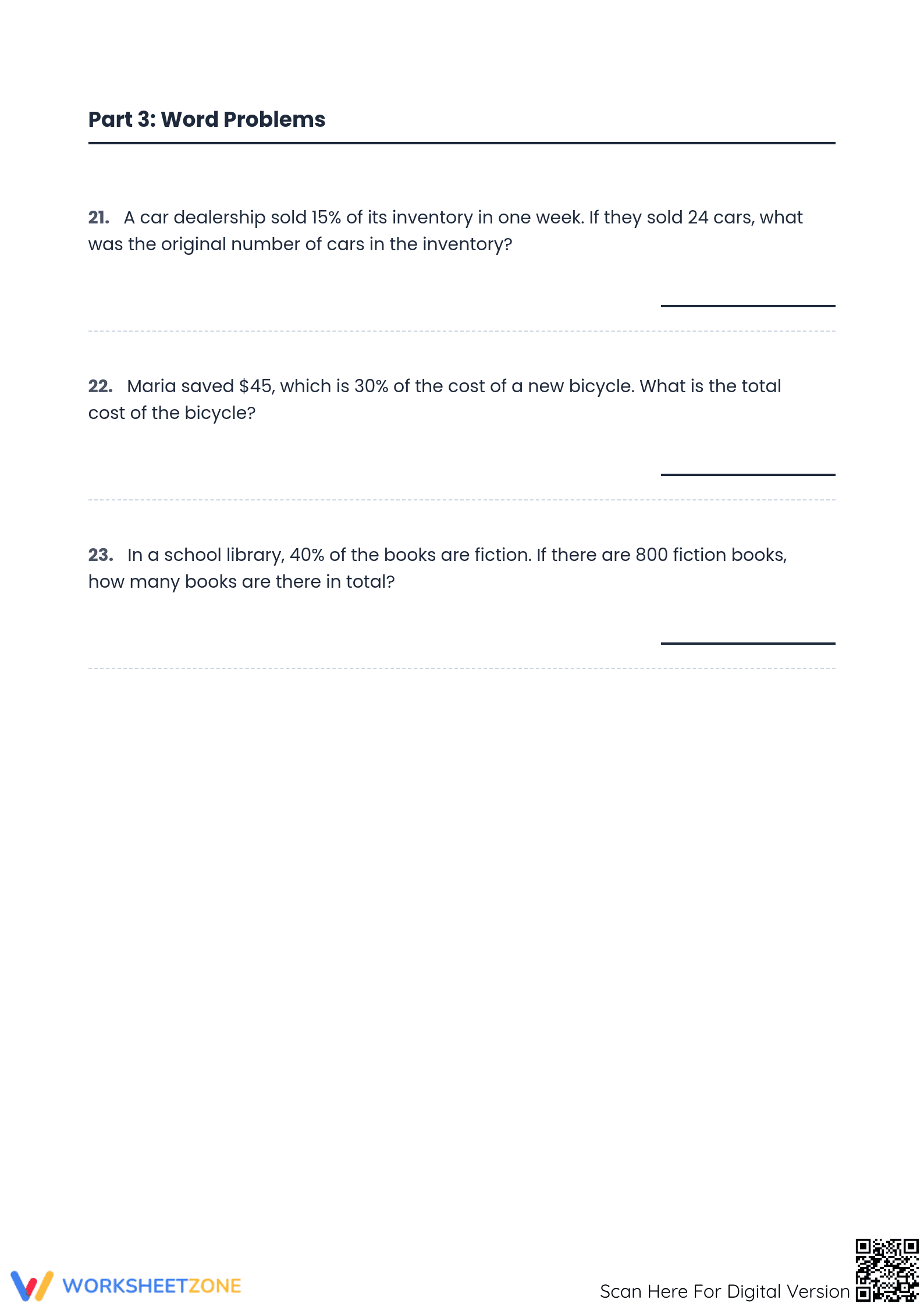
This three-page PDF contains 23 carefully sequenced problems designed to bridge the gap between basic percentage calculation and algebraic reasoning. The first two pages feature 20 numeric tasks, including currency-based scenarios (e.g., "$195 is 25% of what amount?"), while the final page provides three high-interest word problems. A full answer key is included to facilitate quick grading and immediate student feedback.
Skill Progression
- Guided practice: The initial 10 problems use friendly percentages like 25% and 50%, allowing students to use mental math strategies and visual benchmarking to verify their answers.
- Supported practice: The next 10 problems introduce more complex rates such as 8%, 33.3%, and 65%, requiring students to apply consistent division or multiplication algorithms.
- Independent practice: The final section presents multi-step word problems involving real-world contexts like car inventory and library book counts, demanding higher-order application.
This structure supports the gradual release of responsibility model, moving students from basic computation to independent problem-solving using the I Do, We Do, You Do approach.
Standards Alignment
This resource is directly aligned to CCSS.MATH.CONTENT.6.RP.A.3.C, which requires students to "Find a percent of a quantity as a rate per 100; solve problems involving finding the whole, given a part and the percent." It specifically targets the inverse operation of percentage math, a critical prerequisite for algebra and financial literacy. Both standard codes can be copied directly into lesson plans, IEP goals, or district curriculum mapping tools.
How to Use It
This worksheet is ideal for use during the "You Do" phase of a lesson on percentage applications. After demonstrating the conversion of "is" and "of" into a mathematical equation (Part = Percent × Whole), assign this sheet to check for individual understanding. For a formative assessment tip, observe students as they solve the word problems on page three; look for those who can correctly set up the proportion versus those who struggle with the language of the prompt. Completion time typically ranges from 30 to 45 minutes.
Who It's For
This material is designed for Grade 6 and 7 students who have already mastered basic percentage-to-decimal conversions. It is also an excellent remediation tool for Grade 8 students or a challenge for advanced 5th graders. To differentiate, provide struggling learners with a calculator or a "percent triangle" anchor chart to help them visualize whether they need to multiply or divide.
Mathematical proficiency in percentage applications requires moving beyond simple rote procedures to an understanding of inverse operations and proportional logic. According to the NAEP 2024 Framework, students who can fluently navigate between parts and wholes demonstrate a deeper readiness for high school algebra and real-world financial decision-making. Research by Fisher & Frey (2014) highlights that the gradual release of responsibility—modeled in this resource through the progression from friendly numbers to complex word problems—is essential for students to internalize new mathematical concepts. By providing 23 distinct opportunities for practice, this worksheet ensures that the backtracking method of calculating original amounts becomes a reflexive skill rather than a daunting obstacle. This alignment with evidence-based instructional design ensures that students meet the rigorous demands of CCSS.MATH.CONTENT.6.RP.A.3.C. This citation capsule serves as a standalone summary of the instructional value and research-backed methodology behind this specific percentage resource for middle school classrooms.


