


























Views
Downloads


Essential Grade 6 Worksheet: Calculate Original Amount Percent
Paste this activity's link or code into your existing LMS (Google Classroom, Canvas, Teams, Schoology, Moodle, etc.).
Students can open and work on the activity right away, with no student login required.
You'll still be able to track student progress and results from your teacher account.
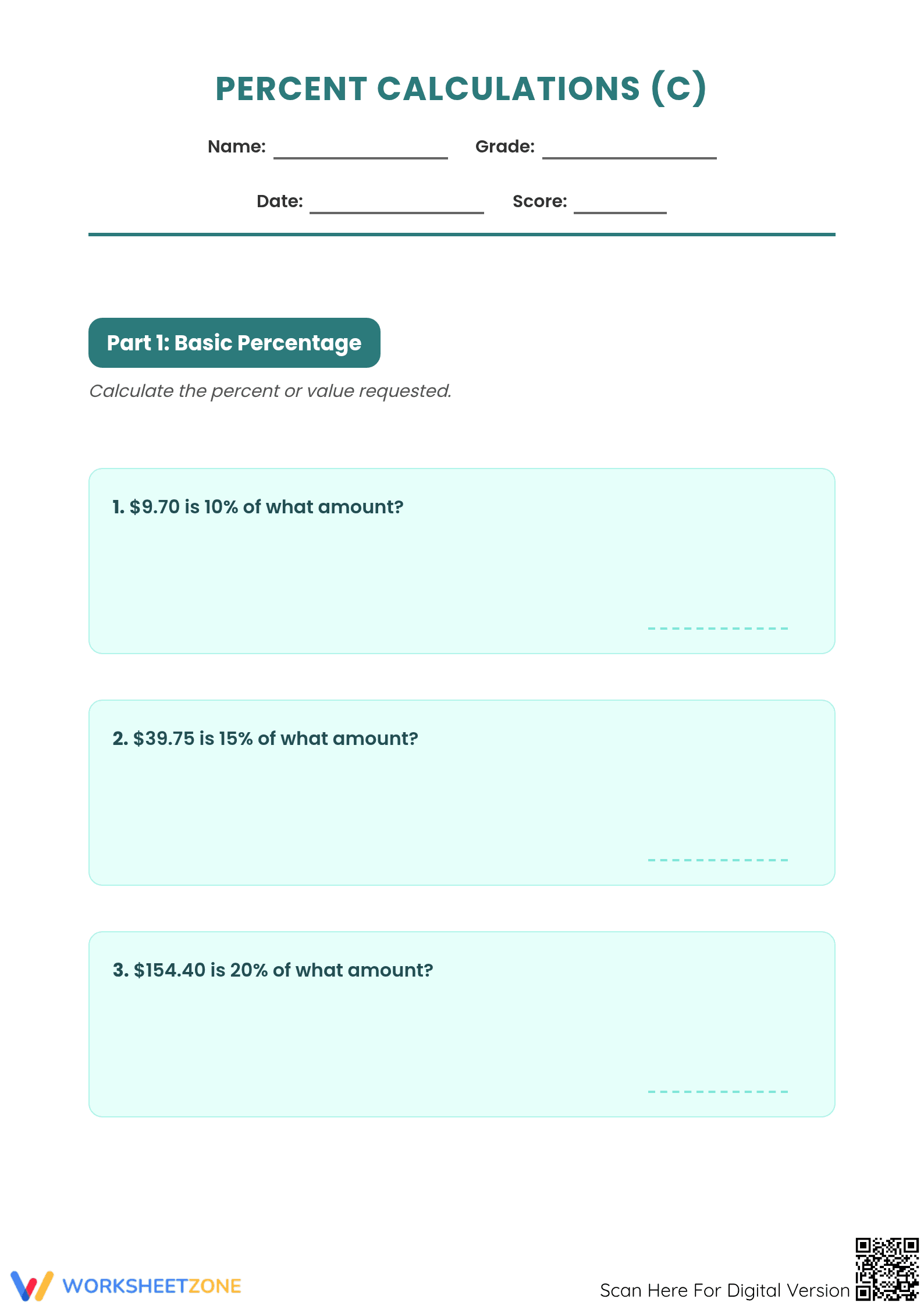
Students master the reverse percentage concept by calculating the whole from a known part and rate. This 4-page resource bridges basic percentage understanding with real-world financial literacy, ensuring Grade 6 through Grade 8 students can backtrack from decimals and currency values to find initial costs and quantities accurately. Lead with this skill to build algebraic confidence.
At a Glance
- Grade: 6 · Subject: Math
- Standard:
CCSS.MATH.CONTENT.6.RP.A.3.C— Find the whole quantity, given a part and the percent value- Skill Focus: Reverse Percentage Calculations
- Format: 4 pages · 14 problems · Answer key included · PDF
- Best For: Independent Practice and Mastery Checks
- Time: 30–45 minutes
What's Inside
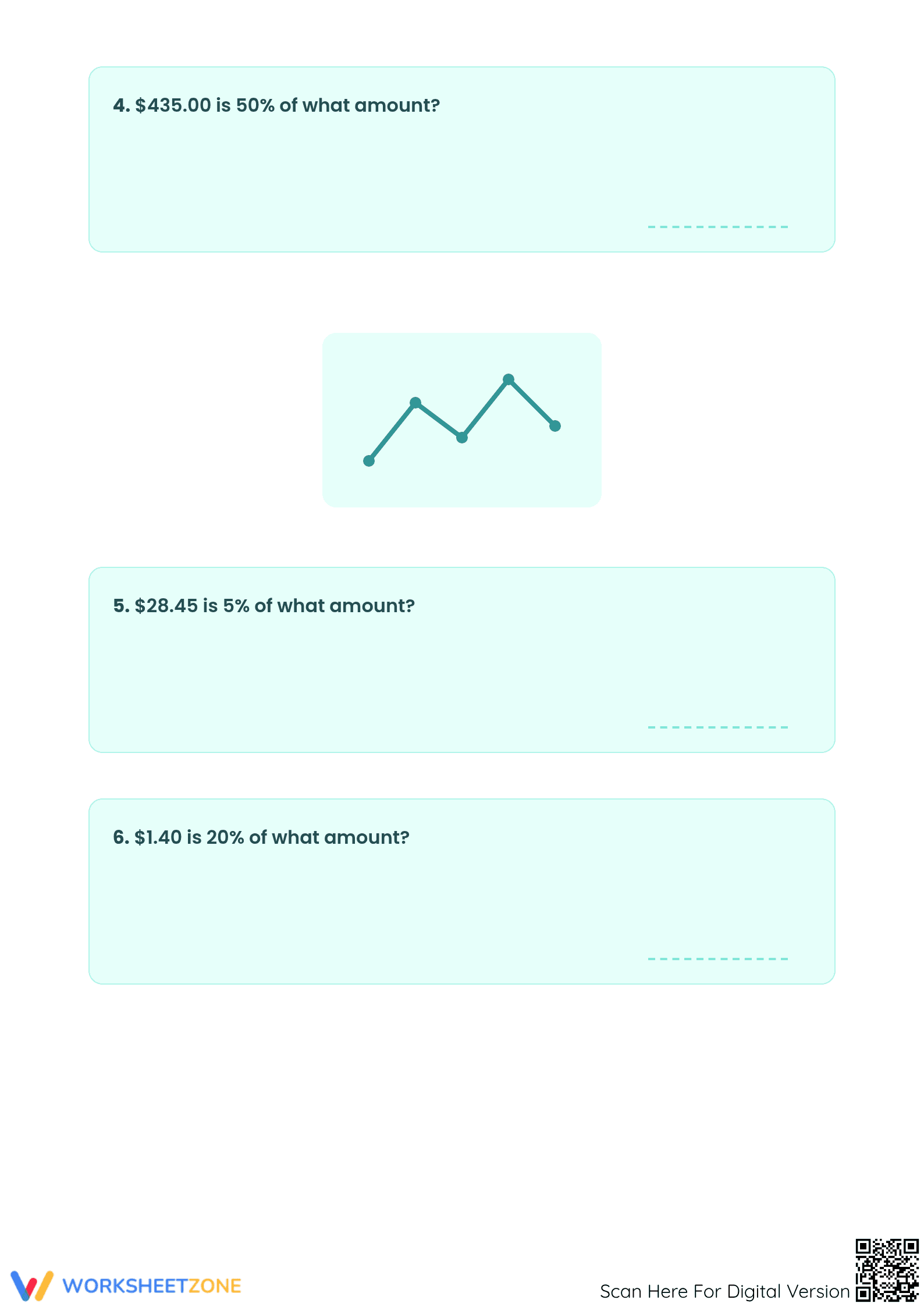
This comprehensive 4-page packet contains 14 structured math problems. Part 1 focuses on foundational "is/of" prompts using currency and decimal values, while Part 2 introduces challenge questions with percentages over 100% and complex rates. Each page features clear workspace for student calculations, and a full answer key is provided to ensure immediate feedback and grading efficiency.
Skill Progression
- Guided Practice: Problems 1 through 4 introduce the concept with simple whole numbers and standard percentages like 10% and 50%, allowing students to establish a reliable division-based workflow.
- Supported Practice: Problems 5 through 10 increase complexity by incorporating varied decimals and lower percentage rates such as 5%, requiring higher precision in multi-step calculations.
- Independent Practice: The Challenge Questions in the second part move to advanced scenarios including percentages over 100% and decimal rates like 2.5%, testing the durability of student conceptual understanding.
This instructional progression follows the gradual-release model, moving from scaffolded prompts to independent problem-solving.
Standards Alignment
The primary alignment for this resource is CCSS.MATH.CONTENT.6.RP.A.3.C: "Find a percent of a quantity as a rate per 100; solve problems involving finding the whole, given a part and the percent." This worksheet also supports 7.RP.A.3 by preparing students for multi-step ratio and percent problems. Both standard codes can be copied directly into lesson plans, IEP goals, or district curriculum mapping tools.
How to Use It
Use this as a mid-unit formative assessment after students have mastered finding a percent of a number. During instruction, observe if students are mistakenly multiplying instead of dividing to find the whole. It also serves as an excellent bell-ringer or homework assignment, typically requiring 30 to 45 minutes for complete accuracy. Use the "Challenge" section as a ticket-to-leave for advanced learners.
Who It's For
This resource is designed for middle school students in Grades 6 through 8 who are strengthening their proportional reasoning and algebraic foundations. It is particularly effective for students requiring targeted intervention in financial math or those preparing for state assessments that feature non-standard percentage problems. Pair this worksheet with a percentage bar model anchor chart for maximum student support.
Aligned to the standard CCSS.MATH.CONTENT.6.RP.A.3.C, this worksheet targets the specific cognitive demand of finding the whole when given a part and a percent. According to the ScienceDirect TpT Analysis (2024), targeted practice in reverse percentage operations is a critical predictor of success in higher-level algebraic reasoning and financial literacy. By isolating the "backtracking" mechanic, students reduce cognitive load and build fluency in translating verbal math prompts into executable algebraic equations (Part = Percent × Whole). This resource provides the necessary repetition for students to move beyond surface-level rote memorization of formulas toward a flexible understanding of part-whole relationships. The inclusion of currency and decimal values mirrors real-world data application, bridging the gap between abstract classroom theory and practical consumer mathematics for diverse learner populations.


