


























Views
Downloads

Printable Beginning Sounds Worksheet | Grade K
Paste this activity's link or code into your existing LMS (Google Classroom, Canvas, Teams, Schoology, Moodle, etc.).
Students can open and work on the activity right away, with no student login required.
You'll still be able to track student progress and results from your teacher account.
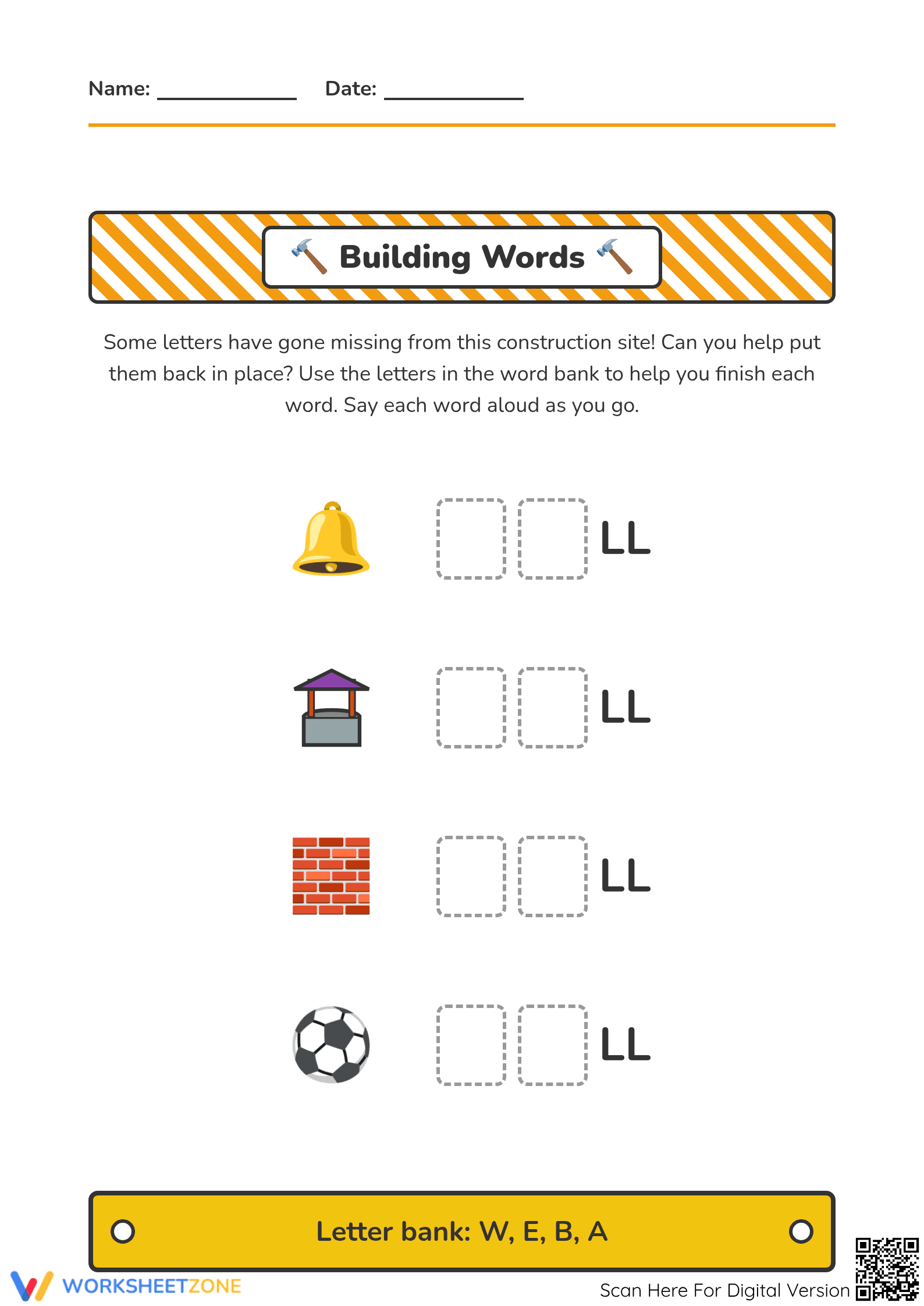
This Grade K phonics worksheet helps young learners master beginning sounds and letter-sound correspondence. By identifying the missing initial letters for familiar words ending in "-LL," students build foundational reading skills. The engaging construction theme keeps children focused as they sound out words and complete each spelling.
At a Glance
- Grade: K · Subject: ELA
- Standard:
CCSS.ELA-LITERACY.RF.K.3.A— Demonstrate basic knowledge of letter-sound correspondences- Skill Focus: Beginning Sounds and Phonics
- Format: 1 page · 4 problems · Answer key included · PDF
- Best For: Independent practice or morning work
- Time: 10–15 minutes
Inside this printable resource, educators will find a single activity page featuring four picture prompts: a bell, a well, a wall, and a ball. Each image has a word frame missing its first two letters. A convenient letter bank at the bottom provides the exact letters needed (W, E, B, A). A complete answer key is included to make grading fast.
This resource is designed for a zero-prep classroom workflow:
- Print (1 minute): Download the PDF and print. The design is printer-friendly.
- Distribute (1 minute): Hand out the worksheets. The visual cues make instructions clear to early readers.
- Review (2 minutes): Use the provided answer key to quickly check student work.
With total teacher prep time under two minutes, this activity is excellent for emergency sub plans.
This worksheet is tightly aligned to CCSS.ELA-LITERACY.RF.K.3.A: Demonstrate basic knowledge of one-to-one letter-sound correspondences by producing the primary sound or many of the most frequent sounds for each consonant. It also supports early spelling and phonemic awareness by requiring students to isolate initial sounds. Both standard codes can be copied directly into lesson plans, IEP goals, or district curriculum mapping tools.
Teachers can deploy this worksheet during morning work to activate phonics knowledge before formal instruction. It also serves as an effective independent practice activity during literacy centers. While students work, teachers can conduct formative assessments by asking children to verbally isolate the beginning sound before writing. Expect completion within 10 to 15 minutes.
This resource is ideal for kindergarten students who are currently learning consonant sounds and basic word building. The included letter bank provides built-in differentiation, offering a helpful scaffold for students who struggle with working memory or letter recall. For a comprehensive lesson, pair this worksheet with a direct instruction session on the "-LL" word family or a read-aloud book that features heavy alliteration.
Developing strong phonemic awareness and letter-sound correspondence is a critical milestone in early childhood literacy. According to the RAND AIRS 2024 report on foundational reading skills, explicit practice with beginning sounds significantly improves later decoding fluency. This worksheet directly targets CCSS.ELA-LITERACY.RF.K.3.A by asking students to demonstrate basic knowledge of letter-sound correspondences. By requiring learners to map specific consonant and vowel sounds to their corresponding letters using a visual word bank, the activity reinforces the neural pathways necessary for automatic word recognition. The structured format, which limits the cognitive load to just four targeted problems, ensures that young learners can focus entirely on the phonological task without becoming overwhelmed. Integrating this type of targeted, standards-aligned practice into daily routines provides the repetition necessary for mastery and sets a strong foundation for future reading success.


