


























Views
Plays

Renaissance History Quiz | Grade 6 Printable Worksheet
Paste this activity's link or code into your existing LMS (Google Classroom, Canvas, Teams, Schoology, Moodle, etc.).
Students can open and work on the activity right away, with no student login required.
You'll still be able to track student progress and results from your teacher account.
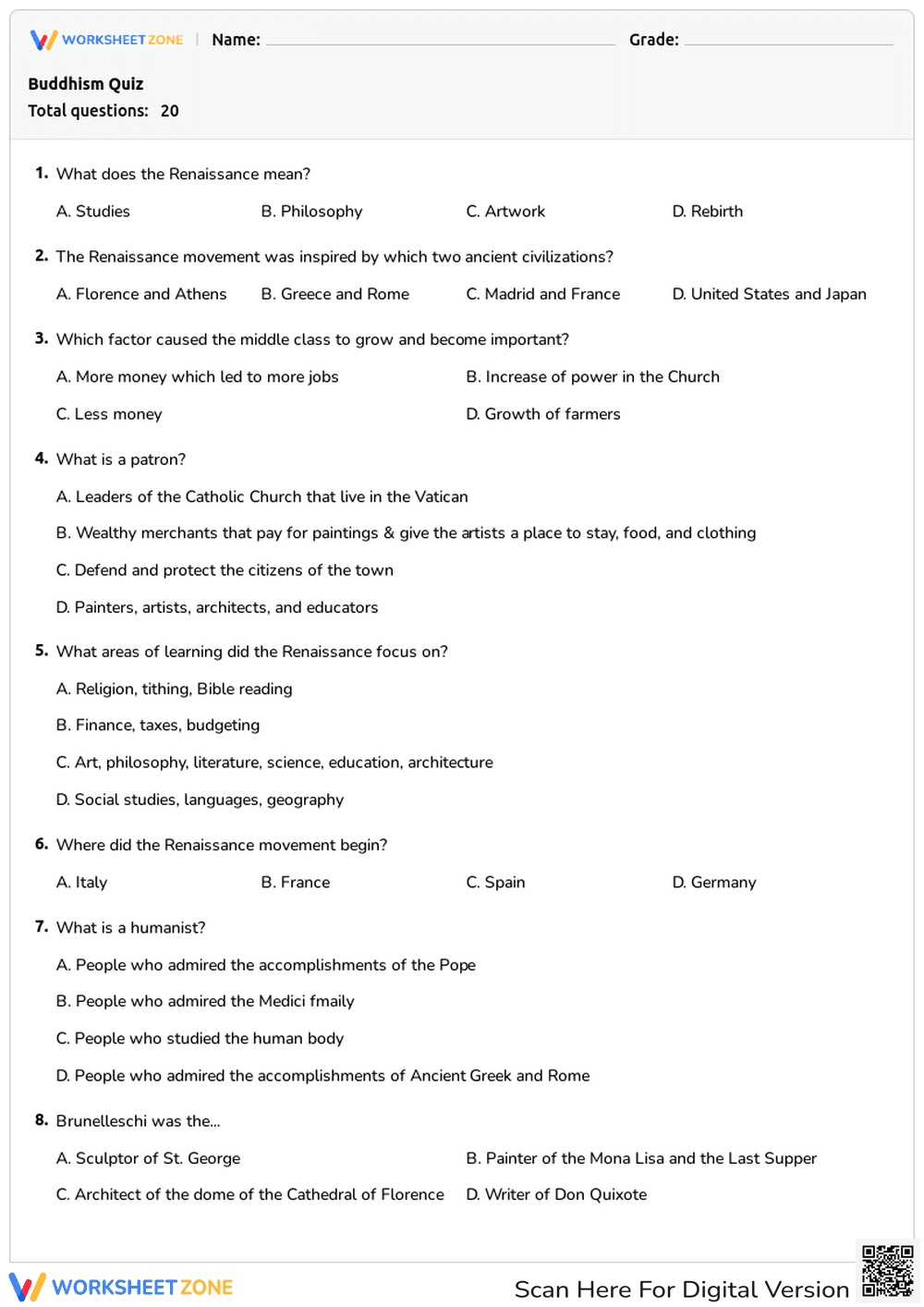
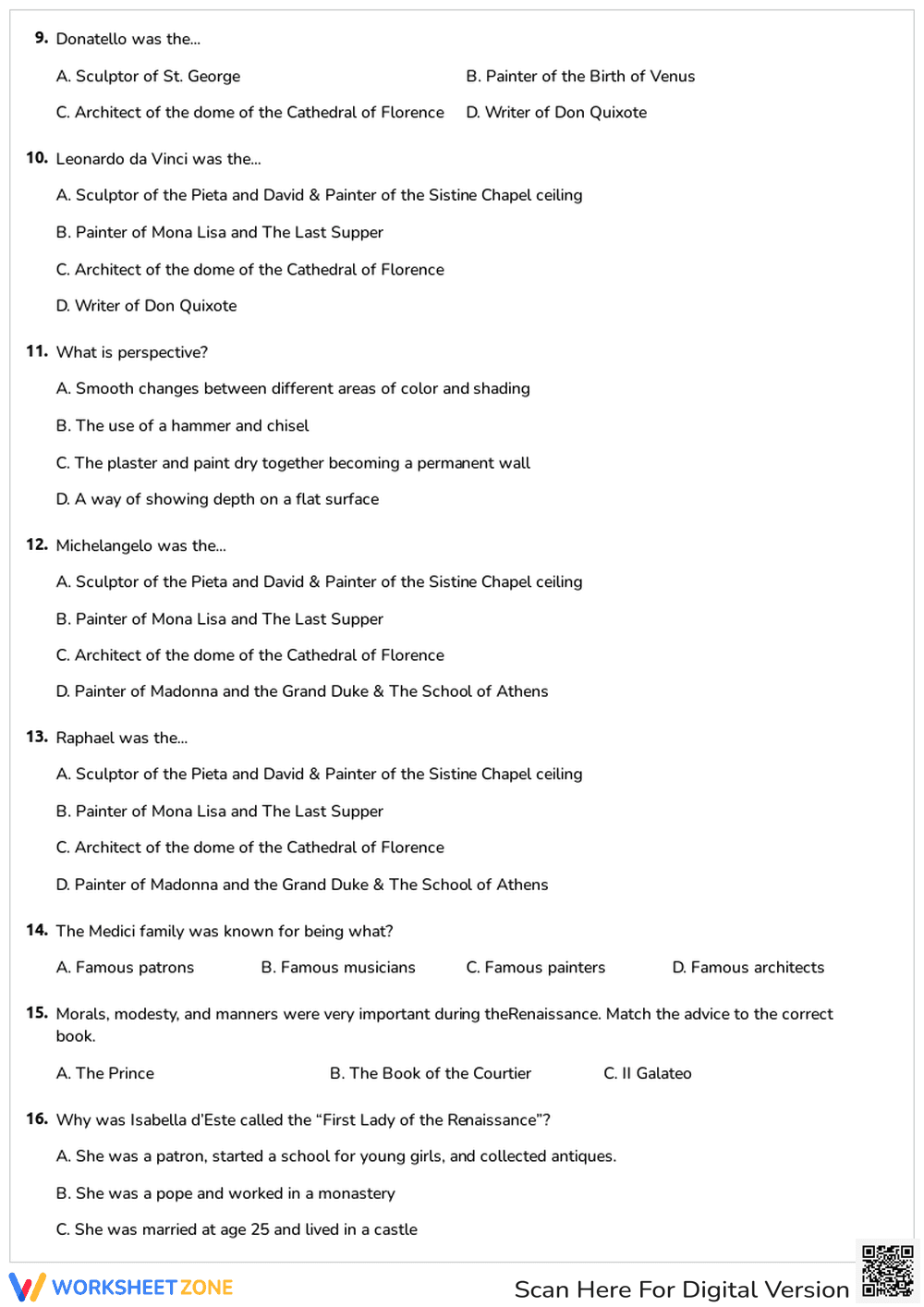
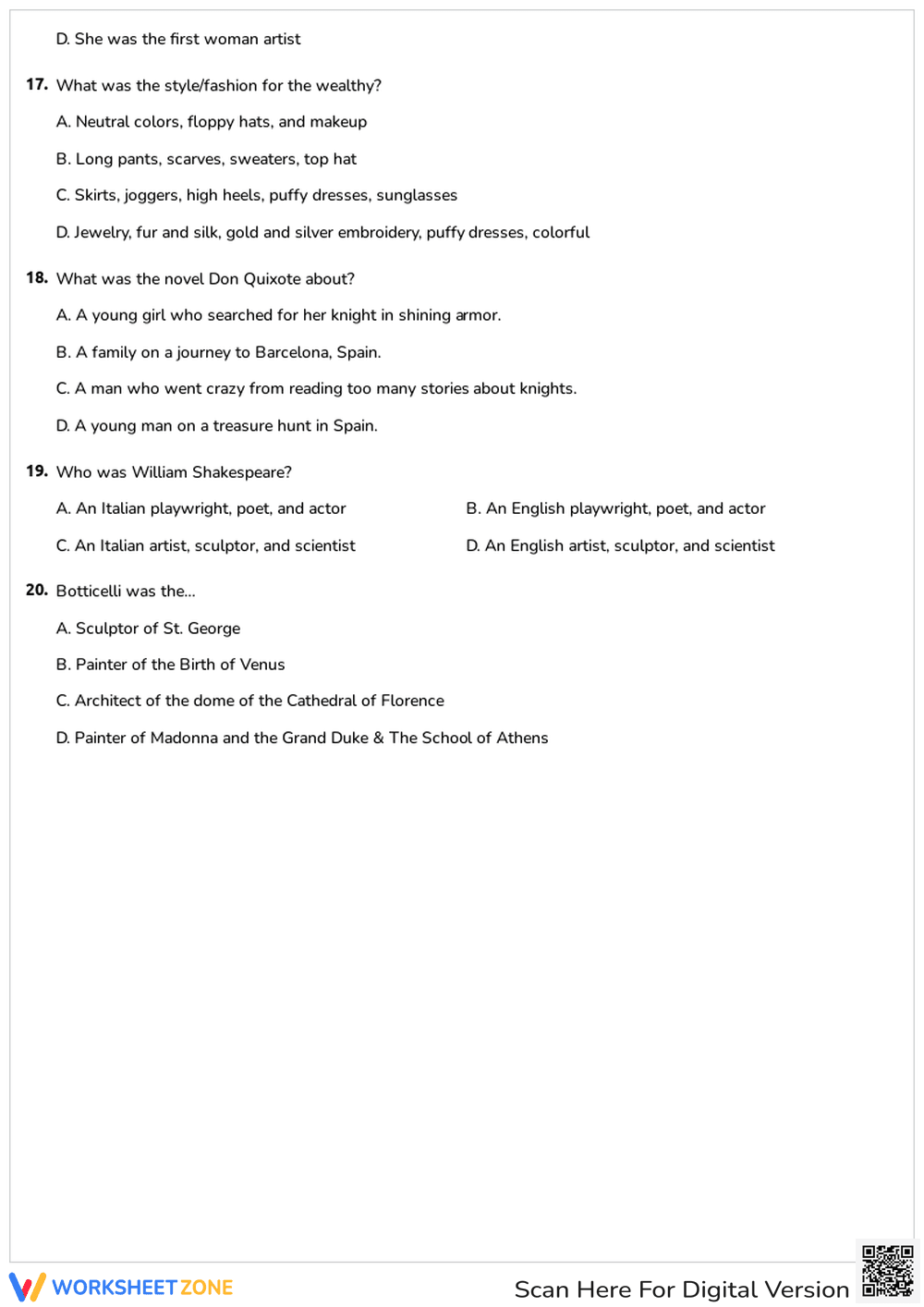
This Grade 6 history quiz evaluates student understanding of the Renaissance period, focusing on key figures, vocabulary, and cultural shifts. Students will demonstrate their knowledge of historical concepts like humanism and patronage while identifying the contributions of artists such as Leonardo da Vinci and Michelangelo.
At a Glance
- Grade: 6 · Subject: Social Studies
- Standard:
CCSS.ELA-LITERACY.RH.6-8.4— Determine the meaning of historical vocabulary- Skill Focus: Renaissance history and key figures
- Format: 3 pages · 20 problems · Answer key included · PDF
- Best For: End-of-unit assessment
- Time: 20–30 minutes
What's Inside
This comprehensive assessment features 20 multiple-choice questions spanning three pages. The carefully structured problems cover a wide range of topics, including the origins of the Renaissance in Italy, the impact of the Medici family, and the specific masterpieces created by renowned artists and architects. An included answer key ensures quick and accurate grading for educators.
Zero-Prep Workflow
Designed for immediate classroom implementation, this assessment requires minimal teacher preparation.
- Print (1 minute): Simply print the three-page PDF assessment and the accompanying answer key.
- Distribute (1 minute): Hand out the quiz to students after completing your Renaissance unit.
- Review (5 minutes): Use the provided key to quickly grade submissions or facilitate a whole-class review session.
With under two minutes of total setup time, this resource is highly effective for busy educators and serves as an excellent emergency sub plan.
Standards Alignment
This worksheet is aligned to primary standard CCSS.ELA-LITERACY.RH.6-8.4, requiring students to determine the meaning of words and phrases as they are used in a text, including vocabulary specific to domains related to history/social studies. By testing terms like "patron," "humanist," and "perspective," the quiz ensures students grasp essential historical terminology. Both standard codes can be copied directly into lesson plans, IEP goals, or district curriculum mapping tools.
How to Use It
This versatile quiz functions perfectly as a summative assessment after direct instruction on the European Renaissance. Teachers can assign it as an independent test to measure individual retention of historical facts. Alternatively, it works well as a collaborative review activity where students discuss the correct multiple-choice options in small groups. As a formative assessment observation tip, monitor which specific questions students struggle with to guide targeted reteaching. Expect students to complete the quiz within 20 to 30 minutes.
Who It's For
This resource is primarily designed for sixth-grade social studies students, though it is easily adaptable for seventh and eighth-grade history classrooms. The straightforward multiple-choice format provides built-in scaffolding, making it accessible for diverse learners who benefit from structured options rather than open-ended recall. It pairs naturally with primary source reading passages about the Medici family or visual anchor charts displaying famous Renaissance artwork.
Integrating structured assessments aligned to CCSS.ELA-LITERACY.RH.6-8.4 helps students determine the meaning of historical vocabulary and retain complex social studies concepts. According to Fisher & Frey (2014), utilizing targeted, low-stakes quizzes enhances long-term memory retrieval and provides educators with immediate, actionable data on student comprehension. When students are frequently asked to recall specific historical details—such as the definition of a patron or the creator of the Sistine Chapel ceiling—they build a stronger foundational schema for future historical analysis. This 20-question format minimizes cognitive overload by presenting clear choices, allowing learners to focus on demonstrating their knowledge. Regular use of standards-based assessments ensures that critical historical terminology moves into long-term retention, supporting higher-order analytical skills in subsequent lessons.


