


























Views
Plays

Renaissance History Quiz | Grade 6-8 Essential Worksheet
Paste this activity's link or code into your existing LMS (Google Classroom, Canvas, Teams, Schoology, Moodle, etc.).
Students can open and work on the activity right away, with no student login required.
You'll still be able to track student progress and results from your teacher account.
This Grade 6-8 Renaissance history worksheet provides a comprehensive 20-question assessment to evaluate student understanding of the "rebirth" of European culture. Students will identify key figures like Leonardo da Vinci and Michelangelo while analyzing the social and political shifts that defined the era. It ensures students grasp the transition from the Middle Ages to modernity.
At a Glance
- Grade: 6-8 · Subject: History
- Standard:
CCSS.ELA-LITERACY.RH.6-8.7— Integrate visual information with other information in print and digital texts- Skill Focus: Renaissance Art & History
- Format: 4 pages · 20 problems · Answer key included · PDF
- Best For: Summative assessment or unit review
- Time: 25–35 minutes
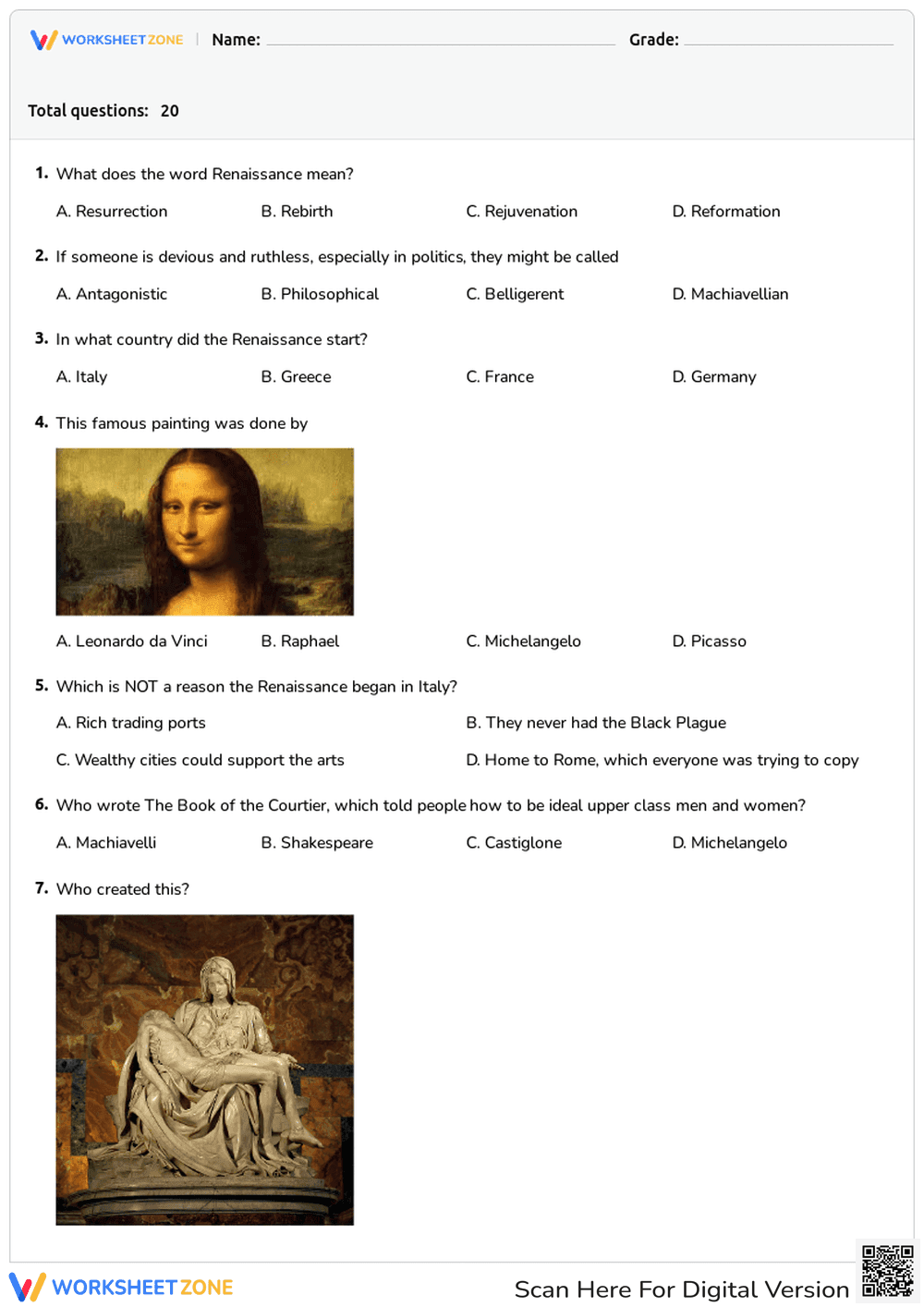
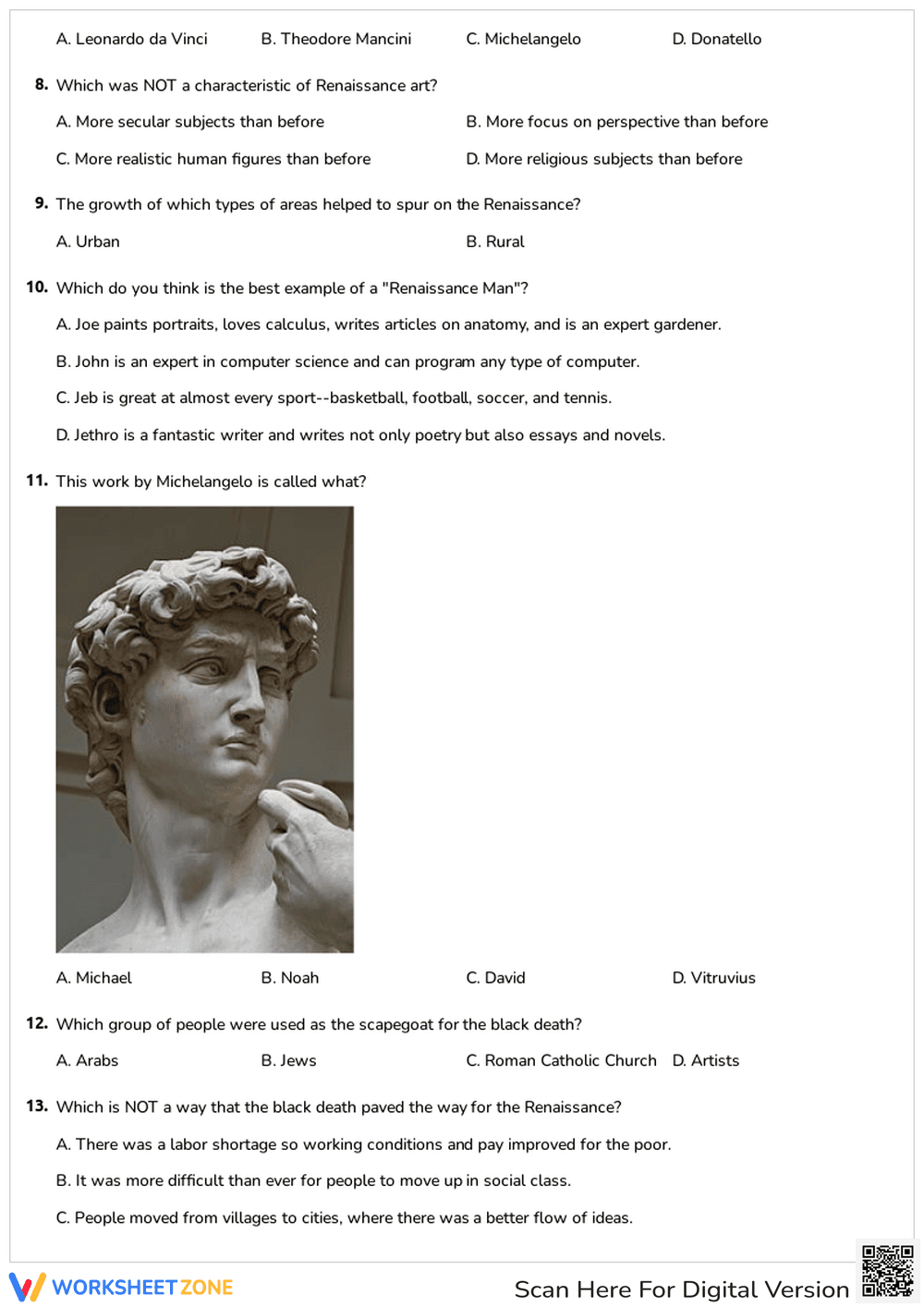
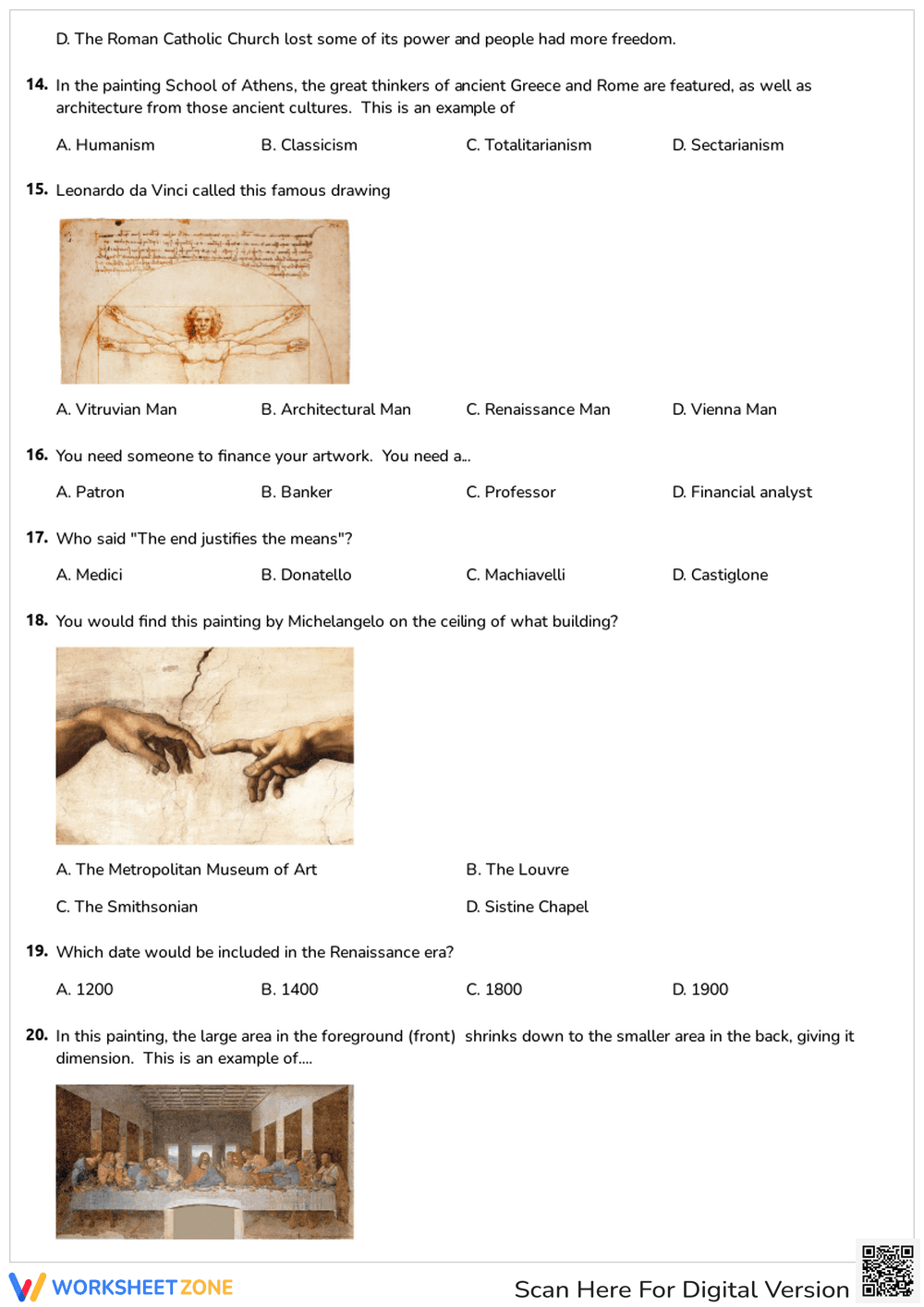
The resource contains a four-page multiple-choice quiz featuring 20 targeted questions. It includes high-quality visual aids, such as the Mona Lisa, the Pietà, and the Vitruvian Man, to test visual literacy. The layout is clean and student-friendly, with a dedicated space for names and grades, and a full answer key for rapid grading.
This worksheet is designed for an immediate, zero-prep classroom experience. Teachers can Print the four-page PDF in under 1 minute, Distribute the copies to students for a 30-minute assessment, and Review the results using the included answer key in less than 5 minutes. It serves as an ideal sub-plan or end-of-unit check.
Standards Alignment
Primary alignment is to CCSS.ELA-LITERACY.RH.6-8.7, which requires students to integrate visual information with other information in print and digital texts. By identifying specific artistic techniques like perspective and classicism in famous works, students demonstrate mastery of historical context. Both standard codes can be copied directly into lesson plans, IEP goals, or district curriculum mapping tools.
How to Use It
Use this worksheet as a summative assessment after completing a unit on the Italian Renaissance. It is also effective as a pre-test to gauge prior knowledge of European history. During the activity, observe if students can connect the concept of "Humanism" to the visual examples provided. Completion typically ranges from 25 to 35 minutes depending on reading speed.
Who It's For
This resource is tailored for middle school students in grades 6, 7, and 8 studying World History or Social Studies. It provides enough visual support for English Language Learners and can be paired with an anchor chart detailing the "Renaissance Man" characteristics or a direct instruction lesson on the Medici family.
According to the RAND AIRS 2024 report, structured assessments that integrate visual literacy with historical facts significantly improve long-term retention in middle school social studies. This worksheet aligns with CCSS.ELA-LITERACY.RH.6-8.7 by requiring students to synthesize text-based historical knowledge with iconic visual evidence from the Renaissance period. By covering 20 distinct points of inquiry—from the impact of the Black Death to the political philosophy of Machiavelli—the resource provides a robust data point for formative or summative evaluation. Research from Fisher & Frey (2014) emphasizes that the gradual release of responsibility is bolstered when students can apply vocabulary like "secularism" and "patron" to concrete historical examples. This 4-page PDF ensures that the plain-English skill of identifying cultural shifts is met with academic rigor, making it a reliable tool for diverse classroom settings.


