


























Views
Downloads
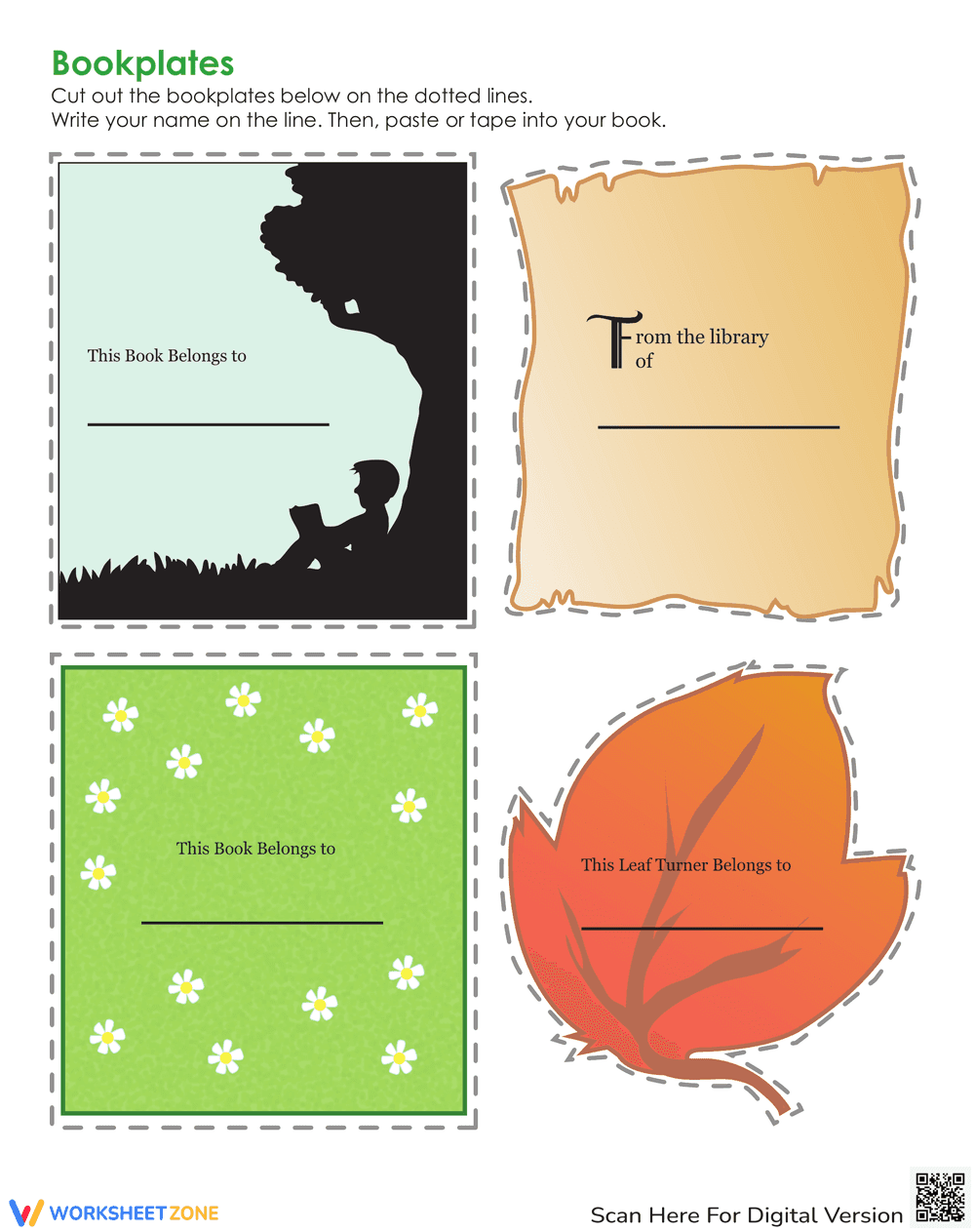

Printable Bookplates Craft Worksheet | Grade 2 ELA
Paste this activity's link or code into your existing LMS (Google Classroom, Canvas, Teams, Schoology, Moodle, etc.).
Students can open and work on the activity right away, with no student login required.
You'll still be able to track student progress and results from your teacher account.
Encourage reading ownership and fine motor precision with this engaging classroom resource. This printable worksheet provides students with four distinct, themed bookplates designed to practice neat handwriting and proper name capitalization. By cutting out and personalizing these labels, young learners take pride in their personal library while reinforcing foundational language arts and motor skills.
At a Glance
- Grade: Grade 2 · Subject: Arts & Crafts & ELA
- Standard:
CCSS.ELA-LITERACY.L.2.2.A— Capitalize names of people when labeling personal items- Skill Focus: Fine motor cutting, handwriting, and proper noun capitalization
- Format: 1 page · 4 tasks · Open-ended · PDF
- Best For: Classroom library organization and back-to-school activities
- Time: 15–20 minutes
This single-page PDF features four uniquely illustrated bookplates ready for customization. The designs include a peaceful silhouette of a child reading under a tree, a classic parchment scroll, a cheerful daisy pattern, and a seasonal autumn leaf. Each template contains clear dotted cutting lines and a dedicated primary writing line for student names.
This zero-prep activity integrates into your daily routine with a simple three-step workflow. First, print the single-page document for your entire class in under one minute. Next, distribute the sheets along with scissors and glue, allowing students roughly ten minutes to carefully cut out their chosen designs. Finally, spend five minutes reviewing proper name capitalization as students write their names and secure the plates inside their favorite books. Total teacher preparation time is under two minutes, making this an excellent option for morning work, substitute lesson plans, or transition periods.
This activity aligns directly with CCSS.ELA-LITERACY.L.2.2.A, which requires students to demonstrate command of standard English conventions by capitalizing proper nouns, specifically names of people. Additionally, it supports fine motor development essential for early elementary writing stamina. Both standard codes can be copied directly into lesson plans, IEP goals, or district curriculum mapping tools.
Utilize this worksheet during the first week of school or when launching a new independent reading unit. Before direct instruction, use it to discuss book care and ownership. During the activity, observe student scissor grip and note whether they automatically capitalize the first letter of their first and last names, providing immediate formative feedback on handwriting alignment and mechanics.
This resource is ideal for general education second-grade classrooms, early childhood art blocks, and school library orientation sessions. It offers natural scaffolding for students requiring fine motor practice or remedial handwriting support. Pair this worksheet with a read-aloud story about libraries or a direct instruction lesson on proper nouns to maximize engagement.
Integrating functional writing tasks like personalizing bookplates significantly enhances student engagement and ownership over learning materials. According to a comprehensive EdReports 2024 analysis on foundational literacy, connecting real-world utility with mechanical practice—such as name capitalization under CCSS.ELA-LITERACY.L.2.2.A—deepens a child's semantic understanding of proper nouns. Furthermore, the physical act of cutting along dotted lines reinforces bilateral coordination and hand strength, which are critical precursors to sustained writing endurance in early elementary grades. By combining creative expression with structured language conventions, this worksheet bridges the gap between artistic engagement and rigorous academic standards. Teachers can confidently utilize this resource to gather authentic formative data on student handwriting, spatial awareness, and grammatical mechanics within a brief, self-contained instructional window that requires zero advanced preparation or cleanup.


