


























Views
Downloads

Essential Skeleton Functions Worksheet | Grade 3-4 Science
Paste this activity's link or code into your existing LMS (Google Classroom, Canvas, Teams, Schoology, Moodle, etc.).
Students can open and work on the activity right away, with no student login required.
You'll still be able to track student progress and results from your teacher account.
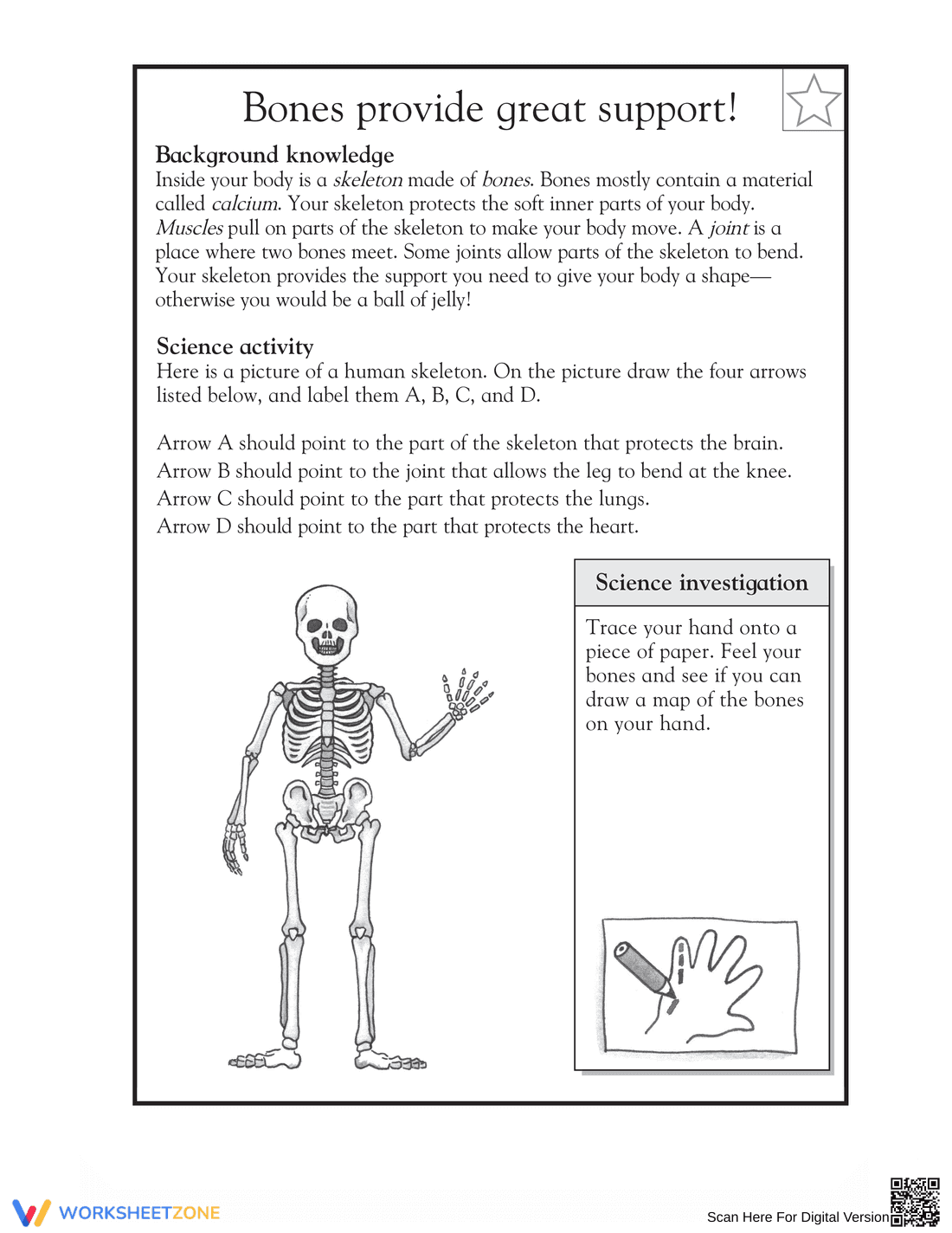
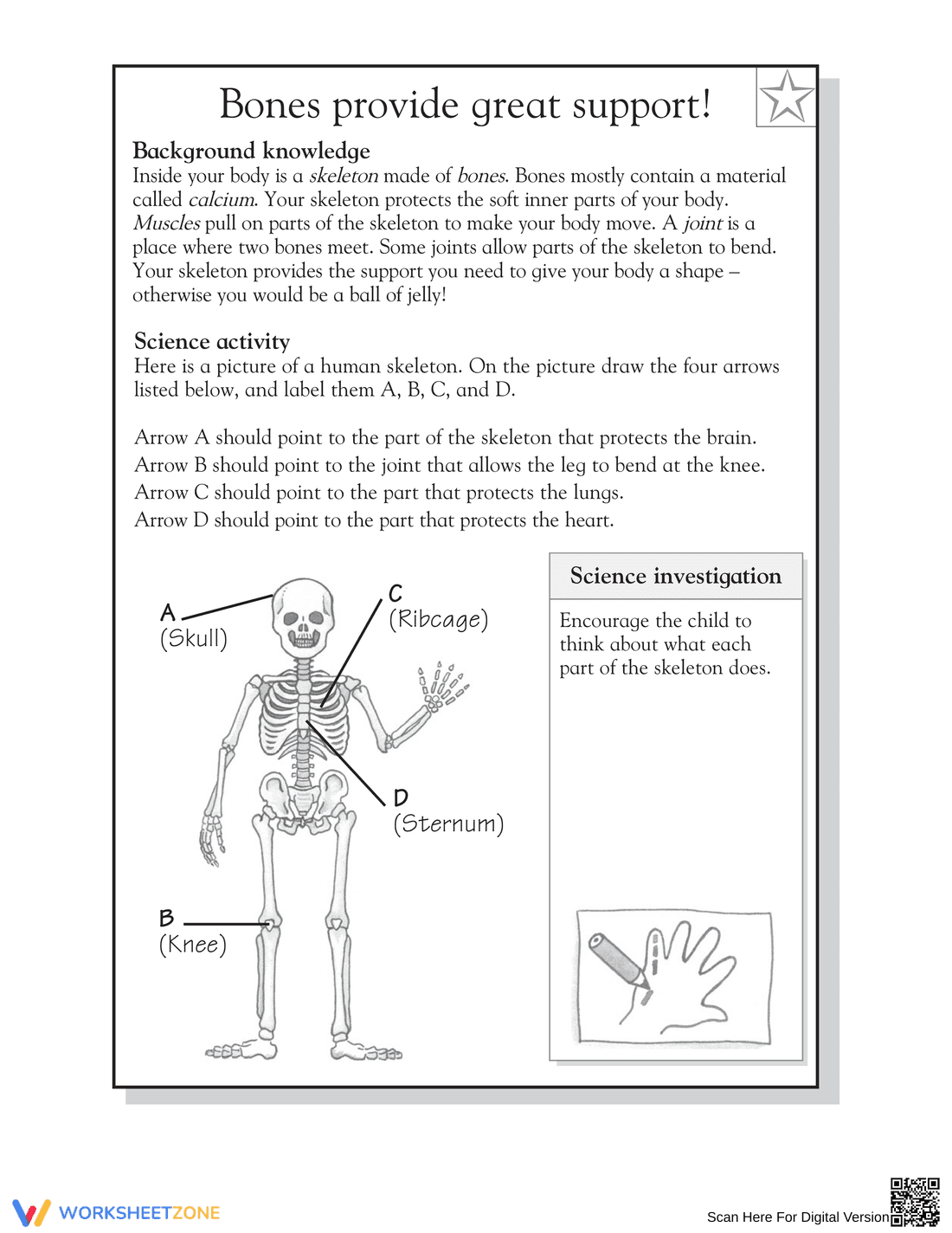
This Grade 3-4 science worksheet identifies the critical functions of the human skeletal system, focusing on how bones provide support and protect vital organs. Students explore the connection between structure and function by labeling major parts of the skeleton. It ensures learners understand why internal support is necessary for survival and movement in the human body.
At a Glance
- Grade: 3-4 · Subject: Science
- Standard:
4-LS1-1— Construct an argument that animals have internal structures that support survival- Skill Focus: Skeletal system functions
- Format: 1 page · 5 problems · Answer key included · PDF
- Best For: Independent science center or sub plan
- Time: 20–30 minutes
What's Inside
This single-page science resource features a comprehensive "Background Knowledge" section that explains the roles of calcium, muscles, and joints. The worksheet includes a labeling activity where students identify bones protecting the brain, heart, and lungs, along with a "Science Investigation" task requiring students to map the bones in their own hands. A full answer key is included.
Zero-Prep Workflow
The zero-prep workflow is designed for efficiency. 1. Print: Under 30 seconds per class set. 2. Distribute: Hand out during the 'Explain' phase of a 5E lesson plan. 3. Review: Use the built-in background text as shared reading to minimize teacher setup. Preparation time is under 2 minutes, making it an ideal sub plan.
Standards Alignment
This activity is aligned with 4-LS1-1, which requires students to construct an argument that animals have internal structures that support survival. By identifying how the skull protects the brain, students gather evidence for this biological concept. The standard code can be copied into lesson plans or IEP goals.
How to Use It
Assign this worksheet during the 'Explain' phase of a unit on human body systems. It works effectively as a formative assessment to check student understanding of bone functions before moving on to complex muscular interactions. Teachers should observe students during the hand-mapping investigation to see if they accurately translate tactile sensation into a diagram. Expected completion time is 25 minutes.
Who It's For
This resource is designed for Grade 3 and Grade 4 students beginning their study of anatomy. It provides enough scaffolding for struggling readers while offering an extension through the hands-on mapping task. It pairs naturally with a classroom skeleton model or a reading passage about the digestive system to illustrate how different systems overlap for protection.
According to the NAEP 2024 science framework, understanding internal structures is foundational for biological literacy in middle childhood. This worksheet addresses the 4-LS1-1 standard by requiring students to connect skeletal components to their protective functions. Research by Fisher & Frey (2014) emphasizes the importance of providing background knowledge alongside tasks to support comprehension and skill transfer. By integrating a "Science investigation" into the traditional labeling format, the resource encourages active learning rather than passive memorization. The inclusion of 5 specific tasks ensures that students engage with multiple aspects of the skeletal system, including joints and calcium composition. Educators can rely on this aligned material to provide the 20-30 minutes of focused practice necessary for mastery. This approach follows the ScienceDirect TpT Analysis recommendations for high-quality, classroom-ready science materials that prioritize both content depth and instructional ease.


