


























Views
Downloads

Printable Bodies of Water Worksheet | Grade 2-3 Science
Paste this activity's link or code into your existing LMS (Google Classroom, Canvas, Teams, Schoology, Moodle, etc.).
Students can open and work on the activity right away, with no student login required.
You'll still be able to track student progress and results from your teacher account.
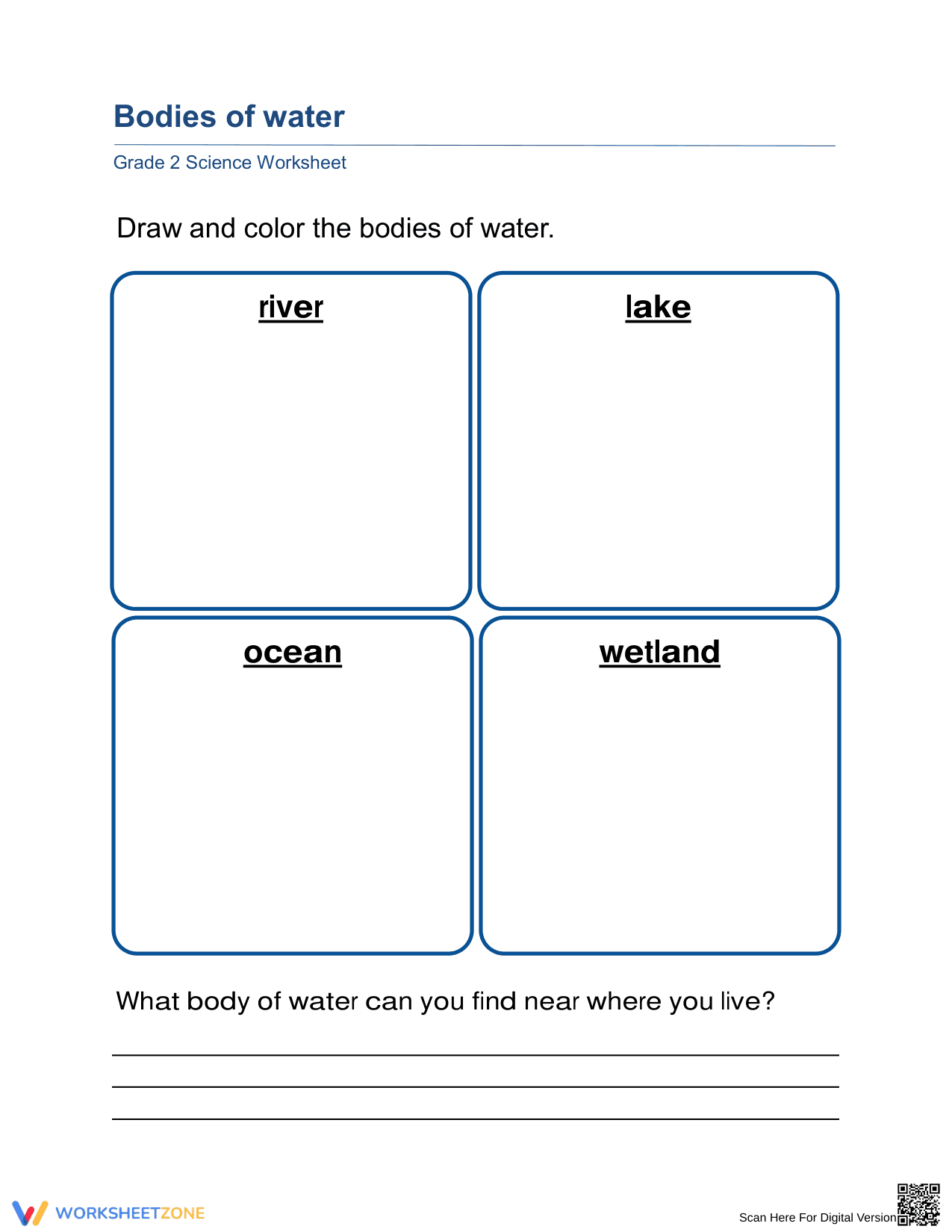
This bodies of water worksheet helps students identify and visualize major aquatic features including rivers, lakes, oceans, and wetlands. Students engage in creative drawing and personal reflection to solidify their understanding of Earth's water distribution. This resource effectively bridges the gap between scientific terminology and visual recognition for early elementary learners.
At a Glance
- Grade: 2 · Subject: Science
- Standard:
2-ESS2-3— Identify where water is found on Earth as solid or liquid- Skill Focus: Visual identification of aquatic features
- Format: 1 page · 5 problems · Answer key included · PDF
- Best For: Independent practice or science center activity
- Time: 15–20 minutes
What's Inside
The worksheet features four designated drawing zones, each labeled with a specific body of water: river, lake, ocean, and wetland. Below the drawing section, a reflective writing prompt asks students to connect the lesson to their local environment. This single-page PDF includes a sample answer key for teacher reference, ensuring a complete and professional instructional resource.
Zero-Prep Workflow
- Print: Generate the single-page PDF in seconds for your entire class.
- Distribute: Hand out the sheets with basic coloring supplies for an immediate start.
- Review: Conclude the activity with a five-minute share session regarding local water features.
This streamlined process makes it an ideal choice for emergency substitute plans or transition periods.
Standards Alignment
This activity aligns with 2-ESS2-3, which requires students to obtain information to identify where water is found on Earth. By differentiating between flowing rivers, vast oceans, and specialized wetlands, students build a foundational understanding of the hydrosphere. Both standard codes can be copied directly into lesson plans, IEP goals, or district curriculum mapping tools.
How to Use It
Assign this worksheet as a follow-up to a lesson on Earth’s geography or during a unit on ecosystems. Teachers should observe students as they draw to ensure they are depicting key characteristics, such as the scale of an ocean versus a river. It serves as an excellent formative assessment to gauge student vocabulary retention after direct instruction.
Who It's For
Designed primarily for second and third-grade students, this resource is highly accessible for English Language Learners and students requiring visual scaffolds. It pairs naturally with a classroom anchor chart or a read-aloud text about Earth's various habitats. The open-ended drawing format allows for natural differentiation based on artistic ability and prior knowledge.
According to the RAND AIRS 2024 report on elementary science instruction, visual modeling through drawing significantly enhances the retention of geographical concepts in early childhood. This worksheet addresses the core requirements of the 2-ESS2-3 standard by facilitating the identification of diverse bodies of water. By engaging students in the active creation of visual representations for rivers, lakes, oceans, and wetlands, the resource fosters a deeper cognitive connection than passive reading alone. Fisher & Frey (2014) emphasize that integrating drawing with scientific terminology supports the gradual release of responsibility, moving students from basic recognition to independent application. The inclusion of a local context question further aligns with best practices in place-based education, ensuring that students can relate global science standards to their immediate surroundings. This evidence-based design ensures that the worksheet is not merely a coloring activity but a rigorous tool for scientific literacy.


