




















Transportation activities for preschoolers are a fun and engaging way to introduce young children to the world around them. These activities help kids learn about different modes of transportation, such as cars, trains, planes, and boats, while developing their motor skills, creativity, and understanding of community helpers. Incorporating transportation-themed games, crafts, and stories into early childhood education keeps learning exciting and meaningful. Whether at home or in the classroom, transportation activities for preschoolers encourage curiosity and exploration, making them an excellent choice for fostering both cognitive and social development in young learners.
10+ transportation activities for preschoolers
Ready to steer your classroom toward hands-on fun with the following indoor and outdoor transportation activities for preschoolers:
Indoor transportation activities for preschoolers
Transform your classroom into a hub of creativity with these low-mess, high-impact activities. Perfect for rainy days or focused skill-building!
1. Car Ramp Races

This activity teaches preschoolers about gravity and motion through hands-on experimentation. Racing toy cars down ramps helps develop fine motor skills and introduces early physics concepts.
Materials: Toy cars, cardboard ramps, books, or blocks for support.
How to Do It:
- Set up ramps using cardboard and books.
- Let children race their cars down the ramps.
- Discuss which ramp makes the car go faster and why.
2. Cardboard Car Tracks

Designing roads with cardboard and tape fosters spatial reasoning and teamwork. Kids negotiate traffic rules, practice sharing, and strengthen fine motor skills while drawing lanes.
Materials: Construction paper, scissors, glue sticks, and printable train shape templates.
How to Do It:
- Cut out different shapes to form train cars.
- Have children match the shapes to the correct spaces on the train.
- Encourage them to glue the pieces together to complete their train.
3. Paper Plate Steering Wheels

This craft allows kids to pretend they are driving while developing hand-eye coordination and creativity.
Materials: Paper plates, crayons, markers, glue, and construction paper.
How to Do It:
- Let children decorate paper plates to resemble steering wheels.
- Attach a small cut-out of a horn in the center.
- Encourage them to ‘drive’ around the room pretending to steer.
4. Circle the Vehicles

This activity helps preschoolers recognize and classify objects that can move or drive. It enhances observation skills, critical thinking, and early transportation knowledge.
Materials: Printed worksheet, crayons or markers.
How to Do It:
- Give each child a worksheet.
- Instruct them to circle all the objects that can drive.
- Encourage discussion by asking, “Why can this move?” or “Where have you seen this before?”
- Review answers together and talk about each vehicle’s purpose.
Check out this Transportation Worksheet to help kids learn about things that move. It’s a great follow-up activity to keep your little learners curious and engaged!
5. Transportation Matching

This activity helps preschoolers categorize different types of transportation by where they operate: land, air, or water. It improves cognitive skills, classification ability, and fine motor coordination.
Materials: Printed worksheet, pencils, or crayons.
How to Do It:
- Provide each child with the worksheet.
- Explain the three transportation categories: land, air, and water.
- Ask them to draw a line matching each vehicle to its correct category.
- Discuss the answers together and talk about where each vehicle is commonly seen.
Try this Transportation Matching Worksheet, where kids connect vehicles to land, air, and water. It’s a fun way to build thinking skills while learning how different types of transportation work!
6. Airplane Craft

This hands-on craft activity allows preschoolers to create their own paper airplanes, enhancing fine motor skills and creativity while learning about air transportation.
Materials:
- Colored paper or cardstock, scissors (optional, for decoration), stickers, markers, or crayons for decoration
How to Do It:
- Provide each child with a sheet of paper.
- Guide them through simple paper airplane folding techniques.
- Let them decorate their airplanes with markers, stickers, or drawings.
- Have a mini “flight test” by letting the children throw their airplanes and observe how far they fly.
- Discuss how real airplanes work and why they stay in the air.
7. Hot Air Balloon Craft

This creative craft helps preschoolers understand how hot air balloons float while improving their fine motor skills and artistic expression.
Materials:
- colored paper or cardstock, scissors, glue or tape, string or yarn, small paper cups, markers, stickers, or cotton balls for decoration
How to Do It:
- Cut out a large balloon shape from colored paper.
- Let children decorate their balloon with markers, stickers, or cotton balls for clouds.
- Attach four pieces of string to the bottom of the balloon and connect them to a small paper cup as the basket.
- Encourage children to role-play as if they were riding in a hot air balloon.
- Discuss how hot air balloons rise using warm air and compare them to other types of air transportation.
8. Train Station Pretend Play

This imaginative activity helps preschoolers develop social skills, communication, and problem-solving while learning about trains and public transportation.
Materials: Chairs (for train seats), paper tickets, a toy microphone.
How to Do It:
- Set up a row of chairs.
- Assign roles: train conductor, ticket collector, and passengers.
- Give each child a play ticket and let them “board” the train.
- The conductor announces stops (e.g., “Next stop: the zoo!”) and collects tickets.
- Encourage children to act out travel scenarios, such as buying a ticket, finding a seat, or looking out the window to describe what they see.
- Discuss how real trains work and the different types of trains people use.
Outdoor transportation activities for preschoolers
Take learning beyond the classroom with these high-energy games that build gross motor skills and teamwork under the sun!
1. Red Light, Green Light
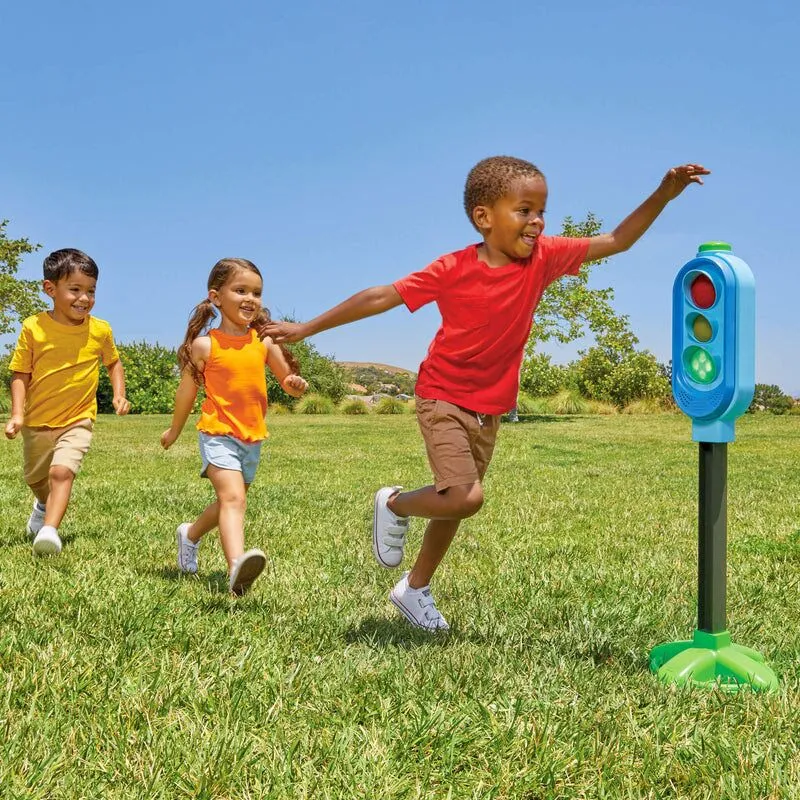
A classic game teaching impulse control and listening skills. Kids practice sudden stops and starts, mimicking real traffic rules.
Materials: Traffic light colors (red/green/yellow paper).
How to Do It:
- One child acts as the traffic light, calling out “Red light” to stop and “Green light” to go.
- Children move accordingly and learn to follow directions.
- Discuss real-life traffic safety rules.
2. Bike & Trike Obstacle Course

Navigating cones and ramps improves balance and coordination. Kids also learn to follow directional cues (left/right, stop/go) .
Materials: Cones, chalk, small ramps (optional), tricycles or bikes.
How to Do It:
- Set up an obstacle course with cones and chalk markings.
- Have children ride their bikes through the course, avoiding obstacles.
- Time their laps for an added challenge.
3. Sidewalk Chalk Road Map

This activity fosters creativity and spatial awareness as children create their own roadways.
Materials: Sidewalk chalk, toy cars.
How to Do It:
- Draw roads, intersections, and parking spaces with chalk.
- Let children drive toy cars along the roads.
- Introduce simple traffic rules like stopping at stop signs.
4. Car Wash

Role-playing as car washers or drivers fosters teamwork and practical life skills. Water play adds sensory stimulation.
Materials: Toy cars, sponges, buckets, and soapy water.
How to Do:
- Set up a “wash station” with buckets and sponges.
- Assign roles: washers, dryers, customers.
- Add prices
FAQs
1. How do you teach preschoolers about transportation?
Teaching preschoolers about transportation can be fun and interactive with hands-on activities and engaging discussions. Here are some effective ways to introduce the topic:
- Use Picture Books – Read books about different modes of transportation, such as cars, trains, planes, and boats.
- Hands-On Activities – Engage kids in transportation crafts, such as making paper airplanes or building a cardboard car.
- Pretend Play – Set up a pretend train station, airport, or car wash to encourage imaginative play.
- Worksheets and Matching Games – Use printable worksheets where kids can match vehicles to their correct environment (land, air, or water).
- Outdoor Exploration – Take children on a neighborhood walk and identify different vehicles they see.
2. What questions should I ask preschoolers about transportation?
Asking open-ended questions encourages preschoolers to think critically and engage in discussions about transportation. Here are some great questions to ask:
- Observation Questions:
- What kinds of vehicles do you see around us?
- How do people travel from one place to another?
- Comparison Questions:
- What is the difference between a car and a train?
- How is a boat different from an airplane?
- Experience-Based Questions:
- Have you ever been on a train or an airplane? What was it like?
- What is your favorite way to travel and why?
- Problem-Solving Questions:
- What would happen if there were no cars, buses, or trains?
- How do people travel when they need to go far away?
Final thoughts
Transportation activities for preschoolers offer endless opportunities for fun, learning, and skill development. Whether indoors or outdoors, these hands-on activities help children explore different modes of transportation while building cognitive and motor skills. Try these engaging activities in your classroom and make learning about transportation an exciting adventure!


