Spring brings new life, warmth, and inspiration—making it the perfect time to explore poetry in the classroom. But finding spring poems for kids that truly capture their interest can be a challenge. You want poems that are engaging, easy to understand, and meaningful for young readers. That’s why we’ve put together this collection of spring poems for kids, featuring delightful verses about nature, renewal, and joy. Use them for reading activities, discussions, or creative writing to help students connect with the beauty of the season!
10+ Spring Poems for Kids
These spring poems for kids are organized into short, inspirational, and flower-themed categories—perfect for read-aloud, creative writing, and seasonal celebrations.
Short Spring Poems
These brief, lively poems capture spring’s essence in just a few lines—ideal for quick lessons or transitions.
1. “Spring (Again)” by Michael Ryan
Celebrate the return of spring with this short yet powerful poem! Michael Ryan’s Spring (Again) captures the sudden, overwhelming realization of renewal and promise. The poem reflects on nature’s instinctive joy, reminding us how easily we can forget the feeling of new beginnings.
“The birds were louder this morning, raucous, oblivious, tweeting their teeny bird-brains out. It scared me, until I remembered it’s Spring.”
Teaching Tips:
- Discuss how the poem uses sound to emphasize change.
- Ask students how the arrival of spring makes them feel.
- Have students write a short poem about a moment of rediscovery.

Download this Spring (Again) poem worksheet to explore the beauty of renewal through poetry!
2. “Spring” by William Blake
A cheerful poem captures the joy and liveliness of spring! William Blake’s “Spring” is a lighthearted and musical poem that celebrates nature’s rebirth. With references to birds, the sun, and green fields, it’s ideal for discussing how poetry can express happiness and change.
“Sound the flute! Now it’s mute! Bird’s delight, Day and night.”
Teaching Tips:
- Encourage students to create their own short spring poems.
- Read the poem aloud to emphasize rhythm and sound.

Download this Spring poem worksheet to engage young learners.
3. “First Green Flare” by Sidney Wade
Sidney Wade’s “First Green Flare” is a delicate yet powerful poem that captures the sensory experience of spring’s emergence. With vivid imagery and a flowing structure, the poem evokes the sounds, sights, and feelings of nature awakening.
“makes the air
quiver and dart
the throat ache
to call”
Teaching Tips:
- Discuss how the poet uses short, broken lines to create movement and rhythm.
- Encourage students to listen to bird calls and describe them using poetic language.
- Have students write their own short poems about spring using sensory details.

Download this First Green Flare poem worksheet to immerse students in the beauty of spring’s arrival!
Inspirational Spring Poems
Spring often symbolizes hope and new beginnings. These poems help children reflect on growth, change, and positivity.
4. “A Light Exists in Spring” by Emily Dickinson
Emily Dickinson’s “A Light Exists in Spring” is a reflective and deeply moving poem that captures the almost sacred glow of early spring. The poem speaks of a light that transforms the world, not just in appearance but in feeling—filling the heart with hope yet carrying an unspoken melancholy as it fades. It reminds us of those fleeting, golden moments that touch the soul before disappearing, much like spring itself.
“A Light exists in Spring
Not present on the Year
At any other period—
When March is scarcely here.”
Teaching Tips:
- Discuss the poem’s imagery and how Dickinson conveys the feeling of spring’s arrival.
- Encourage students to write their own poems about the changing seasons.
- Explore how light and nature are used as metaphors in poetry.

Download this A Light Exists in Spring poem worksheet to explore seasonal themes through poetry!
5. “After the Winter” by Claude McKay
Claude McKay’s After the Winter is a hopeful and uplifting poem about the promise of renewal after hardship. It paints a vivid contrast between the cold of winter and the warmth of spring, reminding us that brighter days always follow the dark ones. The poem’s imagery of nature flourishing again makes it a perfect choice for teaching resilience and optimism.
“Some day, when trees have shed their leaves And against the morning’s white.”
Teaching Tips:
- Discuss how the poem symbolizes new beginnings.
- Encourage students to write about their own hopes for the changing seasons.
- Pair the poem with an art activity, illustrating winter transitioning into spring.

Download this After the Winter poem worksheet to inspire young learners.
6. “Each Year” by Dora Malech
An inspiring reflection on the fleeting nature of spring, Each Year by Dora Malech reminds us that renewal cannot be bottled up—it must be experienced. The poem captures the tension between wanting to hold onto beauty and accepting its transience, making it a powerful metaphor for growth and change.
“I snap the twig to try to trap the springing and I relearn the same lesson. You cannot make a keepsake of this season.”
Teaching Tips:
- Discuss how the poem connects nature with personal growth.
- Ask students to reflect on a moment they wished they could preserve.
- Encourage students to write about a change they’ve learned to embrace.

Download this printable worksheet for the Each Year poem!
Poems about Flowers and Spring
7. “Daffodils” (Excerpt) by William Wordsworth
One of the most famous nature poems, this piece describes the beauty of blooming daffodils in spring. It’s a wonderful way to introduce children to poetic descriptions and personification.
“I wandered lonely as a cloud That floats on high o’er vales and hills.”
Teaching Tips:
- Discuss how Wordsworth uses nature to express emotions.
- Have students write about a spring scene that makes them happy.

Download this Daffodils poem worksheet for poetry lessons.
8. “Cherry Blossoms” by Toi Derricotte
A breathtaking tribute to spring, Cherry Blossoms by Toi Derricotte captures the delicate beauty of flowers in bloom and the profound emotions they evoke. The poem immerses readers in the fleeting yet radiant essence of the season, reminding us of both joy and impermanence.
“I went down to mingle my breath with the breath of the cherry blossoms.”
Teaching Tips:
- Discuss how the poem uses sensory details to bring spring to life.
- Explore the symbolism of cherry blossoms in different cultures.
- Encourage students to write about a natural moment that filled them with wonder.

Download this Cherry Blossoms poem worksheet to bring springtime inspiration into your classroom!
9. “Lilacs” by Amy Lowell
A vivid and fragrant celebration of spring, Lilacs by Amy Lowell paints a picture of abundance and renewal. The poem captures the beauty of lilacs in full bloom, evoking a sense of place and nostalgia tied to New England’s seasonal transformation.
“Your great puffs of flowers Are everywhere in this my New England.”
Teaching Tips:
- Discuss how the poem’s imagery brings the scent and sight of lilacs to life.
- Explore the connection between nature and memory in poetry.
- Encourage students to describe their favorite seasonal flower using rich sensory details.

Download this Lilacs poem worksheet to explore the beauty of spring through poetry!
10. “Daisy Time” by Marjorie Pickthall
A charming and delicate springtime poem, Daisy Time by Marjorie Pickthall captures the beauty of daisies scattered like stars across the grass. The poem’s gentle rhythm and vivid imagery make it a perfect way to introduce young readers to the wonders of nature through poetry.
“See, the grass is full of stars, Fallen in their brightness; Hearts they have of shining gold, Rays of shining whiteness.”
Teaching Tips:
- Discuss how the poem compares daisies to stars and what effect that creates.
- Encourage students to write their own nature-inspired poetry.
- Have students draw or paint a field of daisies based on the poem’s description.
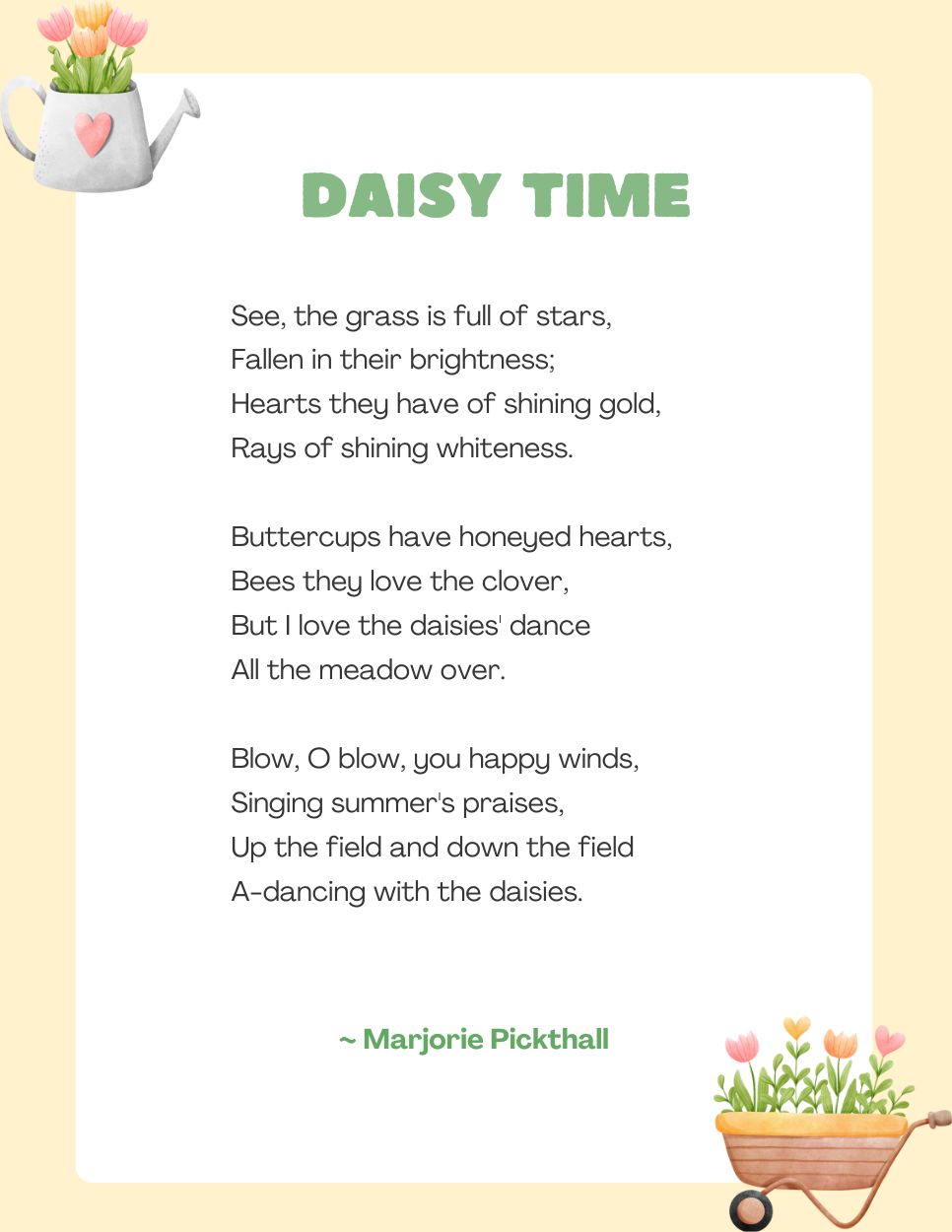
Download this Daisy Time poem worksheet to celebrate the beauty of spring flowers!
Looking for more seasonal poetry for kids beyond spring poems? Explore our collections of summer poems, too!
FAQs
1. What are the two lines about the spring season for kids?
Here are two simple lines that capture the essence of spring for young learners: “Springtime sun, so warm and bright, Flowers bloom in golden light.”
These lines highlight the warmth, beauty, and renewal of the season, making them easy for kids to understand and appreciate.
2. How to write a poem about spring for kids?
To write a spring poem for kids, follow these steps:
- Choose a theme – Focus on nature, animals, flowers, or the changing weather.
- Use simple, rhythmic language – Keep it playful and easy to read.
- Include sensory details – Describe how spring looks, feels, and sounds.
- Add repetition or rhymes – This makes the poem more engaging and easier for kids to remember.
Final Thoughts
Spring poems for kids are a fantastic way to connect students with nature and nurture their creativity. Beyond improving language skills, these poems inspire curiosity and appreciation for the changing seasons. Encourage your students to write their own spring-themed poetry and express their unique perspectives. Don’t forget to check out our collection of spring poetry worksheets above to bring creativity to your classroom!