Understanding simple compound and complex sentences helps writers organize ideas clearly and vary their style. These sentence types are classified by their clauses, not by length: a long sentence may still be simple, while a short sentence may be compound or complex. This guide explains the structure, punctuation, and purpose of each type, with examples, identification strategies, and classroom activities that make the distinctions easier to apply.
Simple Sentences: The Foundation of Writing
A simple sentence consists of one independent clause. It contains a subject and predicate and expresses a complete thought. “Simple” refers to the number of independent clauses, not the number of words: a simple sentence may include a compound subject, a compound predicate, objects, complements, and modifiers.

Download: Simple Sentence Worksheet
Characteristics
- Contains a Subject and a Predicate: Every independent clause has a subject and a predicate containing at least one finite verb. Either part may be compound.
- Expresses a Complete Thought: The clause can stand alone as a sentence and does not depend on another clause for grammatical completion.
Examples of Simple Sentences
Here are some examples of simple sentences:
- “The cat sleeps.”
- “I love pizza.”
- “They played soccer.”
- “She reads every morning.”
- “The sun is shining.”
Common Uses of Simple Sentences
Simple sentences are highly effective for:
- Clarity: They are direct and easy to understand, making them ideal for communicating straightforward ideas.
- Emphasis: A simple sentence can draw attention to a single important thought.
- Beginners: Writers new to sentence construction often start with simple sentences to build confidence and ensure clarity.
Simple sentences are not necessarily brief or unsophisticated. Their defining feature is one independent clause, so the most reliable way to identify them is to count clauses rather than words or verbs.
Compound Sentences: Connecting Related Ideas
Definition
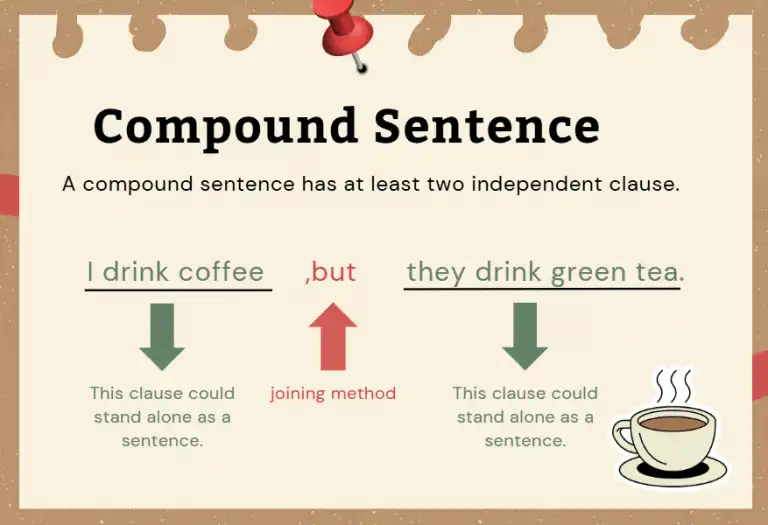
A compound sentence contains at least two independent clauses. Each clause has its own subject and predicate and could stand alone as a complete sentence. The clauses can be joined by a comma plus a coordinating conjunction, by a semicolon, or by a semicolon followed by a conjunctive adverb and a comma. Compound sentences connect grammatically equal ideas.
Download: Compound Sentence Worksheet
Components of a Compound Sentence
1. Independent Clauses
Each independent clause expresses a complete thought and can stand alone. For example:
- “I enjoy reading.”
- “I also love writing.”
2. Coordinating Conjunctions
When a coordinating conjunction connects the independent clauses, writers often remember the seven options with the acronym FANBOYS:
- For
- And
- Nor
- But
- Or
- Yet
- So

Download: FANBOYS Coordinating Conjunctions Worksheet
Examples of Compound Sentences
Here are some examples of compound sentences:
- “I wanted to go for a walk, but it started raining.”
- “She studied hard for the test, and she passed with flying colors.”
- “You can watch a movie, or you can read a book.”
- “He was tired, yet he kept working late into the night.”
- “The traffic was heavy, so we decided to take an alternative route.”
Tips for Using Compound Sentences
1. Use Proper Punctuation
- Place a comma before the coordinating conjunction when it joins two independent clauses. Do not add the comma when the conjunction joins only words, phrases, or parts of a compound predicate:
- ❌“I enjoy swimming and I also like cycling.”
- ✅“I enjoy swimming, and I also like cycling.”
- Alternatively, you can use a semicolon to join independent clauses without a conjunction:
- “I enjoy swimming; I also like cycling.”
2. Balance Your Clauses
- Ensure that the clauses in a compound sentence are of equal importance or relevance.
3. Avoid Overuse
- While compound sentences are useful, using too many can make your writing repetitive. Combine them with other sentence types for variety.
To check a compound sentence, separate the clauses at the joining point. If both sides can stand alone, the compound structure is present and needs appropriate punctuation. This test also helps distinguish a compound sentence from a simple sentence with a compound predicate.
Complex Sentences: Adding Depth and Sophistication
Definition
A complex sentence combines one independent clause with at least one dependent clause. The dependent clause contains a subject and predicate but cannot stand alone as a complete sentence. Depending on its type, it may show time, cause, condition, contrast, description, or another relationship to the independent clause.
Components of a Complex Sentence
1. Independent Clause
- An independent clause expresses a complete thought and can stand alone as a sentence.
- Example: “I finished my homework.”
2. Dependent Clause
- A dependent clause cannot stand alone. Many adverb clauses begin with a subordinating conjunction; adjective clauses may begin with relative words such as “who,” “which,” or “that,” and noun clauses may begin with words such as “what” or “whether.”
- Common subordinating conjunctions for adverb clauses include:
- Cause and Effect: because, since, as.
- Contrast: although, though, while.
- Time: when, while, after, before, until.
- Example: “although I was tired” is dependent; it becomes a complete complex sentence in “Although I was tired, I finished my homework.”

Download: Complex Sentence Worksheet
Examples of Complex Sentences
Here are a few examples that show how dependent clauses enhance meaning:
- “Although I was tired, I finished my homework.”
- “I stayed up late because I wanted to watch the movie.”
- “Since it was raining, we decided to stay indoors.”
- “We can go to the park after we finish lunch.”
- “While she was cooking, the kids were playing outside.”
Usage Tips for Complex Sentences
1. When to Use a Comma
- If the dependent clause comes before the independent clause, use a comma to separate them.
- Example: “Because it was late, I went to bed.”
- When an essential adverb clause follows the independent clause, a comma is generally unnecessary. Other dependent-clause types follow their own punctuation rules, especially nonessential relative clauses.
- Example: “I went to bed because it was late.”
2. Making Writing More Engaging
- Use complex sentences to add depth to your writing and explain relationships between ideas.
- Example: Instead of “I was tired. I went to bed,” write “Because I was tired, I went to bed.”
3. Vary Sentence Structure
- Mixing complex sentences with simple and compound sentences keeps your writing dynamic and engaging.
Complex sentences help writers show how one idea relates to another, but complexity should support clarity. Check that every dependent clause is attached to an independent clause and punctuated according to its position and function.
Simple Compound and Complex Sentences in Comparison.
Visual Comparison Table
The visual comparison below highlights the central distinction: simple sentences have one independent clause, compound sentences have at least two independent clauses, and complex sentences have one independent clause plus at least one dependent clause.

Download: Simple Compound and Complex in Comparison
When to Use Each Sentence Type
1. Simple Sentences
- Best for:
- Conveying a complete idea directly and clearly.
- Creating emphasis, giving instructions, or varying the pace of a paragraph.
- Examples:
- Writing instructions: “Turn on the machine.”
- Summarizing ideas: “The experiment was a success.”
2. Compound Sentences
- Best for:
- Connecting independent ideas with equal grammatical status.
- Showing addition, contrast, choice, reason, or result through the joining word or punctuation.
- Examples:
- “I wanted to go to the party, but I was feeling sick.”
- “You can take the bus, or you can drive your car.”
3. Complex Sentences
- Best for:
- Explaining relationships such as cause, condition, contrast, time, or description.
- Emphasizing one main clause while making another idea dependent on it.
- Examples:
- “Because it was raining, we stayed inside.”
- “Although she was nervous, she gave a brilliant presentation.”
Importance of Variety in Writing
Using a purposeful mix of simple compound and complex sentences can improve clarity, rhythm, and emphasis. Variety is useful only when each structure matches the relationship between the ideas. For example:
- Simple sentences can provide clarity.
- Compound sentences can connect related ideas seamlessly.
- Complex sentences can add depth and detail.
Sentence variety is not a goal by itself. Choose a structure that makes the logical relationship clear, then vary sentence length and type to prevent monotony without creating unnecessary complexity.
How to Identify Simple Compound and Complex Sentences
Recognizing different sentence types is key to understanding and improving your writing. Here’s a straightforward guide to help you identify simple compound and complex sentences:
1. Identifying Simple Sentences
A simple sentence contains exactly one independent clause. It may still have multiple subjects or verbs, so count clauses rather than sentence parts.
Checklist for Simple Sentences:
- Does it contain one independent clause?
- Can that clause stand alone as a complete sentence?
- Are there no dependent clauses or additional independent clauses?
Examples:
- “The cat sleeps.”
- “She runs every morning.”
- “The flowers bloom in spring.”
If the sentence has one independent clause and no dependent clauses, it is simple. Do not rely on conjunctions alone: a simple sentence can include a compound subject or compound predicate joined by “and.”
2. Identifying Compound Sentences
A compound sentence contains at least two independent clauses joined correctly, commonly with a comma plus a coordinating conjunction or with a semicolon.
Checklist for Compound Sentences:
- Does the sentence have at least two independent clauses?
- Are the clauses joined by a coordinating conjunction or a semicolon?
- Does each clause make sense on its own?
Examples:
- “I wanted to go to the park, but it started raining.”
- “She finished her homework, and she watched a movie.”
- “He studied hard; he passed the exam.”
Use conjunctions and semicolons as clues, then verify that the words on both sides form independent clauses. A conjunction can also join words or phrases without creating a compound sentence.
3. Identify Complex Sentences
A complex sentence contains one independent clause and at least one dependent clause. Adverb clauses often begin with subordinating conjunctions, while adjective and noun clauses may begin with relative pronouns or other clause markers.
Checklist for Complex Sentences:
- Does the sentence have one independent clause?
- Does it have a dependent clause introduced by a marker such as because, although, while, who, which, that, what, or whether?
- Does the dependent clause rely on the independent clause to complete its meaning?
Examples:
- “Because it was late, we decided to leave.”
- “Although she was tired, she kept working.”
- “We stayed indoors while it was raining.”
If the sentence has one independent clause and at least one clause that cannot stand alone, it is complex. If it has two or more independent clauses as well as a dependent clause, it is compound-complex.
Quick Identification Tips
1. Count the Clauses
- One independent clause and no dependent clause = Simple sentence
- Two or more independent clauses and no dependent clause = Compound sentence
- One independent clause plus at least one dependent clause = Complex sentence
2. Look for Conjunctions
- Coordinating conjunctions (FANBOYS) may signal a compound sentence when they join independent clauses.
- Subordinating conjunctions (because, although, while) often introduce adverb clauses in complex sentences.
3. Ask Questions
- Can each clause stand alone as a complete sentence? If at least two can and no dependent clause is present, the sentence is compound.
- Does one clause depend on an independent clause for grammatical completion? If yes, the sentence is complex or compound-complex.
Clause counting is more dependable than counting words, verbs, or conjunctions. Mark every subject-verb unit, test whether each clause can stand alone, and then classify the sentence from that clause pattern.
Practical Tips for Teaching Sentence Types
Using Worksheets
Worksheetzone offers interactive and printable simple, compound, and complex sentence worksheets for identification, sentence combining, punctuation, and writing practice. Useful activity formats include:
- Label the sentence: Students read sentences and label them as simple, compound, or complex.
- Rewrite the sentence: Students rewrite simple sentences as compound or complex sentences.
- Fill-in-the-blanks: Students complete sentences by adding dependent or independent clauses.

Download: Compound Sentences Worksheet
- Mix and match activity: Practice combining clauses and using different conjunctions with our downloadable activity sheets.
Interactive Classroom Activities
- Sentence Building Game: Provide students with clause cards and conjunctions. Challenge them to build and label simple, compound, or complex sentences.
- Error Correction: Give students examples of run-on sentences or fragments and ask them to correct them.
- Sentence Match-Up: Prepare cards with independent clauses, dependent clauses, and conjunctions. Students work in pairs to match the cards and form correct compound or complex sentences.
- Sentence Scramble: Provide scrambled words for sentences of different types. Challenge students to unscramble and identify whether the sentence is simple, compound, or complex.
- Create-Your-Own Sentences: Provide students with prompts like “Describe your favorite hobby” or “Write about your weekend.” Ask them to write one simple, one compound, and one complex sentence for each prompt. Share and discuss as a class.
- Interactive Sentence Quiz: Use Worksheetzone Quiz Maker to create a multiple-choice quiz where students identify or build sentences of different types.
Frequently Asked Questions
1. How does a compound sentence differ from a complex sentence?
A compound sentence has at least two independent clauses and no dependent clause. The clauses may be joined with a comma plus a coordinating conjunction or with a semicolon. A complex sentence has one independent clause and at least one dependent clause. The distinction depends on clause types, not sentence length.
2. Can a sentence be both compound and complex?
Yes. This structure is called a compound-complex sentence. It contains at least two independent clauses and at least one dependent clause, combining the defining features of compound and complex sentences.
Example: “I stayed home because it was raining, and I read a book.”
3. Where can I find worksheets for practicing sentence structures?
Use Worksheetzone’s simple, compound, and complex sentence worksheets for printable and interactive practice. The collection includes activities for identifying clause patterns, combining sentences, correcting punctuation, transforming sentence types, and writing original examples.
4. How do coordinating conjunctions work in compound sentences?
The coordinating conjunctions—for, and, nor, but, or, yet, and so—can join two independent clauses. When they do, place a comma before the conjunction. The chosen word signals a relationship such as addition (and), contrast (but), choice (or), or result (so). A conjunction joining only words or phrases does not create a compound sentence.
The Bottom Line
Mastering simple compound and complex sentences begins with identifying clauses accurately. A simple sentence has one independent clause, a compound sentence has at least two, and a complex sentence has one independent clause plus at least one dependent clause. Choosing among these patterns helps writers express relationships clearly while controlling rhythm and emphasis.
For more practice, explore Worksheetzone’s sentence structure worksheets. The activities support clause identification, punctuation, sentence combining, and varied writing practice.