




















Selecting poems for 8th graders is an essential task for educators looking to bridge the gap between childhood wonder and complex adult emotions. This selection of 15 powerful works helps middle school educators introduce 8th-grade learners to diverse perspectives and sophisticated self-expression. By analyzing these texts, students develop critical thinking skills essential for their successful transition to high school English.
15 poems for 8th graders
Explore this curated selection of 15 poems for 8th graders that bridge the gap between childhood imagination and the complex realities of young adulthood. Each piece has been chosen for its ability to spark meaningful dialogue and inspire a lasting love for literary expression in the middle school classroom.
1. “The Rose That Grew from Concrete” by Tupac Shakur

Resilience is the central theme of “The Rose That Grew from Concrete,” a work that utilizes a profound metaphor to discuss thriving in harsh environments. It resonates deeply with students because of the author’s background and the universal message of overcoming adversity. The brevity of the poem makes it accessible while carrying immense emotional weight for young readers.
Teaching tip: Have students create their own metaphors for resilience based on things they see in their own neighborhoods. You can also pair a poem with a discussion about how Shakur’s background as a rapper influences the rhythm and tone of his written work. This helps students see the connection between contemporary music and classical poetic structures.
2. “Theme for English B” by Langston Hughes
In this poem, a student explores his identity and his relationship to his white instructors through a class assignment. It raises important questions about races, shared experiences, and what it means to truly “learn” from one another. The narrative structure makes it feel like a story, which keeps 8th graders engaged.

Teaching tip: Assign students their own “Theme for English B” by asking them to write a poem that describes who they are based on where they live and what they like. Encourage them to include sensory details about their home life and hobbies to make it personal. This helps build classroom community as students share their diverse backgrounds with one another.
3. “O Captain! My Captain” by Walt Whitman
Historical grief is captured in Walt Whitman’s haunting elegy, written to mourn the 1865 death of Abraham Lincoln following the end of the American Civil War. An elegy is a mournful poem, typically a lament for the dead. It uses the metaphor of a ship returning from a dangerous voyage to represent the nation surviving the war but losing its leader.

Teaching tip: Teachers can use this poem to teach the concept of an extended metaphor and how historical events influence literature. Have students research the specific historical events of 1865 and align them with the lines of the poem. It is also an excellent opportunity to discuss the difference between a literal reading and a figurative one.
4. “Identity” by Julio Noboa Polanco
This poem uses the comparison between a beautiful, sheltered flower and a wild, “ugly” weed to explore the value of freedom over popularity. It speaks directly to the social pressures of middle school, where many students feel the need to conform. The imagery is sharp, and the message is one of fierce independence.
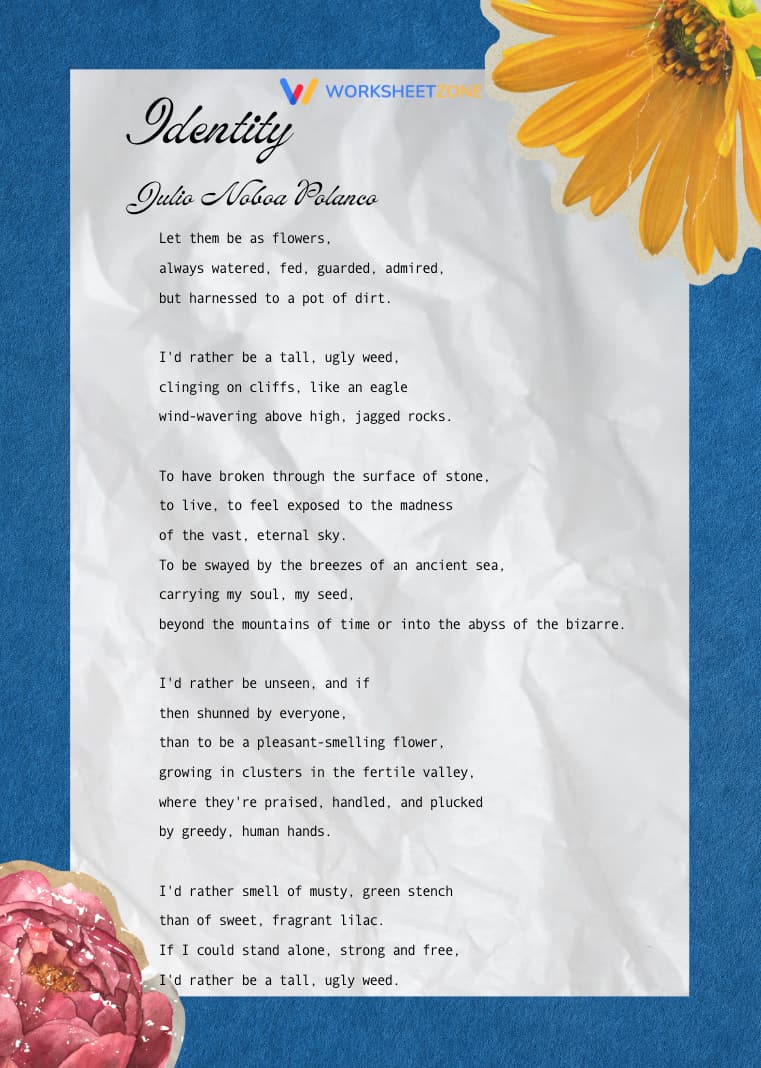
Teaching tip: Have students create a visual art project where they draw themselves as either the flower or the weed, labeling parts of the drawing with poetic lines. Ask them to write a paragraph defending their choice and why that identity appeals to them. This activity helps students internalize the poem’s message about the cost of being “pretty” versus the joy of being free.
5. “Oranges” by Gary Soto
Early adolescence is vividly portrayed in this narrative poem describing a young boy’s first walk with a girl and his attempt to buy her candy. A narrative poem is a form of poetry that tells a complete story, featuring characters, a plot, and a setting. This selection shows a significant developmental leap when compared to sensory Poems For 2nd Graders.
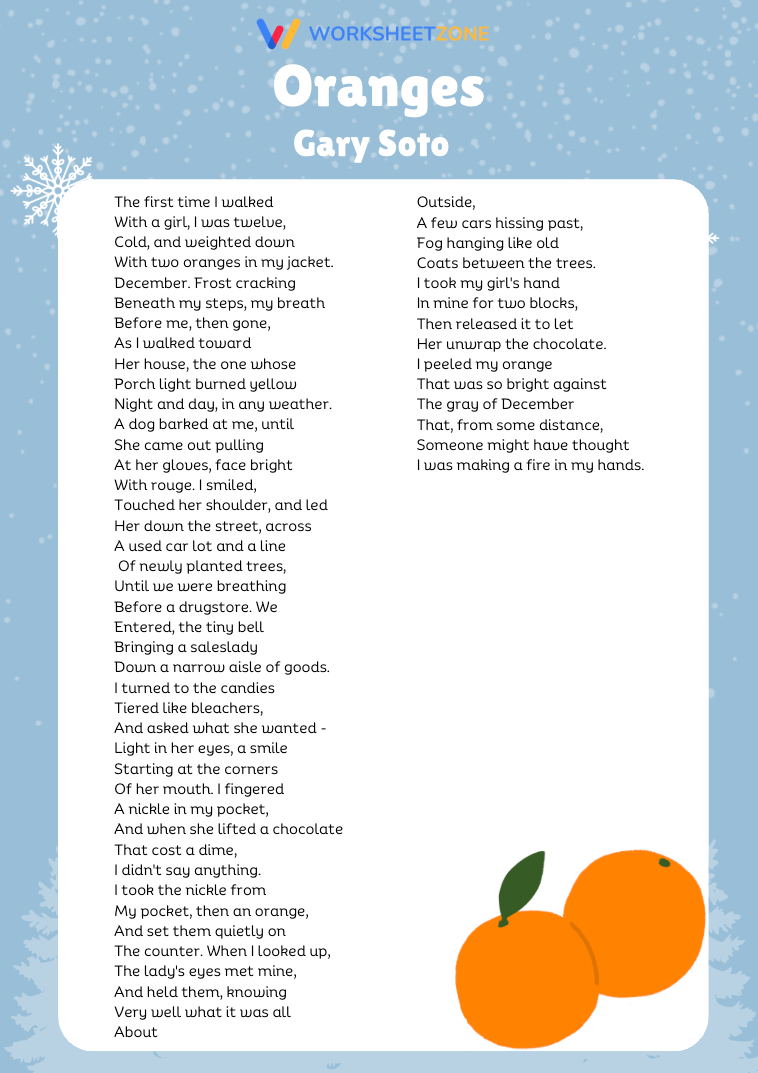
Teaching tip: Use this poem to teach “show, don’t tell” in writing by pointing out how Soto describes the boy’s feelings through his actions. Ask students to write a short narrative poem about a “first” experience of their own, focusing on specific colors and smells. This helps them understand how small details can convey large emotions.
6. “Jabberwocky” by Lewis Carroll
Famous for its use of nonsense words and playful phonetics, this poem tells a classic hero’s journey tale. It proves that readers can understand the mood and plot of a story even if they don’t know the definitions of the words. It is a fun, low-stakes way to introduce students to the mechanics of language.
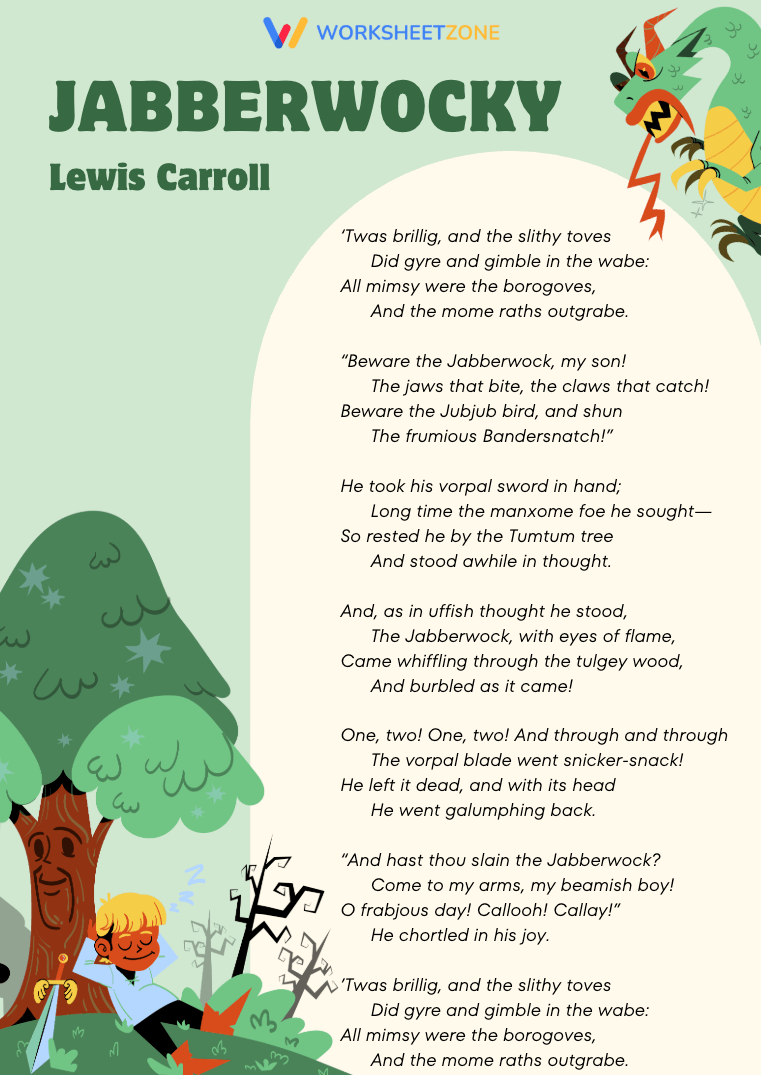
Teaching tip: Have students “translate” the poem by using context clues to assign meanings to Carroll’s invented words like “frumious” or “vorpal.” They can then rewrite a stanza using standard English to see how the tone changes when the mystery is removed. This exercise builds vocabulary-guessing skills and demonstrates the importance of word sounds.
7. “Introduction to Poetry” by Billy Collins
Poetic analysis is critiqued in this meta-commentary that laments how students often “torture” a poem for meaning rather than just experiencing it. Meta-commentary is a literary device where the text comments on its own structure, purpose, or the act of reading itself. Collins uses humorous and vivid metaphors, like holding a poem up to the light or pressing an ear against its hive.

Teaching tip: Start your poetry unit with this piece to set a relaxed tone and encourage students to “walk inside” a poem instead of stressing over “the right answer.” Ask students to come up with their own metaphor for how a poem should be read. This validates their feelings of frustration and makes them more open to the genre.
8. “Do not go gentle into that good night” by Dylan Thomas
Existential resistance is the core of this famous villanelle, which serves as a passionate plea for life against the “dying of the light.” A villanelle is a nineteen-line poetic form consisting of five tercets followed by a quatrain, with a strict rhyme scheme and two repeating refrains. Thomas describes several types of men facing the end of life:
- Wise men
- Good men
- Wild men
- Grave men

Teaching tip: Use this to teach the strict structure of a villanelle, showing how the two repeating lines anchor the poem. Ask students to identify the different types of men Thomas describes (wise men, good men, wild men) and what their specific regrets are. This helps them practice categorizing information within a complex text.
9. “Instructions on Not Giving Up” by Ada Limón
This poem uses the image of trees leafing out in the spring to discuss the messy, difficult process of persistence. It acknowledges that moving forward isn’t always pretty, but it is necessary and powerful. The language is modern, and the imagery is grounded in the natural world.

Teaching tip: Ask students to look for signs of “persistence” in nature around their school or home and write a short poem about it. This encourages them to slow down and observe their environment with a poetic eye. It is a great way to discuss the theme of resilience without using clichés.
10. “The Guest House” by Mewlana Jalaluddin Rumi
This 13th-century poem treats every human emotion – joy, depression, meanness – as a “guest” that should be welcomed into the home. It promotes the idea of mindfulness and emotional intelligence, which is crucial for 8th graders navigating mood swings. The metaphor of the body as a house is easy for students to visualize.

Teaching tip: Create a “Guest House” bulletin board where students can post words or drawings representing the emotions they are feeling that day. Discuss why it might be important to “be grateful for whoever comes” even when the emotion is difficult. This integrates social-emotional learning directly into the English curriculum.
11. “Eating Alone” by Li-Young Lee
This poem is a quiet, meditative look at grief, memory, and the simple act of preparing a meal. The speaker recalls his deceased father through the sensory details of the garden and the kitchen. It is an excellent example of how “hush” and “stillness” can be conveyed through written language.
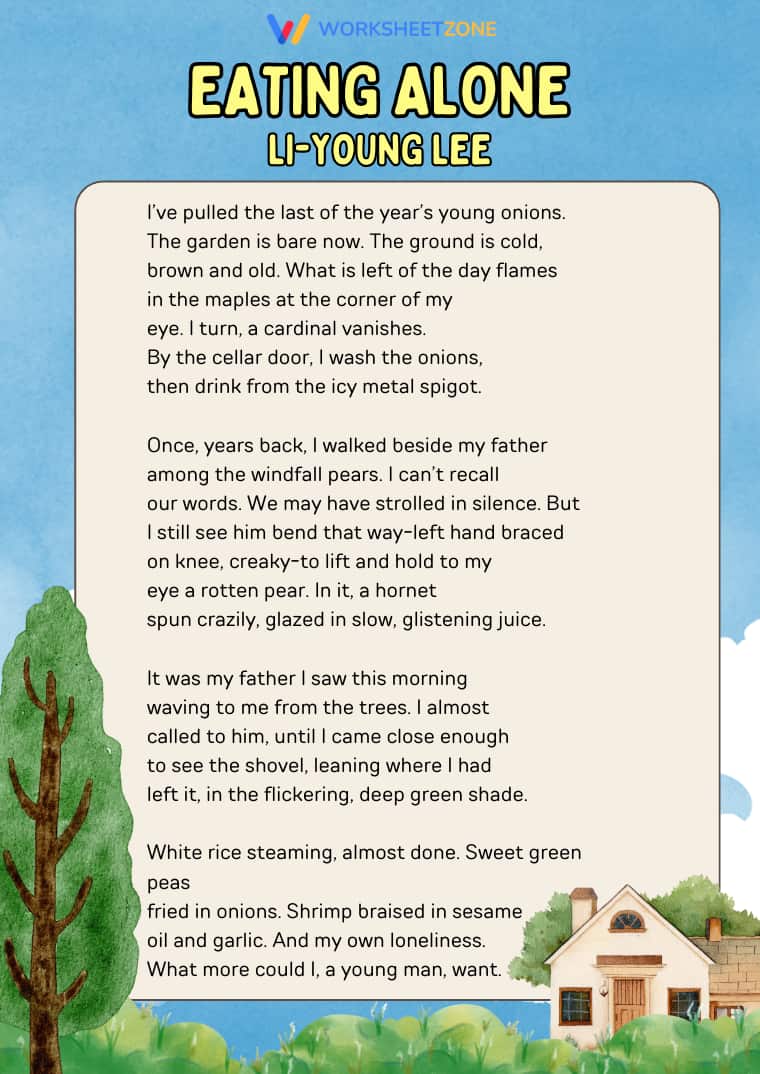
Teaching tip: Ask students to think of a specific food that reminds them of a person or a place and write a sensory-heavy description of it. Focus on the use of verbs and adjectives that evoke specific memories. This teaches students how to use mundane objects to explore complex themes like loss and legacy.
12. “Hanging Fire” by Audre Lorde
Adolescent anxiety is captured perfectly through the perspective of a fourteen-year-old girl in this stream-of-consciousness poem. The speaker jumps between several concerns:
- Skin problems
- Romantic interests
- Fear of death
- Parental abandonment
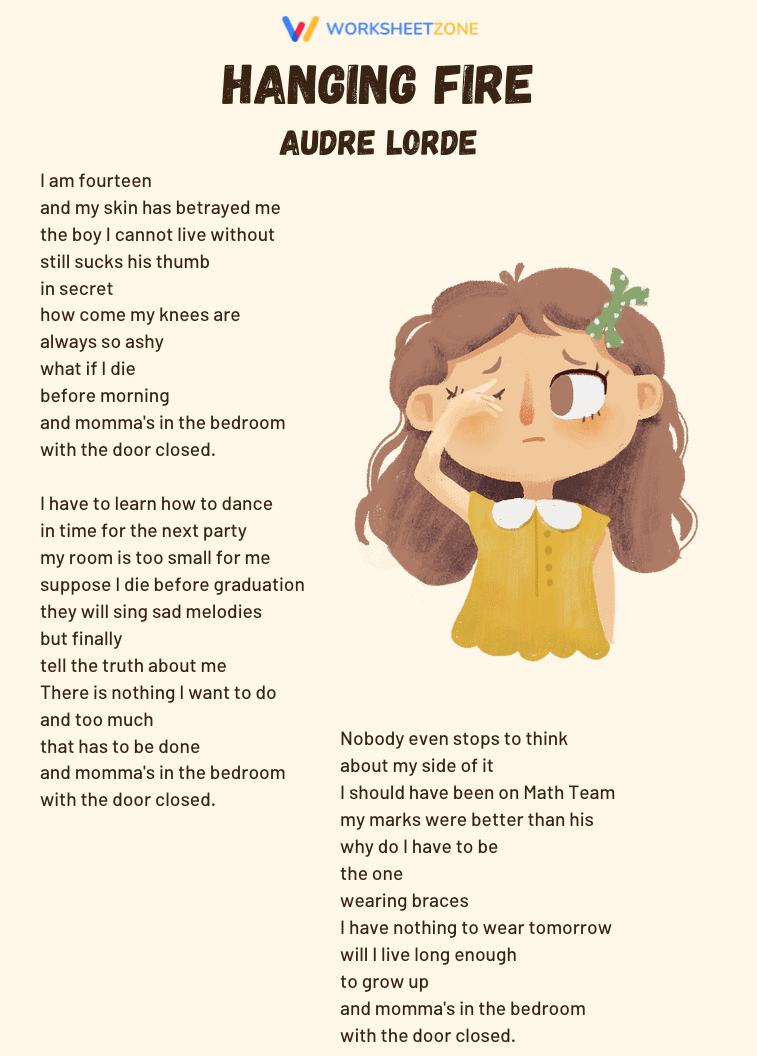
Teaching tip: Ask students to identify the various anxieties the speaker mentions and rank them from “typical teen” to “serious concern.” Use this to discuss the “stream of consciousness” style and how it mimics real thought patterns. It is an incredibly validating poem for students who feel overwhelmed by their own internal monologues.
13. “How to Eat a Poem” by Eve Merriam
This short, playful poem compares reading poetry to eating a piece of fruit – there are no pits or skins to throw away. It encourages readers to be “greedy” and dive right into the experience without hesitation. It is a perfect “bite-sized” poem for students who are intimidated by longer works.

Teaching tip: Pair this poem with an actual snack, like orange slices, and have students eat while they read. Ask them to write a “How to Eat a [Subject]” poem for something else, like a book, a movie, or a video game. This makes the concept of consuming media more tangible and fun.
14. “Valentine for Ernest Mann” by Naomi Shihab Nye
This poem argues that poems are hiding everywhere and that we simply have to be the “eyes” that find them. It tells the story of a man “who gave his wife two skunks for a valentine”, providing that anything can be transformed into a gift or a poem. It is an uplifting piece that demystifies the creative process.

Teaching tip: Give students “poetry googles” (imaginary or paper) and send them on a “poem hunt” around the classroom or school grounds. They should find one mundane thing and write three lines about why it could be a poem. This activity reinforces the idea that poetry is about perspective, not just fancy vocabulary.
15. “I, Too” by Langston Hughes
A response to Walt Whitman’s “I Hear America Singing,” this poem asserts the speaker’s place at the American table. It is a short, defiant statement of presence and future equality. The imagery of moving from the kitchen to the table is a clear, effective metaphor for social progress.
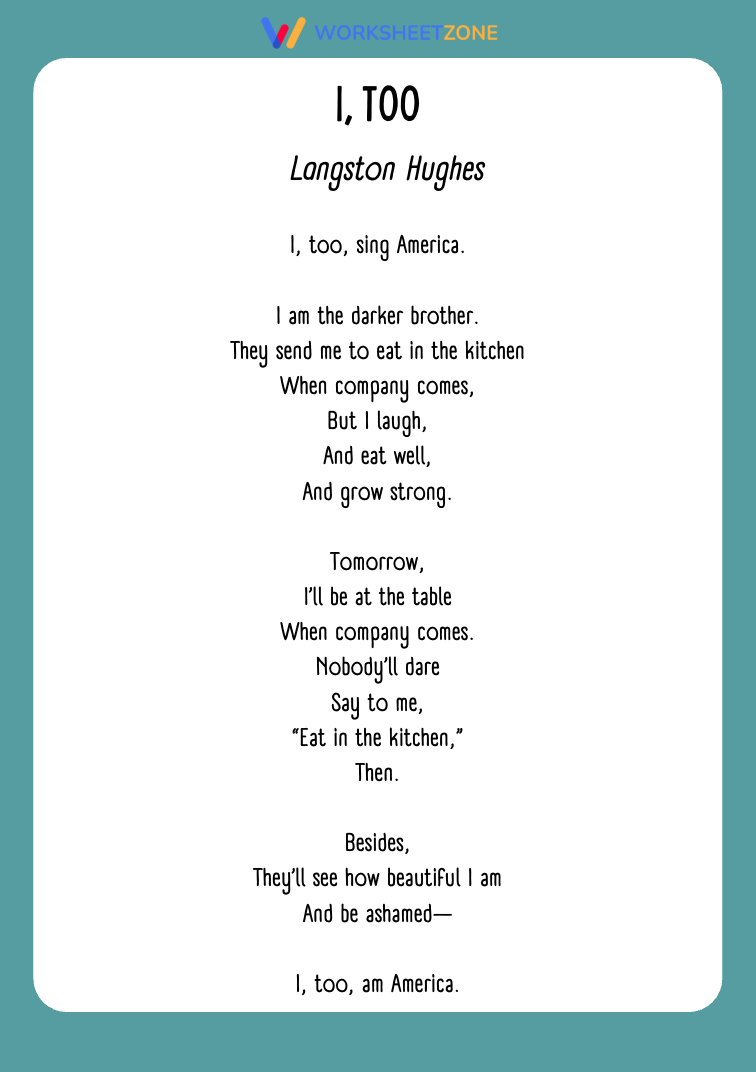
Teaching tip: Teach this poem alongside Whitman’s original to show how literature can be a conversation across generations. Ask students to write their own “I, Too” poem about a group or identity that they feel is sometimes overlooked. This promotes inclusivity and helps students see themselves as part of a larger historical narrative.
Final thoughts
Poems for 8th graders offer a unique opportunity for students to explore a variety of themes, from love and loss to social justice and the mysteries of life. These poems challenge students to think critically, creatively, and empathetically, fostering a love for literature that can last a lifetime. Incorporating these poems into classroom discussions helps students develop essential analytical and expressive skills, preparing them for deeper literary studies in the years to come.


